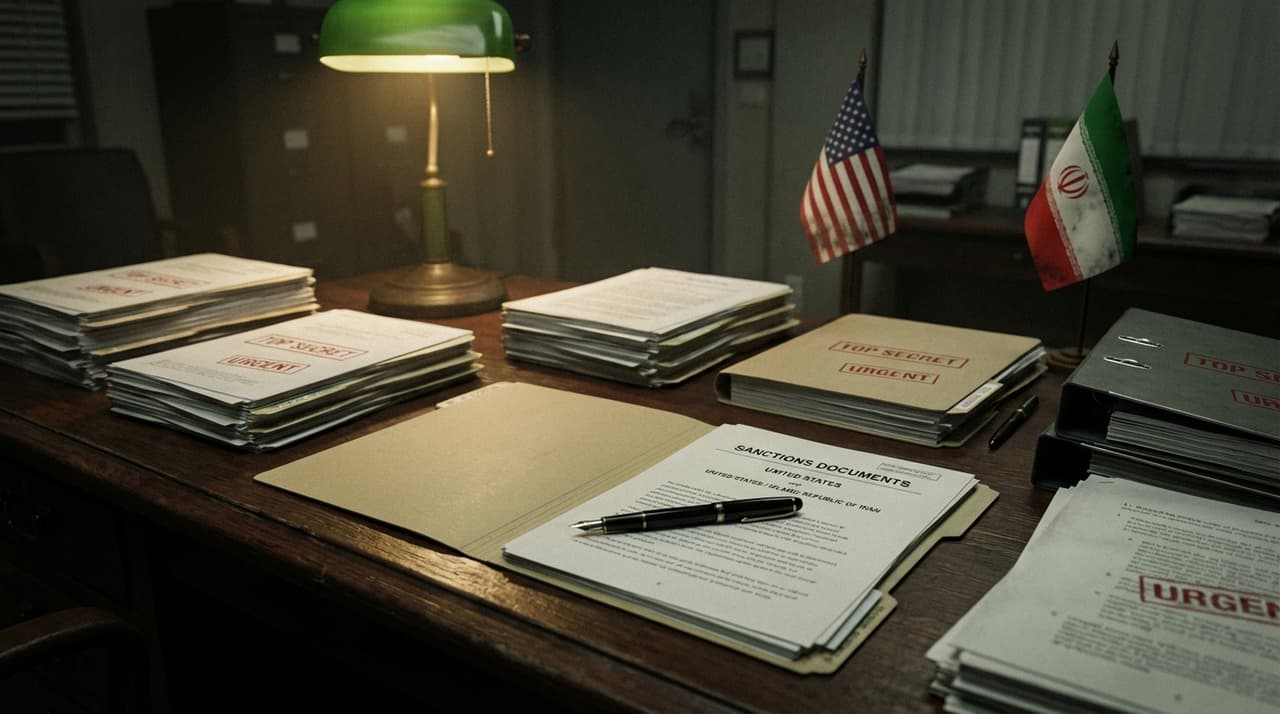
- The White House emphasizes that only President Trump knows the administration's next steps regarding Iran, reflecting a strategy of deliberate ambiguity amid heightened geopolitical risks.
- New U.S. sanctions target Iranian officials and financial networks involved in protest crackdowns and oil laundering, while tariffs threaten to disrupt global trade with countries engaging Iran.
- Diplomatic efforts by Gulf states have temporarily averted military strikes, but tensions persist as Iran faces internal unrest and external economic pressure.
A Deliberate Fog of Uncertainty
In a statement that underscores the administration's unpredictable approach, the White House has reiterated that decisions on Iran rest solely with President Trump, leaving markets and allies guessing amid escalating U.S.-Iran tensions. This opacity comes as Iran grapples with the largest anti-government protests in its history, which have resulted in at least 2,586 deaths according to internal reports, amid widespread repression, internet blackouts, and threats of executions. Trump had previously threatened military intervention but pulled back after receiving assurances from Iran, influenced by frantic mediation from Saudi Arabia, Qatar, Oman, and Egypt aimed at averting a regional war.
On Thursday, the U.S. imposed sanctions on Iranian officials, including Ali Larijani, and financial networks for their roles in the protest crackdown and oil laundering schemes. Concurrently, the administration announced 25% tariffs on goods from countries trading with Iran, such as China and India, a move that could strain global supply chains and raise costs for importers. According to people familiar with the matter, these economic measures are designed to support Iranian protesters while avoiding full-scale conflict, echoing Trump's "maximum pressure" campaign. No immediate executive order has been issued for the tariffs yet, adding to the uncertainty.
Economic Ripples and Market Jitters
The sanctions and tariffs directly target Iran's oil revenues and third-party trade, potentially disrupting global energy markets and Gulf shipping lanes. Gulf states have privately warned of severe economic fallout from any military conflict, highlighting the fragile balance in the region. Market trends initially tied the protests to economic grievances, with unrest leading to flight cancellations and travel warnings that have hit regional tourism and transport sectors. As one analyst noted, "The tariffs could act as a double-edged sword, pressuring Iran while testing the resilience of global trade networks already strained by ongoing U.S.-Iran economic pressure."
Efforts to restructure Iran's economic isolation have hit a snag with these new measures, and without a diplomatic breakthrough, the country could face deeper financial turmoil. Troops have returned to a base in Qatar, signaling a temporary de-escalation, but rhetoric from both sides remains heated. Iran's Foreign Minister has emphasized diplomacy over war and condemned U.S. interference, while Turkey has called for dialogue, according to sources briefed on the discussions.
Human Toll and Diplomatic Maneuvers
Stakeholders in the crisis include Iranian protesters facing brutal repression, with one threatened execution case reportedly averted due to international pressure. The U.S. has publicly expressed support for "freedom and justice" for these individuals, with figures like exiled Crown Prince Reza Pahlavi and U.S. Senator Lindsey Graham rallying for regime change under slogans like "Make Iran Great Again." Communications have been partially restored, allowing international calls, but the internet blackout persists in many areas, complicating efforts to gauge the full societal impact.
Diplomatically, Gulf officials see a "good spirit" for trust-building, but the U.S. response remains uncertain. Historical context looms large, with tensions tracing back to the 1979 Iranian Revolution and no formal ties between the nations. Recent echoes include Trump's June strikes on Iranian nuclear sites after de-escalatory signals, and his "locked and loaded" warnings during prior buildups. The protests, which evolved from economic issues to regime challenges, have paused under fears of further crackdowns.
Looking ahead, short-term prospects hinge on continued diplomacy via Gulf mediators, which could pave the way for renewed nuclear talks. Risks remain high if executions resume or Iran targets U.S. assets. In the long-term, analysts suggest Trump is leveraging the protests for pressure without committing to full regime change, a strategy reminiscent of limited actions like the Venezuela operation. As one expert put it, "The administration is playing a high-stakes game of brinkmanship, where every move is calculated to maximize economic and political leverage without tipping into outright war."
Correction: An earlier version of this article misstated the number of deaths in the protests; it has been updated to reflect the latest internal reports.