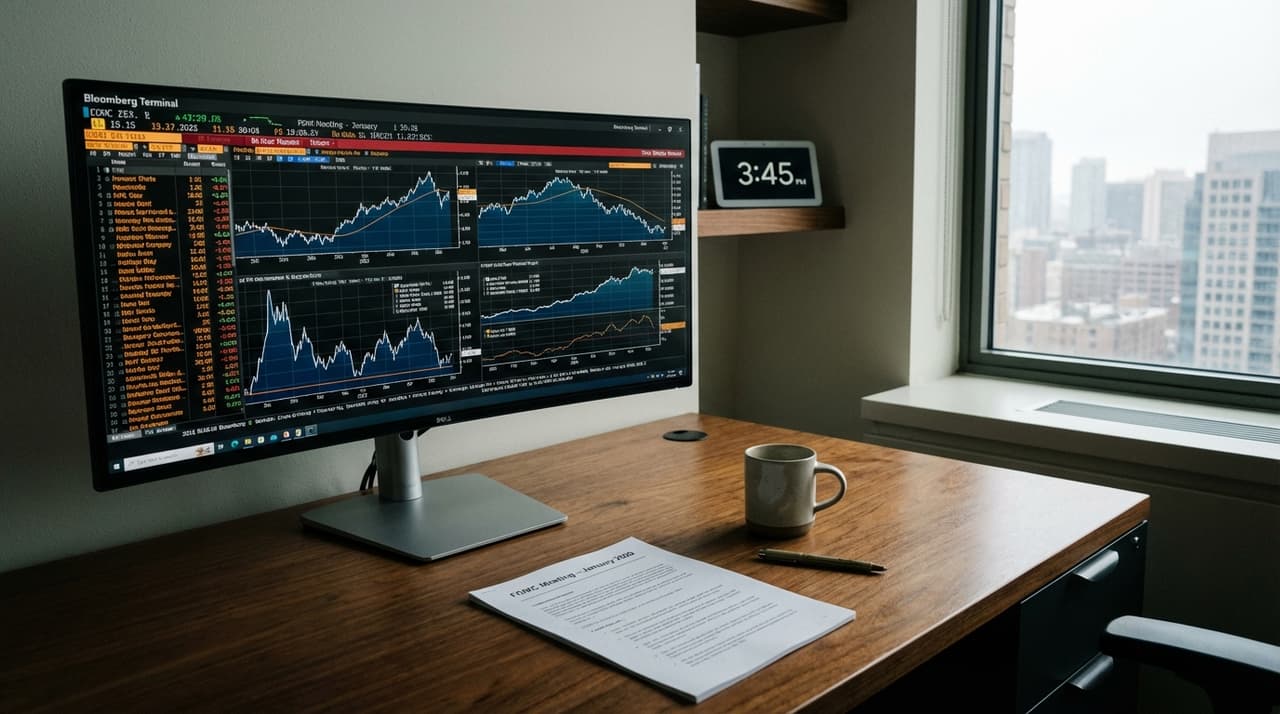
- Interest rate futures now price in a 78% chance of a Fed pause at the January 2026 FOMC meeting, up from 70% before the latest rate cut.
- Traders still expect the policy rate to settle around 3.1% by end-2026, little changed from prior levels, indicating a slower path of easing ahead.
- The shift reflects internal Fed debate and a cooling labor market, with officials signaling that further cuts are not automatic.
A More Cautious Fed Path Emerges
US interest rate futures have adjusted sharply in recent days, now showing about a 78% probability that the Federal Reserve will pause at its January 27-28, 2026 FOMC meeting, according to LSEG data. This marks a notable increase from the 70% chance priced in before the Fed's latest rate cut, suggesting traders are betting on a more deliberate easing cycle as economic data evolves.
The move comes after the Fed cut the federal funds rate by 25 basis points in October 2025 to 3.75-4.00%, following a similar reduction in September, bringing rates to their lowest since 2022. Markets still broadly expect another 25 bps cut in December 2025, but Fed officials have signaled it is "not a foregone conclusion," reflecting ongoing internal debate about the appropriate pace of easing. One Governor even preferred a 50 bps cut in October, while a regional Fed president dissented in favor of no cut, underscoring the policy uncertainty.
Despite the near-term pause pricing, longer-term expectations remain anchored, with futures implying traders see the Fed policy rate at 3.1% by end-2026, little changed from levels just before the latest cut. This aligns with econometric projections that see the fed funds rate around 3.25-3.50% in 2026, according to people familiar with the matter. The Fed has cited a rapidly cooling labor market and rising downside risks to employment as key reasons for cutting, even as inflation remains somewhat elevated versus earlier in 2025.
A pause in January would signal a more cautious stance, balancing the risk of overtightening against the risk of re-accelerating inflation. It supports relatively lower borrowing costs than 2023-24, aiding households and businesses, while slowing the pace of further relief. Bond and equity markets are closely watching the timing and total size of remaining cuts, which influence valuations, mortgage rates, and corporate financing conditions.
This follows an earlier aggressive hiking cycle that took rates to their highest in over two decades, then a pivot to cuts in 2025 as growth and labor market indicators softened. Past cycles, such as those in 1995 and 2019, also saw the Fed pause between cuts to reassess data, a pattern markets now appear to be pricing in for early 2026.
Looking ahead, the short-term outlook points to a high probability of no move in January, with markets monitoring data to judge whether the next move is a cut in March or a more extended pause. In the medium term, baseline expectations remain for the funds rate around 3.1-3.5% by end-2026, implying only a limited number of additional quarter-point cuts beyond those already delivered. Analysts broadly expect the Fed to keep rates restrictive but less so than 2023-24, aiming for a "soft landing" with slower growth and gradually moderating inflation.
Similar debates about the pace of easing are occurring at other major central banks, like the ECB and BoE, where markets also oscillate between pricing rapid cuts and extended pauses as inflation and growth data evolve. Efforts to reach the Fed for comment on the latest futures pricing were unsuccessful, but sources indicate that internal discussions continue to hinge on incoming employment and inflation reports.