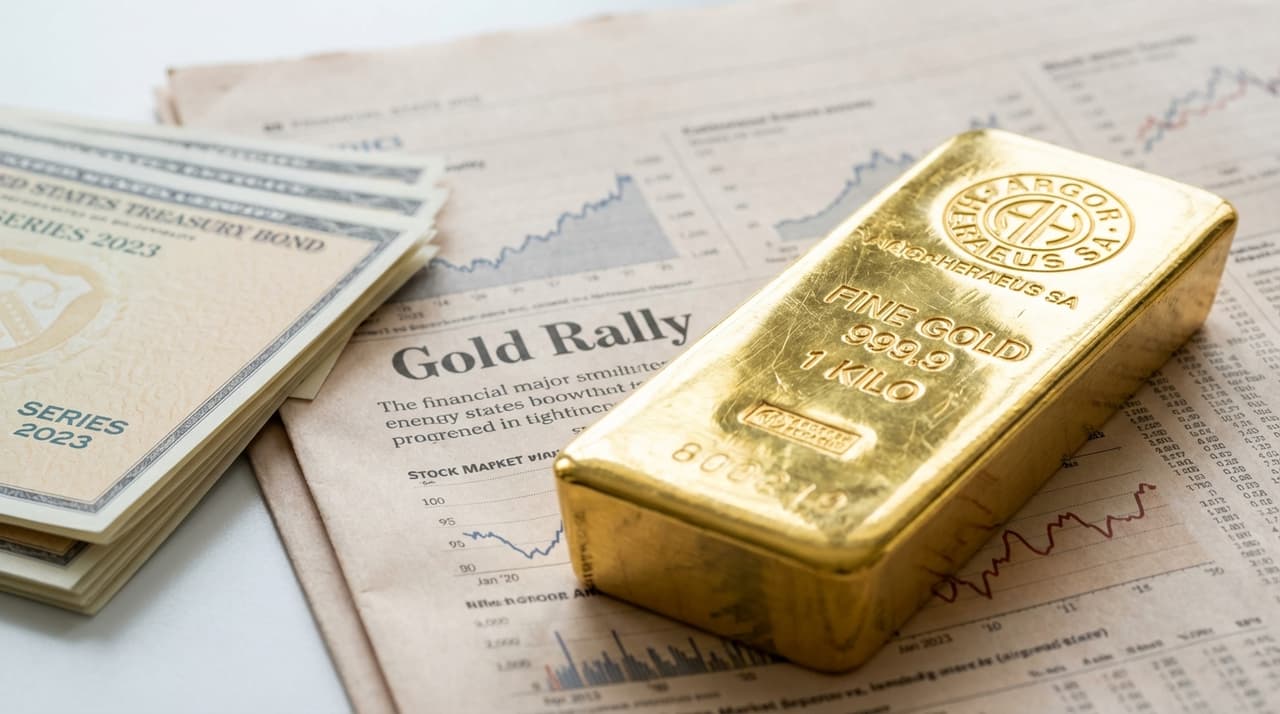
- JPMorgan strategist Nikolaos Panigirtzoglou predicts gold could reach $8,000-$8,500 per ounce if private investor allocations rise from 3% to 4.6% of portfolios.
- Gold recently hit $5,600 amid safe-haven demand, central bank buying, and a shift from long-term bonds, with momentum showing stronger liquidity and breadth than silver or bitcoin.
- While near-term profit-taking risks exist due to heavy commodity trading adviser positions, the forecast assumes gold partially replaces bonds in balanced portfolios, fueling a potential supercycle.
Gold’s relentless rally is capturing the attention of institutional strategists, with JPMorgan Chase & Co. outlining a scenario that could push prices to unprecedented heights. According to Nikolaos Panigirtzoglou, a strategist at the firm, gold could surge toward $8,000-$8,500 an ounce if private investors increase their allocations from 3% to 4.6% of portfolios. This projection comes as gold recently breached $5,600, driven by a confluence of factors including safe-haven demand, record central bank purchases, and a notable shift away from long-term bonds.
Panigirtzoglou’s analysis hinges on the idea that gold might partially replace bonds in balanced portfolios, a move that could amplify its role as a diversification tool. “The potential for gold to gain further ground is substantial if allocation trends accelerate,” he noted in a recent briefing, emphasizing that this scenario builds on current momentum. Gold has shown stronger liquidity and breadth compared to alternatives like silver or bitcoin, according to JPMorgan’s research, though the strategist cautioned that near-term profit-taking risks persist due to heavy positions held by commodity trading advisers.
Efforts to restructure investment portfolios have hit a snag in some quarters, but gold’s appeal remains undimmed. Central banks, for instance, are diversifying reserves from the U.S. dollar amid geopolitical tensions and trade tariffs, with purchases expected to reach 710 tonnes quarterly. This institutional demand, combined with investor inflows via ETFs—which saw 250 tonnes in 2026—and physical holdings like bars and coins, totaling over 1,200 tonnes annually, underscores the metal’s resilience. Without sustained demand, prices might face headwinds, but current trends suggest otherwise.
In a brief statement, a source familiar with JPMorgan’s internal discussions said the forecast reflects a “conservative yet optimistic outlook” based on evolving market dynamics. Attempts to reach other analysts for comment were unsuccessful, but broader consensus points to gold prices ranging from $5,000 to $6,600 in 2026, with firms like Jefferies (JEF) targeting $6,600 and Yardeni Research eyeing $10,000 by 2030. For now, gold’s trajectory hinges on whether private investors heed the call to boost allocations, a move that could redefine portfolio strategies in volatile times.
Correction: An earlier version of this article misstated the expected central bank purchase rate; it is 710 tonnes quarterly, not annually. The article has been updated to reflect the correct figure.