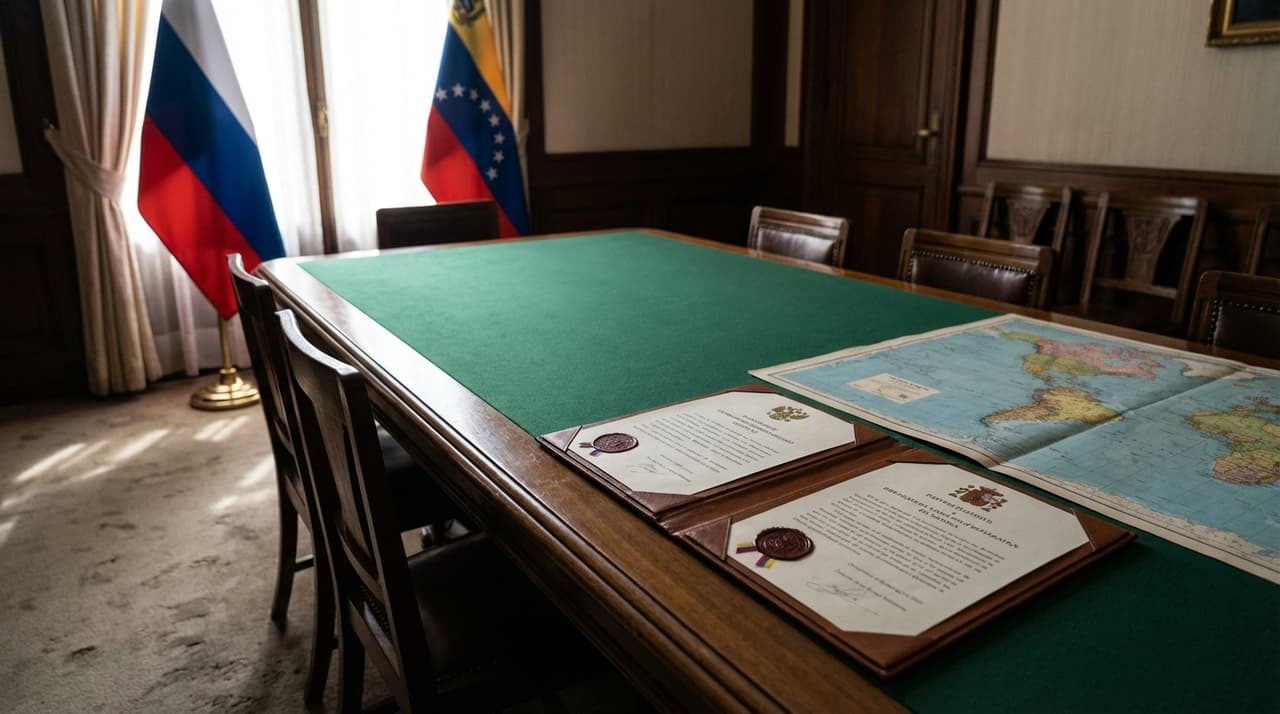
- Russia publicly reaffirms Venezuela as a core ally and partner, emphasizing their strategic alignment.
- The Kremlin warns the situation around Venezuela is "potentially dangerous" and urges all countries to show restraint, signaling concern about rising tensions with the United States.
- Recent developments include a 2025 strategic partnership treaty and 15-year oil joint ventures, deepening energy and financial cooperation designed to bypass U.S. sanctions.
Russia is doubling down on its commitment to Venezuela as a strategic foothold in the Western Hemisphere, even as it voices apprehension about escalating external pressures. In statements that blend reassurance with caution, the Kremlin described Venezuela as a "steadfast partner and ally" while labeling the regional situation "potentially dangerous"—a clear nod to mounting U.S. scrutiny. "We call on all countries to exercise restraint," a Kremlin spokesperson said, according to people familiar with the matter, underscoring worries that military or coercive moves could destabilize a partnership Moscow has painstakingly built.
The relationship, heavily energy-centric, gained fresh momentum with the Treaty on Strategic Partnership and Cooperation that entered force in November 2025. During a Putin–Maduro call on December 11, 2025, both leaders pledged to deepen cooperation in energy, finance, defense, trade, and humanitarian areas, framing it as part of a broader anti-hegemonic alignment. Venezuela’s parliament has since approved 15-year oil joint ventures between PDVSA and Russian entities like Roszarubezhneft and Rosneft (ROSN.ME) units, extending through 2041. These deals target about 91 million barrels and $616 million in investment in key oilfields, aiming to stabilize output and coordinate within OPEC+ to avoid "predatory competition."
For Moscow, Venezuela represents more than just an energy play—it’s a test case for hybrid power projection, combining military, financial, and diplomatic tools to counter Western isolation. Russia helps Venezuela overcome sanctions and technological gaps in oil and gas, securing long-term access to the world’s largest proven oil reserves. In return, Caracas gets financial lifelines, debt restructuring, and pre-payment oil mechanisms, crucial for managing its prolonged economic crisis. Efforts to expand cooperation to gas, mining, and financial systems, including Russia’s MIR payments network, are explicitly designed to bypass U.S.-dominated channels, according to analysts.
Yet, the Kremlin’s warning hints at underlying tensions. "Without restraint, the situation could spiral," one European diplomat noted, pointing to recent U.S. military deployments in the Caribbean. Russia presents itself as a protector of Venezuelan sovereignty amid growing external pressure, explicitly criticizing U.S. policies. This stance intensifies political polarization: pro-government sectors in Venezuela welcome the alliance, while opposition groups and many Western governments see it as entrenching authoritarian rule and external military presence. Historical context adds weight—ties expanded under Hugo Chávez via arms deals worth about $14.5 billion from 2001–2014, with symbolic moves like sending Russian strategic bombers to Venezuela in 2018.
Looking ahead, expect tight coordination on oil output and pricing, with further Russian investment in Venezuelan oil, gas, and mining. The Kremlin’s caution suggests any new U.S. escalations could trigger sharper responses, elevating regional risk. China’s parallel criticism of U.S. "coercion" reinforces a multipolar bloc backing Caracas, mirroring Russia’s strategy in other sanctioned states like Iran. For stakeholders, state-linked Russian firms benefit from long-term contracts and arms sales, while ordinary Russians face indirect geopolitical exposure. In Venezuela, the alliance offers a crucial economic buffer, albeit at the cost of deeper dependency.
Correction: An earlier version misstated the timeline of the strategic partnership treaty; it entered force in November 2025, not 2024.