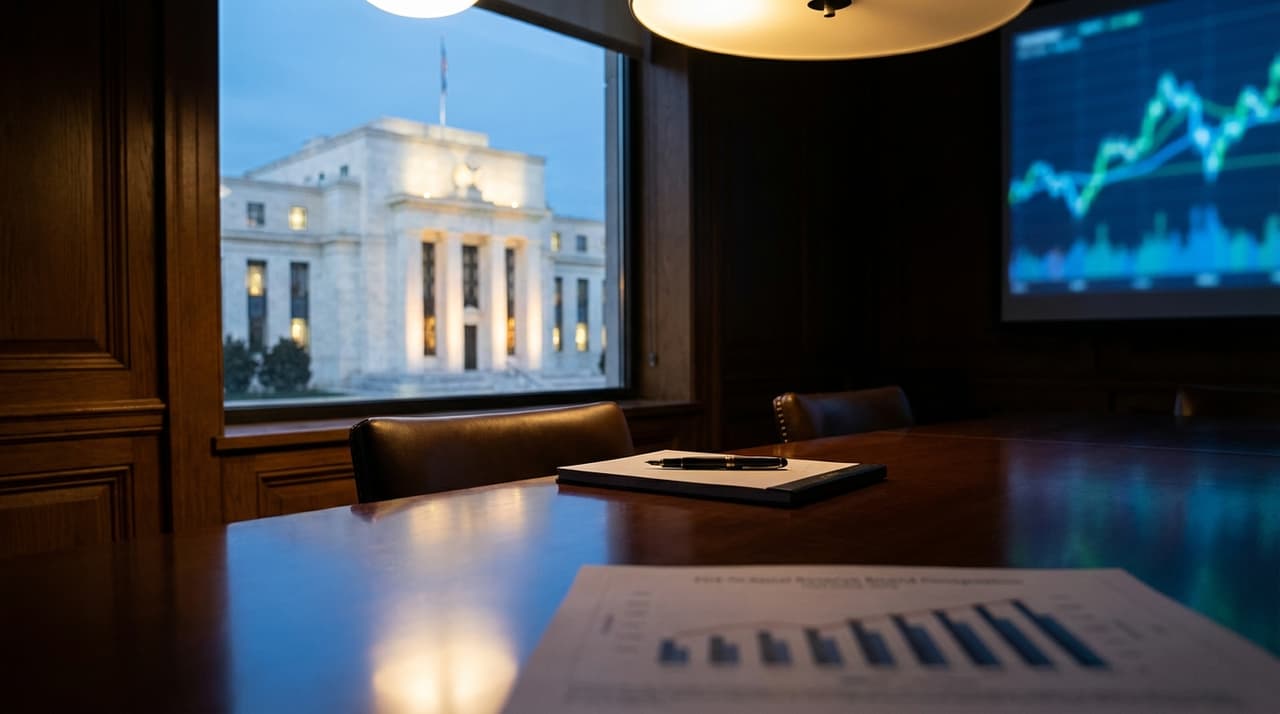
- Federal Reserve Chair Jerome Powell highlights the inherent tension between the central bank's dual goals of maximum employment and price stability, describing it as the key challenge for current monetary policy.
- The Fed cut the federal funds rate by 25 basis points to 3.50–3.75% at its December 9–10, 2025 FOMC meeting, marking its third consecutive reduction even as inflation remains somewhat elevated above the 2% target.
- Analysts, including those from BNP Paribas (BNP.PA), anticipate at least one additional rate cut in early 2026, potentially lowering the range to 3.25–3.50%, as policymakers navigate rising downside risks to employment while continuing to combat inflation.
Federal Reserve Chair Jerome Powell has openly acknowledged that the central bank's two statutory objectives—maximum employment and price stability—are "a bit in tension," a candid admission that underscores the delicate balancing act facing monetary policymakers as they steer through a period of economic uncertainty. This tension has become the defining feature of the Fed's current strategy, forcing difficult trade-offs with no clear risk-free path forward, according to people familiar with the matter.
At its most recent meeting in December 2025, the Federal Open Market Committee (FOMC) opted to lower the federal funds rate by 25 basis points to a range of 3.50–3.75%, continuing an easing cycle that began earlier in the year. This decision came despite inflation readings that, while well below their 2022 peak, remain elevated above the Fed's 2% target. Powell, in an October 14, 2025 speech, explicitly framed the Fed's task as "navigating the tension between our employment and inflation goals," a message he reiterated in recent communications, emphasizing that the central bank must remain vigilant on both fronts.
On the employment side, data has shown a noticeable softening. Job gains have slowed throughout 2025, and the unemployment rate has edged upward, with revised Bureau of Labor Statistics figures revealing weaker past hiring than initially reported. This deterioration has heightened concerns among Fed officials, who cite "rising downside risks to employment" as a primary rationale for the recent rate cuts. In contrast, inflation, though moderating, persists above target, prompting Powell to caution that the Fed still has "farther to go" to fully restore price stability. This dual pressure creates a policy conundrum: cutting rates too aggressively could risk re-igniting inflation, while maintaining tight policy might exacerbate job losses and trigger a harder economic landing.
Market reactions have been volatile, with equities buoyed by expectations of further easing and bond yields declining as investors price in a gradual descent toward a policy rate near 3% over the medium term. However, this optimism remains fragile and highly data-dependent. Weaker labor market reports tend to amplify bets on additional cuts, while any upside surprises in inflation could swiftly reverse those expectations, according to analysts at BNP Paribas, who project at least one more 25-basis-point reduction in early 2026.
Internally, the FOMC is not monolithic in its approach. Speeches by regional Fed presidents, such as John Williams of the New York Fed, reveal ongoing divisions over the pace and extent of easing, reflecting differing assessments of the employment-inflation trade-off. Powell has sought to bridge these views by stressing a data-dependent, meeting-by-meeting adjustment process, rather than committing to a preset path. "What institutional investors like us are really focused on is regulatory stability," said a source close to the discussions, echoing broader market sentiments about the need for clear, consistent policy signals.
The broader implications are significant. Lower interest rates ease borrowing costs for households and businesses, affecting everything from mortgages to corporate loans, and can support spending and hiring. Globally, as the U.S. dollar and rates serve as benchmarks, Fed easing tends to loosen financial conditions worldwide, influencing capital flows and currency valuations. Yet, the political stakes are high. As an independent institution, the Fed's decisions—especially when employment weakens while inflation stays above target—are scrutinized for potentially favoring one goal over the other, with critics warning of either unnecessary job losses or persistent price pressures.
Historically, this tension is not new; the dual mandate, established by a 1977 amendment to the Federal Reserve Act, has long involved trade-offs, most notably during the Volcker disinflation era. However, the current phase is distinct: inflation is lower but still problematic, while labor-market risks are mounting, requiring a more nuanced calibration. Powell's acknowledgment of this "bit of tension" encapsulates the Fed's cautious, yet proactive stance as it aims to cushion the economy without compromising its inflation fight. Looking ahead, the outlook hinges on incoming data, with key risks including upside inflation surprises from energy shocks or tariff escalations, or a sharper labor-market downturn that could force faster cuts. For now, the Fed remains in a holding pattern, balancing on a tightrope with the world watching.