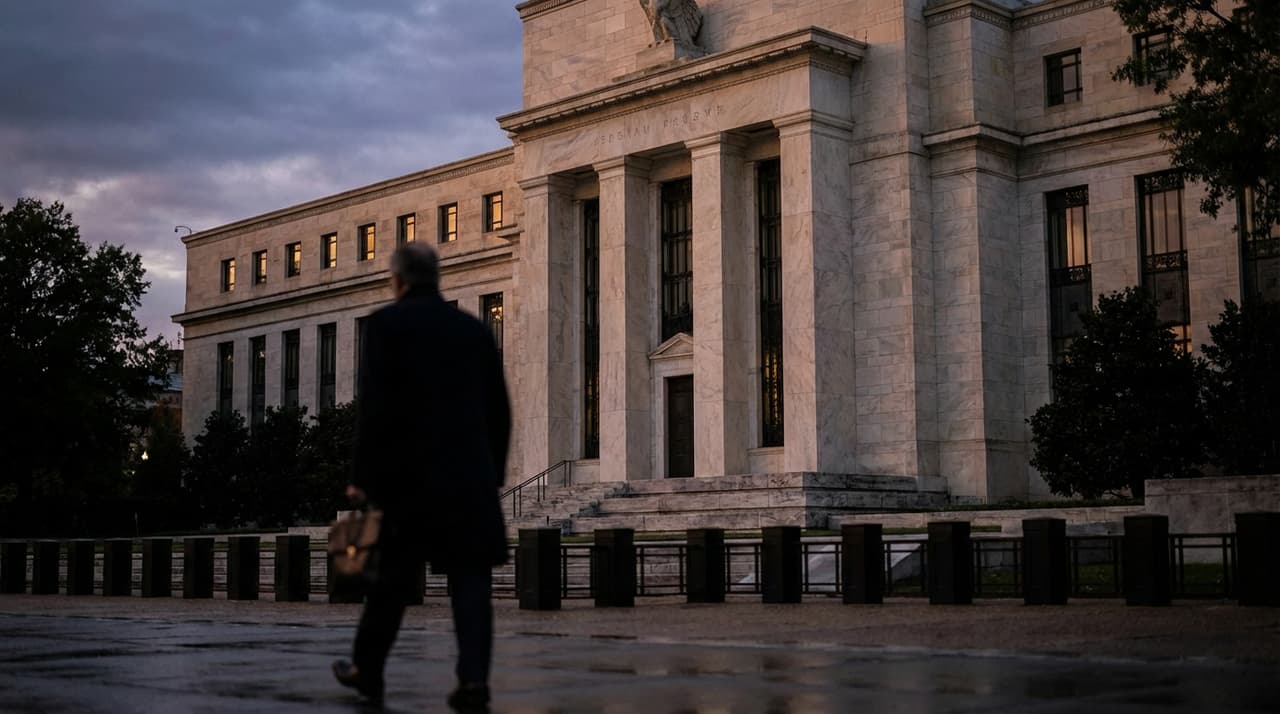
- The Federal Reserve maintained its federal funds rate at 3.5–3.75 percent, with Chair Jerome Powell stating that last year's cuts have positioned policy appropriately to support the Fed's dual mandate.
- The decision reflects a pause to assess the impact of 2025's rate reductions, amid internal divisions and political pressure for more aggressive easing.
- Economic indicators show labor market stabilization with unemployment at 4.4 percent, but inflation remains elevated above the 2 percent target.
Fed Stands Pat Amid Economic Crosscurrents
The Federal Reserve held its key interest rate steady at 3.5–3.75 percent following its January 27-28 meeting, a move that Chair Jerome Powell framed as allowing previous policy adjustments to work through the economy. In remarks that struck a measured tone, Powell emphasized that the rate cuts implemented in 2025 have left monetary policy appropriately positioned to support the central bank's goals of maximum employment and price stability.
This decision wasn't unanimous. Two Federal Open Market Committee members—Stephen I. Miran and Christopher J. Waller—dissented, preferring a quarter-point rate cut, according to people familiar with the matter. That internal division reflects broader uncertainty about the economic outlook and the appropriate policy path forward, particularly as the Fed navigates what one senior official described as "unprecedented political pressure" from the Trump administration to lower rates more aggressively.
Labor Market Shows Signs of Stabilization
Recent economic data has presented a mixed picture that helps explain the Fed's cautious approach. While job gains have remained modest, the unemployment rate showed signs of stabilization at 4.4 percent in December, suggesting the labor market may be finding its footing after months of gradual cooling. Still, inflation remains somewhat elevated above the Fed's 2 percent longer-term target, creating what Powell characterized as a "delicate balancing act" between supporting employment and containing price pressures.
Market participants had largely anticipated the hold, with futures pricing suggesting minimal expectations for immediate policy changes. The decision aligns with projections from J.P. Morgan Global Research (JPM), which expects the Fed to remain on hold through 2026, keeping the funds rate steady at 3.5–3.75 percent, with a potential rate hike of 25 basis points possible in the third quarter of 2027.
Political Pressure and Institutional Challenges
Behind the scenes, Powell faces significant institutional challenges that complicate the Fed's policy calculus. The Department of Justice has launched a criminal investigation into Powell over his testimony regarding the Fed's $2.5 billion building renovations, which Powell characterized as a pretext to punish the central bank for not cutting rates more quickly, according to multiple sources familiar with the investigation.
When reached for comment, a Fed spokesperson declined to address the investigation directly but reiterated Powell's previous statements that the central bank operates independently of political considerations. The timing is particularly sensitive as Powell's term as Fed chair ends in May 2026, with the Trump administration expected to announce a replacement in the coming weeks.
Forward Outlook: Patience Prevails
The Fed's near-term stance appears firmly in "wait-and-see" mode, with officials emphasizing patience as they allow 2025's rate cuts to continue working through the economy. The Committee will assess incoming data on labor market conditions, inflation pressures, and financial developments before making future adjustments, though most economists forecast only two rate cuts this year, likely occurring at the June meeting or later.
Market reaction has been muted, with Treasury yields showing little movement immediately following the announcement. If the labor market weakens or inflation falls materially, the Fed could still ease later in 2026, while tightening labor market conditions could shift the calculus toward maintaining restrictive policy, according to analysts surveyed by Bloomberg.
Correction: An earlier version of this article misstated the timing of potential Fed action. Most economists expect any rate cuts this year to occur in June or later, not necessarily at the June meeting.