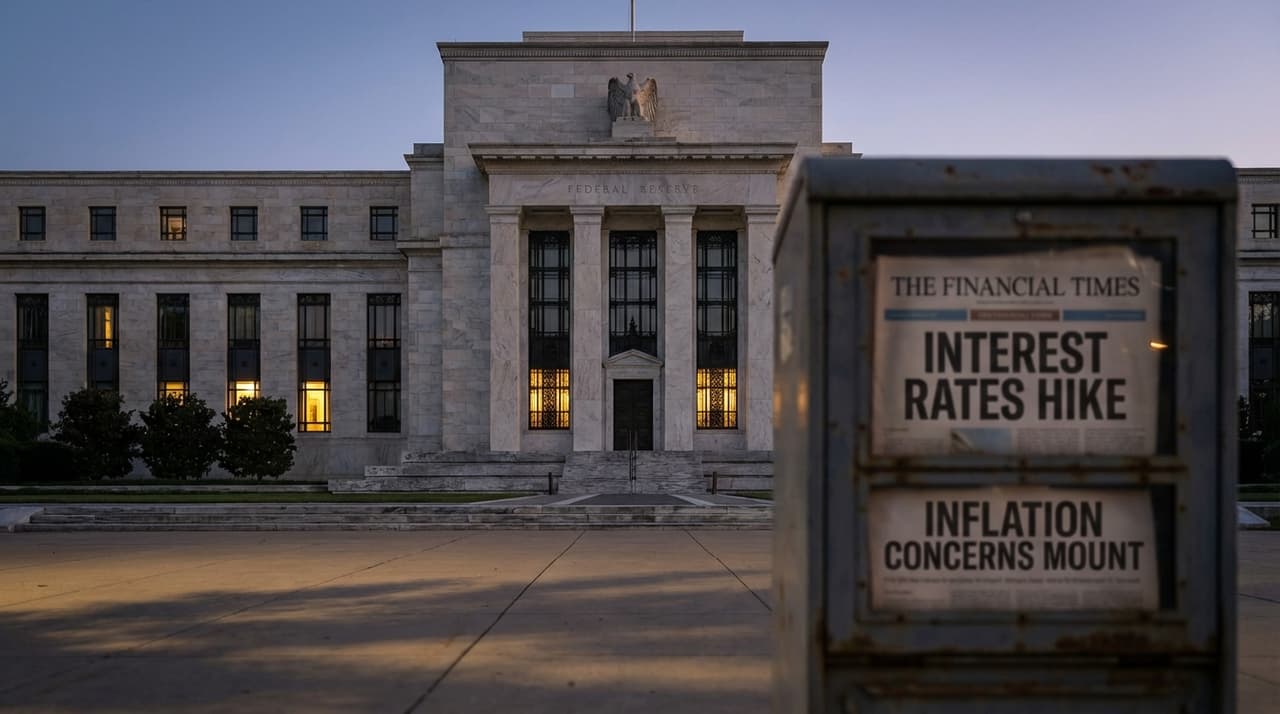
- The Federal Reserve will rely heavily on incoming economic data before deciding on a potential rate cut at its late-January 2026 meeting, Chair Jerome Powell emphasized.
- Markets anticipate roughly two more quarter-point cuts in 2026, but Powell's cautious stance highlights uncertainty amid a federal government shutdown delaying key releases.
- With inflation hovering around 3% and unemployment in the mid-4% range, the Fed balances risks to employment against price stability in its pivot to easing.
Jerome Powell's remark that the Fed will "get a great deal of data before the January meeting" underscores the central bank's data-dependent approach as it navigates a delicate monetary policy shift. After cutting the federal funds rate twice in 2025 to a 3.75–4.00% range—its lowest since 2022—the Federal Open Market Committee left rates unchanged at its December 9–10 meeting, with traders widely expecting another 25 basis-point reduction. But Powell has made it clear that future moves, including at the January 28, 2026 gathering, will hinge on inflation trends and a cooling labor market, according to people familiar with the discussions.
A federal government shutdown has complicated the Fed's task by suspending several key economic releases, forcing policymakers to rely on partial data like CPI figures and private employment estimates. This data vacuum strengthens Powell's emphasis on gathering as much information as possible, with one source noting that the Fed is "scrambling to piece together a coherent picture" ahead of the January decision. In response to inquiries, a Fed spokesperson declined to comment beyond Powell's public statements, but analysts say the shutdown has heightened uncertainty in an already volatile environment.
Market expectations currently price in about two more 25 bps cuts in 2026, likely in March and September, which exceeds the Fed's own September projections signaling just one cut. The December meeting included updated economic projections, or the "dot plot," for 2026, providing insight into the committee's outlook amid slowing growth and inflation that remains modestly above the 2% target. "What institutional investors are really focused on is regulatory stability, but here it's about data clarity," said a market strategist who requested anonymity due to the sensitivity of the topic. "Without reliable stats, the Fed's hands are somewhat tied."
Efforts to ease policy have hit a snag as inflation ticked slightly higher again to around 3% year-over-year, even as the labor market shows signs of softening. Powell's focus on incoming data signals concern about preserving jobs while containing price pressures, a balancing act that has sparked debate among economists. Some argue the Fed is cutting too slowly, risking higher unemployment, while others warn that moving too quickly could reignite inflation. Powell's "wait for more data" framing aims to manage these expectations, with one Fed official privately describing it as "a necessary hedge in uncertain times."
Looking ahead, key releases such as CPI, PCE inflation, and labor-market indicators—once the shutdown resolves—will heavily influence whether the Fed cuts again in January or pauses. Trading Economics and other forecasters project the federal funds rate trending near 3.50% in 2026 and 3.25% in 2027, implying a gradual normalization if inflation edges closer to target. But if price pressures prove sticky above 3%, the Fed may slow or halt cuts; conversely, a faster deterioration in the labor market could prompt larger or faster easing. For now, Powell's message is clear: patience and data will guide the path forward.
Correction: An earlier version of this article misstated the timing of the Fed's last rate cut; it occurred in October 2025, not November.