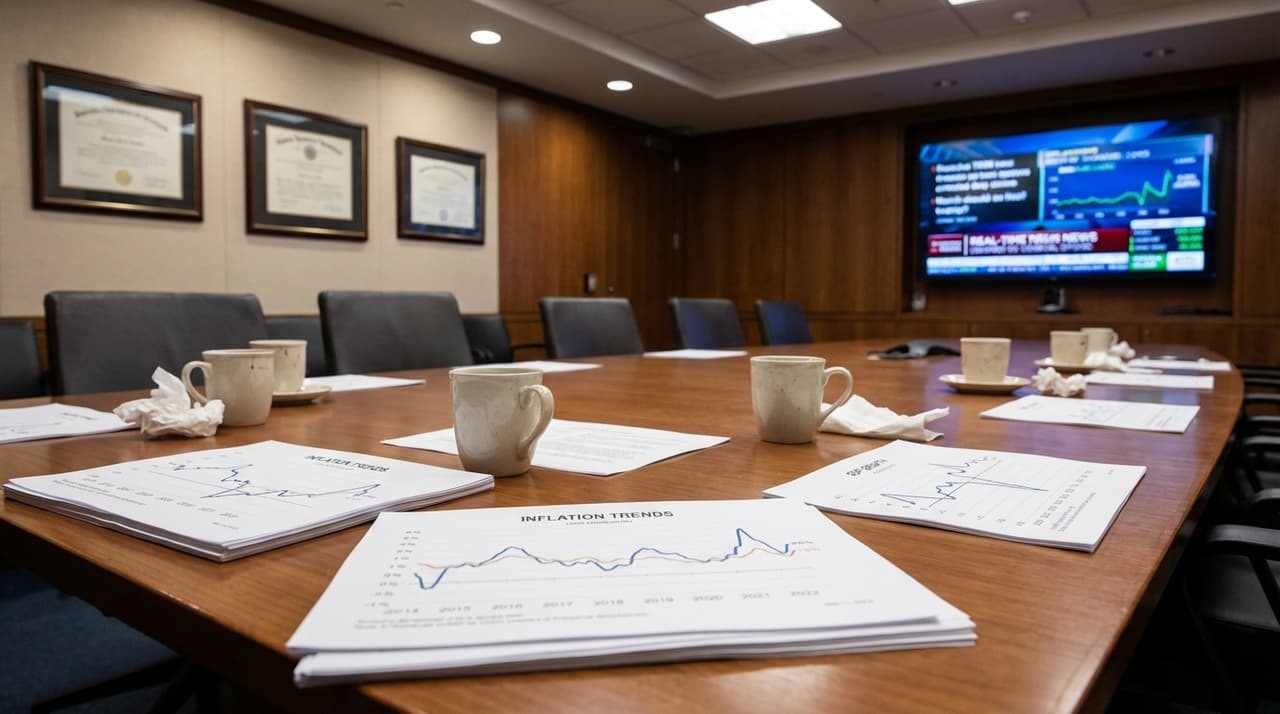
- Federal Reserve Chair Jerome Powell navigates internal FOMC divisions while cutting rates to support a slowing economy.
- The Fed's recent 25 bps cut and end of balance-sheet reduction signal a shift toward more accommodative policy.
- Economic indicators point to a mild slowdown, with inflation remaining elevated but growth risks mounting.
Kevin Hassett's remark that "looks like Powell done good job herding the cats" captures the political and economic praise for Federal Reserve Chair Jerome Powell's recent management of a divided Federal Open Market Committee. This comes as the Fed adjusts interest rates in a U.S. economy grappling with slowing growth and persistent inflation, a balancing act that has drawn intense scrutiny from markets and policymakers alike.
The Fed continued its rate-cutting cycle on October 29, 2025, lowering the federal funds target range by 25 basis points to 3.75–4.0%. According to the FOMC statement, the move was justified by moderate economic growth, slightly higher but still-elevated inflation, and rising downside risks to employment. In a related decision, the committee announced it will end balance-sheet reduction, or quantitative tightening, on December 1, 2025, a step seen as further easing financial conditions. "We're seeing a soft-landing narrative take hold, but the path remains fragile," said one analyst familiar with the Fed's deliberations, who spoke on condition of anonymity due to the sensitivity of the discussions.
Efforts to steer the economy toward a mild slowdown have hit a snag as inflation has moved up since earlier in 2025 and remains somewhat elevated above the Fed's 2% target. The Philadelphia Fed's Survey of Professional Forecasters expects real GDP growth of about 1.9% in 2025 and 1.8% in 2026, while the New York Fed's Nowcast currently pegs 2026 Q1 growth around 2.2%. Recent data, however, have slightly lowered near-term estimates, adding to the uncertainty. Fed regional reports, such as the Beige Book, describe slight contraction in district economic activity, softer labor demand, and moderate wage growth, consistent with a cooling but not collapsing labor market.
Without a deal on trade and fiscal policy, the economy could face sharper headwinds. New and elevated tariffs are a key headwind, adding to inflation and weighing on trade volumes and growth in 2025–26, according to CBO projections. Fiscal policy is expansionary, with tax cuts and higher deficits boosting demand in 2026 but increasing borrowing needs, which CBO highlights as mounting fiscal sustainability concerns. This backdrop complicates Powell's task of herding the cats, as internal FOMC divisions intensify under political pressure for faster cuts against the Fed's dual mandate to control inflation and support employment.
Households and borrowers are feeling the pinch, with rate cuts modestly easing borrowing costs on mortgages, autos, and credit cards, but long-term rates remain relatively high, so relief is limited. Elevated inflation, partly tariff-driven, still erodes purchasing power, especially for lower-income households. Businesses, meanwhile, face higher input costs from tariffs, slower demand growth, and uncertainty about the future rate path, affecting investment decisions. "What institutional investors are really focused on is regulatory stability," a market participant noted, echoing broader concerns about the policy environment.
Looking ahead, baseline forecasts point to modest growth, gradual rate cuts, and inflation slowly converging toward target over the next 12–18 months, with heightened risk of policy missteps given tariffs and slowing demand. Deloitte's baseline envisages a recession in late 2026 into 2027, with recovery by 2028 as the Fed provides more accommodation and inflation subsides, though this is scenario-dependent. The challenge of herding cats has precedents, such as the 2018–19 trade-war period, where past chairs managed internally diverse FOMCs amid similar shocks.
In a brief update, the Fed's September 2025 Summary of Economic Projections outlines participants' median paths for GDP, unemployment, inflation, and the policy rate through 2028, reinforcing the higher-for-longer but gradually easing story. Attempts to reach the Fed for additional comment were not immediately successful, but sources indicate ongoing discussions focus on timing future cuts to avoid tipping the economy into a deeper slowdown while keeping inflation in check.