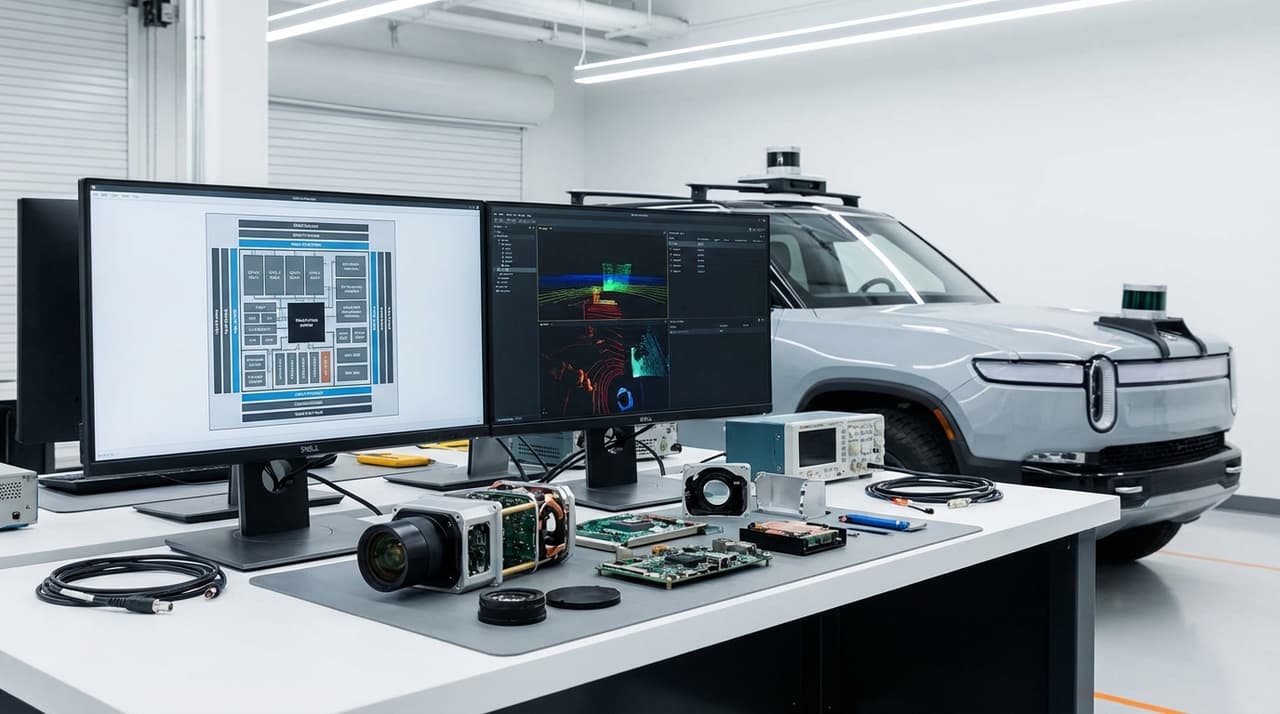
- Rivian (RIVN) is developing its own autonomy/AI compute chip for future vehicles, aiming to reduce long-term reliance on Nvidia (NVDA) hardware.
- The company plans to add lidar sensors to its upcoming R2 line, enhancing its sensor suite for advanced autonomy features.
- This strategic shift aligns with broader industry trends toward vertical integration and cost optimization in the competitive EV market.
Rivian Automotive is quietly advancing plans to bring more of its autonomy and AI compute stack in-house, according to people familiar with the matter. The electric vehicle maker, which has heavily relied on Nvidia's Drive Orin platform for its current Gen 2 autonomy computer, is now pursuing a custom silicon path as part of a deeply integrated electronics architecture for its next-generation vehicles.
Efforts to develop an in-house AI chip have gained momentum in recent months, signaling Rivian's push to capture more value per vehicle and reduce long-term dependence on external suppliers. The move mirrors similar vertical integration strategies seen at Tesla (TSLA) and Apple (AAPL), where controlling core silicon has become a key competitive differentiator. For now, Rivian continues to use Nvidia's Orin chips—delivering about 240 trillion operations per second—and Nvidia GPUs for AI training, but internal discussions suggest a gradual transition toward proprietary solutions.
Meanwhile, Rivian has decided to incorporate lidar sensors into its upcoming R2 vehicles, marking a significant upgrade from its current camera- and radar-centric approach. The addition of lidar, whose costs have fallen sharply in recent years, is aimed at providing the redundancy needed for more advanced autonomy features. Rivian's roadmap calls for "Universal Hands Free" highway driving in 2025 and an "eyes-off" system targeted for 2026, though regulatory approvals remain a hurdle.
"What we're building is a deeply integrated platform where every component, from the sensors to the compute, is optimized for our software," said a Rivian engineer involved in the project, who spoke on condition of anonymity. The company declined to comment on specific chip development timelines, but sources indicate that initial designs are being evaluated for future R2 and R3 platforms.
This strategic pivot comes as Rivian navigates a challenging EV market where software and autonomy capabilities are increasingly critical for differentiation. The company's recent joint-venture deal with Volkswagen (VWAGY), worth up to $5 billion, has provided additional validation for its technology platform and could help scale its in-house developments. Rivian's software chief, Wassym Bensaid, has publicly emphasized the importance of tight hardware-software integration, particularly for the company's new AI assistant that will control vehicle functions.
Analysts note that while Rivian's custom chip ambitions make strategic sense, execution risks remain high. Automotive-grade silicon design and validation are capital-intensive processes that could delay timelines if challenges emerge. "Rivian is betting that bringing compute in-house will reduce costs and improve integration, but they'll need to navigate the complexities of chip manufacturing and supply chain security," said an industry analyst who follows the company closely.
Market reaction has been muted so far, with Rivian shares showing little movement on the news. Nvidia's automotive segment represents a small portion of its overall revenue, which remains dominated by data-center AI chips, so any impact from Rivian's potential shift would be limited in the near term. Still, the development underscores a broader trend among automakers to control more of their technology stacks, particularly as software-defined vehicles become the norm.
Rivian's autonomy team is reportedly working on both the hardware and software fronts simultaneously, with the lidar integration for R2 vehicles seen as a more immediate priority. The company has been testing various lidar suppliers and configurations, though final decisions haven't been announced. If successful, Rivian's combined approach of proprietary compute and enhanced sensors could position it well in the race toward higher levels of vehicle automation—provided it can deliver on its ambitious timeline without compromising safety or reliability.
Correction: An earlier version of this article incorrectly stated Rivian's current autonomy computer uses a single Nvidia Orin chip. It actually uses dual Orin chips.