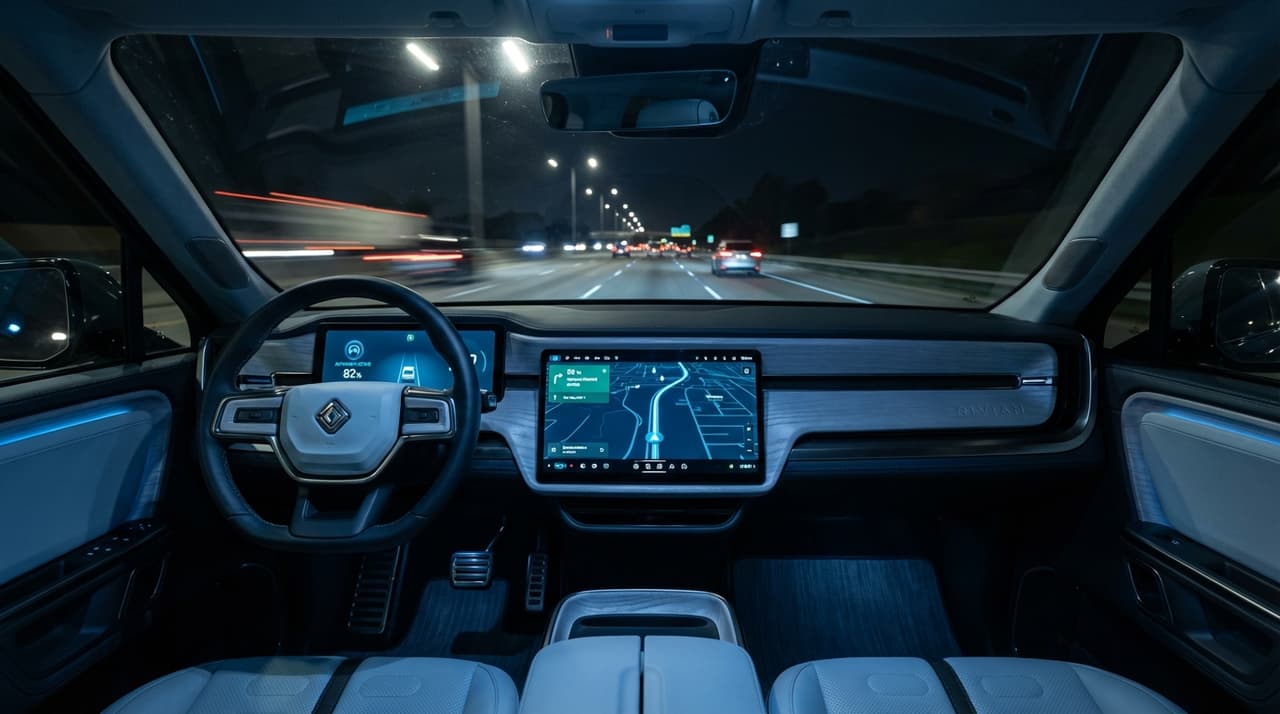
- Rivian (RIVN) plans to launch hands-free highway driving in 2025, followed by eyes-off capability in 2026.
- The Rivian Autonomy Platform is designed with hardware and software to eventually support no human driver in certain conditions.
- This strategy aims to differentiate Rivian in the competitive EV market and address profitability concerns through in-house software development.
At a recent event in San Francisco, Rivian CEO RJ Scaringe detailed a two-stage autonomy roadmap that could reshape the electric vehicle landscape. The company's new Rivian Autonomy Platform, or RAP, is engineered to evolve from current driver-assist features to hands-free driving next year and eyes-off functionality starting in 2026. According to people familiar with the matter, the platform's architecture includes 11 cameras, 5 radars, and a driver-facing camera, powered by a Gen-2 autonomy computer delivering about 250 TOPS—ten times the processing power of its predecessor.
Scaringe emphasized that this incremental approach is designed with safety and regulatory compliance in mind, distinguishing it from more aggressive strategies in the industry. "We're building a platform that can ultimately support no driver in the loop on specific routes and under controlled conditions," he said during the keynote at Rivian's first AI & Autonomy Day in Palo Alto. The event, which drew analysts and investors, highlighted how the company is leveraging vertical integration to control costs and unlock high-margin software revenues.
Financial pressures loom large over these ambitions. Rivian faces a liquidity situation, with profitability remaining a key concern, as noted by analysts covering the autonomy announcement. One analyst argued that bringing autonomy in-house could turn it into a profit center, helping to alleviate these challenges. The company's capital structure includes a U.S. Department of Energy loan of up to $6.6 billion for a planned factory in Georgia, which management has said faces limited risk from recent federal policy shifts.
In parallel, Rivian has spent nearly two years developing an in-house AI assistant, separate from its joint venture with Volkswagen (VOW.DE), expected to reach customers by year-end. Wassym Bensaid, Chief Software Officer, described the assistant as built on an "agentic framework" integrated with vehicle controls, reflecting a broader push toward software-defined vehicles. This move comes amid heightened regulatory scrutiny of driver-assist systems, with NHTSA probes into incidents involving competitors' technologies.
Market reaction has been cautiously optimistic, with shares showing modest gains in after-hours trading following the autonomy details. Customers, meanwhile, are eyeing the promise of recapturing time on highways, where hands-free and eyes-off features could allow for work or relaxation. Scaringe framed this as adding "an enormous amount of value to customers" in a crowded EV sector under intense price pressure.
Looking ahead, Rivian's rollout will focus on Gen 2 vehicles, including a refreshed R1 lineup and the upcoming R2 SUV priced around $45,000. The company acknowledges that achieving higher autonomy levels, such as Level 4, will likely require LiDAR and further development, but the platform is designed with that in mind. As one industry observer put it, "Rivian's cautious, step-by-step approach could set a new benchmark in an era of regulatory uncertainty and safety debates."
Correction: An earlier version misstated the timing of the eyes-off capability; it is slated for 2026, not 2025.