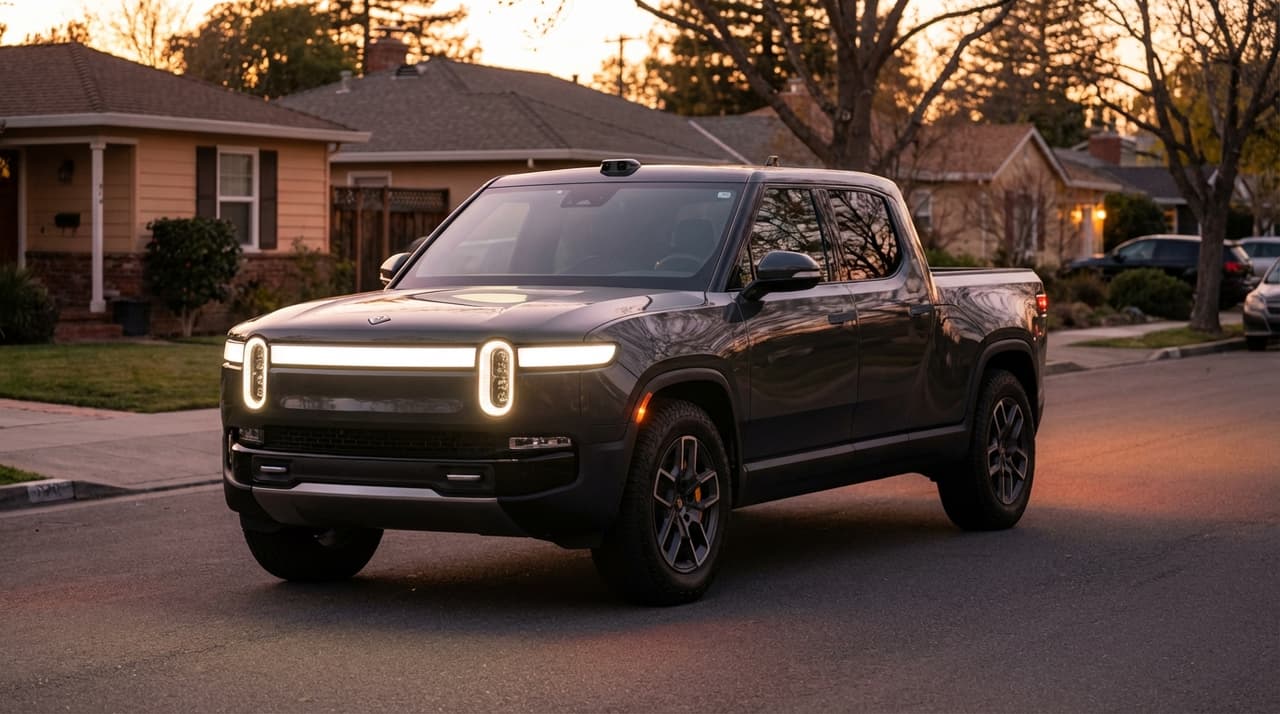
- Rivian announces Autonomy+ premium driver-assistance package launching in early 2026 with $2,500 one-time or $49.99/month pricing
- Company transitions from Mobileye (MBLY) to proprietary in-house hardware and software autonomy stack
- Move signals Rivian's push toward vertical integration and software monetization amid competitive EV landscape
Rivian Automotive (RIVN) has detailed its new Rivian Autonomy+ package, a premium driver-assistance system that will launch in early 2026 and be priced at $2,500 for a one-time purchase or $49.99 per month. The announcement came during the company's Autonomy & AI Day event, where executives outlined their roadmap toward hands-off, eyes-off capabilities for Gen 2 R1 vehicles and the upcoming R2 model.
CEO RJ Scaringe described what he called a "Universal Hands Free" system during the presentation, revealing that he recently spent approximately two hours in a second-generation R1 vehicle in Palo Alto with the vehicle driving itself. According to people familiar with the matter, this demonstration suggests at least Level 3-like capability under controlled conditions, though regulatory approval timelines remain uncertain.
"What we're building is a system that fundamentally changes the driving experience," Scaringe said during the event, though the company declined to provide specific details about regulatory discussions when reached for comment. The transition away from Mobileye hardware represents a significant strategic shift, with Rivian now developing its own proprietary camera and sensor system for future autonomy features.
Rivian's official technology page describes the Rivian Autonomy Platform+ with 360-degree perception and onboard compute of 200 TOPS (trillions of operations per second). Notably, the system will be offered at no extra cost through late 2025, effectively seeding the user base ahead of the paid launch in early 2026. This approach mirrors industry trends where automakers use free trial periods to build adoption before transitioning to paid models.
Financial analysts following the company note that the pricing structure aligns with how other original equipment manufacturers structure similar Level 2+/Level 3-style feature bundles. The move comes as Rivian continues its "scale with discipline" phase, re-engineering vehicles and delaying some capital expenditures to manage cash burn while pushing toward higher-margin software and autonomy features as incremental revenue streams.
Alongside the autonomy developments, Rivian is developing an in-house AI assistant integrated with vehicle controls and built on a hybrid edge/cloud stack. This effort runs separately from but complements the company's automated driving initiatives and its software joint venture with Volkswagen, which could be worth up to $5.8 billion and focuses on electrical architecture, zonal compute, and infotainment systems.
Industry observers point to several parallels with Tesla (TSLA)'s transition from Mobileye to its own Vision stack and the introduction of Full Self-Driving as a separately priced software product. As the EV market matures and price competition intensifies, advanced driver-assistance systems and autonomy features are becoming key differentiators in the U.S. and European markets.
Rivian's emphasis on "hands-off/eyes-off under controlled conditions" aligns with emerging Level 3 regulatory frameworks, including UN ECE rules in Europe and state-level regulations in the United States. The company must comply with National Highway Traffic Safety Administration safety and automated driving policies, and moving its autonomy stack in-house could make Rivian more directly accountable for performance and safety updates rather than relying on third-party suppliers.
Market reaction to the announcement has been cautiously optimistic, with some analysts noting that successful adoption of Autonomy+ could create a meaningful recurring revenue pillar alongside vehicle sales. However, questions remain about consumer willingness to pay subscription fees for capabilities that depend on hardware already installed in vehicles, particularly as economic uncertainty persists in certain segments of the automotive market.
Correction: An earlier version of this article incorrectly stated the timing of Rivian's transition from Mobileye hardware. The company began this transition earlier in 2024 as part of its Gen 2 platform development.