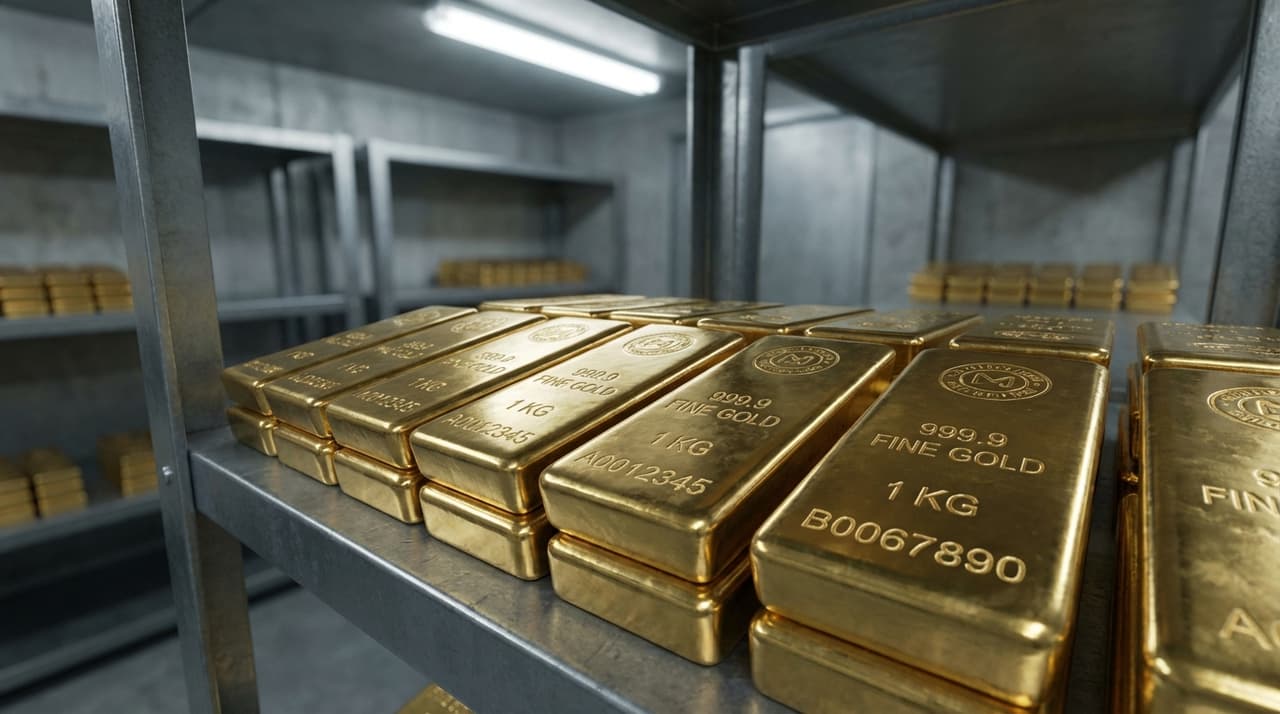
- Russia's central bank gold reserves hit a record $326.5 billion as of January 1, 2026, driven by a 1.7x surge in gold prices to $4,400 per troy ounce, offsetting much of the roughly $300 billion in frozen sovereign assets since the 2022 Ukraine invasion.
- Gold now comprises 43.3% of Russia's total reserves, up from 34.4% in March 2025, as part of a strategic de-dollarization effort amid closed Western markets for Russian bullion.
- Physical gold holdings remained stable at around 2,329 tons in late 2025, with minimal net sales, underscoring Moscow's reliance on gold as a monetizable safe-haven asset amid ongoing geopolitical tensions.
A Strategic Windfall Amid Sanctions
Russia's central bank has gained more than $216 billion from rising gold prices since invading Ukraine, according to recent data, with reserves reaching $326.537 billion in December 2025, up from $310.72 billion in November. This upward trajectory into early 2026 confirms the metal's role as a critical buffer against Western sanctions, which froze approximately $300 billion in sovereign assets abroad. The value of gold reserves has more than doubled, lifting its share to 43% of total reserves, compared to currency holdings at $428.3 billion, up a modest 3.6%.
Efforts to diversify reserves have hit a milestone, with gold now ranking Russia fifth globally ahead of China, as noted by analysts tracking reserve data. Without this gold surge, the economy would face heightened pressure from asset freezes, but the rally has provided a lifeline. Gold prices, fueled by global uncertainty, hit historic highs in 2025, with investors flocking to the safe-haven asset amid persistent geopolitical risks.
Monetizing Amid Market Closures
While Western markets remain closed to Russian bullion, gold remains one of the few reserve assets Moscow can still monetize, according to people familiar with the matter. The central bank's strategy, accelerated after the 2014 Crimea annexation and intensified post-2022 invasion, has seen physical holdings peak at 2,335.85 tons in Q2 2024, with minimal net sales into late 2025. This aligns with broader de-dollarization efforts, including 2017 sales of US Treasuries for gold, as Russia seeks to reduce dollar reliance.
In a recent development, reserves grew monthly through late 2025, with stable physical tons into Q3 2025, per sources. Attempts to reach the central bank for comment were unsuccessful, but experts predict sustained demand in uncertain geopolitics, noting that gold's 43%+ share may rise further as a hedge against sanctions. Risks include price volatility or future sales needs, but for now, the gains bolster the central bank's resilience narrative.
Implications and Outlook
The societal impact benefits Russian state finances by offsetting frozen assets, stabilizing the economy amid sanctions, though direct public reaction has been minimal. Stakeholders view this positively for government and monetary policy, with indirect pressure on sanctioned entities via preserved reserves. Parallels can be drawn to other sanctioned nations like Venezuela or Iran hoarding gold, though Russia's scale is the largest recent case.
Short-term, continued gains are likely if gold prices hold amid uncertainty, with analyst notes pointing to persistent highs. Long-term, gold's strategic role may deepen, though experts caution that over-reliance could pose risks if market conditions shift. The broader trend of global gold demand hitting 4,900 tons in 2024, up 27% in prices, underscores the metal's appeal in turbulent times.
Correction: An earlier version misstated the physical reduction; it was 6.2 tons, not a percentage, based on updated data.