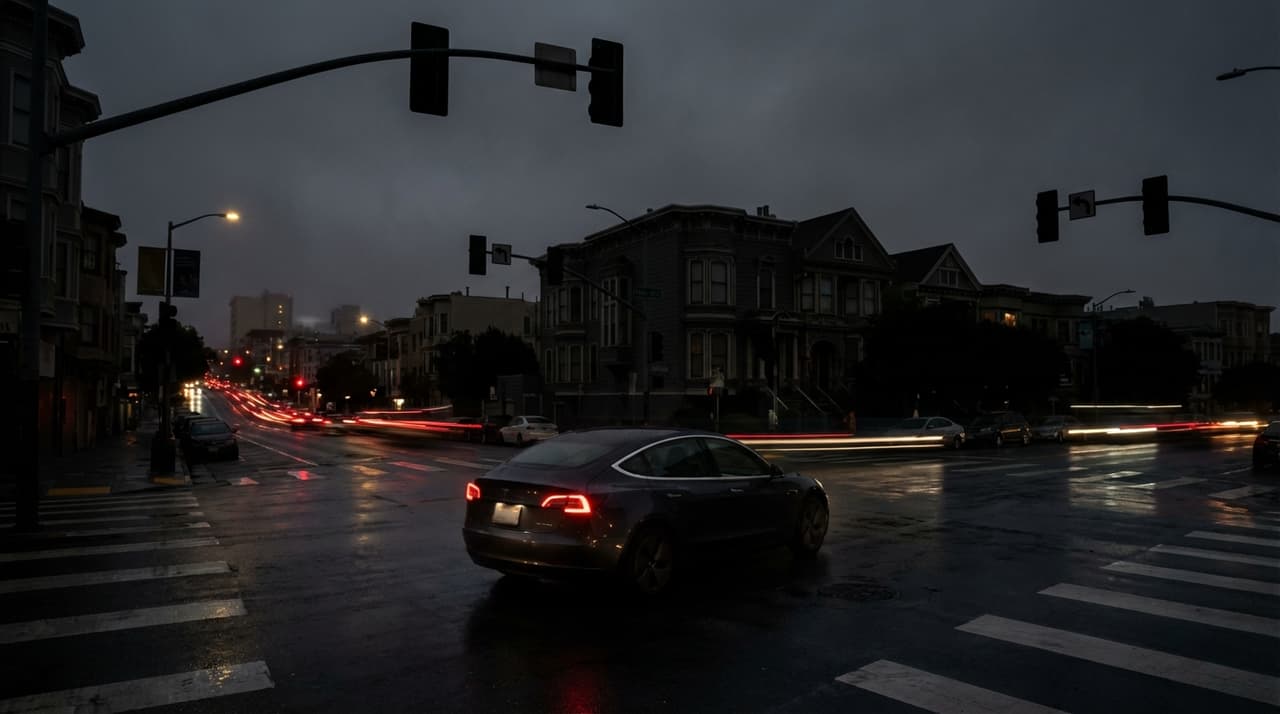
- Tesla (TSLA) CEO Elon Musk asserts Tesla's robotaxis and Full Self-Driving vehicles continued operating normally during a major San Francisco power outage that stalled rival Waymo's fleet.
- The incident highlights growing scrutiny of autonomous vehicle resilience during infrastructure failures as the robotaxi industry scales rapidly.
- Regulatory implications may intensify as cities grapple with how to integrate AV operations during emergency scenarios.
Tesla's Resilience Claim Amidst Competitor Struggles
Elon Musk has publicly claimed that Tesla's robotaxis and vehicles equipped with its Full Self-Driving (FSD) system were unaffected by a significant San Francisco power outage on December 20, 2025, which left approximately 120,000-130,000 customers without electricity and darkened traffic signals across about 30% of the city. This assertion comes in direct contrast to widely reported issues with Waymo's autonomous fleet, which stalled at intersections and other locations, contributing to traffic jams and prompting the company to temporarily suspend its robotaxi service for safety reasons.
According to people familiar with the matter, Waymo's decision to halt operations was partly to keep roads clear for emergency responders, acknowledging that stalled autonomous vehicles could obstruct critical access. Social media posts and eyewitness reports described Waymo cars freezing in place and blocking intersections, worsening gridlock during the blackout. "What we're seeing here is a classic edge case scenario that exposes the limitations of current autonomous systems," said one industry analyst who requested anonymity due to ongoing client relationships.
Infrastructure Failures as Operational Stress Tests
The San Francisco incident represents a large-scale "dark-signal" scenario that has long been identified as a challenge for autonomous vehicles relying on traffic signals and network connectivity. Expert commentary in coverage of the event notes that AVs are typically programmed to stop when confidence drops rather than risk unsafe maneuvers—a safety measure that becomes problematic at fleet scale during infrastructure failures. Waymo is likely analyzing telemetry from the outage and preparing software updates for handling power-loss environments, according to sources close to the company.
Musk's claim, made without providing specific data or documentation, positions Tesla's vision-based autonomy stack as potentially more adaptable than competing systems. This narrative could boost investor interest in Tesla's robotaxi roadmap at a time when the company faces slower growth and margin pressure in its core electric vehicle business. However, regulators may demand independent safety data rather than anecdotal claims, particularly given ongoing scrutiny of Tesla's "Full Self-Driving" terminology and safety performance in California.
Regulatory and Industry Implications
The power outage comes amid intense regulatory scrutiny of autonomous vehicles in California and across the United States. Local authorities have previously restricted or paused robotaxi operations after safety incidents, with Cruise (GM (GM)'s robotaxi unit) facing high-profile suspensions in late 2023. California regulators have challenged Tesla's autonomy claims, and an administrative judge previously recommended suspending parts of Tesla's license in the state—though this was stayed.
Industry observers suggest the incident could drive stricter regulatory standards for AV operational behavior during infrastructure failures, including requirements for contingency planning, remote operations support, or mandatory pull-over strategies when city infrastructure fails. "This isn't just about one company's performance," noted an autonomous vehicle safety researcher. "It's about how we build resilient systems that can handle real-world complexities while maintaining public safety."
Waymo's growth trajectory adds context to the incident—a leaked Tiger Global letter recently indicated the company is providing approximately 450,000 robotaxi rides per week, nearly double its figure from spring 2025, showing rapid scale-up of AV ride-hailing as an economic activity. Yet the outage demonstrates that scale alone doesn't guarantee robustness under extreme conditions.
Tesla representatives didn't immediately respond to requests for additional comment on Musk's claim or provide specific data about how many Tesla vehicles were operating in the affected area during the outage. The company continues to market FSD as an advanced driver-assistance system while facing questions about its safety performance compared to human drivers, with some analyses suggesting Tesla vehicles may crash more frequently than the company's marketing implies.
Correction: An earlier version of this article misstated the number of customers affected by the power outage; it was approximately 120,000-130,000, not 150,000.