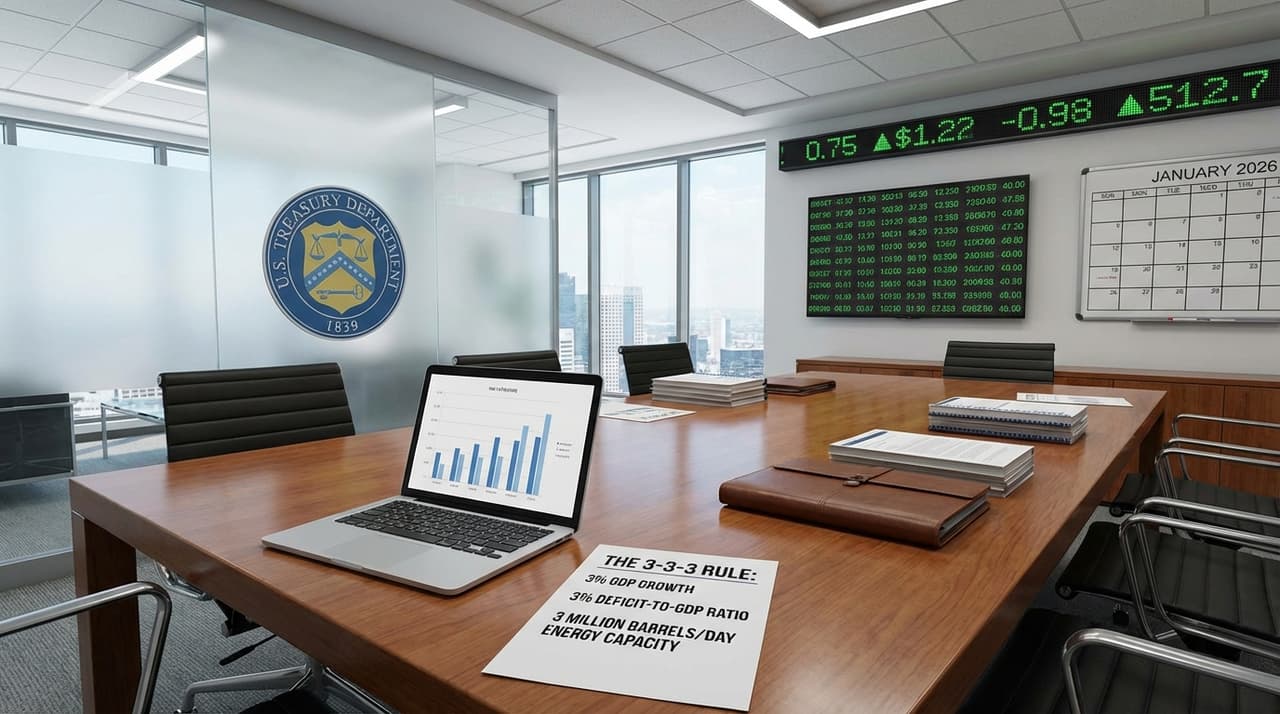
- U.S. Treasury Secretary Scott Bessent forecasts a "supply-side boom" in 2026 driven by deregulation, tax incentives, and increased production, aiming for non-inflationary growth through the "3-3-3" rule: 3% GDP growth, 3% deficit-to-GDP ratio, and 3 million barrels per day of extra energy by 2028.
- Recent data shows a 12% rise in business investment in high-tech manufacturing and energy sectors, with the Atlanta Fed's GDPNow projecting 5.4% growth for the fourth quarter, signaling early momentum.
- The plan includes measures like full expensing for investments, the Working Families Tax Cut Act offering household refunds of $1,000 to $2,000, and the "One Big Beautiful Bill" extending 2017 tax cuts retroactively, injecting $370 billion in refunds this quarter.
Treasury Secretary Scott Bessent has laid out an ambitious vision for the U.S. economy, predicting a "supply-side boom" in 2026 that hinges on a mix of deregulation, targeted tax incentives, and a sharp increase in domestic production. Speaking after recent Davos meetings, Bessent emphasized that the goal is to achieve non-inflationary growth by adhering to what he calls the "3-3-3" rule: targeting 3% GDP growth, maintaining a 3% deficit-to-GDP ratio, and adding 3 million barrels per day of energy capacity by 2028. This framework, according to people familiar with the matter, is designed to fix supply chain bottlenecks and boost manufacturing and energy sectors without sparking inflation.
Recent economic indicators suggest the plan may already be gaining traction. Business investment has surged by 12% in high-tech manufacturing and energy, driven in part by policies like 100% depreciation for capital expenditures, which encourages firms such as Caterpillar (CAT), Deere (DE), and Intel (INTC) to ramp up onshoring efforts. The Atlanta Fed's GDPNow model, a real-time estimate, puts fourth-quarter growth at a robust 5.4%, hinting at the early stages of the boom Bessent envisions. "We're seeing a shift from globalized supply chains to 'America First' production, and it's starting to pay off with falling gas prices and rents, alongside rising wages," said one analyst, who requested anonymity due to the sensitivity of ongoing policy discussions.
The "Bountiful 2026" plan, unveiled by Bessent, includes specific legislative actions codified via 2025 executive and legislative moves. Key components are the Working Families Tax Cut Act, which provides refunds of $1,000 to $2,000 for households, and the "One Big Beautiful Bill" that retroactively extends 2017 tax cuts, resulting in $370 billion in refunds being distributed this quarter. Bessent, who served as Acting IRS Commissioner in late 2025 to implement these changes amid some resignations, has tied these tax cuts to domestic energy and production goals, aiming to rebalance global trade through tariffs like those under the AEIPA on Taiwan chips and critical minerals reshoring. Efforts to restructure the economy have hit a snag, however, with critics warning of potential trade tensions and stagflation risks if the Federal Reserve maintains a hawkish stance or if industry adaptation lags.
Market reactions have been cautiously optimistic, with the S&P 500 rallying on the news, but debates persist over the balance between growth and tariff-related vulnerabilities. Polls indicate that nearly half of Americans feel financially behind entering 2026, adding pressure to deliver tangible benefits. Bessent's approach evolves Reaganomics by prioritizing productivity and automation over high interest rates for stability, building on 2025 policies that averted a recession. In the short term, a Q2 2026 "refund rally" is expected to provide a liquidity boost, driving further capital expenditure and employment gains. Long-term sustainability, analysts note, will depend on hitting energy targets and ensuring supply outpaces tariffs, with Bessent forecasting a multi-year non-inflationary expansion if all elements align.
As the tax filing season reflects these new provisions for the first time since recent policy shifts, industries from semiconductors to machinery are poised for growth, while soybean markets eye potential trade deals and biofuels. The global reordering through critical industry reshoring, including rare earths and addressing Taiwan supply risks, underscores the broader implications. Without a successful implementation, the economy could face challenges, but for now, Bessent's supply-side push is setting the stage for what could be a transformative year.