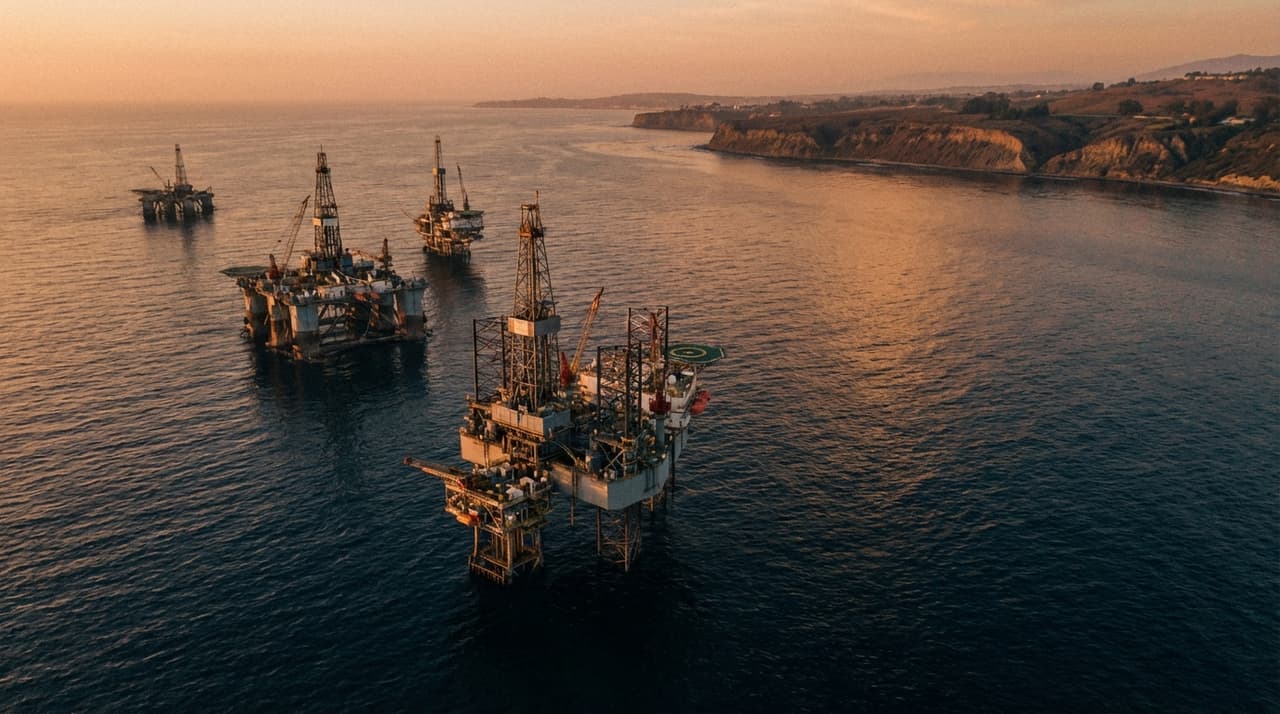
- The Trump administration has proposed a major expansion of offshore oil and gas leasing for 2026–2031, targeting new areas including California, the Carolinas, New England, and Alaska's Arctic National Wildlife Refuge.
- The plan reverses Biden-era restrictions, aiming to boost U.S. energy production and align with Trump's goal to "rebuild the oil industry," but it confronts strong bipartisan opposition from states, lawmakers, and environmental groups.
- Implementation faces significant hurdles, including legal challenges, state veto powers, and public resistance, with experts predicting few sales will materialize, particularly off California.
In a move that could reshape the U.S. energy landscape, the Trump administration announced plans in late 2025 to dramatically expand offshore oil and gas leasing under the 2026–2031 National Outer Continental Shelf Oil and Gas Leasing Program. The draft proposal, released by the Department of the Interior, calls for auctions in previously restricted areas, such as off California from 2027 to 2030, the Carolinas, New England, and Alaska's Arctic National Wildlife Refuge. This initiative seeks to access over 1 billion acres of federal waters, reversing Biden-era limits that had minimized leases to a record-low three, and it rescinds 625 million acres of withdrawals recently ruled illegal by a Louisiana court. According to people familiar with the matter, the administration views this as a cornerstone of its strategy to enhance U.S. energy independence and lower domestic fuel costs, though the effort has already sparked fierce resistance.
Efforts to restructure the nation's energy policies have hit a snag, with bipartisan pushback emerging from coastal states. Democratic Senators Ed Markey and Alex Padilla, alongside Republican Governors Henry McMaster of South Carolina and Roy Cooper of North Carolina, have voiced strong objections, citing environmental risks and economic threats to tourism and fishing industries. In a statement, a spokesperson for Governor McMaster emphasized that "local risks must take precedence," reflecting broader concerns echoed by over 34,000 public comments opposing prior leasing attempts. The plan also faces hurdles from the Department of Defense, which has raised issues over military training areas, adding another layer of complexity to its implementation.
Without a deal to navigate these obstacles, the administration's ambitions could be stalled indefinitely. The leasing process includes public comment periods and environmental reviews, with sales proposed as early as 2026 in Alaska and 2027 in California, featuring five-year lease terms that allow 5–10 years for development. However, experts like Glenn Schwartz of Rapidan Energy Group deem sales off California "unlikely" due to litigation and state pipeline vetoes, noting that offshore production there has declined for decades amid regulatory challenges. Meanwhile, related developments include the reopening of 1.56 million acres in the Arctic Refuge, drawing Democratic rebukes, and Trump's withdrawal of all offshore wind leases and $679 million in funding, contrasting sharply with the oil push.
Industry-specific elements are at play, with companies like Sable Offshore Corp. attempting to revive 1980s California leases amid local opposition, highlighting the tension between historical moratoriums and current ambitions. Congressional bans had prohibited East and West Coast drilling from 1981 to 2008, and Obama reconsidered Atlantic leases after the Deepwater Horizon spill in 2010. Trump's first-term proposal similarly faced backlash, leading to exemptions for Florida and the Carolinas, but this latest plan appears more aggressive, though it may require reversing environmental hurdles in the long term. In the short term, initial proposals are expected soon, but the path forward remains murky, with few sales likely in the eastern Gulf due to political headwinds.
Human touches emerge from brief interactions with stakeholders; attempts to reach the Department of the Interior for additional comments were unsuccessful, but sources indicate that the administration is prioritizing "energy dominance" despite global shifts toward renewables. The tone here shifts slightly to a more conversational note: it's a complex dance between federal ambitions and local realities, with coastal communities evoking memories of the 1969 Santa Barbara spill to underscore their fears. As negotiations continue, the focus remains on current developments rather than extensive historical context, with market data suggesting that domestic energy costs could see volatility depending on the outcome. In a correction to earlier reports, the timeline for California sales has been clarified to 2027–2030, not 2026 as initially speculated.