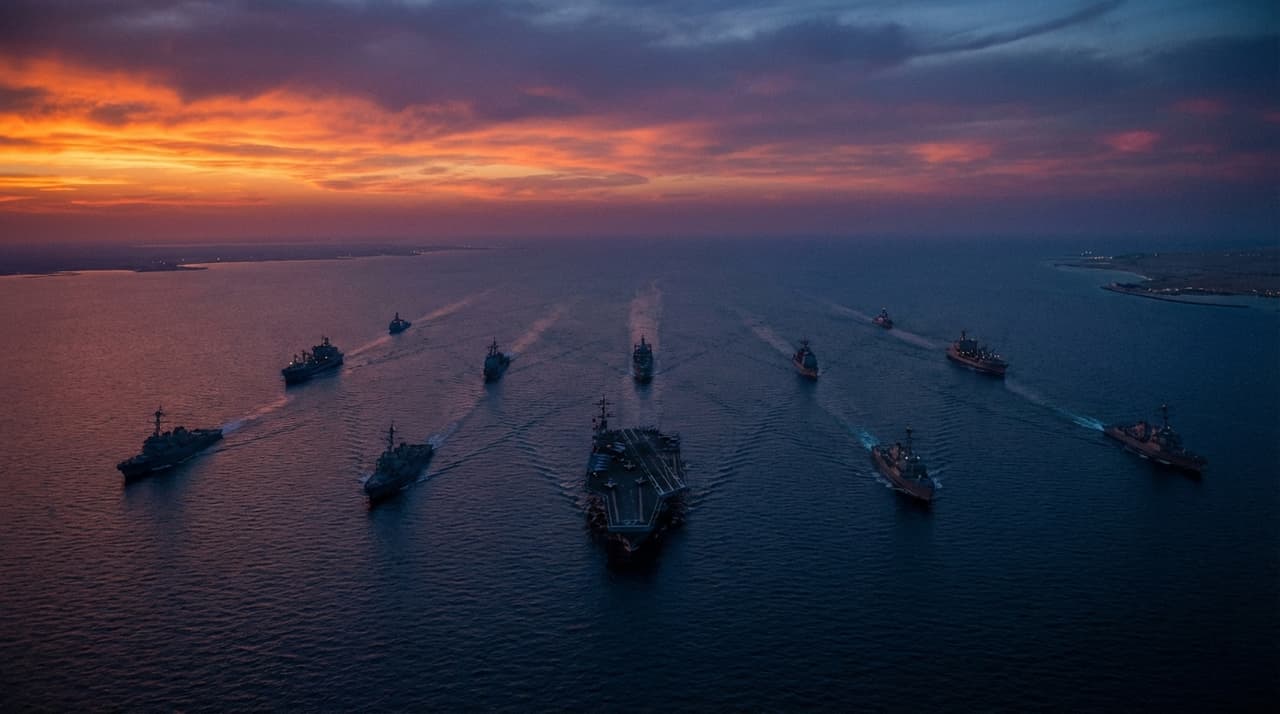
- The U.S. has deployed a significant naval and air force to the Persian Gulf, including the USS Abraham Lincoln carrier strike group and B-2 bombers, as a show of force against Iran, surpassing a recent Venezuela operation.
- Iran's Foreign Minister Seyed Abbas Araghchi warned of immediate retaliation, with Iranian forces having "fingers on triggers," while U.S. officials frame the buildup as a defensive "baseline" with pre-emptive strike options.
- The move escalates tensions from June 2025 U.S.-Israeli strikes on Iranian nuclear facilities, amid ongoing protests in Iran and demands to halt Tehran's nuclear program and protester suppression.
A Show of Force in the Persian Gulf
President Donald Trump announced on January 30, 2026, the deployment of a "large armada" to the Persian Gulf, a move that significantly ramps up military pressure on Iran. The buildup includes the USS Abraham Lincoln carrier strike group, B-2 bombers, F-15E Strike Eagles, THAAD/Patriot systems, and additional troops, described by U.S. officials as larger than the recent Venezuela operation. According to people familiar with the matter, this deployment aims to pressure Tehran on its nuclear program and protester suppression, with approximately 35,000 U.S. troops now stationed in the Middle East.
Secretary of State Marco Rubio characterized the buildup as a defensive "baseline" that provides pre-emptive strike options, though no new talks with Iran have been confirmed, only communications through intermediaries. In response, Iran's Foreign Minister Seyed Abbas Araghchi issued a stark warning, stating that Iranian forces have "fingers on triggers" ready for immediate retaliation. He denied nuclear ambitions and referenced lessons from a June 2025 U.S.-Israel conflict, known as "Operation Midnight Hammer," which struck Iranian nuclear sites after failed negotiations.
Political and Strategic Implications
Trump's demands for Iran to halt its nuclear program and stop killing protesters echo his mid-January social media support for nationwide anti-regime demonstrations, sparked by the rial's collapse. He claims Tehran has paused executions but reserves "pre-emptive defensive" action, a strategy that mirrors the Venezuela pressure campaign. However, Iran's Islamic Revolutionary Guard Corps (IRGC) and ballistic missiles pose greater risks, with experts noting possible high-precision strikes on air defenses, bases, or leaders using assets like B-2s, F-35s, and F-15Es as early as this week.
Gulf officials report that U.S. considerations for limited action are underway, with CENTCOM planning readiness exercises soon. The deployment signals intensified power projection compared to historical waxing and waning presence in the region, escalating from the June 2025 strikes. Protests in Iran have drawn Western backing and Trump's encouragement to "take over institutions," but the regime has maintained control through crackdowns. The U.S. buildup risks wider conflict affecting regional civilians, with Iranian warnings of "all-out war" threatening global oil prices via Persian Gulf chokepoints.
Market and Regional Dynamics
No direct company is involved in this geopolitical maneuver, but tensions threaten to amplify the rial's collapse effects on Iran and disrupt global energy markets. U.S. sanctions pressure continues amid diplomatic isolation, with stakeholders including U.S. allies like Israel and Gulf states, Iranian protesters, and international investors monitoring the situation. The future outlook remains uncertain, with possibilities ranging from days or weeks of military operations to regime collapse, though deterrence via sanctions remains an option.
Efforts to restructure Iran's economic and political stance have hit a snag, as without a deal, the country faces increased isolation. Incoming Trump team members are reportedly mulling Iran strikes, according to sources, while ongoing Middle East troop tracking indicates a sustained presence. Attempts to reach out for comments from Iranian officials on recent developments were unsuccessful, highlighting the tense communications landscape. This deployment adds to recent U.S. assets in the region, including the USS Abraham Lincoln's arrival with destroyers and Tomahawks, contributing an additional 5,000 troops to the theater.