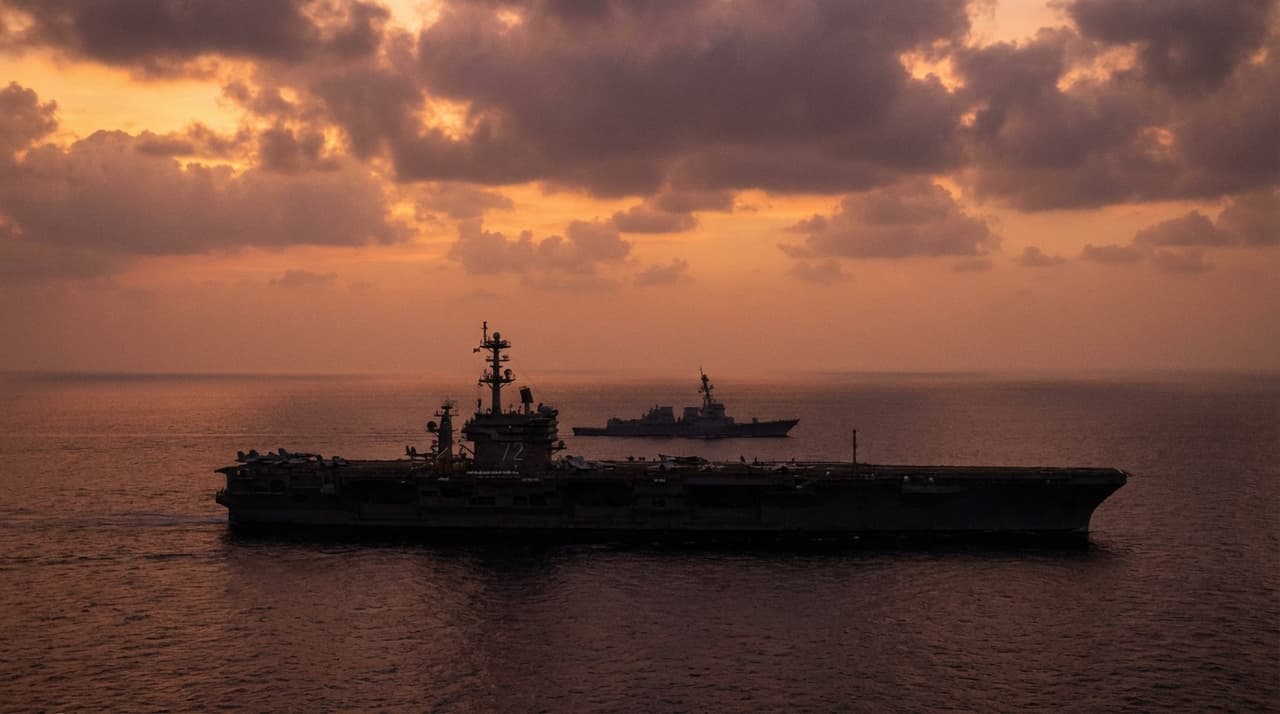
- President Trump announces plans to speak with Iran while deploying a "massive armada" including the USS Abraham Lincoln carrier strike group and additional warships like the USS Delbert D. Black to the Middle East.
- The military buildup adds about 5,000 troops to the region's 30,000+ US presence, responding to Iran's nuclear activities, recent protester crackdowns, and threats to US forces and Israel.
- Trump warns of a "far worse" attack than the prior "Operation Midnight Hammer" if no nuclear deal is reached, with US-imposed 25% tariffs on countries trading with Iran aiming to isolate Tehran economically.
A Dual-Track Approach to Iran
President Donald Trump announced on January 29-30, 2026, that he plans to engage diplomatically with Iran while simultaneously deploying a significant naval force to the Middle East, a move that underscores the administration's "maximum pressure" strategy. According to people familiar with the matter, the deployment includes the USS Abraham Lincoln carrier strike group and additional warships such as the USS Delbert D. Black, bolstering regional security for critical oil shipping lanes. This military buildup, which adds approximately 5,000 troops to the over 30,000 US forces already in the area, is a direct response to Iran's escalating nuclear activities, recent crackdowns on protesters, and persistent threats to US assets and Israel.
Defense Secretary Pete Hegseth affirmed the military's readiness to prevent Iran from pursuing nuclear capabilities, stating that the posture is designed to deter aggression. Meanwhile, Secretary of State Marco Rubio described the deployment as a "baseline" defense against Iranian drones and missiles that threaten US bases and Israel, emphasizing that preemptive action remains an option if intelligence signals an imminent attack. The administration's efforts to restructure its diplomatic engagement have hit a snag, however, as Iran has rejected talks under duress. Foreign Minister Abbas Araghchi insisted on threat-free conditions for negotiations, while an Iranian army spokesman warned of immediate retaliation against US carriers, according to sources close to the regime.
Economic and Market Implications
The geopolitical tensions have immediate financial repercussions, with US-imposed 25% tariffs on countries trading with Iran potentially disrupting global oil markets. Analysts note that escalation risks could trigger short-term oil price spikes, reminiscent of past US-Iran confrontations. In recent trading, oil futures have shown volatility, reflecting investor concerns over supply chain stability. Without a deal, the economic isolation could deepen, impacting not only Iran but also global trade partners caught in the crossfire.
Trump's warning of a "far worse" attack than "Operation Midnight Hammer"—referring to the June 2025 strikes that obliterated three Iranian nuclear sites—adds urgency to the situation. The historical context includes derailed nuclear talks following Israeli strikes on Tehran and echoes of 2019-2020 tensions with similar carrier deployments. This latest move parallels the 2025 Venezuela naval show of force but on a larger scale, according to defense analysts. As the administration reviews strike options, the short-term outlook hinges on whether Tehran negotiates sans nukes or if intelligence prompts military action. Rubio has noted uncertainty in post-Khamenei Iran transition, suggesting the situation is more complex than previous regime change efforts in Venezuela.
Human and Societal Impact
The societal ramifications are profound, affecting US troops within range of Iranian strikes, Iranian protesters who have faced thousands of deaths recently, and civilians vulnerable to potential conflict escalation. Attempts to reach Iranian officials for comment were unsuccessful, but state media has highlighted carrier vulnerabilities, fueling domestic resolve. On the US side, the deployment sparks debate over the balance between "maximum pressure" and diplomacy, with some experts predicting prudent deterrence to protect allies. However, Iranian intransigence could escalate tensions further, risking renewed war that disrupts Middle East stability. Trump's call to "MAKE A DEAL!" underscores the high stakes, as the administration navigates this volatile landscape with both carrot and stick.
Correction: An earlier version of this article misstated the date of the announcement; it was made on January 29-30, 2026.