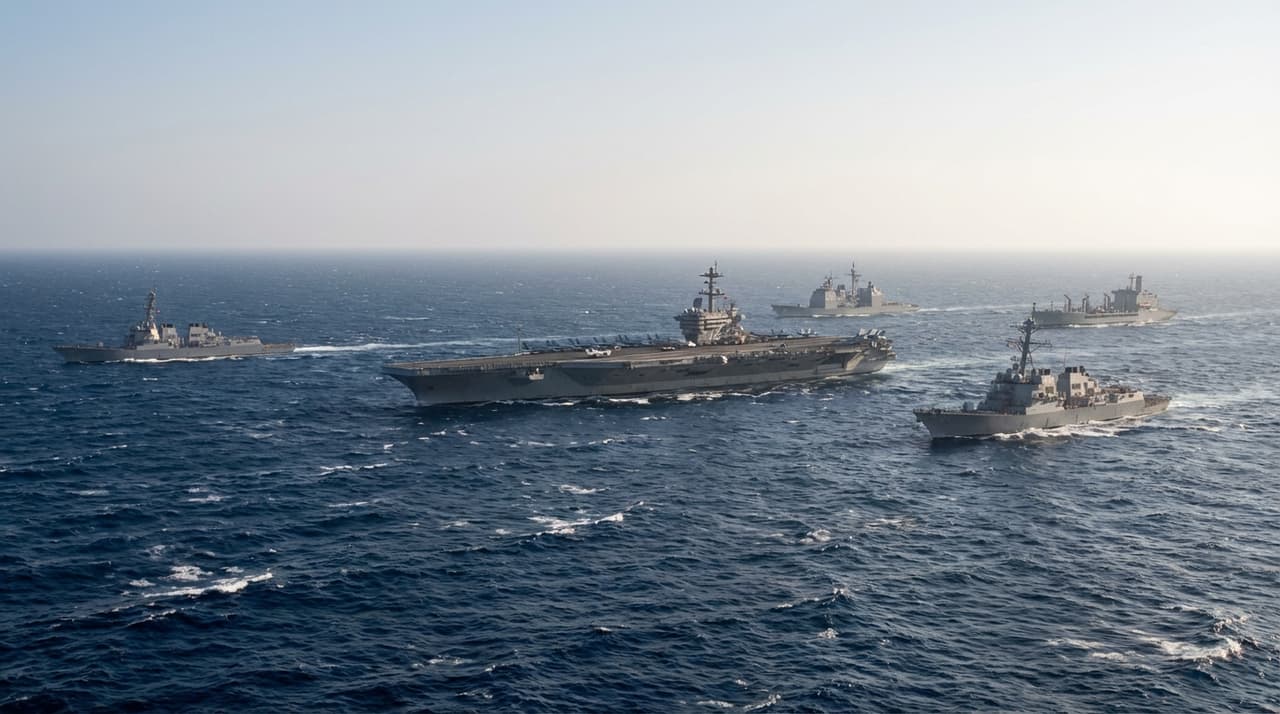
- Trump announces major US naval deployment to pressure Iran into a nuclear agreement, warning "time is running out" for a deal.
- The USS Abraham Lincoln carrier strike group heads to the Indian Ocean, marking one of the largest US military buildups near Iran in years.
- Tensions escalate amid Iran's domestic protests and economic woes, with Tehran vowing retaliation if pushed while signaling openness to dialogue.
Naval Buildup and Nuclear Demands
US President Donald Trump announced on January 29, 2026, via Truth Social that a "massive Armada" including the USS Abraham Lincoln carrier strike group—comprising warships, fighter jets, submarines, and aircraft—is deploying toward Iran to pressure Tehran into a nuclear deal, warning that "time is running out" if no agreement is reached. This deployment, confirmed by US Central Command as promoting regional security in the Indian Ocean (not directly bordering Iran), marks one of the largest US military buildups near Iran in years, led by the Nimitz-class USS Abraham Lincoln (333m long, over 65 aircraft, ~5,680 crew, $4.5B cost).
According to people familiar with the matter, Trump's demands have shifted from addressing protester issues to curbing Iran's nuclear program and ballistic missiles threatening US allies. The move mirrors last year's US air defense relocations anticipating Iranian retaliation after US strikes on three Iranian nuclear facilities during the Iran-Israel conflict in June 2025. Analysts note growing strike options via the armada, with short-term risks including potential US strikes on Iranian missiles or nuclear sites if no deal emerges.
Regional and Domestic Flashpoints
Trump's rhetoric has escalated amid Iran's domestic protests, triggered by rising living costs and rial devaluation, which the regime blames on US and Israeli interference; Trump has called for ending Supreme Leader Ali Khamenei's rule and halting protester executions. Iran's army chief vowed a "crushing response" to aggression, while its UN mission stated readiness for "dialogue based on mutual respect" but warned of unprecedented retaliation if pushed. Protests pose the biggest challenge to Iran's regime since 1979, with US-based reports citing over 6,000 deaths (including 5,925 protesters since December) and potential totals exceeding 25,000; Trump has encouraged demonstrations, claiming "help is on the way."
Ordinary Iranians face heightened risks amid crackdowns, economic woes, and escalation fears. Iran grapples with rial devaluation and cost-of-living spikes fueling protests, exacerbating a legitimacy crisis; no direct global market data, but tensions risk broader West Asia instability affecting oil routes and energy prices. Efforts to reach Iranian officials for comment on the deployment were unsuccessful, but sources indicate ongoing diplomatic backchannels.
International Reactions and Outlook
Internationally, Russia warns of regional "chaos," Turkey offers mediation, Hezbollah views attacks on Iran as attacks on itself, and Norway's foreign policy chief opposes new Middle East wars. US cargo planes are heading to the region; parallels include prior 2025 deployments post-nuclear strikes. Ongoing Iran protests and nuclear ambitions remain central flashpoints. Firstpost speculates if this signals war or forces negotiations, with analyses questioning Trump's unclear goals but noting the strategic pressure of the naval buildup.
Long-term, this could spark wider conflict, but for now, the focus is on whether Tehran will bend to US demands or double down on its nuclear ambitions. As one regional analyst put it, "It's a high-stakes game of chicken, with both sides testing red lines in real-time."