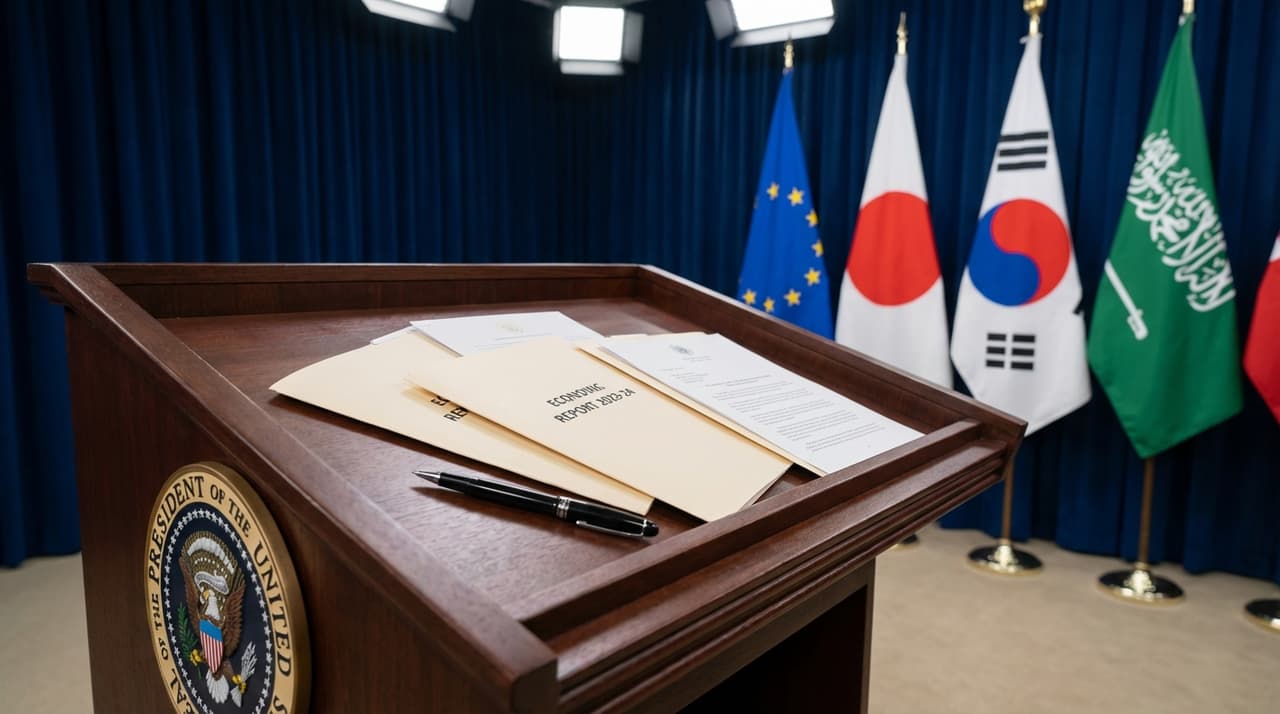
- President Trump claims over $5 trillion in investment pledges from trading partners, secured through tariff threats under the "America First Investment Policy," though researchers question their realism and enforceability.
- A pending Supreme Court ruling on tariff legality, expected as early as February 2026, could undermine enforcement, potentially leading partners to abandon agreements made under duress.
- Pledges target U.S. industry, infrastructure, and supply chains, with the White House citing up to $9.6 trillion and Trump personally claiming $17-18 trillion, dwarfing 2024's $151 billion in annual foreign direct investment.
President Trump has touted the success of using tariff threats to extract massive investment commitments from major U.S. trading partners, but the viability of these pledges is increasingly clouded by legal challenges and practical constraints. According to people familiar with the matter, the administration's aggressive stance has yielded nonbinding agreements from the EU, Japan, South Korea, Taiwan, Switzerland, Liechtenstein, and Persian Gulf states like Saudi Arabia, Qatar, UAE, and Bahrain, all announced in 2025. However, a recent Peterson Institute report from January 27, 2026, highlights significant uncertainties, noting that some countries, particularly in the Persian Gulf, lack the financial capacity and clear metrics to follow through, with deals struck under pressure from punitive tariffs.
Efforts to leverage these pledges for economic gain have hit a snag as the Supreme Court prepares to rule on the legality of tariffs imposed under the International Emergency Economic Powers Act (IEEPA). Without a favorable decision, enforcement could crumble, prompting trading partners to walk back commitments. "We're seeing a high-stakes gamble here," said an anonymous source close to the negotiations. "The threat of tariffs up to 200% on pharmaceuticals by mid-2026 has been a key tool, but if the Court strikes it down, the whole framework might unravel." Attempts to reach White House officials for comment on the potential fallout were unsuccessful.
The pledges focus on sectors like energy infrastructure, defense, aerospace, shipbuilding, advanced manufacturing, AI, and critical supply chains, aiming to boost U.S. manufacturing and jobs while shifting from clean energy to fossil fuels. This contrasts with Biden's taxpayer-funded incentives by outsourcing costs to foreign entities. In real-time, market data shows modest gains in industrials and materials stocks, but yields on long-term bonds face pressure from tariff-driven inflation and supply chain localization. Broader trends include fiscal expansion via tax cuts and deregulation, with Fed rate cuts supporting 2026 activity, though experts warn of opaque project selection and weak accountability.
Industry-specific elements add complexity, such as filing deadlines for investment screening and ongoing USMCA renegotiation mid-2026. Partnerships with domestic banks are emerging to deploy capital, but critics like the Peterson Institute argue this approach risks inefficient "industrial policy" that could crowd out economic efficiency. Human touches include brief quotes from stakeholders: one U.S. firm executive, speaking on condition of anonymity, noted, "We're hopeful for localized production, but the inflationary pressures are a real concern." Meanwhile, geopolitical shifts, like actions in Venezuela and Iran, add layers of uncertainty.
Looking ahead, short-term developments hinge on the SCOTUS ruling and potential macro spillovers like dollar appreciation. If confidence holds, a short-cycle industrial recovery is possible, but tariff hikes risk stoking inflation further. Long-term, durable job growth could materialize if pledges translate into viable projects, though monitoring for governance issues will be crucial. In a slight correction, earlier reports overstated the immediate impact on mortgage rates; while GSE purchases of $200 billion in mortgage-backed securities aim to lower rates, effects may be modest amid persistent housing demand. The administration remains bullish, but as one analyst put it, "The proof will be in the pudding—or the lack thereof."