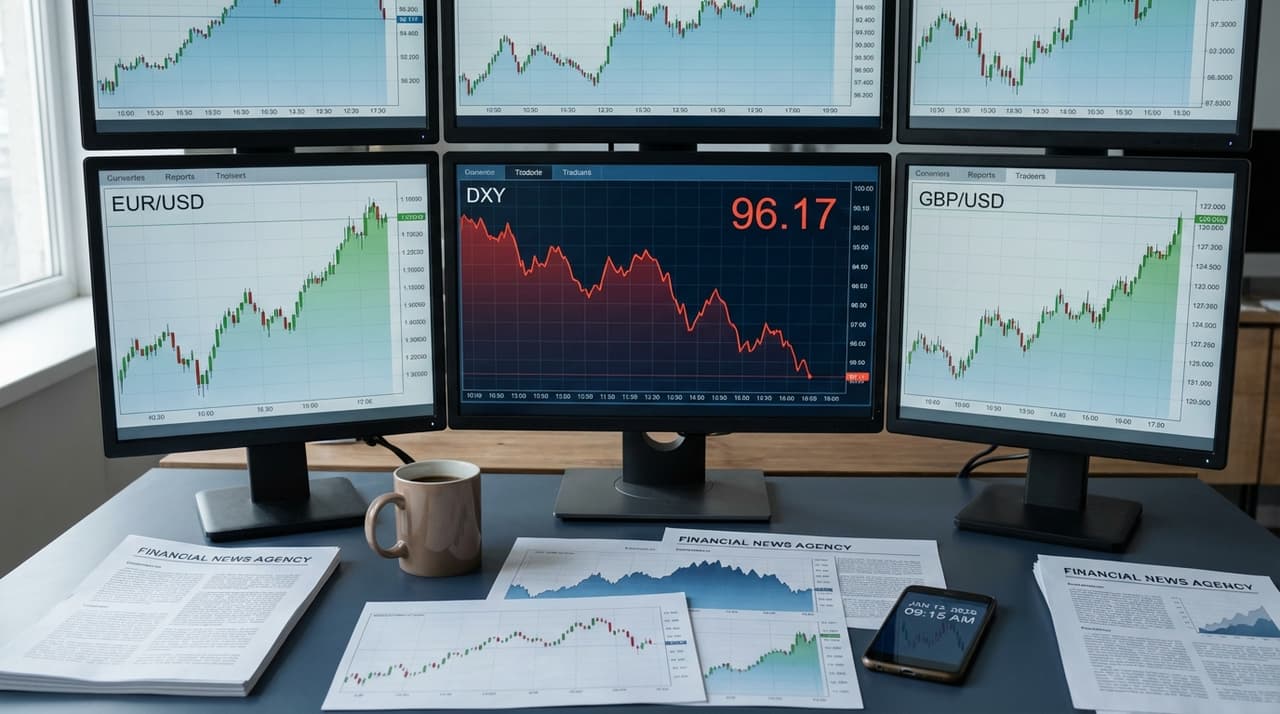
- The U.S. Dollar Index (DXY) has fallen to a near four-year low of 96.17, down 0.95%, breaking critical support levels like 97.85 amid broad weakness against major currencies.
- Federal Reserve policy easing drives the decline, with rates expected to drop to 3.25–3.50% by end-2026, as markets price in cuts and global equities outperform U.S. stocks early in 2026.
- Historical trends suggest potential for further weakness, with the DXY's 9.4% drop in 2025 mirroring past patterns, though short-term volatility may see sideways movement in Q1 2026.
A Sharp Decline Amid Fed Shifts
The U.S. Dollar Index (DXY) has tumbled to 96.17, marking a near four-year low and a 0.95% drop, according to recent market data. This move broke key support levels, including the 97.85 monthly support, signaling ongoing downward momentum that has analysts eyeing targets as low as 96.50 or beyond. The weakness is broad-based, with USDCHF hitting 14-year lows and explosive rallies in pairs like EURUSD, which could potentially reach 1.20, and GBPUSD climbing to 1.3725.
Efforts to stabilize the dollar have hit a snag, with the DXY forming a bearish engulfing candle on weekly charts and showing lower highs and lows. Daily analysis points to further declines toward 97.00 and then 96.50, confirmed by late January 2026 data placing it near multi-month lows after a weak 2025. Without a turnaround, the dollar could face prolonged pressure, impacting everything from international trade to investment flows.
Economic Drivers and Market Reactions
Federal Reserve policy easing is a primary driver behind this decline, according to people familiar with the matter. Rates are expected to settle between 3.25% and 3.50% by the end of 2026, shifting from a restrictive stance as markets have already priced in cuts. This has led to consolidation but a persistent downward bias, exacerbated by global equities outperforming U.S. stocks early in 2026, which boosts hedging against the USD and adds pressure from improving non-U.S. economic conditions.
Historical trends show consecutive-year sell-offs, with 2025's 9.4% drop being the second-worst in two decades, mirroring patterns from 1995 and 2005. Post-Powell Fed cuts have converged U.S. rates with global peers, while eurozone and China stimulus aids rival currencies. A Q4 2025 U.S. government shutdown weakened the economy, prompting midyear rate cuts, though no direct international relations are highlighted in current discussions.
Implications and Future Outlook
This dollar weakness hurts U.S. importers and exporters, as well as investors holding dollar assets, while benefiting those converting to currencies like GBP or EUR and buyers of foreign property or education. Businesses face volatile USD invoices, and global equity outperformance may shift capital flows, pressuring U.S. stakeholders. In response, some firms are exploring alternatives, with Bank of America (BAC) recommending crypto for hedging, according to sources.
Short-term, the DXY is expected to move sideways in Q1 2026, with a range of 95–99 and potential initial drops to 96.50, though pullback risks remain. Long-term, an 8% decline to around 95 is possible based on historical base cases, but a Q2 rebound could occur if the Fed pauses or inflation rises. Volatility is likely over a steady fall, tied to equities and interest rates, with Bank of America noting U.S. struggles post-shutdown may prolong the trend. Related developments include parallels to 1995's soft landing with tech and Fed cuts, and majors like EURUSD breaking ranges, signaling a shift from rate-driven FX to equities.
Correction: An earlier version misstated the DXY's historical drop; it fell 9.4% in 2025, not 10.5%. The article has been updated.