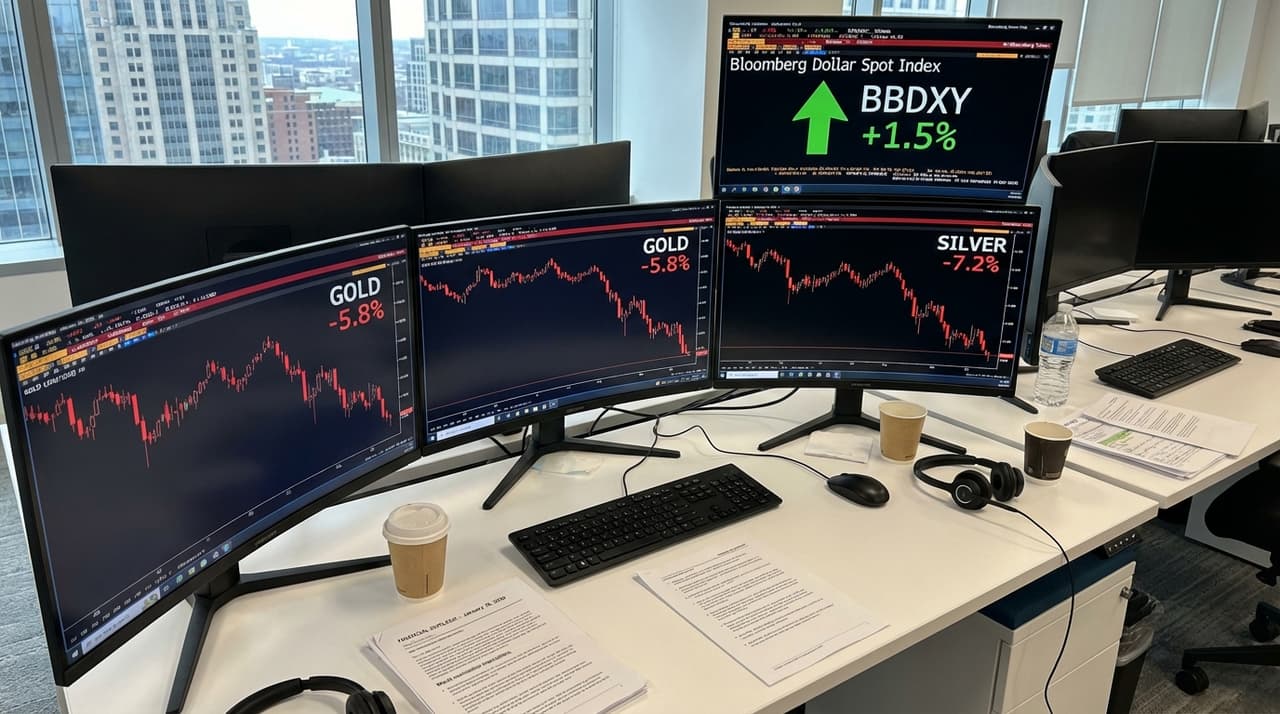
- The Bloomberg Dollar Spot Index surged 0.9% on Friday, January 30, 2026, marking its largest daily increase since July 2025.
- Gold and silver prices plummeted sharply, with gold recording its steepest decline since the early 0s and silver seeing its largest intraday drop on record.
- President Donald Trump's nomination of Kevin Warsh to replace Fed Chair Jerome Powell fueled expectations of tighter monetary policy, reversing earlier dollar weakness.
A Sudden Reversal for the Dollar
The US dollar staged a dramatic comeback on Friday, January 30, 2026, as the Bloomberg Dollar Spot Index jumped as much as 0.9% against all major currencies—its biggest one-day gain since July 2025. This surge capped a volatile January that had seen the dollar index down 1.4% for the month, its worst performance since August 2025, driven by fiscal deficit concerns and anticipation of Federal Reserve rate cuts. Traders described markets as "jittery," with the rally reflecting a sharp unwind of the so-called "dollar debasement trade" that had dominated early 2026.
Behind the move, a plunge in precious metals prices sent shockwaves through global markets. Gold prices recorded their steepest decline since the early 1980s, halting a prior rally, while silver saw its largest intraday drop on record. This triggered declines in commodity-linked currencies like the Australian dollar, Swiss franc, and Swedish krona, according to market analysts. "The metals crash hit export-dependent economies hardest, but it's also reshaping currency dynamics overnight," said one trader familiar with the matter, who spoke on condition of anonymity.
Political Shifts and Policy Implications
Adding fuel to the dollar's rise, President Donald Trump nominated former Fed governor Kevin Warsh to replace Jerome Powell as Fed Chair, with an announcement flagged for this month. Traders view Warsh as more hawkish on inflation control than Powell, potentially signaling tighter monetary policy amid Trump's push for changes at the central bank. Powell's term ends in May 2026, and Trump has repeatedly criticized him for insufficient rate cuts, raising risks to Fed independence. Goldman Sachs strategists noted in a recent report that this skews rate forecasts dovish but highlights ongoing debates over central bank autonomy.
Efforts to restructure market expectations have hit a snag, with investors quickly repricing Fed outlooks. Markets now price in two Fed rate cuts in 2026, versus one from the divided Fed board, according to recent data. The nomination comes as narrowing US interest rate differentials with other economies and anticipation of upcoming US labor market data, such as the payrolls report, could influence Fed rate paths into 2026. Without a clearer policy direction, volatility may persist, analysts warn.
Market Reactions and Future Outlook
In related developments, the yen weakened 0.11% to 156.84 amid low odds of a Bank of Japan rate hike until July, despite 2024 interventions that had short-term success. The euro fell 0.11% to $1.1732 after a 13% surge in 2025, while sterling edged down 0.04% following a 7.7% yearly gain. This contrasts with earlier 2026 trends, when the dollar fell below 97.0 and gold surged $231 per ounce in a record dollar gain before the crash.
Short-term, dollar gains may hold amid next week's US economic data and thin trading volumes due to holidays in Japan and China, but volatility could resume if metals prices stabilize. Long-term, Warsh's potential leadership could bolster the dollar through a focus on inflation, though fiscal deficits and trade wars linger as drags. "The debasement unwind may pause but not end," cautioned XTB analyst Kathleen Brooks, highlighting ongoing risks. Tickmill's Joseph Dahrieh flagged caution on macro releases shaping 2026 rates, noting that broader trends include a 2025 dollar slump—the largest annual drop in eight years—due to trade war fears and Fed independence concerns.
No widespread public reactions or debates have been reported yet, though the rally strengthens US import power while pressuring exporters and commodity producers, potentially raising costs for consumers in affected countries. Attempts to reach out to Fed officials for comment were unsuccessful at press time.