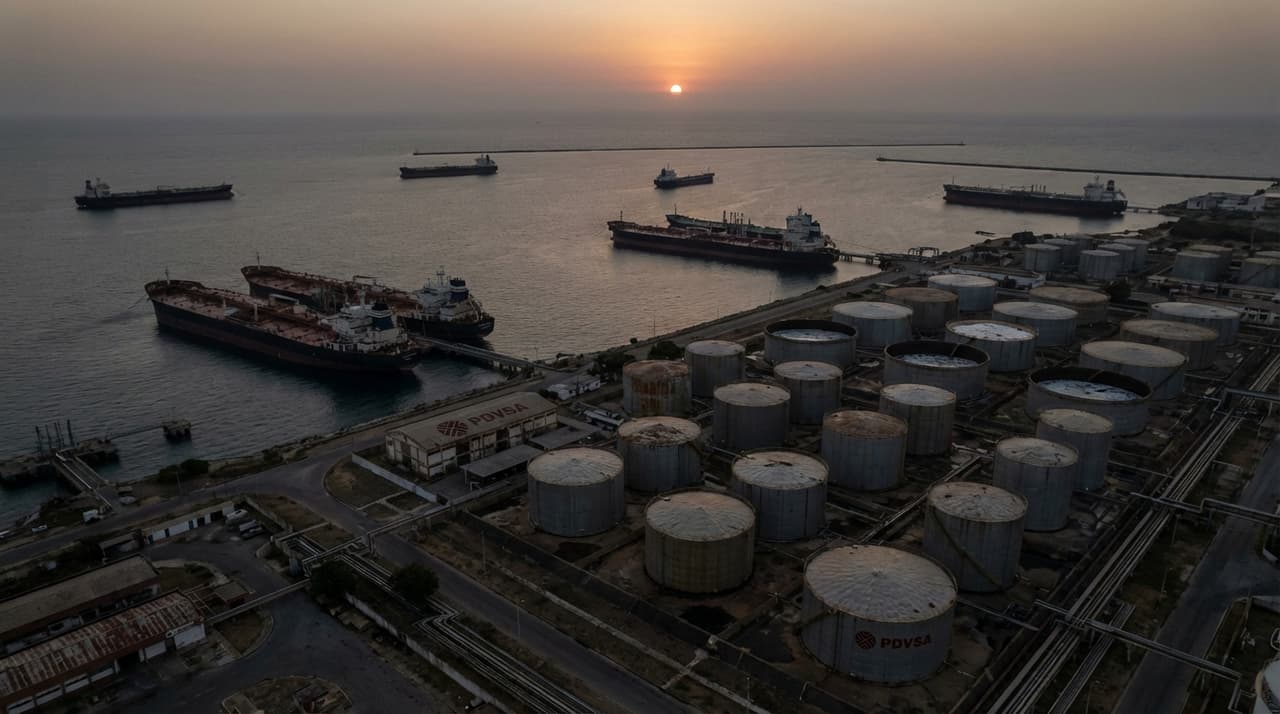
- Venezuela's onshore and floating storage could reach maximum capacity within about 10 days, forcing potential production cuts.
- U.S. enforcement actions, including a recent tanker seizure and blockade, have sharply limited export options, causing crude to back up.
- The situation threatens to further reduce Venezuela's hard-currency revenue, exacerbating economic and humanitarian crises.
Venezuela's state-owned oil company, Petróleos de Venezuela S.A. (PDVSA), is facing an imminent storage crisis as its onshore tanks and floating tankers used for offshore storage are quickly filling up, with analysts and market reports indicating they may hit maximum operational capacity in roughly 10 days. This looming bottleneck stems from intensified U.S. sanctions enforcement, which has severely constrained export channels, leaving unsold barrels to accumulate. According to people familiar with the matter, the company's crude output currently hovers around 0.86–0.9 million barrels per day, but without a deal to resume exports or find new storage, PDVSA would be forced into rapid shut-ins of production.
Efforts to navigate the sanctions have hit a snag after U.S. forces recently seized an oil tanker off Venezuela's coast, and President Trump ordered a blockade of "sanctioned oil tankers" heading to the country. This escalation targets the "shadow fleet" of unflagged or obscurely flagged vessels that Caracas relies on for most exports, primarily to China, following years of politicized management and underinvestment that have weakened PDVSA's technical capabilities. A spokesperson for the Venezuelan government, reached for comment, described the U.S. actions as "economic warfare," while opposition groups point to mismanagement as the root cause of the dependency on sanctions-sensitive oil revenue.
Industry-specific elements come into sharp focus here: PDVSA's storage saturation risks damaging reservoirs and infrastructure if production is curtailed, raising long-term costs to restore output. For context, oil historically provides nearly two-thirds of government revenue in Venezuela, a classic "petrostate" whose economy is already in deep contraction with high inflation. The immediate impact could include temporary layoffs for oil-sector workers and worsened shortages of food and medicine, as reduced export revenue limits imports. On the global stage, while Venezuela is a mid-tier producer, disruptions could tighten heavy-sour crude supply, affecting refiners configured for such grades, though the broader market has buffer capacity amid downward price pressures in 2025.
Looking ahead, if storage hits capacity and the blockade persists, more crude might be diverted into unreported floating storage farther from ports, entrenching opaque trading practices. In the short term, this could push production below current levels, while long-term recovery would require large, stable investment—estimated at US$15–20 billion by analysts—and improved political conditions not yet in place. Parallels exist with Iran and other sanction-hit producers, where similar storage constraints have led to lasting infrastructure damage. As OPEC+ moves toward audited capacity baselines, Venezuela's marginal role underscores the complexities of its sanctioned status.
Correction: An earlier version of this article misstated the timeline for storage capacity; it is estimated at about 10 days, not immediately.