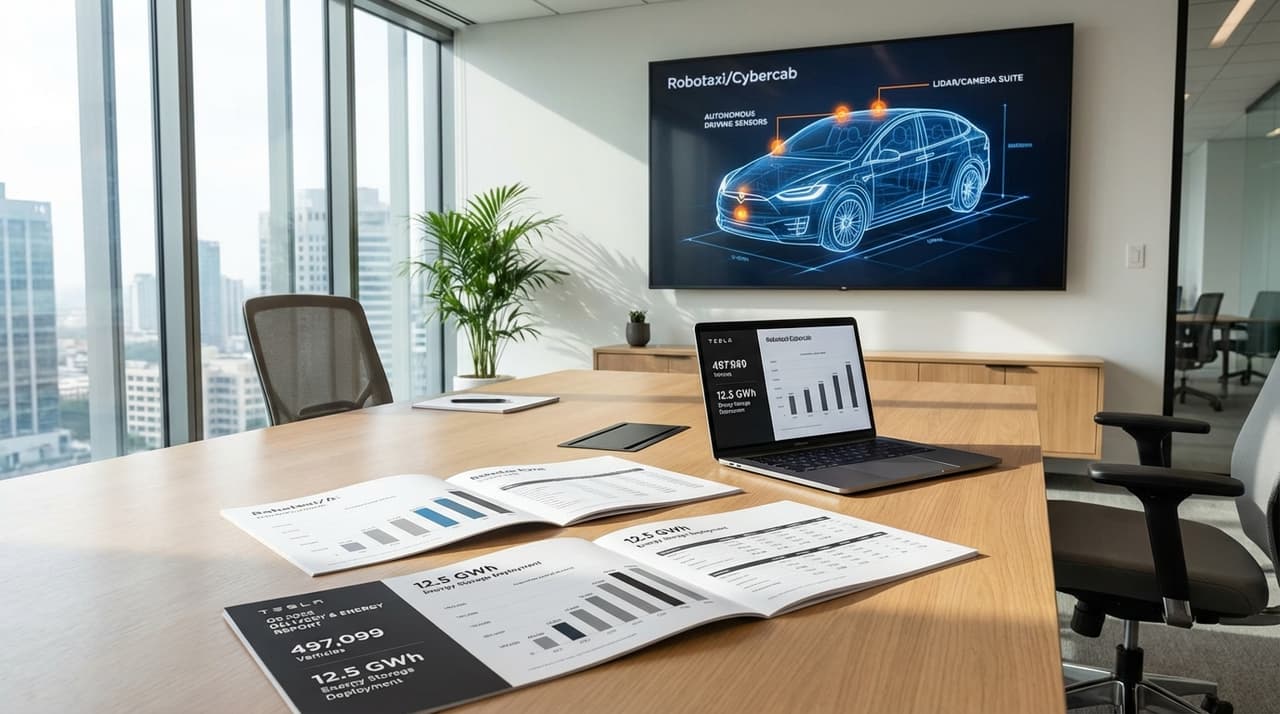
- Wedbush analyst Daniel Ives reaffirms an Outperform rating and $600 price target on Tesla (TSLA), framing 2026 as a "pivotal" year driven by autonomous driving, a U.S. Robotaxi/Cybercab rollout, and robotics/AI.
- Tesla's Q3 2025 results show record vehicle deliveries of 497,099 and energy storage deployments of 12.5 GWh, but operating income fell about 40% YoY to $1.6B amid margin pressure.
- The company's strategic shift toward AI, Full Self-Driving (FSD), and robotics is seen as a structural "game changer," with a Robotaxi launch in Austin expected to accelerate U.S. rollout and volume production of Cybercabs starting in April/May 2026.
Wedbush Securities analyst Daniel Ives has doubled down on his bullish stance for Tesla Inc., reiterating an Outperform rating and maintaining a $600 price target in a note to clients. Ives views 2026 as a critical inflection point for the electric-vehicle maker, with autonomous driving and robotics taking center stage in what he characterizes as a structural shift for Tesla's long-term story.
According to people familiar with the matter, Ives' analysis hinges on Tesla's progress in AI and its planned Robotaxi network, which he believes could redefine the company's valuation beyond traditional auto metrics. This comes as Tesla navigates a mixed financial landscape: its most recent quarter, Q3 2025, delivered record vehicle deliveries of 497,099 units and energy storage deployments of 12.5 gigawatt-hours, but operating income plummeted approximately 40% year-over-year to $1.6 billion, reflecting ongoing margin compression. Revenue grew 12% YoY to $28.1 billion, yet GAAP earnings per share settled around $0.39, below prior-year levels.
"We see 2026 as a pivotal year for Tesla and Elon Musk," Ives wrote, pointing to the autonomous driving and robotics initiatives as key drivers. He expects an accelerated U.S. rollout following a successful Robotaxi launch in Austin, with volume production of Cybercabs slated to begin in April or May 2026. Efforts to scale this business have gained momentum, though regulatory approvals remain a hurdle, according to sources close to the company. Without a broader regulatory green light, Tesla's ambitious timeline could face delays.
Tesla's leadership, led by CEO Elon Musk, has consistently emphasized AI, FSD, and the Optimus humanoid robot as central to future growth. On the Q3 earnings call, management highlighted these areas as long-term value drivers, even as near-term auto margins stay compressed. Musk has warned of "a few rough quarters" ahead, particularly after the expiration of U.S. federal EV tax credits on September 30, 2025, which pulled demand forward into Q3. This policy shift has sparked concerns about softer demand in Q4 and into 2026, adding volatility to the stock, which dipped 1–2% in after-hours trading post-earnings.
Industry watchers note that Tesla's cash position—with $41.6 billion in cash, equivalents, and investments at quarter-end—provides ample runway for investing in AI and Robotaxi development. Operating cash flow hit $6.2 billion in Q3, with free cash flow nearing $4 billion, underscoring the company's ability to fund these initiatives despite margin pressures. The energy segment, with over $3.4 billion in revenue and more than $1 billion in gross profit in some analyses, is emerging as a profitability stabilizer amid auto-sector headwinds.
Regulatory factors loom large. Musk has tied Tesla's growth to broad U.S. coverage for autonomous services, contingent on state and federal approvals. Any large-scale Robotaxi rollout will depend on evolving AV safety rules and liability frameworks, which vary by jurisdiction. Additionally, Musk has referenced an upcoming "AI5" inference chip that might face export controls, reflecting tightening U.S. restrictions on advanced AI hardware. These elements add layers of complexity to Tesla's roadmap.
In the broader market context, global EV growth has slowed, intensifying price competition and squeezing margins across the industry. Tesla's pivot toward software, Robotaxi networks, and energy storage aligns with a sector-wide trend of diversifying beyond hardware commoditization. Ives' $600 target essentially bets on Tesla evolving into a leading AI and autonomy platform, not just a cyclical automaker. As one industry insider put it, "It's a high-stakes wager on execution and regulatory tailwinds."
Looking ahead, short-term challenges include potential demand softness and sustained margin pressure, but the medium-term outlook hinges on Tesla's ability to scale Robotaxi deployment, boost FSD adoption, and commercialize robotics. If successful, these could tilt the business mix toward higher-margin software and services, supporting the upside embedded in Wedbush's price target. For now, investors are split between near-term concerns and long-term optimism, with 2026 poised as the year that could tip the scales.