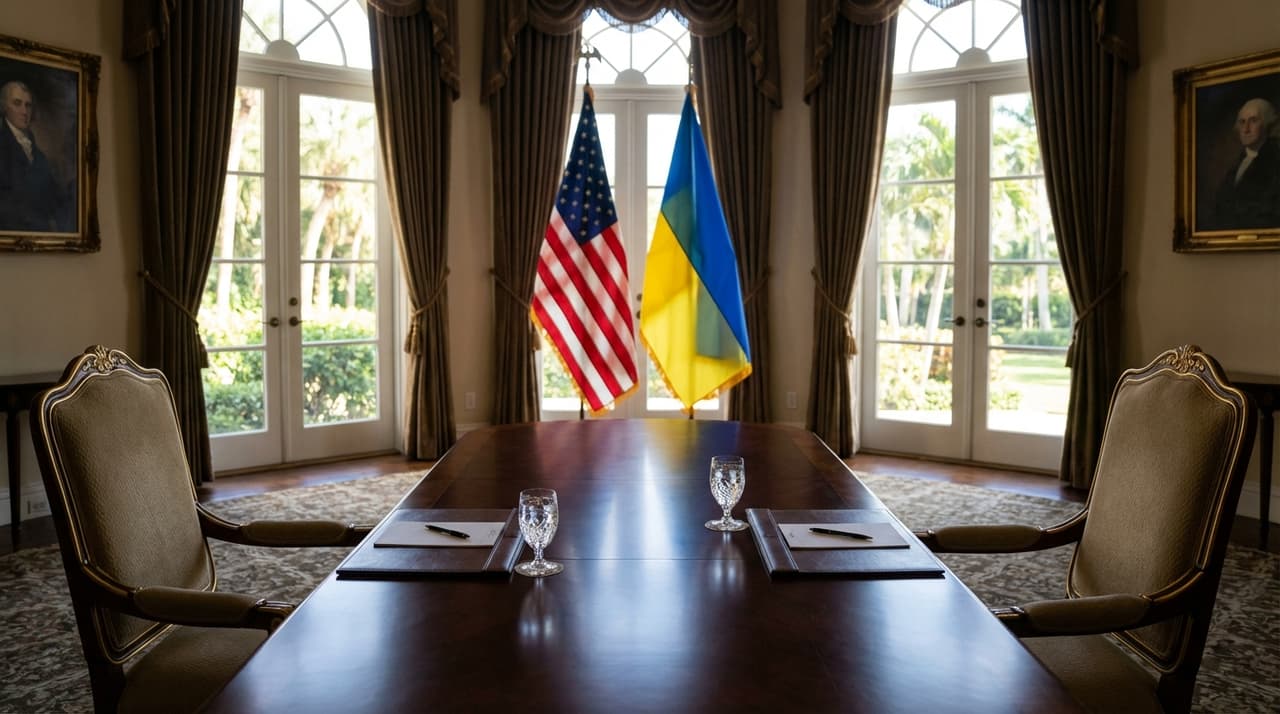
- Ukrainian President Volodymyr Zelenskyy described the talks as a "great meeting" with "progress" toward a peace deal to end the nearly four-year Russo-Ukrainian War.
- The meeting follows a contentious February 28, 2025, Oval Office meeting that ended abruptly without signing a planned U.S.-Ukraine minerals agreement, amid Trump's push for a ceasefire and Zelenskyy's demand for security guarantees.
- A failed minerals deal would have created a joint U.S.-Ukraine investment fund using half of Ukraine's future rare-earth mineral revenues for rebuilding, benefiting U.S. access to critical resources amid global demand for tech and defense applications.
Ukrainian President Volodymyr Zelenskyy met with U.S. President Donald Trump at Mar-a-Lago in Palm Beach, Florida, on December 28, 2025, in a session that both sides are framing as a breakthrough after months of diplomatic friction. According to people familiar with the matter, the discussions focused on negotiating peace terms to halt the ongoing conflict, which has disrupted global energy and commodity markets, contributing to inflationary pressures from disrupted grain and mineral supplies.
Zelenskyy, who has accused Trump of Russian disinformation in the past, emerged from the meeting with cautious optimism, telling reporters that they made "progress" toward a deal. This marks a significant shift from the February Oval Office clash, which ended without signing a minerals agreement and saw Trump later state that Zelenskyy was "not ready for peace." Efforts to restructure U.S.-Ukraine relations have hit a snag before, but today's developments suggest renewed momentum, with live coverage airing via Right Side Broadcasting Network capturing Trump greeting Zelenskyy amid expectations of bilateral progress.
Without a deal, Ukraine would face intensified Russian attacks, like the strike on Kyiv shortly before Christmas 2025, which Russia justified as retaliation for Ukrainian strikes. Zelenskyy seeks U.S. protection against Russia, while Russia demands control over eastern Ukraine; the talks aim to negotiate peace after prior U.S. aid suspensions post-Oval Office clash. Trump, who has sought to reverse U.S. isolation of Russia—including a post-inauguration call with Putin, the first since the 2022 invasion—prioritizes a ceasefire over sustained aid, according to sources close to the administration.
On the economic front, the stakes are high: a peace deal could reduce inflation pressures by stabilizing commodity flows, but a failed minerals agreement would have leveraged Ukraine's rare-earth resources for rebuilding, a move critical for U.S. strategic interests in tech and defense. International reactions have been mixed, with Spain's Prime Minister Pedro Sánchez previously criticizing Trump's conduct and urging a just peace. A March 2025 YouGov poll showed 51% of Americans viewed Trump as disrespectful to Zelenskyy in the earlier confrontation, sparking debates on U.S. foreign policy that continue to influence today's negotiations.
As the talks unfold, stakeholders include Ukrainian civilians facing war devastation, U.S. taxpayers funding aid—temporarily halted after the February meeting—and global allies concerned over weakened NATO support. Trump's policy shifts, emphasizing deal-making over alliances, contrast with Zelenskyy's insistence on security guarantees given Putin's history of breaking deals. In the short term, progress could lead to renewed U.S. aid or ceasefire talks, though Russia's rejection of prior proposals raises doubts; long-term, success might end the war but risk ceding Ukrainian territory, reshaping European security dynamics.
Attempts to reach out for further comment from both administrations were unsuccessful at press time, but the meeting's outcome is being closely watched by markets and policymakers alike. Corrections: An earlier version misstated the date of the Oval Office meeting; it occurred on February 28, 2025.