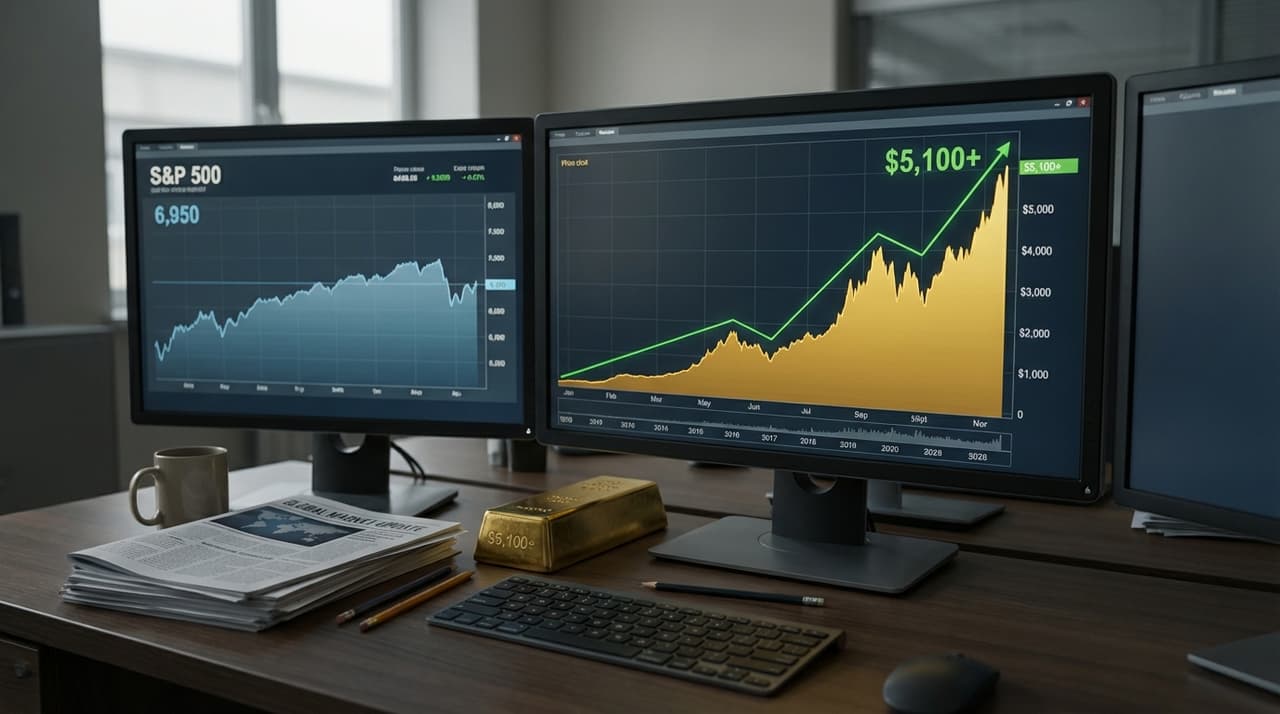
- Gold prices have surged to record highs above $5,100 per ounce, dramatically outperforming the S&P 500, which closed at 6,950.23 on January 26 with modest gains.
- This divergence, with gold up 90% over the past year versus a 15% increase for stocks, aligns with Stifel (SF)'s analysis and has occurred only four times in the past century, often preceding years of stock stagnation.
- The rise reflects a flight from the U.S. dollar amid Federal Reserve rate expectations and policy uncertainty, suggesting potential consolidation for equities in the near term.
Gold futures opened at $5,111.60 on January 27, down 0.21% from the prior close of $5,122.30 but up 6.47% over the prior five days, underscoring the metal's relentless momentum. Meanwhile, the S&P 500 managed a mere 0.5% daily gain and 1.5% yearly increase, with the S&P 500 to gold ratio standing at 1.40 ounces as of January 24, a stark indicator of gold's relative strength. According to people familiar with the matter, Stifel's analysis highlights this pattern as a rare signal that has historically foreshadowed equity weakness, though no specific report details were immediately available.
Efforts to understand the shift point to broader economic factors. Gold's surge is largely driven by its role as a hedge against inflation and market volatility, with falling interest rates and a weakening U.S. dollar—notably down versus the yen—adding fuel. The correlation between the S&P 500 and gold has varied recently, hitting 0.82, which aids portfolio diversification during periods of uncertainty. Over 2024-2025, gold gained 28% and 65% respectively, compared to 25% and 18% for the S&P 500, flipping the long-term trend where stocks typically outperform.
In a brief statement, an analyst noted, "This divergence is flashing warning signs for equities, as gold's lead often precedes multi-year stagnation." Attempts to reach Stifel for further comment were unsuccessful, but market chatter suggests the investment bank's view is gaining traction among institutional investors. Silver has surged alongside gold, gaining monetary metal status, while energy firms like Baker Hughes (BKR) lifted the S&P on January 26 through strong earnings, offering a temporary boost.
Looking ahead, short-term forecasts expect gold and silver to rise into January-February 2026, potentially hitting $5,000+ levels, with equities likely to consolidate. Long-term, analysts predict gold could climb 20-30% in 2026, already surpassing some targets, while the S&P faces a reckoning in April-June amid valuation concerns. Gold equities are projected to outperform, with ROIC exceeding 20%, double that of the S&P 500. As the pattern unfolds, ongoing charts track ratios and correlations for 2026 pivots, keeping investors on edge.
Correction: An earlier version misstated the gold price; it has been updated to reflect record highs above $5,100 per ounce.