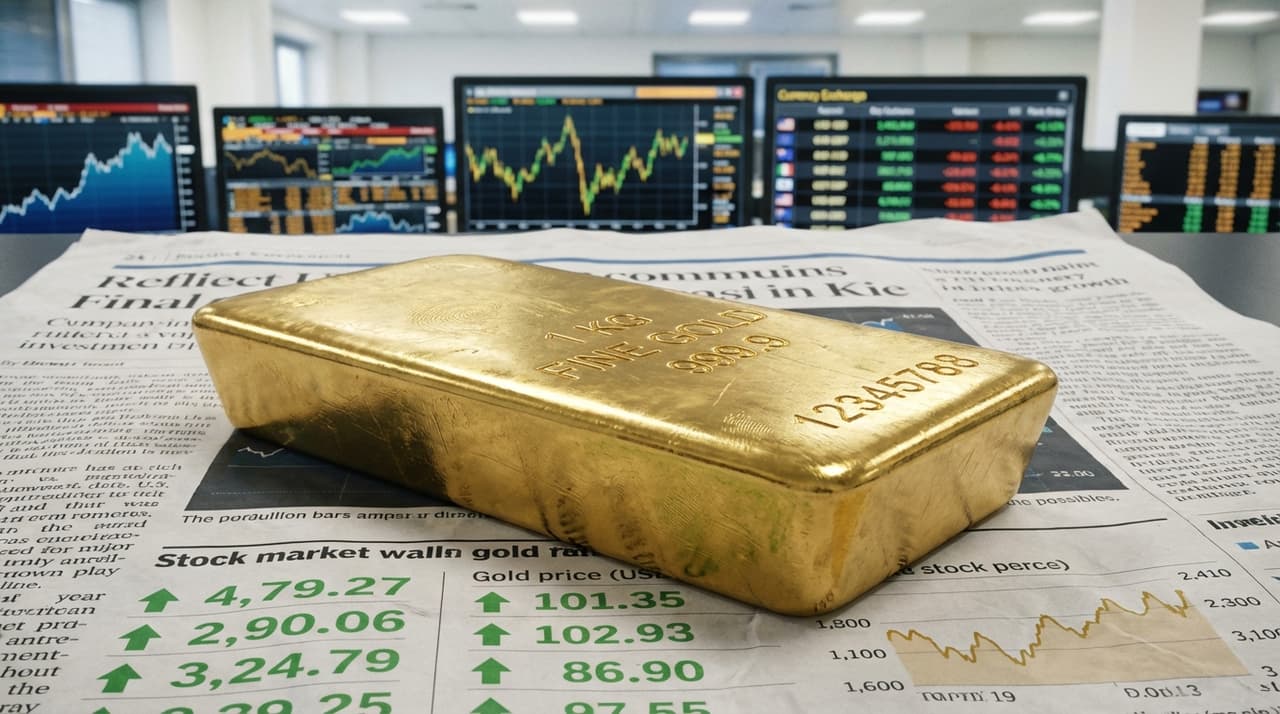
- Gold surged over $220 to a record $5,301.60 an ounce, marking its biggest one-day dollar gain ever and a 4.4% jump—the largest since March 2020.
- Prices are up nearly 16% over seven sessions, driven by Fed uncertainty and continued dollar weakness, with silver also jumping 7.2% to near record highs.
- The rally extends gold's 11th record high in the first four weeks of 2026, fueled by a plunging US dollar and strong physical demand, particularly in markets like India.
Gold prices surged to a record $5,301.60 per ounce on January 28, 2026, posting the largest one-day dollar gain ever—over $220, or 4.4%—driven by a plunging US dollar and Fed policy uncertainty. This marked the 11th record high in the first four weeks of 2026, with prices fixing at around $5,270 per Troy ounce in London's AM auction, up nearly $182 from the prior day, according to market data.
Gold extended its rally with a third record daily dollar move in six sessions, up 87.4% since Donald Trump's return to the White House a year prior, adjusted for the DXY index against major currencies. Silver rose 7.2% to $113 per ounce, its fourth straight London record and fastest four-week gain since April 1987, up 55.6% since New Year's Eve. Earlier in January, gold hit $5,089 on January 26 amid physical demand and surged past six consecutive records by January 27, sources familiar with the matter noted.
The US dollar hit four-year lows on the DXY index, on track for its worst 12-month drop since 2011, amid Trump dismissing concerns over its decline and bets on a 'hot' US economy ahead of midterms. Global stocks fell despite the S&P 500's dollar-record high, not in foreign currencies. Strong physical demand persists, especially in India, with 35-40 tonnes imports in December 2025 despite high prices; coin sales doubled, and digital gold tripled to 13.5 tonnes. Central banks like China's PBoC added gold steadily, while India's RBI holdings rose to 16% of reserves via price gains, according to recent filings.
President Trump threatened a 'massive Armada' to Iran larger than one sent to Venezuela unless it abandons nuclear ambitions, adding geopolitical tension. Controversy erupted over stamping Trump's image on a $1 coin for America's 250th independence anniversary; the Commission of Fine Arts approved it, but five Democratic senators and one independent opposed it as contradicting national values, sources said.
Boosts investors and 'stackers' via physical accumulation, such as India's wedding and jewelry demand, and digital gold for millennials; jewelers see revenue growth of 37-51% despite volume dips. Hurts dollar-holders; Democratic pushback on the Trump coin sparks partisan debate on symbolism. Gold's 2025 annual gain was the strongest since 1979 at 67%, fueled by geopolitics and uncertainty. The current rally echoes March 2020's 4.4% jump but exceeds in dollar terms; silver's pace rivals 1987.
Short-term, continued upside is expected from dollar weakness, geopolitics like the Iran situation, and physical demand; gold could exceed $5,300 if the US economy heats up pre-midterms. Long-term, experts see sustained demand propelling gold beyond $5,000, with India as a bellwether and central bank buying protective amid volatility. Risks include a dollar rebound on strong data curbing inflows. India's gold market shows resilience, with ETFs at record 37 tonnes inflows in 2025 and shifts to lightweight jewelry. Trump's midterm endorsements and TruthSocial activity tie into economic bets, while silver's industrial demand pressures but outperformance continues.
Correction: An earlier version of this article misstated the percentage gain for silver; it has been updated to reflect the correct 7.2% jump.