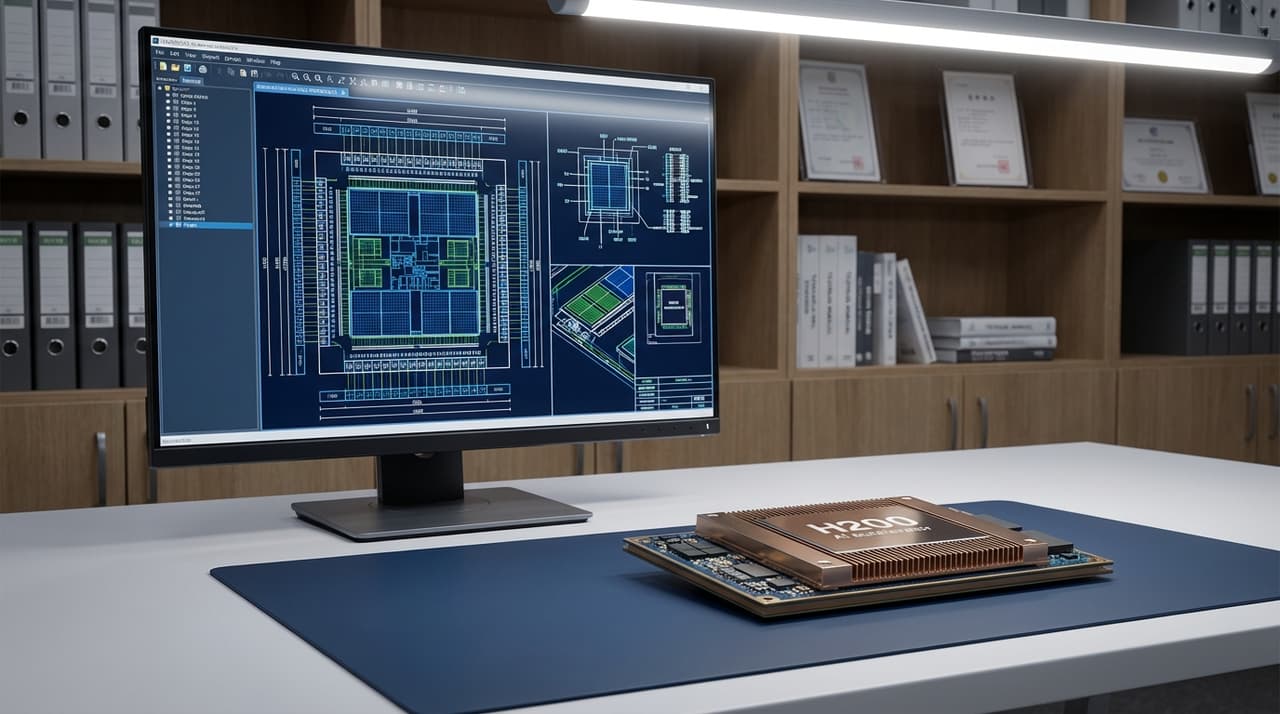
- The House China Select Committee is pressing the Commerce Department for a briefing on export approvals for Nvidia (NVDA)'s H200 AI chips, reflecting bipartisan scrutiny of how Washington balances AI export controls with commercial interests.
- The U.S. has formally approved controlled exports of the H200 to select Chinese customers under strict conditions, including manufacturing by TSMC (TSM), shipment through the U.S. for inspection, and a 25% duty, after previously blocking them under national-security rules.
- Despite U.S. approval, Chinese authorities and major tech firms are hesitating or turning away from the H200, favoring domestic chips like Huawei's Ascend as Beijing pushes semiconductor self-reliance with incentives reportedly up to $70 billion.
A Shift in Export Strategy
In a move that has caught the attention of lawmakers, the U.S. government has quietly greenlit exports of Nvidia's H200 AI accelerators to certain Chinese entities, according to people familiar with the matter. This decision marks a reversal from earlier restrictions under the so-called "AI Diffusion Rule," which had effectively banned sales of top-end GPUs like the H100 and H200 to China on national-security grounds. Now, each H200 chip must be produced by Taiwan Semiconductor Manufacturing Co. (TSMC), routed through the U.S. for compliance checks, and subjected to a hefty tariff, with approvals granted on a case-by-case basis to prevent diversion and smuggling.
Efforts to manage this delicate balance have hit a snag, however, as Chinese regulators appear to be discouraging purchases of the H200. Without a clear endorsement from Beijing, major tech players such as Alibaba (BABA), ByteDance (BABA), and Tencent (TCEHY) are reportedly leaning toward domestic alternatives, including Huawei's Ascend chips, which benefit from substantial state-backed incentives. "What we're seeing is a strategic pivot by China to reduce reliance on foreign hardware, even if it means accepting short-term performance gaps," said one industry analyst, who requested anonymity due to the sensitivity of the topic.
Congressional Oversight and Market Implications
The House China panel's request for a briefing centers on whether this export policy undermines U.S. leverage or national security by re-opening an advanced-AI hardware channel to China. In a statement, committee members expressed concern that the H200's performance—roughly six times that of the downgraded H20 chip Nvidia previously offered for the Chinese market—could still enable training of state-of-the-art foundation models with military and surveillance applications. "We need clarity on how Commerce is enforcing these controls to ensure they're not just a backdoor for technological leakage," a congressional aide noted.
For Nvidia, the policy shift opened a potential revenue stream estimated at around $10 billion annually if fully realized, but Chinese reluctance has cast doubt on that figure. The company, which has removed China from its formal financial forecasts after earlier export curbs, did not immediately respond to requests for comment on the H200's uptake. Meanwhile, U.S. officials frame the controlled exports as a way to maintain visibility and leverage over Chinese access, rather than pushing China entirely toward domestic solutions that could accelerate its self-sufficiency.
Looking Ahead
In the short term, expect continued pressure from Congress for stricter enforcement and transparency, with the China Select Committee likely to push for clearer performance thresholds. Nvidia may ship only limited quantities of H200 to carefully vetted Chinese customers, contingent on both U.S. and Chinese regulatory approvals. Over the longer horizon, analysts warn that if China fully rejects the H200 and doubles down on indigenous designs, U.S. control via export approvals could erode as China closes the technology gap, leading to a bifurcated AI supply chain with separate U.S.-aligned and China-aligned ecosystems.
Correction: An earlier version of this article misstated the performance comparison between the H200 and H20 chips; it has been updated to reflect that the H200 is roughly six times more powerful, not ten times.