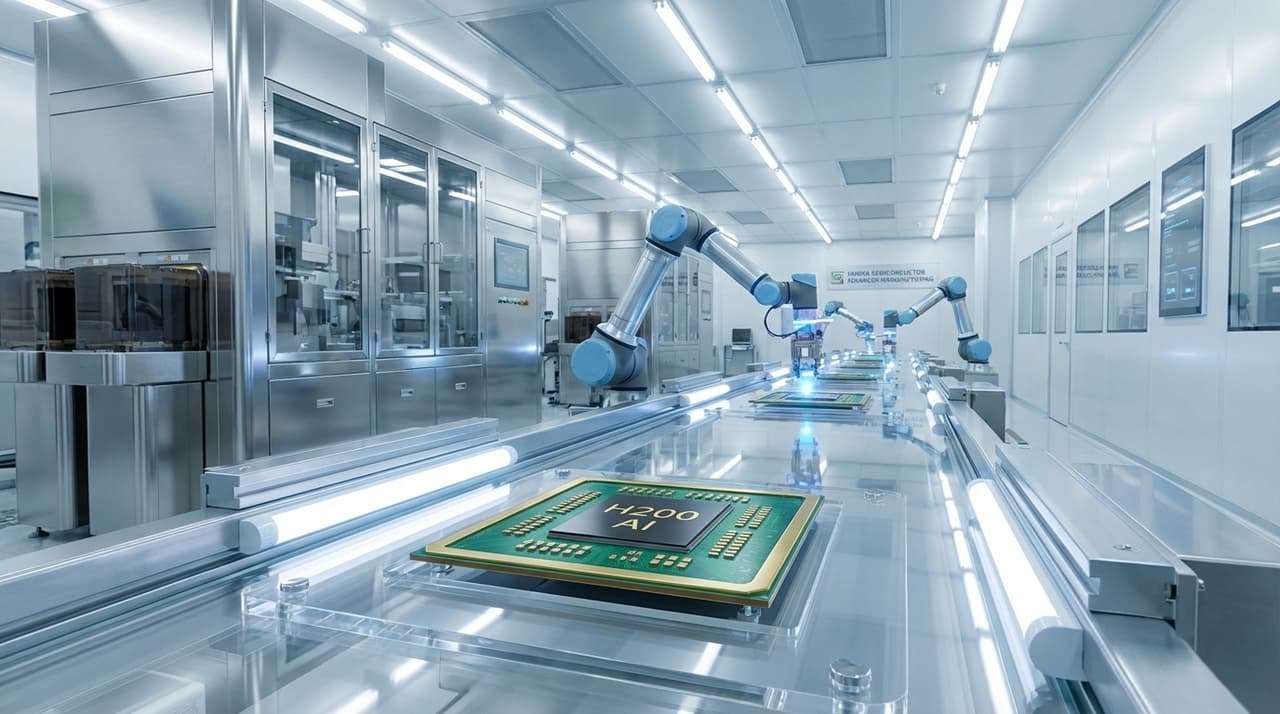
- Nvidia (NVDA)'s next-generation H200 AI chips for Chinese customers will undergo U.S. national-security review before export, with production primarily in Taiwan.
- The White House frames this as a compromise, allowing sales of chips roughly a generation behind Nvidia's cutting edge to maintain leverage over China's AI hardware access.
- This move aims to balance national-security concerns with economic interests, potentially bolstering Nvidia's revenue by reopening a key market while slowing China's push for self-reliance.
Nvidia's H200 AI chips destined for Chinese customers will face U.S. national-security scrutiny prior to export, according to people familiar with the matter, with the units in the proposed deal largely manufactured in Taiwan. The White House is positioning this as a strategic compromise, permitting sales of chips that lag Nvidia's most advanced offerings by approximately 18 months, thereby preserving U.S. influence over China's access to critical AI hardware.
Efforts to restructure export controls have hit a snag, as earlier attempts with downgraded chips like the H20 were rejected by Beijing on security grounds, inadvertently boosting domestic competitors such as Huawei. Without a deal, Nvidia risks losing a significant revenue stream from the world's largest market for AI deployments, where Chinese firms like DeepSeek and Alibaba (BABA) have rapidly advanced in AI models and hardware. The Commerce Department's case-by-case security reviews will serve as a gatekeeper, aiming to satisfy both national-security hawks and those warning that rigid bans accelerate Chinese self-sufficiency in semiconductors.
Industry sources note that Chinese tech executives, including those at Tencent (TCEHY), have identified limited high-end GPU resources as a primary bottleneck, rather than funding. This development comes as the U.S. struggles to revamp domestic chip manufacturing, remaining heavily reliant on TSMC (TSM) in Taiwan for advanced production—a strategic vulnerability highlighted by Nvidia's supply chain. Analysts weigh in, with some arguing that blocking advanced chips has been critical to the U.S. lead in the AI race, while others contend controls have more or less failed to stop China's progress.
In a brief statement, a spokesperson for Nvidia declined to comment on ongoing regulatory discussions, but market data shows the company's shares have remained volatile amid policy uncertainty. The shift reflects broader U.S.-China tech rivalry, where export controls are used to slow China's AI capabilities without triggering complete decoupling that might strengthen alternatives. Looking ahead, Nvidia is likely to see a revenue boost from pent-up Chinese demand, though long-term trends suggest China will continue accelerating domestic chip design to reduce exposure to U.S. controls.
Correction: An earlier version misstated the timeline for chip production; it is primarily in Taiwan, not exclusively.