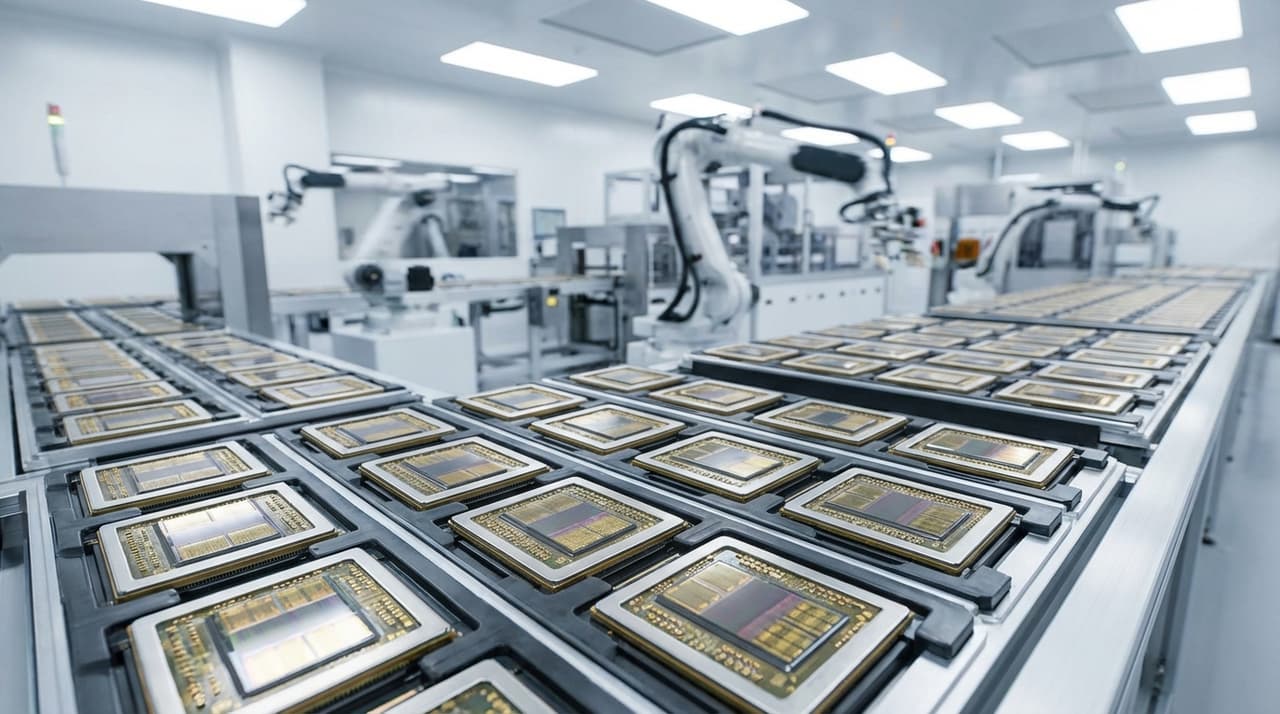
- NVIDIA (NVDA) shares rose premarket amid reports the company may increase output of its H200 AI chips for export to China.
- The move follows U.S. approval for H200 sales to China with a 25% fee, with strong demand persisting as Chinese processors lag significantly behind the H200.
- Limited current supply, due to NVIDIA prioritizing newer Blackwell and Rubin chips, may prompt the company to add capacity, according to people familiar with the matter.
NVIDIA traded slightly higher in premarket activity on Thursday after Reuters reported the semiconductor giant is considering expanding production of its H200 AI chips for the Chinese market. The company has notified Chinese clients of the potential capacity increase, sources said, following recent U.S. government approval for H200 exports to China subject to a 25% fee.
Efforts to meet robust Chinese demand have hit a snag as NVIDIA focuses on rolling out its next-generation Blackwell and Rubin chips, which has constrained Hopper-generation supply. Without a deal to boost output, the company could face missed opportunities in a key market where domestic alternatives remain inferior. "Chinese processors still lag the H200, driving strong demand despite interest in newer NVIDIA models," one analyst noted, speaking on condition of anonymity.
In a brief statement, NVIDIA declined to comment on specific production plans but acknowledged ongoing assessments of market needs. Attempts to reach Chinese clients for reaction were unsuccessful by press time. The H200, an upgraded version of the H100 using TSMC (TSM)'s 4nm process and released in March 2024, has become a critical tool for AI workloads, with projections showing 3.56 million Hopper chips like the H100/H200/H800 installed worldwide by the end of 2025.
Industry insiders point to global AI chip supply constraints that favor NVIDIA, with China estimated to produce just 1-4% of U.S. output in 2025 due to manufacturing bottlenecks. This gap boosts H200 demand, as no domestic match exists until Huawei (000725.SZ)'s potential chip in Q4 2027 at the earliest. Meanwhile, NVIDIA produced 3.5 million Hopper chips in 2024, including approximately 1 million H20s, and its 2025 output includes around 460,000 H20s and 160,000 H100/H200s, according to recent data.
The political context adds complexity: U.S. export controls approved H200 sales with the fee, but critics argue it adds to China's AI compute capacity, potentially shrinking the U.S. advantage from 21-49 times to 4-1.3 times by 2026 without stricter limits. This has sparked debate, with some analysts publicly calling the policy a "mistake" for national security. In response, Beijing has restricted U.S. imports for critical infrastructure to favor domestic products, though the H200's performance edge keeps it in demand.
Looking ahead, expanded H200 output could meet Chinese demand and sustain NVIDIA revenue in the short term, but long-term risks include eroding the U.S. AI edge if exports scale significantly. The H200 is expected to remain viable through 2026, filling a high-end gap as Chinese companies like Huawei work to catch up. As one market watcher put it, "It's a balancing act between commercial gains and strategic concerns."