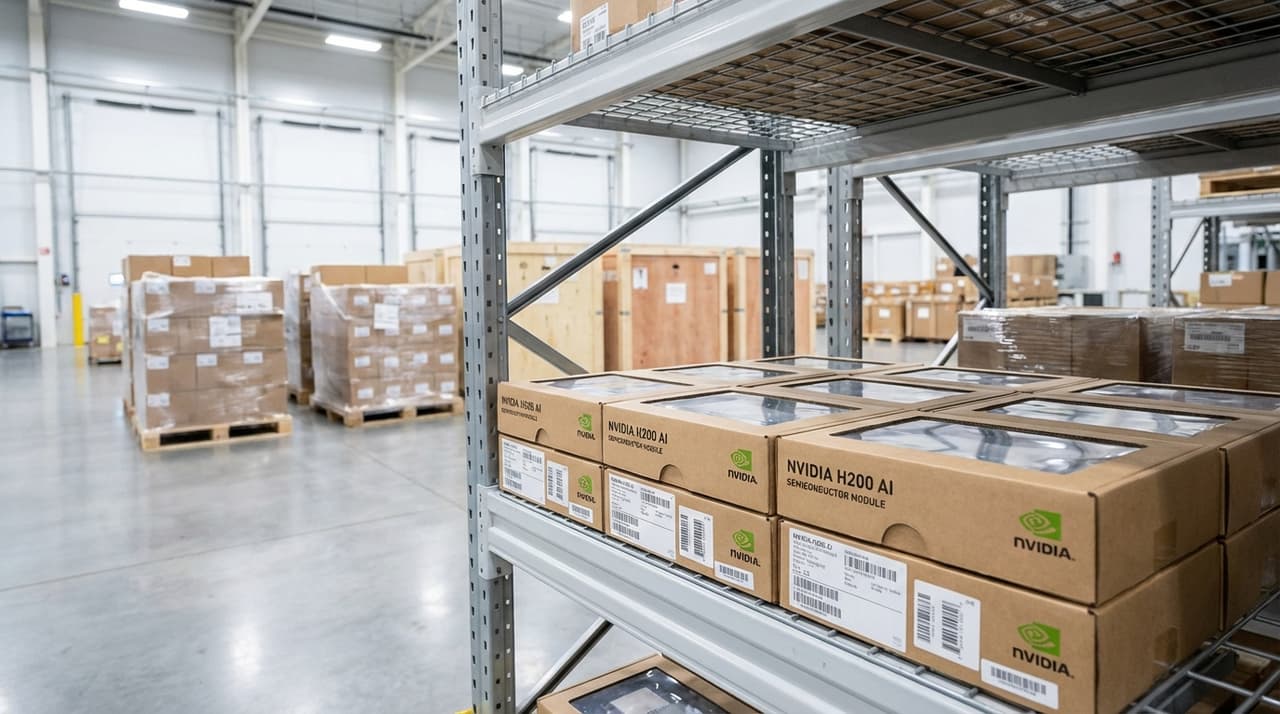
- NVIDIA (NVDA) plans to ship 5,000-10,000 H200 AI chip modules to China from existing inventory before the Lunar New Year in mid-February 2026, contingent on Chinese government approval.
- The move follows a U.S. policy shift under President Trump that reversed prior bans, allowing H200 sales with a 25% fee, though an inter-agency review is underway and could delay or block shipments.
- This development eases NVIDIA's lost revenue in China, estimated at around 20% of prior sales, amid surging global AI chip demand and competition from rivals like Huawei and AMD (AMD).
NVIDIA has informed Chinese clients of its intention to restart shipments of its H200 AI chips, targeting a timeline just ahead of the Lunar New Year festivities in mid-February 2026, according to people familiar with the matter. Initial deliveries would draw from current inventory, with plans to ramp up production from 2026 onward. However, the effort hinges on approval from Chinese authorities, which has not yet been secured, adding uncertainty to the rollout.
The potential resumption comes after the Trump administration eased export curbs on advanced AI processors, reversing Biden-era restrictions that had barred such sales over national security concerns. Under the new policy, H200 chips—NVIDIA's second-most powerful AI accelerators—can be sold to China with a 25% fee attached. A U.S. inter-agency review involving the Commerce, State, Energy, and Defense Departments is now in progress, with a final decision expected from President Trump after a 30-day assessment period. White House officials have emphasized maintaining "American tech stack dominance" without compromising security, but critics like former Biden administration adviser Chris McGuire argue that allowing H200 exports represents a "significant strategic mistake" that could aid China's military and AI advancements.
In recent quarters, NVIDIA's financial performance has been robust, with Q3 FY2026 revenue hitting record highs driven by a data center segment that surged over 100% year-over-year, despite earlier China restrictions. The company, led by CEO Jensen Huang, has focused on expanding AI chip production to meet global hyperscaler demand. If shipments proceed, they could bolster NVIDIA's position in a key market while countering rising competition from domestic Chinese players like Huawei, which has accelerated its own AI chip development in response to U.S. bans.
On the Chinese side, Beijing has signaled plans to limit access to advanced NVIDIA chips, even as it weighs approval for the H200 shipments. The dynamic reflects ongoing strains in U.S.-China tech decoupling, with both nations implementing reciprocal export controls. Industry observers note that partnerships and "China-special" compliant chips are becoming more common, but the H200 move marks the first major AI chip concession since the 2024 approval of downgraded H20 chips for the Chinese market.
Efforts to reach NVIDIA for additional comment were not immediately successful, but sources indicate that the company is preparing for potential delays due to the thorough U.S. review process. Market analysts suggest that high demand in China could spur increased H200 output in the long term, though experts remain split on whether this will slow Chinese innovation or pose strategic risks for the United States. As negotiations and reviews continue, stakeholders from U.S. shareholders to Chinese hyperscalers are closely watching for updates that could reshape the competitive landscape in the semiconductor industry.