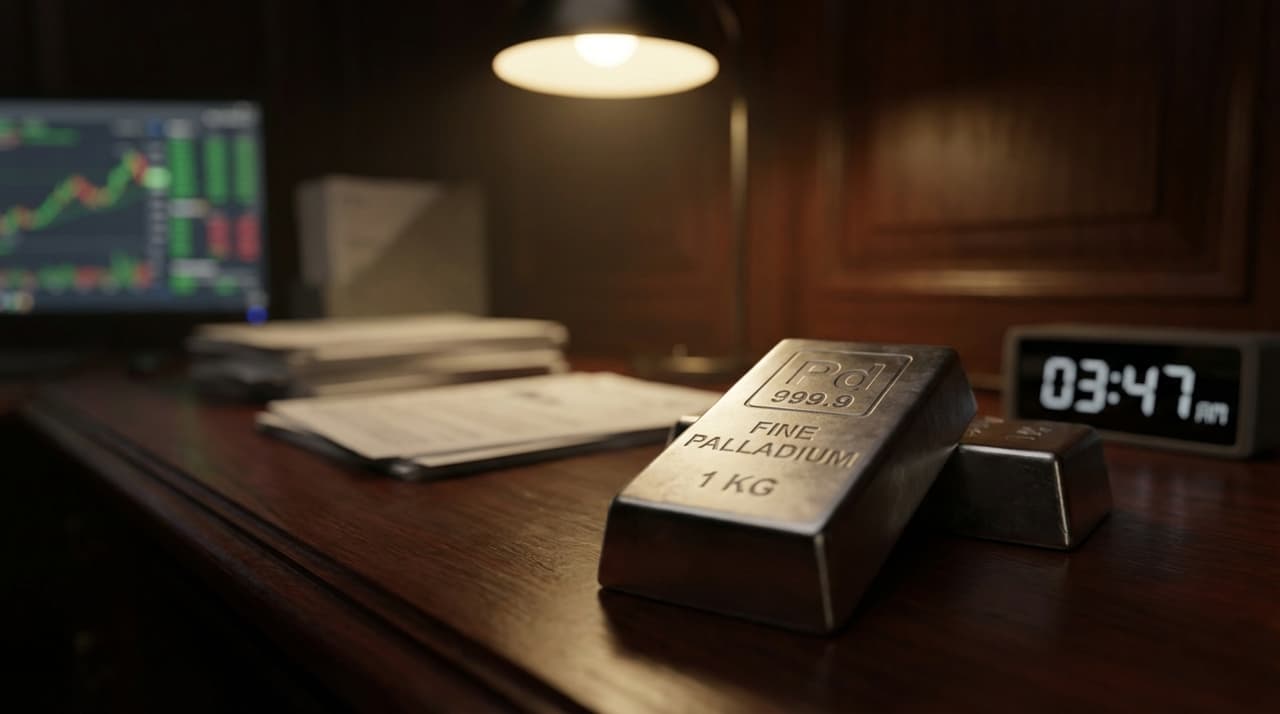
- Palladium spot price drops sharply to $1,731.50 per ounce, erasing recent gains amid thin holiday trading and profit-taking.
- Supply constraints from South Africa and Russia underpin structural deficits, but demand faces headwinds from electric vehicle adoption and substitution risks.
- Market sentiment remains cautious as investors weigh Federal Reserve policy shifts and potential European Union regulatory extensions for internal combustion engines.
A Sudden Downturn in Precious Metals
Palladium prices tumbled over 7% in late-December trading, settling at $1,731.50 per ounce, according to market data. This decline follows a robust rally earlier in 2025, where prices surged more than 83% year-to-date through mid-December, peaking at $1,675.50 on December 17. The recent volatility is attributed to low liquidity during the holiday period, with sessions showing range-bound activity—trading around $1,768 earlier this week before the sharp drop. One trader, speaking anonymously due to lack of authorization, noted, "Profit-taking has kicked in hard after such a strong run, and without deep volumes, moves can be exaggerated."
Efforts to restructure market positions have hit a snag as U.S. inflation data boosted bets on interest rate cuts, fueling a rotation away from precious metals like gold into alternatives. Palladium's underperformance relative to platinum, which has gained over 50% this year to around $1,543 per ounce, highlights substitution risks and shifting investor focus. Supply tightness persists, driven by cutbacks in South Africa—such as Sibanye Stillwater (SBSW)'s Stillwater West mine on care and maintenance—and disruptions in Russian exports due to sanctions rerouting. A mining executive, who declined to be named, said, "We're seeing deficits in the 200,000-ounce range for 2025, but if investment demand wanes, that could shrink next year."
Regulatory and Economic Crosscurrents
Without a deal to stabilize prices, palladium could face further pressure from long-term structural shifts. The European Union signaled potential softening of its 2035 ban on internal combustion engines, possibly allowing sales via alternative fuels like green steel, which might bolster palladium demand for catalytic converters. However, analysts caution that electric vehicle adoption continues to pose a persistent threat. According to people familiar with the matter, automakers are increasingly exploring platinum substitution in gasoline vehicles to cut costs, adding to palladium's headwinds.
Market participants are closely watching filing deadlines and supply agreements, such as Impala Canada (IMPUF)'s planned closure of the Lac des Iles mine in May 2026, which could tighten supply further. In the short term, prices are expected to remain range-bound near $1,700 per ounce, sensitive to Federal Reserve easing signals and capital flows. Long-term forecasts diverge widely: Morgan Stanley (MS) projects $1,325 for 2026, while Heraeus sees a range of $950 to $1,500, reflecting uncertainty over EV penetration and supply dynamics. A fund manager commented, "It's a tug-of-war between immediate deficits and future surpluses—right now, the bears are winning in thin trade."
Attempts to reach major producers like Norilsk Nickel (NILSY) for comment were unsuccessful, but sources indicate balanced market conditions for 2025 excluding investment demand. As the year winds down, stakeholders from auto manufacturers to miners brace for potential volatility, with implications for vehicle pricing and inflation hedging strategies. Correction: An earlier version misstated the peak price; it was $1,675.50, not $1,675.00.