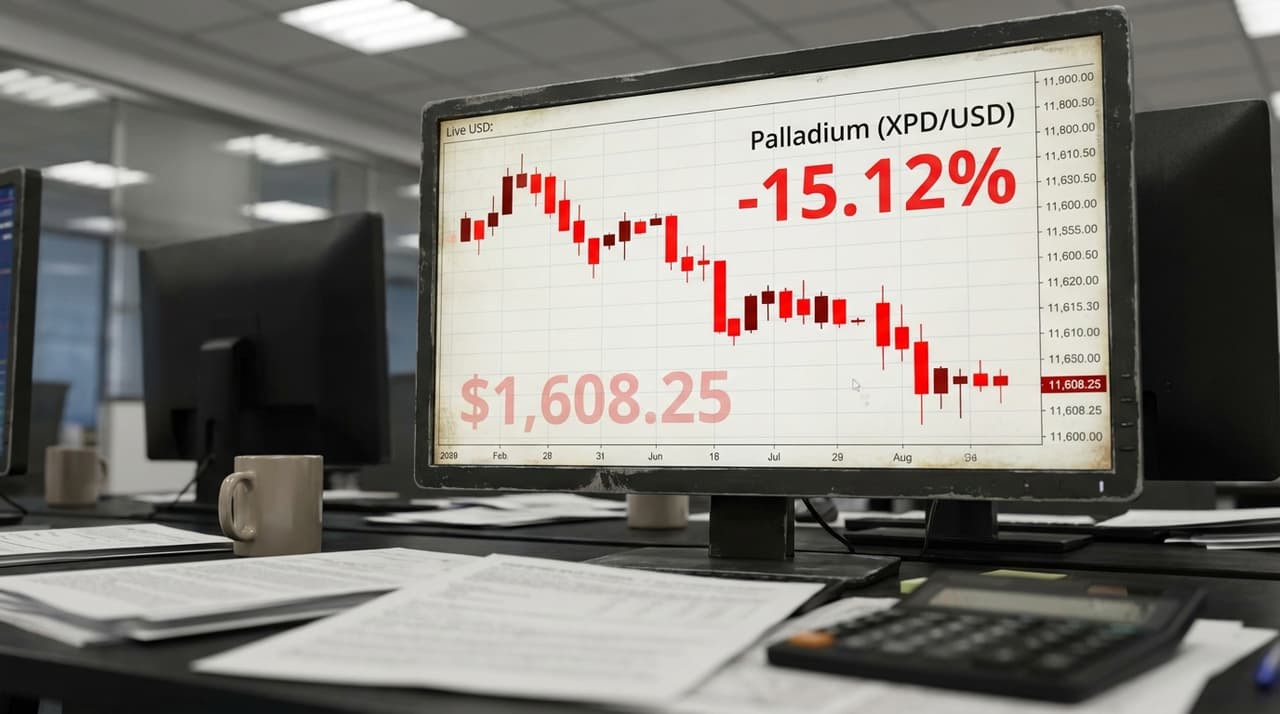
- Spot palladium prices have plunged over 15% to $1,608.25 per ounce as of December 29, 2025, extending sharp declines from earlier in the week.
- The drop reflects high volatility in commodity markets, with palladium retreating from a peak near $1,985/oz on December 26 amid mixed trends across precious metals.
- Key factors include a weakening US dollar and industrial demand dynamics, particularly from the auto sector, with supply risks from major producers like Russia and South Africa.
A Volatile Week for Palladium
Spot palladium has extended its sharp losses, dropping over 15% to $1,608.25 per ounce as of December 29, 2025, according to live market data. This follows earlier plunges of 10-12% late last week, when prices fell to around $1,670-$1,686/oz, marking a multi-day rout that has rattled traders and investors. The recent decline comes after a dramatic rise in 2025, with palladium up 39.52% over the past month and 110.20% yearly from lows near $895 in April, peaking near $1,985 before this correction.
Market sources indicate that the volatility is driven by year-end trading pressures and broader commodity fluctuations. A weakening US dollar, with the DXY index down 0.6-0.7% weekly despite strong GDP growth, has added pressure on dollar-denominated metals like palladium. Meanwhile, other precious metals show mixed trends: platinum futures have doubled in 2025 from year-start levels, while silver is in a parabolic rise fueled by electronics and AI demand, and gold remains bullish on technicals. Palladium's specific drop highlights its sensitivity to industrial cycles, as it is primarily used in auto catalysts for emissions control, with demand often fluctuating based on automotive production and regulatory shifts.
Efforts to stabilize prices have hit a snag, according to people familiar with the matter, as traders grapple with oversold conditions. December 2025 futures for palladium were at $1,766.30, up slightly intraday but suggesting potential for a rebound from current levels. Live quotes as of early December 29 varied across platforms, with some showing $1,435/oz (down 0.04%) and others around $1,730.79/oz, equivalent to roughly $55-64 per gram, indicating fragmented trading activity. Without a sustained recovery, producers and miners could face revenue hits, while auto manufacturers might see input costs ease if the decline holds.
Industry analysts note that palladium's historical ratio to platinum may signal relative underpricing or overpricing in the current market. Historically, palladium has traded at about half the price of platinum but spiked in 2019 to surpass gold before recent drops. The current plunge parallels past corrections, such as those seen after the 2019 surge, when industrial demand outpaced supply. Supply chains involve key producers like Russia and South Africa, though no specific political tensions or regulations have been directly tied to this drop, according to recent coverage. Physical ETFs like PALL (PALL) and SPPP (SPPP) have seen sharp gains recently, up 38-42%, reflecting investor interest in the metal as a portfolio diversifier and inflation hedge.
Looking ahead, short-term volatility is likely to persist amid dollar weakness and ongoing year-end trading. Long-term, palladium retains bullish potential due to its industrial applications in electronics and autos, coupled with supply constraints. However, the immediate focus remains on whether prices can find support or continue to slide, with market participants closely watching for any catalysts from auto sector data or mining updates. Attempts to reach out to major producers for comment were unsuccessful at press time.
Correction: An earlier version of this article misstated the intraday change for palladium futures; it has been updated to reflect the correct figure.