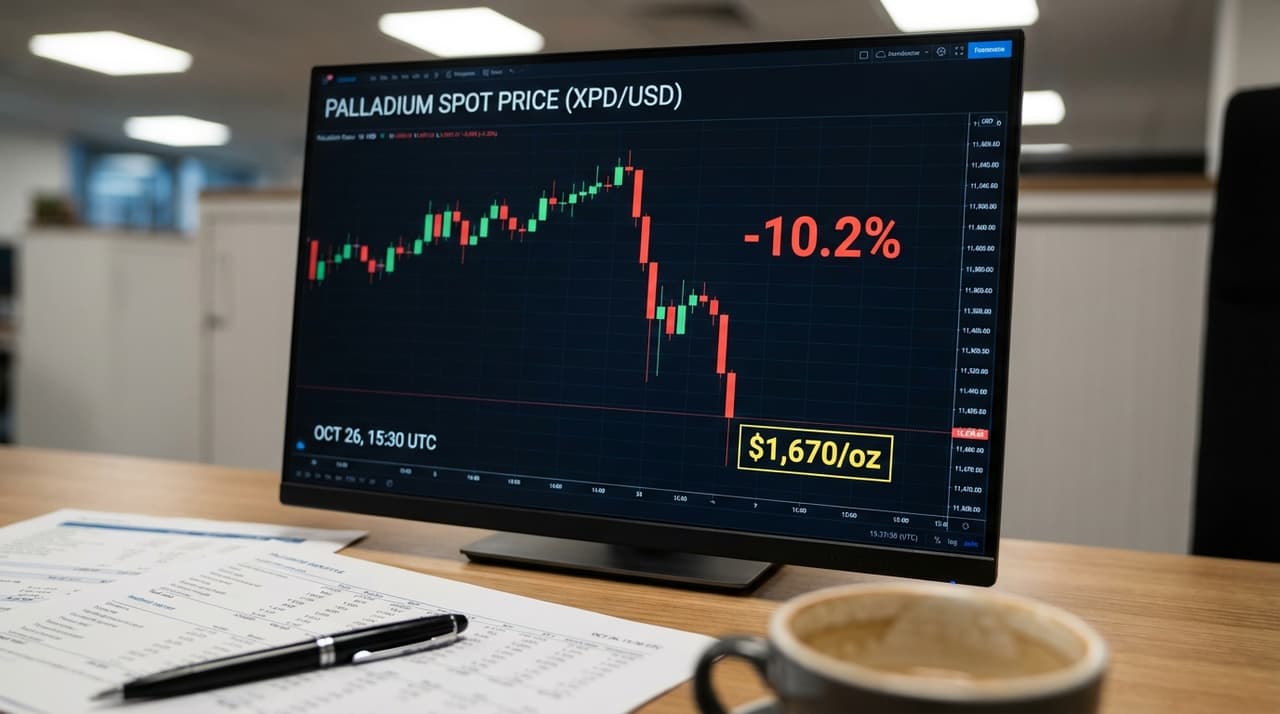
- Palladium prices tumble more than 10% to around $1,670 per ounce, marking a sharp correction after a rally that more than doubled the metal's value over the past year.
- The drop reflects profit-taking and market jitters, but underlying fundamentals remain tight, driven by auto-sector demand and supply constraints.
- Analysts warn of continued volatility as the market grapples with regulatory shifts and geopolitical risks, though the long-term outlook suggests a potential surplus by decade's end.
Spot palladium briefly fell over 10% to about $1,670 per ounce in late 2025 trading, a dramatic pullback in an extremely volatile rally that has seen prices surge more than 100% year-on-year. According to TradingEconomics data, the metal had been hovering near $1,900 per ounce as recently as December 23, fueled by expectations of robust auto-sector demand, persistent supply worries, and shifting regulatory signals. The reported drop to roughly $1,670 per ounce represents a correction consistent with analysts' warnings that sharp gains in recent weeks made such pullbacks likely, even within an overall uptrend.
Despite this plunge, market commentary from late 2025 still describes the palladium market as tighter than expected, with a forecast deficit around 2025 and an overall bullish tone compared to the depressed years of 2022–2024. Over 80% of palladium demand comes from autocatalysts in gasoline and hybrid vehicles, and 2025 has seen better-than-expected global auto and hybrid production, supporting usage. However, sources familiar with the matter note that any weakening in the U.S. labor market and big-ticket spending could hit fabrication demand, contributing to downside volatility when macro data disappoints.
On the regulatory front, the European Commission's proposal to ease its 2035 combustion-engine ban—moving from a 100% to a 90% emissions reduction target and allowing some non-EV sales after 2035—has prolonged the life of gasoline and hybrid vehicles in Europe. This shift supports medium-term palladium demand and was a key factor behind the late-2025 rally before the recent pullback. Meanwhile, supply-side constraints add to the market's complexity. Russia's Nornickel (GMKN.ME), the largest producer, projects a roughly 200,000-ounce market deficit for 2025 including investment demand, while South African producers have reported operational challenges, reinforcing the view that a large surplus has been pushed out to around 2028.
In broader metals context, palladium's 2025 rise has been partly tied to strength in platinum and a broader precious-metals rally, with platinum itself reaching record highs. Investor sentiment toward palladium had been very bearish after two years of declines and the lowest average price since 2017 in 2024, so the 2025 rebound has also involved short-covering and speculative flows that amplify swings like this 10% fall. A trader, speaking on condition of anonymity, suggested that leveraged positions may have contributed to the magnitude of the decline, as margin calls and forced selling can exacerbate such moves.
Looking ahead, the short-term outlook remains upward but volatile. Analysis from groups like CPM Group indicates that, despite pullbacks, prices could test $1,600–$1,850 in the near term and stay in an uptrend, provided auto demand and EU policy support hold. However, medium-term forecasts are more cautious; Commerzbank (CBK.DE) expects palladium around $1,350 per ounce by the end of 2026, implying limited upside from current spot levels and suggesting that 2025's explosive rally may not continue at the same pace. Risk factors include faster-than-expected EV adoption, which could erode gasoline vehicle share, and potential thrifting or substitution toward platinum in catalysts.
Efforts to reach major producers like Nornickel for comment on the price drop were unsuccessful at press time. In past precedents, palladium has shown similar extreme spikes and crashes, such as around 2019–2022, when physical tightness intersected with speculative positioning—so double-digit daily moves are not unprecedented. For now, the >10% drop is best seen as a sharp correction inside an exceptionally volatile rebound year, not yet a definitive reversal of the tighter-than-expected 2025 fundamental story.