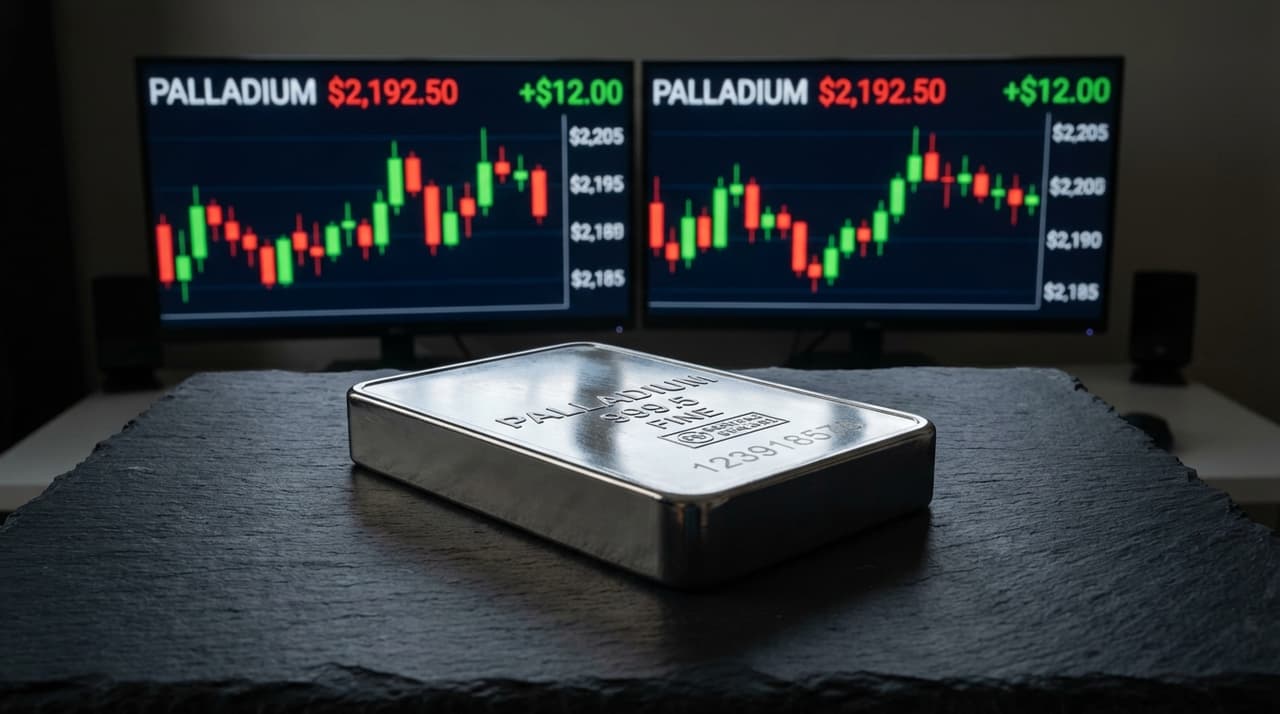
- Spot palladium prices fell sharply, dropping about 8% in recent trading after hitting a three-year high above $2,190 per ounce earlier in the week.
- The decline is attributed to profit-taking by institutional investors and cooling technical momentum, following a volatile rally driven by supply concerns and geopolitical tensions.
- Despite the pullback, palladium remains up 23% monthly as of late January, supported by broader precious metals strength and ongoing supply constraints.
A Volatile Week for Palladium
Spot palladium prices tumbled in late January, with a roughly 8% drop in recent trading sessions after briefly surging past $2,190 per ounce—a level not seen in three years. The reversal comes amid profit-taking by institutional investors and a cooling of technical momentum, according to market analysts. Earlier in the week, prices had rallied over 12% to around $1,920 in futures, aligning with the headline's reported decline, before recovering somewhat to $2,124.50 by January 29, still up 3.86% daily but down from recent peaks.
Efforts to sustain the rally have hit a snag as traders lock in gains, with one source familiar with the matter noting that "the market got ahead of itself, and now we're seeing a natural correction." The pullback reflects broader volatility in precious metals, with palladium posting a 108% year-over-year gain as of January 29, though monthly gains of 25% have been offset by sharp corrections.
Supply and Demand Dynamics
Supply constraints are providing underlying support, with declines in Canadian output from the Las Des Illes mine closure in May 2026 and slower South African growth as miners shift from palladium-rich ores. Persistent tightness persists despite rising Russian production, fueling physical buying by automakers hedging first-quarter needs, particularly amid China's export controls. On the demand side, automotive sector shifts toward electric vehicles are pressuring prices downward by reducing catalytic converter use, though industrial hedging is countering this trend.
Market shifts include a broader platinum-group metals rally driven by U.S. inventory hoarding, Chinese jewelry demand, and substitution from high gold prices. Without a deal to stabilize supply, prices could face further volatility, impacting end-users reliant on palladium for emissions control. Attempts to reach major miners for comment were unsuccessful, but industry insiders suggest aggressive hedging is underway to manage costs.
Geopolitical and Economic Factors
Political context adds to the uncertainty, with U.S. tariffs on Canadian trade—potentially reaching 100% if Canada deals with China—and anti-dumping probes on Russian palladium, estimated at an 828% dumping margin, spiking concerns. These factors boosted prices before the recent pullback and have drawn U.S. inventories higher via exchange-for-physical swaps. No direct international escalations are reported beyond these trade frictions, but the situation remains fluid.
Societal impact includes higher volatility squeezing automotive manufacturers, prompting potential cost pass-throughs to consumers. Investors benefit from gains but face correction risks, while miners in South Africa and Canada see mixed effects from supply cuts. Historical context shows palladium surged 82% in 2025 from low bases, the weakest among precious metals but still marking a recovery from prior declines tied to EV shifts. Recent patterns echo 2022-2023 corrections after 2021 peaks, driven by auto demand drops.
Outlook and Implications
Short-term, elevated but volatile prices are likely, with pullbacks from speculative peaks; Bank of America raised its 2026 average forecast to $1,725 per ounce from $1,525, citing deficits, tariffs, and China demand, and expects platinum to outperform. Long-term forecasts diverge, ranging from $1,262 to $2,700 per ounce for 2026, supported by mine closures but capped by global production growth and auto transitions. Monex sees higher levels than early 2025 but no sharp rises without fundamentals improvement.
Related developments include platinum prices also volatile, up to $2,785 per ounce on January 29 with a 194% year-over-year gain, and broader PGMs anchored by gold at record highs. Parallels can be drawn to Russian supply probes echoing U.S. actions on other metals and Canadian tariff threats mirroring aluminum and steel frictions. As negotiations continue, market watchers are closely monitoring for updates that could sway prices further.