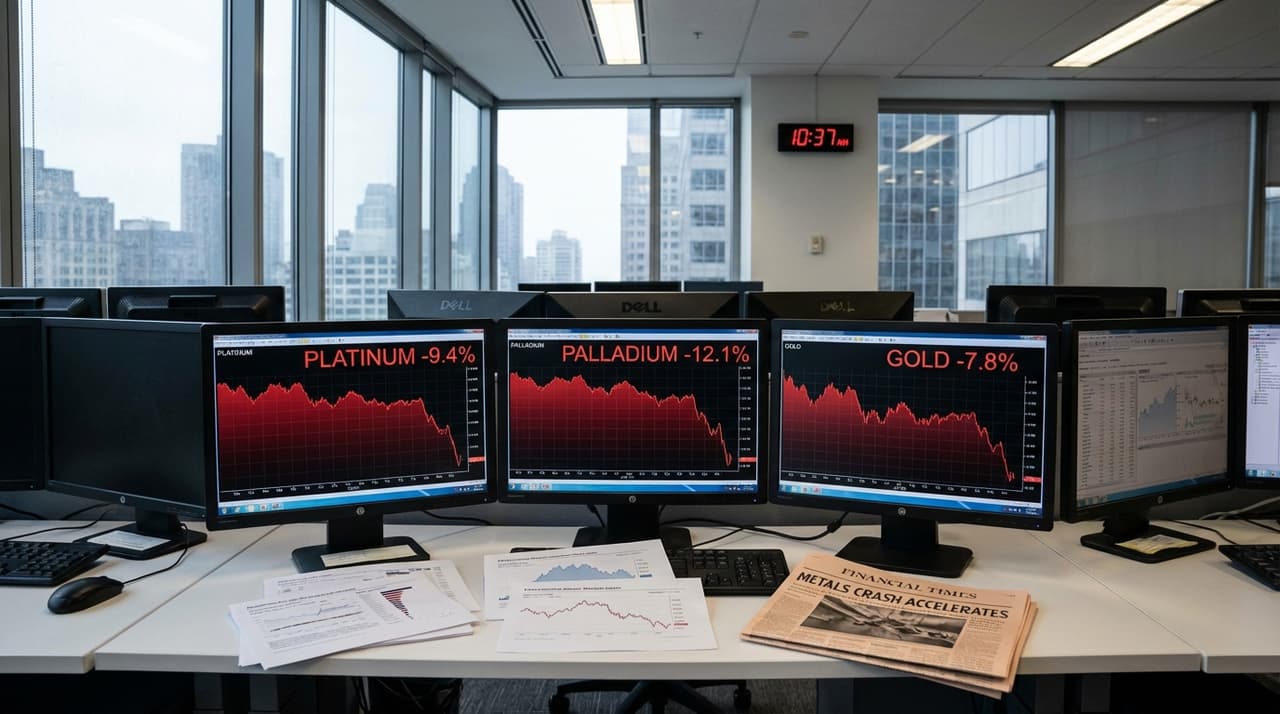
- Platinum and palladium lead declines with drops exceeding 15%, while gold extends losses from recent peaks.
- The sell-off follows a record-breaking January rally driven by safe-haven demand and geopolitical tensions.
- Analysts attribute the volatility to profit-taking, a firmer U.S. dollar, and uncertainty over Federal Reserve policy.
Precious metals prices crashed on January 30, 2026, with platinum falling over 19% to $2,126.04 per ounce and palladium dropping more than 16% to $2,041.35 per ounce, according to real-time market data. Gold further extended declines, last down 11% at $4,786.85 per ounce, reflecting a broad-based retreat after January's strong gains amid heightened volatility.
Prices plummeted following record highs driven by safe-haven demand, with gold hitting nearly $5,600 per ounce on Thursday due to U.S.-Iran tensions and a weaker dollar, before retreating as markets digested profit-taking and a firmer dollar. Platinum fell from $2,785.87 per ounce yesterday despite a 137% yearly rise, while palladium retreated from three-year highs around $2,190 per ounce. Intraday fluctuations show prices stabilizing somewhat by mid-morning ET, but they remain down significantly from peaks, according to traders familiar with the matter.
Efforts to sustain the rally have hit a snag, with a stronger U.S. dollar and profit-taking after January rallies—gold surged 20-92%, platinum 11-195%, and palladium 74-75% yearly—pressuring prices. Uncertainty over U.S. fiscal health, interest rates, and Fed policy added to the downward momentum. South African supply disruptions earlier boosted prices, but abundant above-ground stocks now limit upside; industrial demand, such as for auto catalysts with platinum and palladium, ties these metals to broader economic shifts. Broader commodity trends show debasement trades pushing highs, but sell-offs reflect cooling momentum, analysts noted.
Geopolitical tensions, including U.S. plans for Iran attacks, fueled recent safe-haven buying, while President Trump's Friday announcement of his Federal Reserve chair pick adds uncertainty to monetary policy. Potential Section 232 tariffs risk tightening platinum-group metals supply from sources like Russia and China, though they are not expected to materialize soon, contributing to late-January volatility.
Miners in South Africa face production pressures from prior disruptions amid falling prices, potentially affecting jobs; investors see losses on leveraged positions after rallies, but long-term holders benefit from yearly gains. Industrial users, such as automakers relying on palladium for catalysts, gain from lower costs, easing inflation in manufacturing. No major public reactions have been noted yet.
Precious metals surged in January 2026—unmatched since 2008—due to inflation hedges, dollar weakness, and supply issues, echoing 2008 when platinum peaked above $2,100 per ounce before crashing to $800 per ounce on liquidations. Similar profit-taking followed 2025 gains, with platinum up 77% yearly before this drop.
In the short term, further volatility is expected from Fed chair news and dollar moves, with prices possibly testing lower supports amid profit-taking. Long-term, TD Securities predicts gold to reach $5,400 per ounce in the first half of 2026, platinum to $3,000 per ounce, and palladium to $2,250 per ounce, supported by debasement and demand, though Section 232 risks could elevate then correct prices. Analysts see platinum as a steady inflation hedge despite swings.
Silver sank 5.5-12% from January records, mirroring the metals rout. Broader commodities like cobalt and lead show mixed trends; U.S.-Iran escalations drove Thursday highs across havens. Parallel sell-offs hit futures markets ahead of Trump policy reveals.
Correction: An earlier version misstated the percentage drop for palladium; it has been corrected to over 16% from the initial figure.