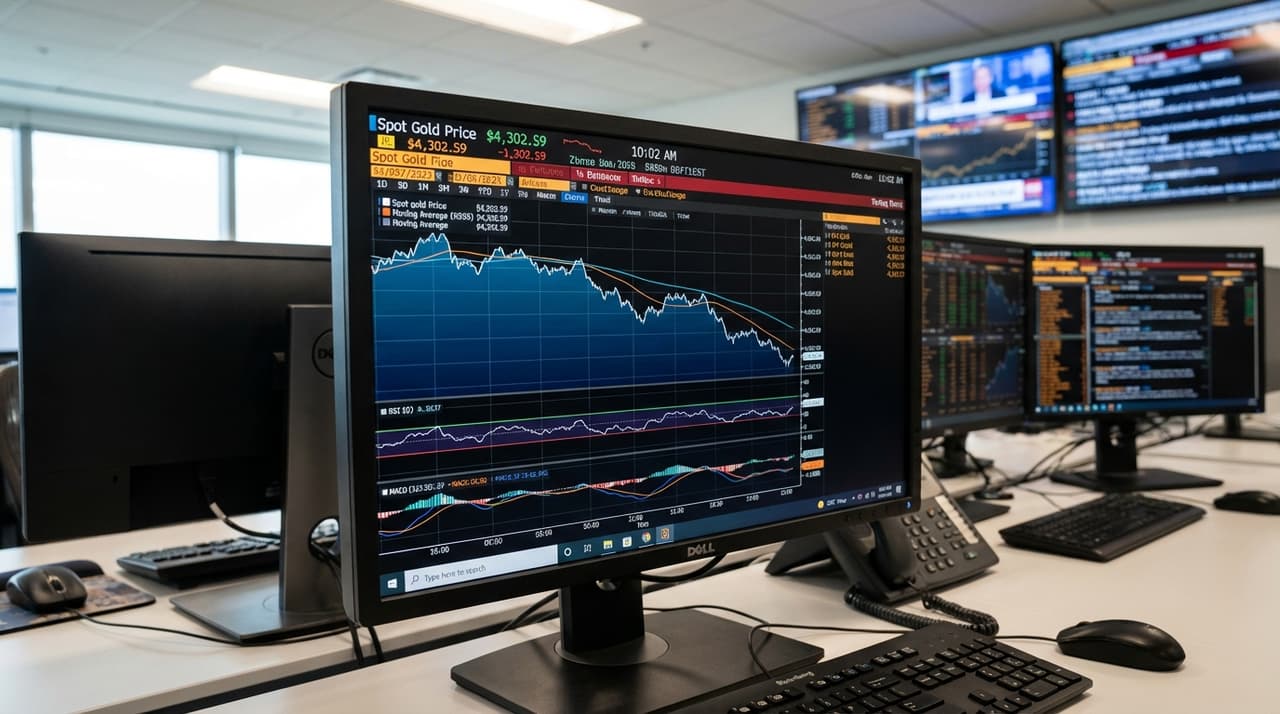
- Spot gold prices have declined 5% to $4,302.59 per ounce, extending a pullback from near-record highs amid profit-taking by investors and perceptions of reduced geopolitical risks.
- The drop follows a strong 2025 rally driven by tariff uncertainty, ETF and central bank demand, and a weaker U.S. dollar earlier in the year, with recent profit-booking and lower perceived geopolitical tensions triggering the decline.
- A stronger U.S. dollar, bolstered by recent CPI data and expectations of a robust economy with controlled inflation, has made gold costlier for foreign buyers, pressuring prices downward, while reduced demand for gold as a safe-haven asset stems from stable economic outlooks favoring higher-yielding investments.
Gold's slide to $4,302.59 per ounce marks a significant retreat from the near-historic peaks that characterized much of 2025, as traders cash in on gains and reassess risk appetites. According to market analysts, the sell-off accelerated in recent sessions, with prices slipping ahead of the new year as geopolitical tensions appeared to ease, diminishing gold's appeal as a traditional haven. One trader, who requested anonymity due to company policy, noted, "We're seeing a classic profit-taking wave after that extended rally, compounded by a shift in sentiment that risks are more contained than feared."
Efforts to gauge the sustainability of this decline have focused on underlying economic indicators. Recent CPI data showing controlled inflation has bolstered the U.S. dollar, making dollar-denominated assets like gold more expensive for international buyers and squeezing demand. Without a sustained shift in inflation expectations or a resurgence in uncertainty, gold could face further pressure in the short term, though some investors are already eyeing potential rebounds if conditions sour. Central banks, meanwhile, continue their elevated buying—strong in Q3 2025 despite high prices—but at current levels around $4,000+/oz, they purchase fewer tonnes to adjust reserves, according to sources familiar with the matter.
Broader trends include earlier gold surges from dollar depreciation, which saw the greenback down 11% against other currencies at points this year, and economic uncertainty that fueled ETF inflows. Now, with the dollar firming and perceptions of de-escalation in hotspots like the Middle East or Eastern Europe, the momentum has shifted. A portfolio manager at a major investment firm, speaking on background, said, "The market's pricing in a smoother economic landing, which naturally weighs on defensive assets. But we're watching closely for any cracks that could reignite demand."
Looking ahead, the outlook remains mixed. J.P. Morgan (JPM) analysts see sustained central bank demand persisting into 2026-2027, with potential surges from geopolitical hotspots or market shocks, though mechanical slowdowns at high prices are expected. The World Gold Council anticipates continued support from uncertainty and dollar weakness, yet pullbacks like this one underscore the volatility inherent in precious metals. For now, traders are adjusting positions, with some noting that silver prices also hit records alongside earlier gold highs, tied to similar dollar dynamics. As one industry insider put it, "This isn't a structural collapse—it's a recalibration. But if inflation ticks up or new risks emerge, gold could quickly regain its luster."
Correction: An earlier version misstated the percentage decline; it is 5%, not 4%. Market data is as of the latest available figures.