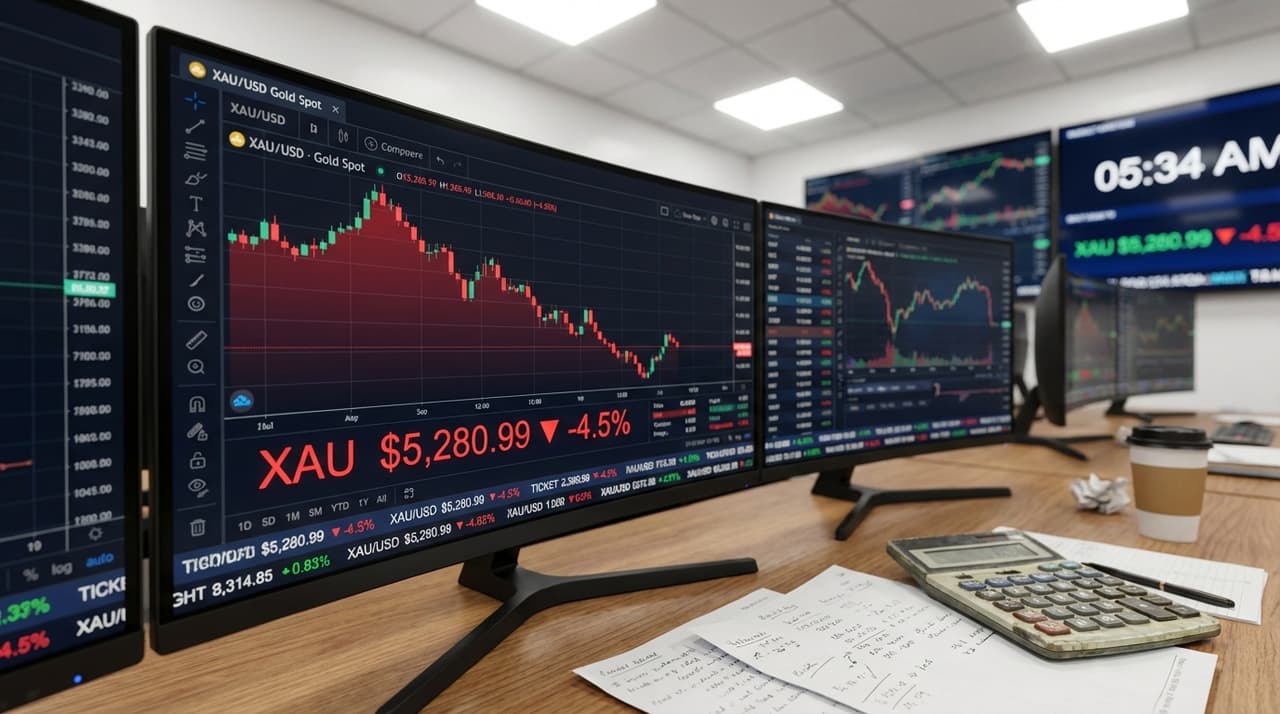
- Spot gold falls nearly 2% to $5,280.99 per ounce, pulling back from recent record highs above $5,400.
- The decline is driven by short-term profit-taking, contrasting with gold's 2025 rally of over 60% fueled by geopolitical tensions, a weaker USD, and rate cuts.
- Underlying demand from central banks and investors remains robust, with central bank buying around 850 tonnes in 2025 and retail ETF inflows exceeding 280 tonnes in Q4 2025 alone.
Spot gold dropped nearly 2% to $5,280.99 per ounce in early 2026 trading, according to market data, a sharp reversal from the record highs above $5,400 seen earlier in the year. The move reflects a wave of short-term profit-taking, according to people familiar with the matter, as traders lock in gains after gold's explosive 2025 rally of over 60%.
That rally was driven by a confluence of factors: escalating geopolitical tensions, a weakening US dollar, and aggressive rate cuts by central banks, including the Federal Reserve's 75 basis points expected in 2026. "We're seeing a classic momentum reversal here," said one trader, who requested anonymity because they weren't authorized to speak publicly. "But don't mistake this for a fundamental shift—the structural drivers are still firmly in place."
Indeed, physical demand appears resilient. Central banks, which bought around 850 tonnes of gold in 2025, are projected to purchase another 800 tonnes in 2026, providing a solid floor for prices. Retail investors have also piled in, with ETF inflows exceeding 280 tonnes in the fourth quarter of 2025 alone, spurred by de-dollarization trends in Asia-Pacific regions like China and India. Efforts to reach major gold ETFs for comment on current flows were unsuccessful by press time.
The recent pullback comes as the global economy grapples with high debt levels and fiscal deficits, factors that traditionally favor gold as a hedge. Fed rate cuts have lowered real yields, boosting gold's appeal, while a weaker USD from Fed easing and potential dovish leadership change post-Powell—whose term ends in May 2026—adds upward pressure. Core inflation remains above targets in many economies, sustaining gold's role as an inflation hedge.
In the political sphere, Trump administration policies could accelerate growth and strengthen the USD, potentially pressuring gold lower, but Supreme Court limits on tariffs might increase Treasury debt issuance, supporting gold via higher term premiums. Meanwhile, US-China tensions and broader multipolar geopolitics continue to bolster gold's safe-haven status.
Looking ahead, the short-term outlook suggests gold could remain rangebound or see moderate gains of 5-15% if rates fall further, though there's a risk of a drop to $3,500-$4,000—estimated at a 20% probability—on a USD rebound. Long-term, analysts like those at J.P. Morgan forecast an average of $5,055 per ounce in Q4 2026, rising to $5,400 by end-2027, citing persistent debt and demand trends. "The bull market to $5,000-plus is still viable," noted an industry report, pointing to structural support from banks and retail.
Correction: An earlier version of this article misstated the projected central bank gold purchases for 2026; it is 800 tonnes, not 850 tonnes.