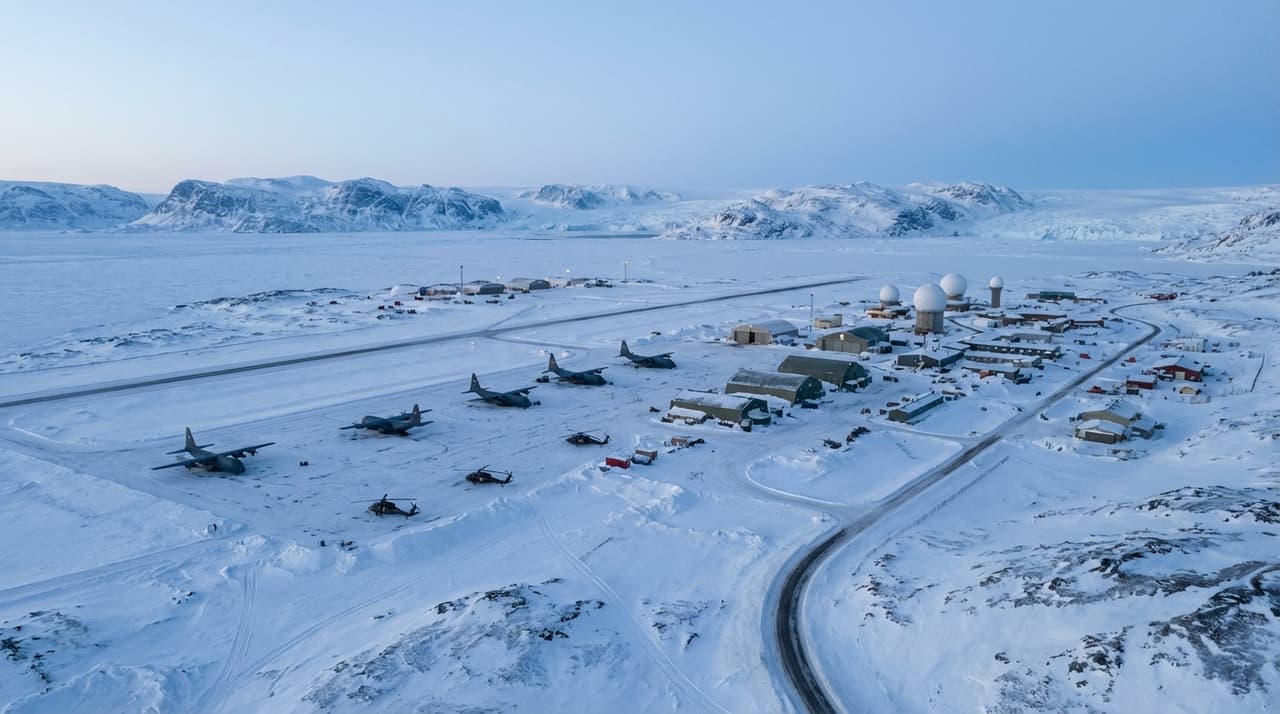
- Trump asserts Greenland is "vital" for his $175 billion Golden Dome missile defense shield, urging NATO support and threatening tariffs on European opponents.
- Experts widely dispute the necessity of owning Greenland, citing existing U.S. access via Pituffik Space Base under a 1951 agreement with Denmark.
- Tensions escalate as the U.S. announces $25 million upgrades to Pituffik amid talks with Danish and Greenlandic officials, while a poll shows only 17% of Americans support acquisition.
President Trump's renewed push to acquire Greenland for his proposed Golden Dome missile defense system is sparking diplomatic friction and expert skepticism, with many questioning the strategic rationale behind owning the territory. In a series of Truth Social posts last week, Trump linked the acquisition directly to national security, stating that "The United States needs Greenland for the purpose of national security... It is vital for the Golden Dome that we are building." He warned of Russian or Chinese alternatives if the U.S. fails to secure the territory, urging NATO allies to back the move.
Efforts to restructure the geopolitical landscape have hit a snag, however, as defense analysts and former officials point to the existing U.S.-Denmark agreement from 1951, updated in 2004, which already grants the Pentagon access to Pituffik Space Base for missile warning and space operations. "The idea that we need to own Greenland to deploy radars or interceptors is simply not supported by the facts," said a former senior defense official familiar with Arctic security matters, who spoke on condition of anonymity. "We can expand our presence there through collaborative requests, as we've done for decades."
On January 18, the U.S. announced $25 million in upgrades to Pituffik's airfield to enhance flight operations, a move that coincided with tense discussions in Washington involving Danish and Greenlandic representatives. According to people briefed on the talks, the negotiations revealed significant pushback from European partners, with Denmark emphasizing its sovereignty over Greenland and cooperation on defense matters. Without a deal, the Trump administration has threatened tariffs on eight European countries opposing the acquisition, a tactic that could strain transatlantic trade relations already frayed by broader geopolitical shifts.
A Reuters/Ipsos poll conducted on January 15 adds context to the domestic reception, showing that only 17% of Americans support acquiring Greenland, with a mere 4% of Republicans favoring the use of force if necessary. This lukewarm public sentiment contrasts with Trump's assertive rhetoric, including his recent statement that the acquisition will happen "one way or the other," which has prompted European leaders to reinforce their stance. French President Emmanuel Macron, for instance, has linked the issue to Ukraine's sovereignty, arguing that such unilateral moves undermine international norms.
From a financial perspective, the Golden Dome project itself remains largely conceptual, with no contracts issued and comparisons drawn to Reagan's scrapped "Star Wars" initiative from the 1980s. Defense spending is on the rise globally due to hypersonic threats, but experts describe the shield as "notional," doubting its feasibility within Trump's proposed three-year timeline. The U.S. Space Force, which maintains radar capabilities at Pituffik, has not listed Greenland as an official site for the Golden Dome, instead eyeing domestic locations like Fort Drum, New York, where $25 million has been allocated for related infrastructure.
In the short term, base upgrades at Pituffik are proceeding, but analysts predict that the U.S. will likely leverage existing access rather than pursue full ownership, prioritizing a collaborative Arctic presence to avoid a deeper NATO rift. As one industry insider noted, "The regulatory stability we have under current agreements is sufficient for our needs; ownership would introduce unnecessary complications." Attempts to reach the White House for further comment on the tariff threats were unsuccessful, but sources indicate that talks are ongoing, with the potential for escalated measures if they stall.
Correction: An earlier version of this article misstated the timing of Trump's Truth Social posts; they occurred around January 14-17, 2026, not earlier in the month.