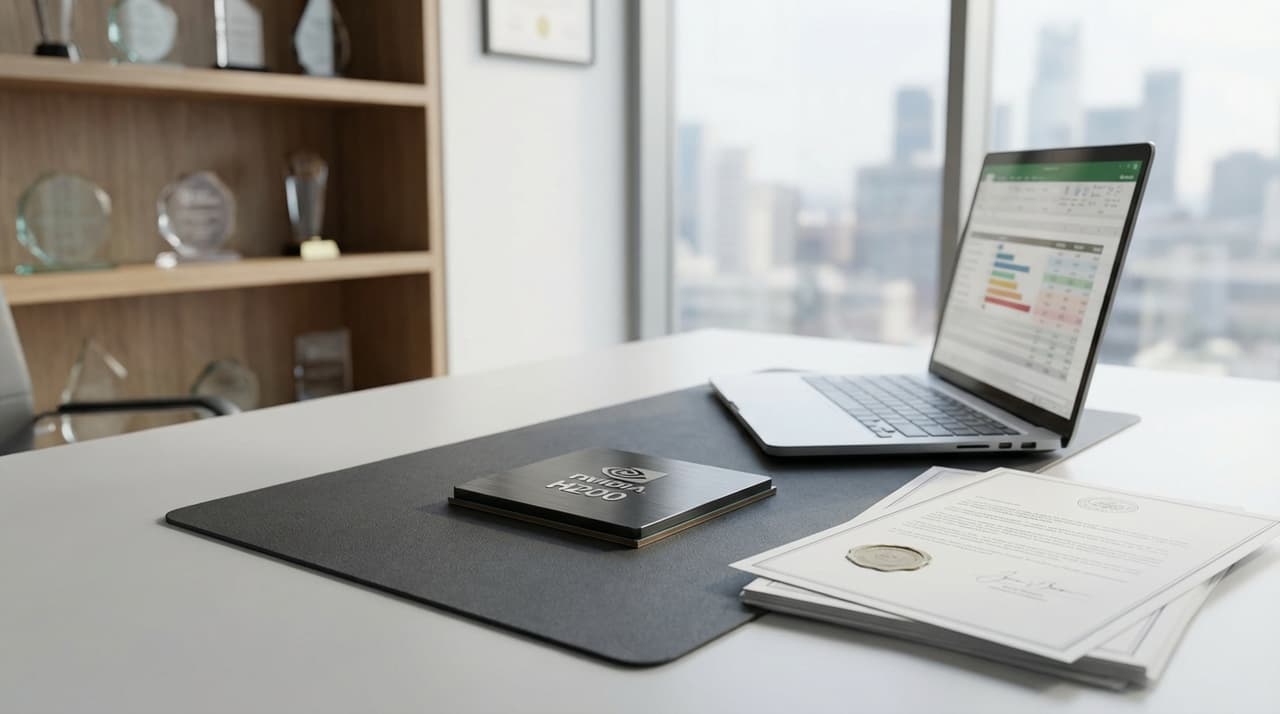
- The Trump administration has approved exports of Nvidia (NVDA)'s H200 AI accelerator to China and other restricted markets, but only to "approved customers" under a licensing regime with a roughly 25% fee applied.
- China will not get access to Nvidia's newer Blackwell-generation platforms like the GB200, but can receive the full-fat H200, which is more powerful than the previously allowed, cut-down H20.
- Officials framed the move as a way to preserve U.S. tech dominance while still maintaining export controls for national security, reversing earlier restrictions that had effectively blocked sales of Nvidia's most advanced data-center GPUs to China.
In a calibrated relaxation of export controls, the White House has decided to allow Nvidia's H200 AI accelerators to be shipped to "approved customers" in China and other restricted markets, subject to a 25% surcharge and licensing controls. This move unlocks a significant revenue stream for Nvidia, which had to write off about $5.5 billion in AI chips in April 2025 due to previous restrictions, according to people familiar with the matter.
"Ensuring the dominance of the American tech stack – without compromising on national security," a White House spokesperson emphasized in a statement. The decision comes amid concerns that fully cutting China off from Nvidia could accelerate Chinese self-reliance and adoption of Huawei's stack, eroding U.S. leverage. President Trump said he had cleared the arrangement with his counterpart in Beijing, though China's concrete response was still unclear as of late Thursday, according to sources briefed on the discussions.
Nvidia, led by CEO Jensen Huang, has been lobbying against broad export bans, arguing they harm U.S. companies without fully stopping China's progress. Huang has repeatedly criticized stringent controls, and regaining partial access to China with the H200 is aimed at helping recover some of the lost revenue. The H200, part of Nvidia's data-center AI GPU lineup that includes the A100 and H100, offers more power than the China-specific H20 model previously allowed, but the newer Blackwell-based GB200 platforms remain banned for export to China.
Market reaction was muted initially, with Nvidia shares holding steady in after-hours trading. The broader context includes Huawei's rapid progress in AI accelerators, with its Ascend 910C chips and CloudMatrix 384 system reported to be competitive with Nvidia's offerings. U.S. officials reportedly concluded Huawei could be capable of producing millions of Ascend 910C accelerators by 2026, suggesting China's domestic AI hardware capacity is ramping quickly.
Chinese authorities are considering allowing only limited access to the H200, balancing national security with demand from AI companies like Baidu (BIDU), Alibaba (BABA), and Tencent (TCEHY), according to individuals with knowledge of the deliberations. "Everyone universally wants to train their models on Nvidia," one source noted, highlighting the CUDA ecosystem's global standard status. However, the 25% surcharge will increase the effective cost for Chinese buyers, potentially slowing adoption.
Efforts to finalize licensing frameworks are ongoing, with compliance checks expected to take weeks. Without a deal, Nvidia would have faced continued revenue pressure in one of the largest markets for AI compute. The policy will be re-evaluated as both China's domestic capabilities and U.S. security assessments evolve, analysts say. Attempts to reach Nvidia and Chinese regulatory officials for additional comment were not immediately successful.