American Assets Trust, Inc.
NNYSE:AATQ1 FY2026 · Earnings Call TranscriptApril 29, 2026
Operator
Please note, this event is being recorded. I would now like to turn the call over to Meleana Leaverton, Associate General Counsel of American Assets Trust.
Please go ahead.
Meleana Leaverton
Thank you, and good morning. The statements made on this earnings call include forward-looking statements based on current expectations, which statements are subject to risks and uncertainties discussed in the company's filings with the SEC.
You are cautioned not to place undue reliance on these forward-looking statements, as actual events could cause the company's results to differ materially from these forward-looking statements. Yesterday afternoon, American Assets Trust's earnings release and supplemental information were furnished to the SEC on Form 8-K.
Both are now available on the investor section of its website, americanassetstrust.com. It is now my pleasure to turn the call over to Adam Wyll, President and CEO of American Assets Trust.
Adam Wyll
Good morning, everyone, and thank you for joining us today. At American Assets Trust, we continue to approach this market with the same mindset that has guided us across cycles: patient, disciplined, and with a long-term focus.
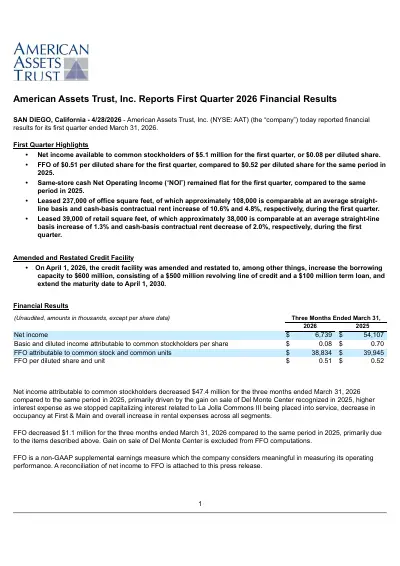
That mindset, combined with the quality of our assets and our platform, guides how we allocate capital, manage risk, and run our business. We started 2026 in line with our expectations, generating 51 cents of FFO per diluted share and continuing to make progress against the priorities we laid out last quarter.
Across the portfolio, we saw encouraging activity, most notably in office leasing, while our retail assets remained highly leased and consistent. Our multifamily teams operated well through a competitive supply environment, and Waikiki Beach Walk delivered steady results against a still mixed tourism backdrop.
Before turning to the portfolio, I want to highlight a significant balance sheet accomplishment. On April 1st, we successfully completed the recast and upsize of our unsecured credit facility.
We increased our revolving line of credit from $400 million to $500 million and extended the maturity of the revolver and our $100 million term loan to April 1st, 2030. Altogether, this facility provides us with $600 million of total unsecured borrowing capacity.
This outcome reflects the quality of our portfolio, the strength of our banking relationships, and the confidence of our lender group has in our credit. Importantly, it gives us enhanced financial flexibility and runway as we execute our leasing and operating objectives, now with no debt maturities until 2027.
That added capacity is particularly valuable in the current market. While the macro backdrop remains uneven, our tenants are generally well-capitalized, and the markets where we operate continue to benefit from diversified economies, strong demographics, and meaningful barriers to new supply.
Those structural advantages matter, particularly during periods when the broader landscape is less predictable. One topic that has generated considerable discussion in our office segment is artificial intelligence.
AI is driving investment, business formation, and growth across technology, infrastructure, and innovation-oriented companies, along with the professional and advisory ecosystem that supports them. While its impact on office demand will vary by industry, we believe the net effect in our markets has been constructive.
At the same time, the bar for office space keeps rising. When companies make office commitments today, they are focused on location, amenities, flexibility, ownership quality, and the ability to attract talent, attributes that define our coastal office portfolio.
On our own platform, we are investing in technology to improve how we operate, from work order management and preventative maintenance analytics to tenant communication tools, while also building the data foundation for future AI capabilities. We are early in this effort, but we believe it can become a differentiator as we improve the tenant experience and our operating margins.
In office, the momentum we flagged last quarter carried forward. Demand concentrates at the top of the market in well-located, well-amenitized buildings with strong ownership.
That is where we compete. Our office portfolio ended the quarter 84.5% leased, and our same-store office portfolio ended the quarter 86% leased.
Same-store office cash NOI came in essentially flat year-over-year, modestly ahead of our internal expectations, reflecting the known move-outs we've previously discussed. During the quarter, we executed approximately 237,000 square feet of office leases, with comparable cash leasing spreads of 4.8% and straight-line leasing spreads of 10.6%.
Meanwhile, of our 14 non-comparable leases in Q1, which are now separately disclosed in our supplemental, 12 were new tenants, 9 of which were in our spec suite program, underscoring the role that program is playing in converting demand into executed leases. We entered the second quarter on solid footing, including approximately 244,000 square feet of previously signed leases not yet commenced, another 122,000 square feet in lease documentation, and a proposal pipeline of over 200,000 square feet.
At La Jolla Commons Tower 3, the building is currently 49% leased, with proposals out on another 30% of the building. The UTC submarket has limited large block availabilities outside of Tower 3, and with no meaningful new supply on the horizon, we believe we are in a strong position to capture large tenant requirements in the submarket, including several active requirements we are tracking today.
At One Beach Street, the building is currently 36% leased. While one larger opportunity we referenced last quarter did not move forward, our leasing focus has shifted toward building a broader pipeline of smaller and mid-sized tenants.
We already have permits in hand and work underway to advance our spec suite build-out, positioning us to capture tenants seeking high-quality, move-in-ready space. Prospect activity has improved, and the execution across the portfolio has been strong.
We remain confident that the trajectory of our office portfolio, including our progress toward stabilizing Tower 3 and One Beach, will translate into increased cash flow as these leases convert to revenue. Last quarter, I mentioned our goal of ending the year between 85% and 88% leased across our office portfolio.
Since then, we learned that Genentech at Lloyd District, approximately 67,000 square feet, reversed course on a short-term renewal and will be vacating in Q4. The space itself is turnkey and modern, and we believe it will show well in the market.
However, the vacancy was not in our assumptions last quarter, and as a result, we are now targeting the lower end of that range. We have some work to do, but reaching that level would still represent a meaningful step forward.
Retail remains a source of consistent, reliable performance. Our retail portfolio ended the quarter 98% leased, and we executed approximately 39,000 square feet of leasing during the period, with average base rents reaching a new portfolio record of $30 per square foot.
Same-store cash NOI was modestly below the prior-year period, primarily due to the temporary impact of vacancies from two former Party City spaces and a former Discount Tire space. The Discount Tire space and one of the two Party City spaces are already re-leased, with cash rents expected to commence later this year.
Tenant health across the retail portfolio is strong, leasing demand is solid, and our centers benefit from affluent, supply-constrained trade areas with limited new competition. Less than 3% of our retail square footage expires this year, and we are actively engaged on upcoming rollover.
While we are closely monitoring the consumer in an uncertain economic climate, we believe the demographics surrounding our retail assets support a resilient spending base and a steady cash flow profile. In multifamily, same-store cash NOI increased 3% year-over-year, a solid result given the competitive supply landscape in San Diego and Portland.
Excluding the RV park, our multifamily portfolio ended the quarter 96% leased. In San Diego, our apartment communities ended the quarter 98% leased.
Excluding our newest acquisition, Genesee Park, net effective rents in San Diego were up just over 1% compared to the prior-year period. In Portland, Hassalo on Eighth ended the quarter at 93% leased, up an additional 4% from a year ago.
Net effective rents were essentially flat, which we view as a reasonable outcome in the current Portland market. The recovery remains gradual, and our focus right now is on protecting occupancy while positioning for better growth as supply moderates.
As we have noted, 2026 is more of a stabilization year for multifamily than a recovery year, and we are focused on optimizing pricing, maintaining occupancy, and tightly managing controllable expenses. At Waikiki Beach Walk, our retail component continued to perform well year-over-year, partially offsetting softness on the hotel side, with overall mixed-use cash NOI down modestly versus the prior-year period.
We believe in the long-term value of this irreplaceable fee simple asset and are focused on driving performance across both the hotel and retail components. Finally, I'm pleased to share that our board has approved a quarterly dividend of 34 cents per share, payable on June 18th to shareholders of record as of June 4th.
While our payout ratio remained elevated in the quarter, much of that reflects leasing-related capital tied to signed leases and our spec suite program, both of which are intended to drive occupancy and future NOI growth. We continue to have conviction in the long-term cash flow profile of the portfolio and are comfortable maintaining the current dividend at this point in time.
Bob will provide more detail on the payout ratio and its expected moderation in just a moment. In closing, we are pleased with how we have begun 2026.
We are converting leasing activity into future revenue, strengthening our balance sheet, and executing against the plan we laid out entering 2026. Our priorities for the year are unchanged: advance office leasing, protect the steady cash flow from our retail and multifamily platforms, and remain disciplined in how we allocate capital.
At our core, we own irreplaceable coastal real estate, we operate through a vertically integrated platform, and we manage this business with a long-term perspective. We are in a good position, and our focus is on converting that position into earnings growth.
With that, I will turn the call over to Bob, who will walk through the financials in more detail.
Robert Barton
Thanks, Adam. Good morning, everyone.
Last night, we reported first quarter 2026 FFO per share of 51 cents and net income attributable to common stockholders of 8 cents per share. FFO increased 4 cents per share compared to the fourth quarter of 2025, driven primarily by lower G&A expense, incremental rental income at Pacific Ridge Apartments and 1400 acres, as well as lower operating expenses at La Jolla Commons.
As we expected, same-store cash NOI across all sectors was flat year-over-year in Q1. Breaking that down by segment as compared to Q1 2025, office same-store NOI was essentially flat, primarily due to the expiration of Clear Result at 1st & Main in April of 2025.
The space has been partially backfilled. Retail NOI declined 0.7%, driven by the known vacancies Adam mentioned at Gateway Marketplace and Solana Beach Towne Centre, both of which have now been addressed through executed leasing.
Multifamily NOI increased 3%, driven by higher rental income and improved occupancy, particularly at Pacific Ridge and Hassalo on Eighth. Mixed-use NOI declined 2.7%, as a year-over-year increase of 2% of the retail component was offset by lower ADR and higher operating expenses at Embassy Suites Waikiki, where in Q1 occupancy improved to 92% from 85%.
RevPAR increased 2% to $305. ADR softened by 6% to $332, and NOI was approximately $2.4 million versus $2.6 million last year.
Turning to liquidity and leverage, we end the quarter with approximately $518 million of liquidity, including $118 million of cash and $400 million available on our revolving credit facility. As Adam mentioned, we closed the recast and upsized the credit facility on April 1st, extending both the $500 million revolver and $100 million term loan to April 2030.
Net debt to EBITDA was 6. times 6.9 times on a trailing 12-month basis.
Our long-term target remains 5.5 times or below. Interest and fixed charge coverage were both 3.0 times.
Turning to the dividend, our first quarter dividend payout ratio was approximately 111%, driven primarily by the timing of leasing-related capital expenditures, including tenant improvements, leasing commissions, and our spec suite program, along with normal recurring capital needs. Importantly, a meaningful portion of this capital is tied to leases that have already been signed or spaces that we are proactively preparing to meet current tenant demand.
As those leases commence and convert to cash rent, we expect the payout ratio to moderate. For the remaining three quarters of the year, we currently expect the payout ratio to trend in the low to mid-90% range, with the full-year payout ratio likely landing in the upper 90% range.
Since our IPO in 2011, our payout ratio has generally been approximately 65% to 85%, and we continue to view that as an appropriate long-term range for the business. In the interim, given our liquidity position, our visibility into signed lease commencements, and our confidence in the long-term cash flow profile of the portfolio, management and the board are comfortable maintaining the current dividend.
As always, we will continue to evaluate the dividend each quarter in the context of operating performance, leasing progress, capital requirements, and broader market conditions. Turning to 2026 guidance, we are reaffirming our full-year FFO guidance range of $1.96 to $2.10 per share, with a midpoint of $2.03.
This reflects continued stability across our diversified portfolio, supported by leasing activity, contractual rent growth, and disciplined cost management. Based on our current outlook, we believe we are well-positioned to achieve our full-year objectives, with potential to trend toward the upper end of the range as several factors align.
Number one, retail tenants currently reserved for bad debt continue to pay their rents. Number two, office lease commencements occur ahead of expectations.
Number three, multifamily outperforms expectations on occupancy and/or rent growth. Number four, tourism demand improves, supporting performance at Embassy Suites Waikiki.
As a reminder, our guidance excludes the impact of future acquisitions, dispositions, capital markets activity, or debt refinancings not yet announced. We remain committed to transparency and will continue to provide clear insight into both our results and assumptions.
Additionally, all non-GAAP metrics discussed today are reconciled in our earnings materials. I'll now turn the call back over to the operator for Q&A.
Operator
Thank you. We will now begin the question-and-answer session.
To ask a question, you may press star, then one on your touchtone phone. If you are using a speakerphone, please pick up your handset before pressing the keys.
If at any time your question has been addressed and you would like to withdraw your question, please press star, then two. The first question comes from Todd Thomas from KeyBanc.
Please go ahead.
Sean Glass
Hi, good morning. This is Sean Glass on for Todd.
You previously discussed some known move-outs in the office portfolio. I think there was an expectation that there could be 300 to 400 basis points of occupancy from expected vacates.
Have any tenant decisions shifted or changed since year-end, and could you remind us what's embedded in guidance for the office portfolio's year-end lease rate?
Robert Barton
As Adam said, the one new one is Genentech, which will occur in Q4 of this year. On the positive side, we have three known move-outs that are in lease documentation at City Center Bellevue specifically.
That's 20 28,000 feet of move-outs that are already in lease documentation. That's the latest.
One one thing of note, I'm tracking 173,000 feet right now, 17 deals, eight of those, or about 60,000 feet, are relocations due to expansions. We're expanding tenants and they're giving space back.
Those are good news givebacks of tenants that are already expanded. We're just getting that once the TIs are done, we're getting their spaces back.
It's not all bad news.
Adam Wyll
Sean, we mentioned in the script that we're targeting mid-80% full portfolio occupancy, or leased percentage by the end of the year, which is achievable if momentum continues as it is right now. We're going to give you guys a range, we have a little bit of flexibility to figure out how it shakes out.
Sean Glass
Thank you. That's great color.
Wanted to ask about La Jolla specifically. Some very good traction there on leasing.
Can you talk about the pipeline a little, whether any additional leases are out for signature, anything in documentation, and maybe some color on where you might expect La Jolla to be at year-end? Thank you.
Adam Wyll
It is the premier offering in not only UTC, but Del Mar Heights as well in terms of available spaces. I'm speaking of Tower 3 specifically.
Right now, we're in proposals with two full-floor users and two multi-floor users, and we don't have that many floors to lease. That's a good situation.
We're in space planning with every one of them. The competition is very narrow.
We expect to make one or more of those. That would account for the remainder of the full floors.
On the spec suite program, we only have one suite left on the fourth floor. We've already pre-leased a fifth-floor spec suite, and those aren't going to be completed until September of this year.
The traction's good. The attraction is with well-capitalized professional service firms, like the tenants that you want in this sort of building.
We're pleased with that.
Sean Glass
Okay. If I could slip one one more in on One Beach, some good traction there, too.
Could you talk a little about you touched on the AI demand or otherwise, and also where you think that might be at year-end? Maybe you could touch on the one large opportunity that didn't pencil, if that changes the equation at all?
Adam Wyll
For that large deal, we gave ourselves a 30-day window in which to vet it. There were some complexities to it due to the use, dealing with exiting, dealing with traffic and such, and it ended up not panning out.
We spent 45 days on it, but we pivoted very quickly back to this spec suite program, which is underway, and Jerry and his team will complete that construction around September, per talked with Shadley yesterday. Keep in mind we pre-leased that third floor before we had started construction on that floor.
We expect to have similar results. I can't give you the exact timing, but we're optimistic.
Sean Glass
Thank you.
Operator
The next question comes from Haendel St. Juste from Mizuho.
Please go ahead.
Ravi Vaidya
Hi there. Good morning, guys.
This is Ravi Vaidya on the line for Haendel. Hope you all are doing well.
I wanted to ask a bit about the signed and not occupied pipeline in both office and retail. Can you give maybe some numbers as to when you think leases will begin cash flowing for those two verticals?
Maybe regarding detail about the timing and when over the next couple years for both office and retail? Thank you.
Yeah.
Adam Wyll
Hey, Ravi, it's Adam. As I mentioned in my script, we have about a quarter million square feet on the office portfolio signed, not commenced.
I think about 7 cents is reflected in 2026 guidance, but about 100,000 square feet in that signed, but not commenced, won't hit meaningfully until next year. You're looking at about 7 cents per share or so, call that $5-plus million that'll hit this year.
I don't have the retail numbers in front of me. I have it.
I don't think there's much on that front, though.
Ravi Vaidya
Got it. That's super helpful.
I wanted to ask about the hotel in Hawaii. Noticed the occupancy came up quite a bit, as you discussed in your script, but was mostly offset by rate.
What can we see regarding demand for tourism, for traffic, and how that asset is positioned from both seeing demand from Japanese and American tourists right now?
Robert Barton
Ravi, this is Bob here. It's still slow right now, but what's interesting in terms of the rates, we still outperform our competitive set, which consists of just under 10 hotels, including beachfront properties.
For example, our occupancy was 91%, but our comp was 79%. Our ADR was $300-plus, and theirs was under $300.
RevPAR, we're $300-plus, and our comp set significantly under $300. Everybody's feeling the impact, though from the statistics that I'm seeing is that we're the number one hotel in Waikiki.
Two things happened during March. One is that, I don't know if you heard about it, but there was a Kona from the Kona island got over to Waikiki, and there was two huge rainstorms.
It was two rainstorms, one in March 16th, March another one in March 24th, significant flooding, dumping over 2 trillion [scillion?] gallons of rain, or 2 years of rain in two storms overall.
Everybody in town felt that impact on that. Secondly, is that the Japanese yen, we're still following the more wealthy clientele from Japan continue to come, but if you notice, Japan yen has got up to the 160 range.
I think it dipped to 159, it continues to stay up there, and they have to work through that issue. There's a lot of little things that are impacting that.
Also, you have operating expenses going up. All in all, it's the number one performing Embassy Suites in the world.
It continues to be.
Adam Wyll
Hey, Ravi, just to layer on that, as Waikiki is very sensitive to tourism, especially international demand. As Bob was mentioning, the Japanese weren't there as much as they used to be.
It used to be closer to 40% of tourism in Waikiki. Now it's about 20%.
It's slow incremental progress. Recovery's been slower than anticipated, and the affordability pressures are really weighing on the results.
Still it remains a high-barrier-to-entry, globally relevant market, and we view the asset well-positioned for the long term.
Ravi Vaidya
Thank you. Appreciate the color, guys.
Operator
This concludes our question-and-answer session. I would like to turn the conference back over to Adam Wyll for closing remarks.
Adam Wyll
Thanks for everybody for calling and joining us today or listening on record later. We appreciate your interest, and we'll be transparent as possible going forward.
Take care.
Operator
The conference is now concluded. Thank you for attending today's presentation.
You may now disconnect.