Ambev SA
Q3 FY2026 · Earnings Call TranscriptOctober 29, 2026
Operator
Good afternoon, and thank you for waiting. We would like to welcome everyone to Ambev's 2026 third quarter conference call.
Today with us, we have Mr. Carlos Lisboa, Ambev's CEO, and Mr.
Guilherme Fleury, CFO and Investor Relations Officer. As a reminder, this conference presentation is available for download on our website, ir.ambev.com.br, as well as through the webcast link.
We would like to inform you that this event is being recorded, and all participants will be in listen-only mode during the company's presentation. After Ambev's remarks are completed, there will be a Q&A session, during which we kindly ask that each participating sell-side analyst ask only one question.
Before proceeding, let me mention that forward-looking statements are being made under the safe harbor of the Securities Litigation Reform Act of 1996. Forward-looking statements are based on the beliefs and assumptions of Ambev's management and on information currently available to the company.
They involve risks, uncertainties, and assumptions because they relate to future events and therefore depend on circumstances that may or may not occur in the future. Investors should understand that general economic conditions, industry conditions, and other operating factors could also affect the future results of Ambev and could cause results to differ materially from those expressed in such forward-looking statements.
I would also like to remind everyone that, as usual, the percentage changes that will be discussed during today's call are both organic and normalized in nature, and unless otherwise stated, percentage changes refer to comparison with 2025 third quarter results. Normalized figures refer to performance measures before exceptional items, which are either income or expenses that do not occur regularly as part of Ambev's normal activities.
As normalized figures are non-GAAP measures, the company disclosed the consolidated profit, EPS, operating profit, and EBITDA on a fully reported basis in the earnings release. Now, I will turn the conference over to Mr.
Carlos Lisboa. Mr.
Lisboa, you may begin your conference.
Carlos Lisboa
Good afternoon, everyone, and thank you for joining our third quarter earnings call. At the end of our last call, we said we had reached halftime.
We closed the first half encouraged by what we had delivered, but with a clear challenge ahead of us: to sustain that performance as the year progressed. The third quarter provides another important proof point on this journey.
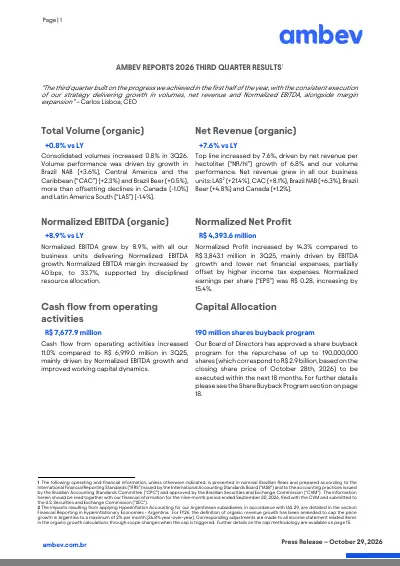
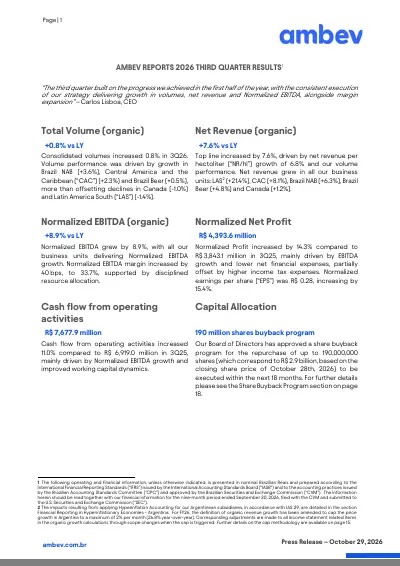
The shape of the performance closely mirrored what we delivered in the first half. Total volumes grew 0.8%, net revenue grew 7.6%, and normalized EBITDA increased 8.9%, with 40 basis points of margin expansion, while normalized EPS grew 15.4%.
Looking at the first nine months, the consistency becomes even clearer. Total volumes grew 0.7%, with beer growing at more than twice that pace, bringing beer growth broadly in line with its historical growth rate over the past decade, despite a still challenging environment.
The quality of our portfolio, together with disciplined revenue management, supported net revenue growth of 7.3%, ahead of inflation, while normalized EBITDA grew 9.3% and normalized EPS grew 12.3%. Importantly, we delivered this while continuing to invest behind growth, with marketing investment growing double digits organically in both the quarter and year to date.
This is the growth formula we are pursuing: a stronger and broader set of brands delivering healthy volume growth, net revenue ahead of inflation, and disciplined conversion all the way to the bottom line. Delivering it consistently requires us to be ambidextrous.
Behind that formula is a clear growth strategy based on three interconnected pillars: lead and grow the category, digitize and monetize our ecosystem, and optimize our business. Together, they form the flywheel that delivers profitable growth and perpetuate it over time.
Before going deeper into how that flywheel works in practice, let me give you a quick view across our markets. Our unique footprint and leadership positions set us apart.
We operate mostly in emerging markets, where beer is one of the most loved consumer categories. These markets have different economic and consumption cycles, and close to half of our business is outside Brazil.
Because those markets do not all move together, the portfolio can absorb volatility in one market while benefiting from stronger momentum in another. In both the third quarter and year to date, LAS, CAC, and Canada all delivered EBITDA growth ahead of net revenue, with margin expansion, despite very different industry environments.
This quarter, LAS stood out on profitability, despite a still soft consumer environment. CAC delivered healthy volume growth with margin expansion.
Canada, again, expanded EBITDA and market share, despite a soft industry. That balance allows the group to perform while we keep closing gaps where needed and accelerating business with stronger momentum.
In Brazil NAB, the commercial recovery became more visible in the quarter. Volumes grew by a mid-single digit, despite the continued phase-out of a lower-return channel, while sell-out market share improved sequentially, reaching last year's level, with price relativity remaining at historical levels.
Year to date, net revenue and EBITDA were ahead of last year, with around 200 basis points of margin expansion. Just as important, we kept investing to foster growth.
Our zero sugar portfolio grew double digits in both the quarter and year to date, with pioneering propositions, such as Guaraná with fibers, scaling to national distribution. Brazil Beer provides the clearest example of our three-pillar strategy working as a flywheel.
On pillar one, lead and grow the category, the Brazil beer industry continued its sequential recovery through the second and third quarters. Nielsen data shows some timing differences between Q2 and Q3 around the capture of World Cup-related demand.
In Q2, Nielsen reported an industry that was still slightly negative, with its measurement period ending before capturing most of the World Cup demand that took place later in June. In Q3, Nielsen reported industry growth of approximately 4%, also capturing part of that late June demand.
For that reason, the two quarters are better understood when read together. Across Q2 and Q3, Nielsen indicates industry volume growth of 1.3% year over year.
We estimate that nearly half of that growth came from the FIFA World Cup, with the remainder reflecting the underlying strength of the category, despite still challenging macro conditions and mixed weather. That reinforces our view that the category's foundations remain solid.
Our own performance should be read through the same lens. Brazil Beer volume grew 5% in Q2 and 0.5% in Q3, resulting in 2.7% growth across the two quarters.
Nielsen indicates that our sell-out grew approximately 3.5% over the same two-quarter period, higher than reported sell-in. Market share momentum explains that sell-out outperformance versus industry.
According to Nielsen, our share continued to improve sequentially in the quarter. Versus last year, we gained share in both on- and off-trade, with particularly strong progress in premium and zero alcohol, where we further expanded our leadership, while mainstream remained broadly stable.
Year to date, share gains were also broad across most regions. As category captain, we want to bridge category potential to actual consumption.
This is why we have built what we believe is our most complete portfolio so far, with complementary propositions across consumer needs, occasions, and price points. Our brand equity continued to strengthen, reaching a five-year record on a year-to-date basis.
Our category development playbook is creating new growth engines, with premium volumes growing high teens, balanced choices more than doubling, and no-alcohol beer growing in the 40s in the quarter. The quality of the portfolio is increasingly supporting volume growth, share expansion, and value creation.
In the quarter, we took another step in our revenue management agenda while maintaining price relativity above last year's level. A more complete portfolio also brings more complexity, what leads us to our second pillar: digitize and monetize our ecosystem, and how we use it to turn that complexity into a business opportunity.
On B2B, BEES has become the foundation of our commercial capabilities, delivering efficiency and better services to our customers. Its role is twofold.
First, it strengthens the core business. The platform is embedded in how we plan, sell, and execute across more than 1 million points of sale.
Its data and intelligence help us improve sell-out activation, sharpen product recommendations, and increase the availability of the right brands and SKUs in the right points of sale. That granularity matters.
In the on-premise channel, one of the most fragmented and execution-intensive channels in the market, our market share reached its highest level in five years, according to our estimates, supported by stronger distribution and execution, with SKUs per point of sale growing a high single digit year to date and double digits in Q3 versus last year. Second, the same infrastructure enables us to build new growth engines.
Through BEES Marketplace, we are expanding the assortment available to our customers beyond our own products and therefore expanding our total addressable market. Over 80% of our customer base has already bought through Marketplace, and GMV grew above 80% in both the quarter and year to date, supported by the continued expansion of 3P.
On the consumer side, Zé Delivery follows the same strategic role. For the core beer business, Zé provides a direct relationship with roughly 27 million consumers annually, a user base largely composed of young adult beer lovers.
That direct connection gives us a valuable window into how demand is evolving. Premium represents around mid-30s of Zé volume versus nearly the mid-20s in Brazil Beer, while balanced choices over-index by around 50% versus Brazil Beer average, helping us identify trends, test propositions, and scale what works faster.
In the quarter, Zé GMV grew mid-teens, while Zé Marketplace already represents close to 20% of that GMV. Similarly to BEES, we are also bringing to our consumers a broader assortment and expanding the categories and occasions we can serve them beyond our own portfolio.
The more growth opportunities we create under pillars one and two, more important a disciplined resource allocation becomes, which brings me to pillar three: optimize our business. For us, optimization is not simply about spending less.
Between the gross revenue and net income we generate, there is a significant pool of resources that we allocate every day. Our opportunity is to keep improving where those resources go, the returns they generate, and how much we can recycle behind future growth.
We see that discipline across different lines of the P&L. First, in revenue management.
Our broader portfolio and digital capabilities allow us to manage the company's pricing and promotions more efficiently and with greater precision. As a result, the incremental gross revenue generated per Brazilian real invested in BEES-enabled on-trade promotions improved by around 50% versus 2025.
Second, in cost productivity. In Brazil Beer, expected commodity headwinds, particularly aluminum and diesel-related costs, have pressured cash COGS per hectoliter year to date.
Better sourcing, increased vertical integration, and continuous improvement across our operations generated approximately R$450 million of non-commodity savings year to date, helping offset a meaningful part of those pressures. Third, in organizational productivity.
Year to date, hectoliters sold per FTE increased approximately 4% versus last year and more than 20% versus five years ago. This reflects continued investments in automation, technology, digital tools, and increasingly artificial intelligence, helping our people simplify processes, make better decisions, and focus on higher-value activities.
We are reinvesting those efficiencies behind our brands and commercial priorities. In 2026, marketing investment grew almost double the top-line growth.
That is the flywheel: category growth, sharp execution, and disciplined resource allocation to sustain profitable growth. We want that model to travel.
We are building Ambev as a company without borders, scaling what works across our footprint and bringing the best ideas and capabilities from our markets back into the system. The context may differ by market, but the capabilities behind the model are increasingly replicable.
With that, I will now turn it over to Fleury for the financial highlights. Thank you, Lisboa.
Hello and good afternoon, everyone. Our performance year to date reflects our mindset of focus on what we can control to deliver consistent results and create sustainable value over time.
Disciplined resource allocation has been central to this approach, enabling us to step up investments behind our brands and commercial priorities, driving organic growth.
Guilherme Fleury
On a consolidated basis, we delivered 9.3% normalized EBITDA growth year to date, with both gross margin and normalized EBITDA margin expansion, as well as 11.6% normalized net income growth. Normalized EBITDA as reported grew 2.6%, and stated net income increased by 2.3% in the period, reflecting one-off items recorded in the third quarter of last year.
The third quarter itself is one more quarter of consistent results, reflecting our continued focus on productivity and operational efficiencies that enable us to mitigate increased cost pressures across several of our markets. Normalized EBITDA grew 8.9% this quarter, reaching R$7.3 billion, with 40 basis points of normalized EBITDA margin expansion, reflecting the strength of our brands and commercial execution, together with disciplined revenue, cost, and expense management.
Consolidated cash COGS per hectoliter, excluding Marketplace, increased 6.5%, while gross margin expanded 60 basis points in the quarter. Consolidated cash SG&A grew by 7.6% in the quarter, mainly reflecting incremental sales and marketing investments, higher distribution expenses, and higher bonus accruals compared to the same period of last year.
Moving now to below-EBITDA lines, which have been an important focus area for our finance team, working closely with our procurement and supply teams. Since the beginning of the year, we have been actively managing our financial FX exposures.
As a result, on a year-to-date basis, we have been able to capture a meaningful improvement in our financial expenses. In the quarter, net financial expenses totaled R$312 million, a 71% reduction compared to the third quarter of last year.
This improvement primarily reflects a favorable comparison in the non-derivative instruments line, driven by lower costs associated with sourcing U.S. dollars in Bolivia, following the changes in the country's FX dynamics last quarter, together with positive effects from the translation of hard currency balances held locally due to the further devaluation of the local currency during this third quarter.
Additionally, interest income increased year over year, largely supported by a higher average cash position in Brazil, despite the continued return to our shareholders on a quarterly basis. Turning to income taxes, our consolidated effective tax rate was 16.8% in the quarter compared to 6.7% in the third quarter of 2025.
The difference mainly reflects the absence of one-off impacts recognized last year, including the partial reversal of liabilities associated with the 2017 amnesty program, PERT, fiscal incentive recognitions, and tax impacts related to the Barbados divestment. On a year-to-date basis, our effective tax rate reached 19.2%, broadly in line with the approximately 20% level we would have reported in the prior year if absent the one-off effects.
As a result, stated net income totaled roughly R$4.4 billion in the quarter, decreasing 10.2% versus last year, mostly reflecting the one-off items recorded in the third quarter of 2025. Normalized net income also reached roughly R$4.4 billion in the quarter, growing 14.3% versus last year.
Normalized EPS increased 15.4% year over year in the quarter, while both stated and normalized EPS reached 28 cents of Brazilian reais. Taken together, our operating performance, improved below-EBITDA results, and solid balance sheet allowed us to deliver, in nominal terms, normalized net profit growth ahead of normalized EBITDA growth, both year to date and this quarter.
Now, turning to cash flow generation. In the first nine months of the year, cash flow from operating activities increased by 39%, a R$4.4 billion improvement, reaching R$15.6 billion.
This performance was mainly driven by higher EBITDA and improved working capital dynamics. As part of our resource allocation mindset, our logistics team has optimized packaging and raw material inventory levels through regular inventory reviews, contributing to our working capital and cash flow generation year to date.
On a year-to-date basis, cash flow consumed in investing activities totaled R$5.4 billion, R$2.4 billion higher than in the same period of last year. Roughly R$800 million of this variation relates to investments in Brazilian Treasury bonds, reflecting a capital allocation decision that maintains a liquid and low-risk investment profile, as disclosed in Note 5 to our financial statements.
The increase was also driven by the deconsolidation of assets previously reported as restricted cash in CAC, as disclosed in our first quarter financial statements, partially offset by lower CapEx investments. Year to date, cash flow consumed in financing activities totaled R$8.7 billion, R$7.3 billion below last year, mainly reflecting the payment of our 2024 R$6.7 billion dividends in early 2025, partially offset by a higher cash outflow related to our share buyback program.
All in all, this cash flow performance has continued to support our shareholder return agenda. Since our last earnings call, we have completed our 2025 share buyback program, totaling roughly R$3.3 billion in cash disbursement, and we have also paid, on October 6th, the third and last tranche of the 2025 IOC of R$1.9 billion gross of taxes.
This makes up for nearly R$8 billion on a cash basis, gross of taxes, in our shareholder return agenda as announced this year until the date of this report. Finally, as we approach year-end, our guidance for Brazil Beer cash COGS per hectoliter, excluding the sale of non-Ambev Marketplace products, remains unchanged, estimated to increase between 4.5% and 7.5%.
As we look ahead, we remain committed to our ambition of expanding consolidated margin over time through efficient resource allocation. We will continue investing behind our growth engines, strengthening the business through investments across our operations, including brand-building investments, brewery upgrades and extensions, innovation pipeline, and commercial assets, reinforcing our sustainable, long-term value creation journey.
Now, back to you, Lisboa.
Carlos Lisboa
Thank you, Fleury. Let me close with one thought.
With three quarters behind us, one quarter remains. Our focus is to carry this consistency into Q4.
Q4 is more than the end of 2026. It is also the starting point for 2027.
The best way to enter next year strong is to finish this year strong. We are confident in what lies ahead, and that confidence rests on three foundations.
First, confidence in the category. Beer is one of the most loved consumer categories across our footprint, with significant development potential ahead.
Second, confidence in our strategy. Our three interconnected pillars work together as a flywheel, powered by capabilities that are uniquely ours.
Third, confidence in our momentum. Our value creation formula delivered consistent results through the first nine months and gives us the north to carry profitable growth forward.
That confidence is shared by our board. Consistent with our capital allocation framework, on October 28th, the board of directors approved another share buyback program for up to 190 million shares, approximately R$3 billion.
If there is one thing that has always set this company apart, it is our culture and our people. I am equally confident in our teams and business partners, and in their ownership and delivery as we build on this momentum.
Thank you very much for joining us today. With that, let me hand it back to the operator.
Operator
We will now begin the Q&A session. To ask a question, we kindly ask sell-side analysts to click on raise hand button at the bottom of the screen.
To remove a question from the queue or after your question has been addressed, please click on lower hand button. We kindly reinforce our request that each participant ask only one single question.
Our first question comes from Henrique Brustolin of Bradesco. You can open your microphone, sir.
Henrique Brustolin
Hello, Lisboa, Fleury. Thank you for taking my question.
My question is about your Brazil Beer pricing strategy, right, especially when we think about the standpoint of affordability versus the pricing power that you have. If you could help us understand, on affordability, you often mention that ratio of work hours needed to buy a beer, what does that tell you about the room to raise prices today?
On the pricing power, Lisboa, you mentioned, right, your price relativity already above last year levels, with market share gains, strong brand equity, how do you evaluate the room to increase prices further based on the market position that you have built, rather than preserving affordability and leaving some of that incremental pricing to consumers to keep driving category growth? That would be my question.
Thank you very much.
Carlos Lisboa
Hello again, everyone, and thanks for having us. Thank you, Henrique.
Nice to talk to you again. Let me express the following about your question.
First and foremost, our approach remains unchanged, right? Manage revenue per hectoliter broadly in line with inflation over time, protecting both, as you said, right, industry growth on one hand through affordability, and on the other hand, protect the profitability of the organization, right?
These are the two-fold mission that we always keep in mind when we manage our revenue management. Year to date, our net revenue per hectoliter grew 5.8% in Beer Brazil, well above inflation, on a healthy balance between pricing and portfolio mix.
The third quarter net revenue per hectoliter, excluding Marketplace, increased by 4.8% year over year against a 4.4%, more or less, CPI, with again revenue management and portfolio mix driving the growth, right? Within the quarter, we took another step in our pricing agenda sequentially, which, by the way, net revenue per hectoliter is sequentially improving and more than offsetting the state VAT growth ahead of our pricing.
As states usually update their price reference tables, the VAT base, on a different schedule from ours, right? All in all, price relativity, as you mentioned, was also maintained above last year level, while our portfolio kept gaining share, showing momentum from a stronger portfolio of brands coupled with a stronger execution.
Henrique Brustolin
Thank you, Lisboa.
Carlos Lisboa
Thank you.
Operator
Our next question comes from Thiago Duarte of BTG. You can open your microphone, sir.
Thiago Duarte
Hi. Hello, everybody.
Lisboa, Fleury, thanks for the opportunity. My question is linked to the same subject, and maybe if I could ask you to develop a little bit more on when we look at those figures you mentioned, Lisboa, regarding revenue per hectoliter growth into the quarter and into the nine months of the year, how you would strip out the impact of the mix and the channel relative, especially considering premiumization, and obviously you had the World Cup, which changes a little bit the occasions, as opposed to the impact of the pricing per se, effective pricing action that you've taken?
If I may, on the same subject, how comfortable you are with your pricing carryover into next year, considering how you're exiting the quarter, and obviously in light of what you mentioned regarding affordability and the category and your price index and so on? Thank you.
Carlos Lisboa
Hey, Thiago. Thanks.
Nice to talk to you as well, and thanks for the question. Actually, our performance so far is the consequence of the two, right, components: a consistent pricing execution pretty much in line with what we designed for the year, coupled with a consistent evolution of our portfolio, especially the new category segments that bring differentiation and, as a consequence, enhance our top line, right?
On the second point about the confidence, we feel confident. We do see the portfolio in a pretty interesting momentum, right?
The reason why, I have a few data points to share. First and foremost, brand power is at its highest level in the past five years, right?
Equity is converting into share, and this is the way we want to keep the balance: equity always ahead and converting to incremental market share. We are gaining share, Thiago, not depending only on one segment, one channel, one region.
It's quite the opposite. It's a broad-based gain, right?
The portfolio is promoting something that for us is pretty powerful, which is a combination of segments improving year over year, both channels evolving, pretty much all regions across the country showing very encouraging results, right? This is the kind of brand utility we aim, right?
Because, in fact, either we keep relativity at the same time similar to last year and we increase market share, or even we stay with relative price above last year, and even with that, we are gaining share. That's pretty much the reason why we look forward, and we feel that we are in a good momentum to jump into '27, right, because we don't expect again a stable scenario.
We have been facing a very volatile and dynamic context here, which is exactly the same we expect moving forward. The momentum and the fact that innovation is responding really well and providing a pretty important contribution to our growth, right, this year put us in the right position moving forward.
Lisboa,
Guilherme Fleury
let me just add one angle here, Thiago. When we think about revenue management, as Lisboa explained, there's also the other component that we look together is the discipline on costs, and we always look at that together with the ambition of expanding margins over time.
I think I'm just trying to bring the perspective that revenue is not looking itself separate from the full P&L, and I believe that what we have delivered, and Lisboa explained that year to date, on a quarter, is exactly the shape of the P&L that we want to deliver going forward.
Thiago Duarte
That's clear. Thank you.
Guilherme Fleury
Thank you.
Operator
Our next question comes from Lucas Ferreira of J.P. Morgan.
You can open your line.
Lucas Ferreira
Hi, guys. Thanks for the space for question.
We know that very soon the government should send to Congress the proposal for the sin tax, the excise tax on alcohol. I know you may not have anything to comment on how much of that that's going to be, but maybe, Fleury, I want to sort of revert the question.
Once these numbers out, you guys can help us and the market understand what would be sort of a tax-neutral rate? My best guess would be something around the IPI tax, which would be the one that would be sort of disappearing in the transition, right, but which is I estimate something around 4% on beer, maybe a little less on the non-alcoholics.
Wondering if you can help us sort of do this math and understand what would be the expectation over a sort of a tax-neutral sin tax on your case? Thank you.
Carlos Lisboa
Oh, thank you, Lucas. As soon as we have more visibility, we'll definitely include that in our communications to the market.
I'll take the advantage of your question to really try to bring two aspects for us to think together. One is that we've grown our company, together the senior management here, always working on I'd call volatile environment, and we know quite well how to navigate changes in economy, change in politics, on and so forth.
That's the history of our company. The second one is that, just to reinforce what we have said before, we need to remember ourselves that Brazil Beer already faces one of the highest tax burden.
More than 50% of the final price to consumers go into tax, and with that comes that Ambev is one of the Brazil's largest taxpayers. The other point to remember is that we've been very supportive on the objective of simplify Brazil tax systems.
I believe that in another call, we also commented with you guys that we have an important part of the organization, our shared services, really focusing on that matter, and we believe that it should be aligned with what the government has demonstrated before: it should preserve tax neutrality to maintain that tax burden going forward. With that, as soon as we have more details, we'll definitely come back to you.
Lucas Ferreira
Super, very fair. Thank you very much, Fleury.
Operator
The next question comes from Ben Theurer from Barclays. You can open your microphone.
Ben Theurer
Good afternoon, and thank you very much for taking my question. I wanted to follow up on some of the commentary you already made as to the portfolio and the performance, particularly outside of Brazil.
If you could elaborate maybe what has changed and what has been working, particularly in Latin America South, as it relates to profitability improvements, what were the factors here, was that commercial initiatives, was that just market conditions because of raw materials, just to understand a little bit better the drivers of the margin expansion despite the volume contraction in the region? Thank you.
Carlos Lisboa
Hey, Ben. Thanks for the question.
Sequential improvement in beer volumes that drove real growth on top and bottom line with strong margin expansion, LAS stood out this quarter on the profitability end. Despite a volume decline of 1.4%, mostly impacted, as we mentioned, by the adverse weather and soft consumer environment in Argentina, that was partially offset by a recovery commercial momentum in Bolivia, which is a very profitable market for us.
Net revenue grew 21.4%, with net revenue per hectoliter, excluding Marketplace, up 23.6%, which is ahead of inflation and led by a consistent revenue management strategy that we have in place this year, right? Normalized EBITDA increased 41.5%, gross margin 300 basis points ahead of last year, right, and 480 points on a year-to-date basis, right?
Argentina, the industry still soft after a peak during the World Cup. Our volumes declined by mid-single digit, mostly in core, while the total portfolio brand equity strengthened again, and the P&L delivered real growth, right?
Bolivia, as I mentioned, back on momentum after a second quarter disruption. Volumes up high single digit in Bolivia, beer brand equity another round of gains, and estimated beer market share on a positive track, right?
Pretty interesting to see some initiatives that we introduced in Brazil now gaining momentum across LAS, right, with, for instance, Stella Pure Gold being introduced in Argentina, right? In Argentina specifically, macroeconomic has been evolving, right, with lower inflation and less volatile FX, but it's still yet to translate into a sustainable consumption recovery.
Sell-out market share in Argentina stayed ahead of last year through August, right, and as I mentioned, we are also starting a pretty strong category development playbook there, strengthening mainstream, scaling up premium, developing new portfolio choices like Stella Pure Gold and Michelob Ultra, which is both expanding the category into new occasions. We just launched a new core proposition, which is Brahma, a flavor line extension, with very encouraging results so far.
This is the portfolio coupled with digital capabilities that we have in place in Argentina, we continue positive about the future. Lisboa,
Guilherme Fleury
if I can add one point here on the resource allocation. We are also deploying and working very closely with the team with the same playbook that we have developed, expanding to other markets.
That also explains our continued investment behind our brand to lead and grow the category and do all the investments, innovation that we need to carry forward the growth. The second aspect also, we've been very careful also outside of Brazil to look into our risk management policy and how to protect our P&L and also how to protect exposure, on and so forth.
It's also a combination of everything that we have done here, expanding that playbook to the other market.
Ben Theurer
Thank you very much.
Operator
Our next question comes from Felipe Ucros of Scotiabank. You can open your microphone.
Lisboa,
Felipe Ucros
Felipe, thanks for the space. A quick one on Zé.
Historically, before the strength of the direct-to-consumer business was developed, there was a layer, an intermediary between you and the final consumer, right? Usually a supermarket, an on-premise location, a mom-and-pop store.
Now with your direct contact with the consumer, and that's giving you pretty direct access to behavioral data, you probably relied on third parties for this before, it's a big differentiator. DTC options haven't really worked at the other beverage companies in LatAm.
Can you talk about the value of that direct data and how are you using it not just to understand the consumer a little better, but also as feedback for your innovation process?
Carlos Lisboa
Absolutely. Zé, as you said, is a key enabler for us in terms of category development.
We do believe we have a beautiful opportunity, as we portrayed in the video in the beginning of the session, to build a bridge between category potential, right, and current consumption, right? Not only Brazil, but across all our footprint.
Specifically about Zé in Brazil, as you mentioned, currently we connect roughly with 20 million consumers annually, right? Imagine the amount of data we collect, and the kind of signals those consumers provide us about the future of the category in Brazil, right?
Just to give you a quick data point, right, we have been using Zé to test and learn some of our new portfolio solutions, right? Based on the response, we can quickly scale those solutions to other channels, right?
Not a coincidence, but a consequence of that, Zé keeps evolving well, right, this year, becoming one of the most important e-commerce platforms in Brazil, right? It's very interesting to see because this is pretty much almost like a one-category platform, but we are adding now a different assortment to offer our shoppers, right, products that go above and beyond our portfolio of alcoholic and non-alcoholic products here, right?
As you said, it's a very interesting kind of insightful channel for us, right, especially when you keep in your mind that we are talking directly with those consumers, right, that we consider the true beer lovers, right? They are young adults that love beer, right?
By interacting directly with them, we have a very interesting push about how this category will evolve over time. Just to complement the point, when we look at our volumes within the platform and the weight of the segments, premium is 50% higher than the average we see, right, in the industry, which means that we have plenty room to keep evolving.
The more consumers add to their baskets balanced choices, more frequently they interact with the category, which point towards the opportunity we have to really expand beer above and beyond the most important occasions where beer, right, sits today, right? Not only that, we are gathering more and more insights about the new steps for our portfolio moving forward.
Guilherme Fleury
Felipe, it's Fleury here. Just one aspect here to think through.
I just want to try to add of a financial perspective is that, as you said, when we think about innovation, one important aspect of that is normally to hire third-party company to do surveys, to interact with consumers, on and so forth. Here, we have the privilege of contacting direct with clients, understand their taste and test.
One clear example is what we've been doing with Beats. For the pink lemonade flavor that we've just launched, connect with some learning, and we can do that faster, we can do that with a lower investment, and with a much larger number of consumers.
I think that is very unique to what we have today.
Felipe Ucros
Fantastic. Thanks so much, guys.
Carlos Lisboa
Thank you.
Operator
Our next question comes from Gustavo Troyano of Itaú. You can open your line.
Gustavo Troyano
Hello, everybody. Thanks for taking my question.
My question is on Beer Brazil, actually on the sell-in and sell-out discussion that you guys presented in a slide earlier in this call. When we compare the sell-out figures you disclosed with the sell-in and looking the combined performance of both the second quarter and third quarter, as you suggested, it still seems that there was some inventory reduction at the retailer level throughout the period, as sell-out outpaced sell-in, right?
I was wondering if you could comment on where you believe the inventory levels across the supply chain stand today, I don't know, versus historical levels, or if this mismatch was part of some market share strategy across specific channels, and what could we expect for this specific discussion going forward? Thank you very much.
Carlos Lisboa
Hey, Gustavo. Nice to talk to you, and thanks for the question.
I'm really glad that you brought this point, because you're going to give me the opportunity to maybe share a different perspective that we at Ambev, the way we read the industry performance and our volume performance, right, on '26. First and foremost, in our view, the Brazil beer industry performance is best understood against what we compare an appropriate comparison base.
When we compare '26 against '23 and '24, particularly '24, that creates a very tough comp, right, because two of the industry key drivers were exceptionally favorable during that period: disposable income and weather. This is something that we have been emphasizing with you all for a long time, right?
The first one, the economy was growing, look at this, at around 1.5 times its historical average. Income growth was also above average, and the household consumption grew at roughly three times the pace we are seeing today.
Second, El Niño brought temperature at that moment, in that period, well above historical average. '23 and '24 were the two hottest years in recent history in Brazil, right?
Some may view 2025 as an easy comp for '26. We see differently.
'25 almost like as a reset the base for Brazil beer industry, as the two drivers that I just mentioned went back to historical average, right? In our view, this was not an structural, right, impact in the category, was a result of two cyclical factors that brought '25 to a new, more normalized base.
Now, using the same lenses to understand '26, right, I think the key takeaway here is the following: our Brazil Beer, right, unit outperform a recovering industry, with our portfolio delivering broad-based share gains, as I just explained, right? Nielsen captured the World Cup consumption differently across Q2 and Q3, and the underlying trend is clearer when we combine the two, right?
According to that, Nielsen indicates approximately 1.3% growth across Q2 and Q3, being our selling 2.7% and sell-out 3.5% over the same period. That difference is explained by market share gains, right?
When we look to the quarterly timing effects, the nine-month picture is very healthy as well. Brazil Beer volumes grew 2%, primarily supported by continued market share gains.
Sell-out share increased more than one percentage point. Year to date, both sell-in and sell-out moved in the same direction, outperforming the industry and landing in a positive territory.
With that in mind, and to go now straight to the final part of your question, the inventory we have today is the right, in our point of view, the right one at the right level to jump into the high season in Brazil. We saw last year, right, even with somehow a negative industry performance, the late December, we saw a very interesting pick-up in demand and consumption that put a lot of pressure on our service level that stayed, right, in place until the mid, right, of January, was almost one month of very strong pressure, good pressure, having a pretty interesting right consumption in Brazil, which just reinforced how healthy the foundations of the category are, right?
That's the reason why we feel confident that we have the inventory that is the correct one for a recovering industry.
Gustavo Troyano
Super helpful. Thank you very much.
Carlos Lisboa
Thank you.
Operator
Our next question comes from Guilherme Palhares of Santander. You can open your microphone.
Guilherme Palhares
Good afternoon, Carlos, Fleury, and the IR team. Thank you for taking the question.
I just want to resurface a bit of one discussion that we just had in the call of ABI, looking at the bets here in Brazil, right? We got the ban recently, it was a sector that was impacting on the merchandise and just sales expenses, fighting for spots on the TV and etc., but at the same time impacting overall consumption, it seems.
I just want to get your thoughts about, with the bets now being banned, how are you thinking in terms of disposable income and just overall also competition for marketing expenses?
Carlos Lisboa
Hi, Guilherme. Let me share a few thoughts with you about this topic.
First and foremost, for sure we are following the debate about the online betting in Brazil and its effects on consumption, debt, and the political environment, right? I think an important point of view to share is the following.
We have an engagement with more than 1 million points of sale in Brazil, right? If there is one shared concern is that online betting may be impacting consumption, particularly when it leads to increased debt.
The second point, which is also interesting, is the following. ABRAS, the Brazilian Supermarket Association, recently pointed to signs of improvement in household consumption across food retail channels following the new restrictions on online betting, right?
With that in mind, we continue to monitor. Our focus remain on what we can control.
This has been a very important point of differentiation, in our point of view, about how we have been navigating such a volatile context, and we want to keep executing our strategy and supporting our customers the way we have been doing.
Guilherme Palhares
Thank you.
Operator
This concludes the Q&A session. I would like to invite Mr.
Carlos Lisboa to proceed with his closing remarks. Please go ahead, sir.
Carlos Lisboa
Before we close, let me just emphasize that we are entering Q4 and 2027 confident in our strategy, energized by our momentum, ready to capture opportunities ahead, prepared to navigate a still dynamic environment, and determined to keep building an even better company moving forward. Thank you again for joining us today.
Hope to see you guys soon.
Operator
This concludes today's presentation. You may disconnect and have a nice day.