Asbury Automotive Group Inc
Q3 FY2026 · Earnings Call TranscriptOctober 27, 2026
Operator
Welcome to Asbury Automotive Group's Third Quarter 2026 Earnings Call. At this time, all participants are in a listen-only mode.
A question-and-answer session will follow the formal presentation. If anyone should require operator assistance during the conference, please press star zero on your telephone keypad.
Please note this conference is being recorded. I will now turn the conference over to Parin Patel, Vice President of Finance and Treasurer.
Thank you. You may begin.
Parin Patel
Thanks, operator, and good morning. As noted, today's call is being recorded and will be available for replay later this afternoon.
Welcome to Asbury Automotive Group's third quarter 2026 earnings call. The press release detailing Asbury's third quarter results was issued earlier this morning and is posted on our website at investors.asburyauto.com.
Participating with me today are Dan Clara, our President and Chief Executive Officer; and Michael Welch, our Senior Vice President and Chief Financial Officer. At the conclusion of our remarks, we will open up the call up for questions and will be available later for any follow-up questions.
Before we begin, we must remind you that the discussion during the call today is likely to contain forward-looking statements. Forward-looking statements are statements and discussions which are historical in nature, which may include financial projections, and current expectations, each of which are subject to significant uncertainties.
For information regarding certain of the risks that may cause actual results to differ materially from these statements, please see our filings with the SEC from time to time, including our Form 10-K for the year ended December 31, 2025, any subsequently filed quarterly reports on Form 10-Q, and our earnings release issued earlier today. We expressly disclaim any responsibility to update forward-looking statements.
In addition, certain non-GAAP financial measures as defined by the SEC may be discussed on this call. As required by applicable SEC rules, we provide reconciliations of any such non-GAAP financial measures to the most directly comparable GAAP measures on our website.
Comparisons will be made on a year-over-year basis unless we indicate otherwise. We have also posted an updated investor presentation on our website, investors.asburyauto.com, highlighting our third quarter results.
Now, it is my pleasure to hand over the call to our President and CEO, Dan Clara. Dan?
Dan Clara
Thank you, Parin, and good morning, everyone. Welcome to our third quarter earnings call.
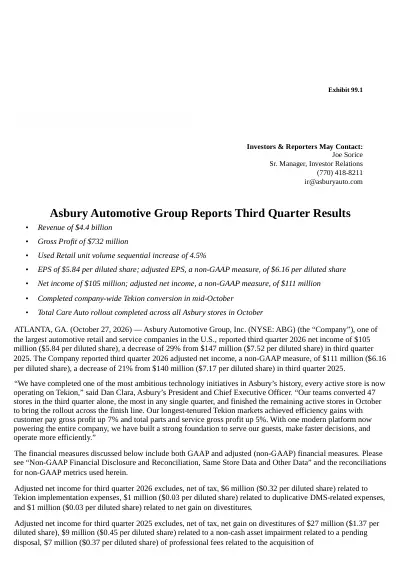
I am pleased to share that we have reached a defining milestone. Every active Asbury store is now operating on Tekion, our single modern technology platform.
After several years of planning and execution, we now run the entire company on one system, giving us a common foundation to operate more efficiently, make decisions faster, and serve guests better. This milestone is one part of a broader strategy, anchored in our five pillars, which aligns the organization on operational excellence within the following five priorities: growing new vehicle market share, driving profitable volume growth in used vehicles, reestablishing consistent growth in customer-pay gross profit, disciplined management of SG&A, and leveraging technology.
On the technology pillar, we converted 47 stores to Tekion in the third quarter, our largest single quarter ever, and completed the final 10 dealerships in October. Our longest-tenured Tekion stores in Georgia and at Koons are giving us an early read on the platform's impact.
In the third quarter, customer-pay gross profit grew 7% versus the total company same-store being flat. Total fixed-ops gross grew 5% versus total company same-store down 2%.
Units per salesperson increased 4% and gross profit per technician improved by 9%, both outpacing the rest of the company. As we have shared before, it takes time for team members to build the muscle memory that comes with a new platform before taking it to another level.
These stores have had the time, and we believe the same opportunity exists across the rest of our stores to improve efficiency, enhance the guest experience, and drive value for our shareholders. This was a major lift for our organization.
Our store teams learned a new system while continuing to sell, service, and care for our guests every day. Our support teams worked alongside them at every step.
I am grateful to them and to our partners at Tekion for getting us across the finish line. With the conversion behind us, the time and resources we dedicated to implementation can now go back into running and growing the business.
Our teams have done the hard work. Now it is time to put the technology to work.
It has been a busy few months for our teams. In addition to converting 47 stores to Tekion in the third quarter, we also implemented Total Care Auto to our 30-plus Herb Chambers stores, which completed our TCA rollout to all of Asbury.
Now, I will speak to our operational results on a same-store basis unless otherwise noted. I will note that our Herb Chambers stores are included in same-store results for August and September only.
Starting with new vehicles, our new vehicle business continued to perform in line with our expectations this quarter. On an all-store basis, new PVRs were $2,949, down 6% sequentially.
These PVRs are well within the range where we expect them to remain going forward. Same-store new units were down 8% against a tough prior-year comparison as we were lapping the expiration of federal and state BEV tax credit eligibility in 2025.
The sharp decrease in EV volume accounted for 5% of this 8% change year-over-year, mostly driven by Colorado, which had a robust state EV incentives last year. We closed the quarter with a well-managed inventory position of 53 days of supply, in line with the second quarter and setting us up well for the fourth quarter.
Next, turning to used vehicles, our used vehicle business continued to build momentum this quarter, and we are encouraged by the progress. Used retail gross profit grew 3% over last year, and we grew used retail PVR by 10% to $1,777, reflecting our focus on growing volume profitably.
Our strategy and retailing process improvements are taking hold and driving a stronger pre-owned business. On an all-store basis, our used retail volume increased 4.5% over the second quarter.
With our disciplined processes in place, we anticipate used volume to increase on a year-over-year basis as we move into the fourth quarter. We ended the quarter with a 41-day supply, keeping us well positioned heading into the fourth quarter.
Moving to F&I, our F&I business performed well at the dealership level this quarter where F&I PVR was up year-over-year. On a reported basis, F&I PVR was $2,177, down $19 from the prior year.
That decline was driven entirely by the non-cash TCA deferral, which represented $138 of impact. Excluding the TCA deferral, our F&I PVR was $2,453, up $119 year-over-year.
Our front-end yield per vehicle was $4,583 in the third quarter. Next, parts and service, our customer-pay revenue was up 2% with gross profit flat year-over-year.
Warranty gross profit was down 1%. Overall, parts and service was not where we wanted it to be.
Now, with a heavy lift of rolling out a new DMS behind us, we are optimistic in our ability to get back to consistent growth while delivering an exceptional guest experience. Quickly on operational efficiencies, our same-store adjusted SG&A as a percentage of gross profit was 67% in the quarter.
With the Tekion conversion now complete, we believe our SG&A can reach the low 60% range by the end of 2027, driven by efficiency gains as our teams become more productive on the platform. As we enter the fourth quarter, I am encouraged by what I see.
Our used business has improved for several quarters in a row. With our Tekion rollout now behind us, our teams can turn their full attention to serving our guests and executing our five-pillar strategy.
We will remain disciplined in allocating capital. Our priority is to bring net leverage below 3x.
We believe we are well positioned to finish the year strong and look forward to one platform to achieve our goals in 2027. Most of all, I want to thank our team members.
They took on one of the largest changes in our company's history and delivered it while keeping our guests at the center of everything we do. We are now positioned to see the benefits of their hard work.
Before I pass to Michael, one additional item worth noting: in early October, the FTC administrative proceeding against the company was dismissed. The outcome is consistent with our long-held view that our F&I sales practice have been and continue to be sound, lawful, and in compliance with applicable regulations.
We remain focused on serving our guests with the integrity and transparency that we have always defined how we do business. With that, I'll now hand the call over to Michael to discuss our financial results for the quarter.
Michael Welch
Thank you, Dan, and good morning, everyone. I'll start with our high-level financial results for the third quarter.
We generated $4.4 billion in revenue, earned a gross profit of $732 million, and gross profit margin of 16.6%. We delivered an adjusted operating margin of 4.9%.
Our adjusted net income was $111 million. Our adjusted EBITDA was $218 million.
Adjusted EPS was $6.16 for the quarter. In addition, the non-cash deferral headwind due to TCA this quarter was $0.69 per share.
Our adjusted EPS would have been $6.85 without the deferral impact. Adjusted net income for the third quarter 2026 excludes, net of tax, $6 million related to the Tekion implementation expenses, $1 million related to duplicate DMS-related expenses, and $1 million related to the net gain on divestitures.
Adjusted SG&A as a percentage of gross profit on an all-store basis was 67.4%. This reflected the peak of our Tekion conversions with 47 stores converting in the quarter and a number of stores still early in the adoption.
We expect SG&A leverage to improve in the fourth quarter with cost savings continuing in to 2027. Next, the adjusted tax rate for the quarter was 24.5%.
We estimate our effective tax rate for the full year to be approximately 24.8%. TCA generated $5 million of pre-tax income in the third quarter versus $14 million in the prior year.
The negative non-cash deferral impact for the quarter, net of tax, was about $12 million, compared to $4 million in the third quarter 2025. TCA's rollout to Chambers Group has been completed, and now all Asbury platforms are enabled with this differentiated asset.
As previously noted, we are assessing the next phase for TCA following its full rollout. We generated $525 million of adjusted operating cash flow year-to-date.
Excluding real estate purchases, we've spent $190 million on capital expenditures in the first three quarters of this year. We are updating our view for the full year CapEx in 2026 to be approximately $27 million or $275 million.
Adjusted free cash flow was $336 million through the end of September. We ended the quarter with $1 billion of liquidity comprised of floor plan offset accounts, availability on both our used line and revolving credit facility, and cash, excluding cash at Total Care Auto.
Our transaction-adjusted net leverage ratio was 3.5x at the end of the third quarter. Our target of 3x remains a priority for us, and we plan to reach it by mid-2027.
Driving operational excellence and reducing leverage is our focus. Once there, we will look for opportunities for share buybacks and tuck-in acquisitions.
With that, this concludes our prepared remarks. We will now turn the call over to the operator and take your questions.
Operator?
Operator
Thank you. If you would like to ask a question, please press star one on your telephone keypad.
A confirmation tone will indicate your line is in the question queue. You may press star two if you would like to remove your question from the queue.
For participants using speaker equipment, it may be necessary to pick up your handset before pressing the star keys. Our first question is from Jeff Lick with Stephens Inc.
Please proceed. ):
Jeff Lick
Good morning. Thanks for taking my question and congrats on getting the Tekion installation out of the way.
Dan and Michael, you've given some Tekion stats in terms of SG&A of the stores that are starting to see the benefit or productivity of technicians or sales people. I was wondering maybe you could just break apart a little bit more what the Tekion stores look like versus the non-Tekion stores.
Then, what the rollout or when we'll start to see the benefit of the stores that were still within that, call it that, 6- to 12-month time frame of installation.
Dan Clara
Jeff, good morning. Thank you for the call.
Thank you for the question. Yes.
As I stated, the customer-pay gross profit grew 7% in the Koons and the Georgia stores. The reason why I'm focusing on that is consistent with what we have been stating in the past, which it takes 6 months for the muscle memory to kick in.
Those stores have definitely been in the 6-month timeframe. We're excited what we see.
I will give you a little bit more color as well. When you look at ROs per advisor per day, we're seeing about a 9% increase.
When you look at dollars per technician, we're seeing about a high single-digit growth to a low double-digit growth. Then from a unit per salesperson standpoint, we're seeing about a mid single-digit improvement from an efficiency standpoint.
As I stated at the beginning of the call, we rolled 47 stores in the quarter, it's going to take us 6 months to get the muscle memory in those stores to be able to see the efficiencies that I just mentioned. We are very excited with what we see, the hard work that the team members have put together alongside our partner, Tekion, and excited for the future.
As you stated at the beginning, appreciate your congrats. It's been a heavy lift, but excited that it is behind us.
Michael Welch
Jeff, just one more thing on that from an SG&A percentage of gross perspective. We were down 329 basis points in the quarter on a same-store basis.
The two groups, Koons and Georgia who have been on the longest, one of those platforms was actually improved on an SG&A percentage of gross basis, and the other one was, with the decline in new PVRs, it was down or it increased on an SG&A percentage of gross basis, but about a third of what the rest of the company did. We're already seeing the impact on SG&A as well.
It's a two-sided coin. It's a gross profit item, it helps on the gross profit, but it also helps on the efficiencies.
We're seeing that on the SG&A side, percentage of gross, with those two markets as well. ):
Jeff Lick
In terms of just the store composition, what's the number of stores that at this point you'd say they were in the Tekion beneficiary column versus the Tekion, hey, we're still working through it or it's a net drag on productivity in SG&A measures?
Dan Clara
Jeff, if I look at the Koons and the Georgia markets, we're probably talking 35 to 40 stores that have reached the 6-month threshold that is crucial for us to see that muscle memory kick in. ):
Jeff Lick
Okay. Just one last quick one for you, Michael.
Could you talk about the dynamic of SG&A as it's obviously a little more noticeable when the GP dollars come from service and parts? Is there a bit of a double-whammy impact on SG&A in terms of getting better because, obviously, not only is Tekion going to help your SG&A in general, but it helps your service and parts gross as well?
Can you talk about that a little bit?
Michael Welch
Yeah, 100%. That's really our focus is we're growing gross profit again coming out of Tekion.
The goal is to be productive with our people and so don't put the cost back in that go with that gross profit growth. That's really where the focus is.
It's some cost cuts, some benefits for AI, but it's really getting back to growing gross profit and maintaining the cost structure to go with that. If we're trying to chase reducing gross profit, it's just hard to get that SG&A number, it's two pieces.
When we talk about low 60s, I'd say half of that comes from gross profit growth and the other half comes from true SG&A saves. ):
Jeff Lick
Great. Thanks very much for taking my questions.
Best of luck in Q4.
Michael Welch
Thank you.
Operator
Our next question is from Rajat Gupta with JPMorgan. Please proceed.
Rajat Gupta
Great. Thanks for taking the question.
Just on the metrics you provided on the Koons and the Georgia stores, that is just on a same-store basis versus last year third quarter, correct? Just to clarify.
Michael Welch
Correct.
Rajat Gupta
If you look at it on a dollar basis, pre-Tekion versus post-Tekion seasoning, are those metrics still higher year-over-year or we're still working through more progress for those stores on the parts and services side? I have a quick follow-up.
Thanks.
Michael Welch
Parts and services is higher. We think there's still room to go.
We are seeing, if you think about the layers, Koons is farther ahead than Georgia because it's been on it longer. As we see the stores work through the system, we are seeing those kind of improvements.
Dan can kind of hit on those pieces because Florida just kind of got over the 6-month mark at the very end of the quarter. There's some numbers there that we're starting to see in Florida at the very end of the quarter as well.
Dan Clara
Yeah. Rajat, good morning.
On Michael's comment, I'll just give you a few more numbers on what we saw at the end of September from a fixed operations gross profit. Florida, which just hit the mark, was up 3%.
I'll give you Koons as well, which I've already mentioned before, but Koons just for September was up 9%. Then Georgia was up 7%.
That gives you a pretty good indication of the efficiencies and the gains that we're getting once the muscle memory takes place.
Rajat Gupta
Understood. That's helpful.
Then, just on TCA, I know in the past there has been some chatter around maybe potentially disentangling that from the company. I'm curious, as you've spent more time evaluating if the business needs to be core and in-house, what's been the outcome?
Do you still think TCA is better as an in-house captive, or a hybrid model would serve it better? Thanks.
Michael Welch
We really love the TCA business. We love what it does for us long term and the cash flow that it provides.
Also just owning the guest experience all the way through the cycle. Once we've rolled it out fully to all the groups, we have to evaluate, keep it as is, grow it through other channels outside our dealerships, or to your point, flip it out to have it be an outside company to kind of get rid of the accounting noise.
We're still in the evaluation phase of that. Again, we love the business, love what it does for us, love the cash flow.
Very, very solid business for us, but just, again, trying to think through the next steps for that company.
Dan Clara
Rajat, one thing I'd like to add to to Michael's comment is, to his point, we love the business. When you think about the cash flow that it generates, it is also one part of the business that does not require heavy CapEx, or any CapEx for that matter.
We really like what it generates from a cash flow standpoint. As Michael mentioned, those are the three options on the table that we are always analyzing.
Rajat Gupta
Understood. Thanks for the color and good luck.
I'll jump back in queue.
Michael Welch
Thank you.
Operator
Our next question is from Glenn Chin with Seaport Research Partners. Please proceed.
Glenn Chin
Good morning. Thank you.
Congrats on completing the rollouts of both Tekion and TCA. Glad to see all the benefits starting to come through.
First, can you tell us what you saw with the consumer in the quarter? There was a lot of noise and chatter of volatility and glad to see that parts and service still grew same-store, but margins compressed a bit.
Can you tell us what happened there?
Dan Clara
Yes. I'll start with the last question, margin compression in fixed operations.
That is a product of what I just mentioned, that the 6 months that it takes of muscle memory to be developed as we roll out Tekion. To be more specific, think about this: you're used for 20, 30 years as an advisor to process customers one way under CDK.
Your world is turned upside down. You're learning a new system.
You have five, six customers waiting for you. The path of least resistance, which I don't blame team members to taking, they start discounting just to make sure that we take care of the guests.
As that muscle memory starts to come in, the discounts start to go away, and then the margins start to stabilize and get back to its normal course. Not concerned about that.
That's going to get back to normal, and we're already seeing the progress being made. On the first part of the question, on consumer affordability, I will tell you that we saw from a customer-pay standpoint, we measure all of them, we measure BEV, plug-in hybrid, and internal combustion.
The dollars per ticket have stayed flat. In some cases, they've gone up a little bit here and there.
That gives us good indication that things are working properly, and the consumer is still spending money with us. I will tell you that our customer-pay traffic for the quarter, meaning the repair order count, was down 1.9%.
I think I've answered your question. If you have any other follow-ups, happy to take them as well.
Michael Welch
Glenn, then one other thing on the margin. Internals is highly accretive to the gross margin on parts and service because there's no revenue for it.
It's just all gross profit. As we continue to grow the used car business, especially in the fourth quarter and in '20 '27, that will also help the fixed-ops margin as we get that used car volume back through and get that recon work through the fixed-ops side.
Glenn Chin
Okay. Very good.
Thanks for all the color. Then, just on used.
Good to see the progress there, the improvement in comps. Can you just tell us what we might expect going forward just with respect to the balance between volume versus GPUs?
Dan Clara
Yes. I cannot remember when it was, it might have been May or June, but we announced that our strategy was shifting.
For years, we had been protecting gross profit and not chasing the volume. As a reminder, we shifted that strategy in May because we knew that lease returns were coming and it was a good time to start going after a little bit of the volume while protecting the profitability of the used car department.
When you think about 70 70% to 75% of our cars that we retail come from, either it is trade-ins, or acquisitions from guests, or loaner cars. That puts us in a pretty good place to continue to grow that business.
Then about 15%, 20% of them come from acquisition at the auction, which we have made the concerted effort to go after to grow the volume. I will tell you that we are fully committed to growing the volume while protecting the gross profit.
We expect in the fourth quarter to be ahead year-over-year compared to last year.
Glenn Chin
Okay. Very good.
Thanks, gentlemen. Good luck.
Dan Clara
Thank you.
Operator
Our next question is from Alex Perry with Bank of America. Please proceed.
Alex Perry
Hi. Thanks for taking our questions here.
Just wanted to follow up on the last question, actually. Just on the customer-pay RO count being down, I think you said 2%.
Do you think there's share loss happening to cheaper independents for some of the P&S work given some of the affordability constraints on the consumer right now? Are you seeing any sort of evidence of work deferrals, given some of the affordability challenges?
Thanks.
Dan Clara
Yep. Good morning, Alex.
On the work deferral, the measurements that I have when I compare what we call decline work from our customers, I have not seen an increase in that. That gives us some level of comfort that nothing is changing materially.
On the first question in regards to maybe a loss of share, I'll tell you that it's more than a fair question, but when you look at the average miles that are coming through our shop at 70,000 mi, I would argue that we do a pretty good job of retaining that guest after the manufacturer's warranty expires. The 1.9%, like anything, I would not make a big deal about it.
It is seasonality. Obviously, when you roll 47 stores in Tekion in the quarter, and I can't stress it enough, the heaviest lift of the entire rollout of Tekion, you will see an impact in traffic because people's muscle memory gets lost, they don't move as fast, the efficiency is not there.
That will all come as we have proven after 6 months of the muscle memory kicking back in.
Alex Perry
That's really helpful. Then my follow-up was just on the FTC enforcement actions.
What impact are those enforcement actions sort of having on your business? Did you have to take advertised prices up at all?
Do you think it's impacting your used volume sales? Then, what do you think happens to some of those doc fees?
Do you think they get dropped over time, or how do you think this all sort of plays out? Thanks.
Dan Clara
Yeah. The impact that we've had is more of a level playing field.
We've always done things the legal, ethical way, with full transparency. As a reminder, when the FTC came with this notification at the beginning of the year, Asbury did not receive a letter because we have always been compliant.
Some of our major markets such as Georgia, Colorado, and Massachusetts, it was already state law to have the doc fee included in the price. We've been operating under those circumstances for years.
As far as what does it do, I think that it is great for the industry. I think that being transparent, no hidden charges, is what the consumer deserves.
It level-sets the playing field for all of us out there. I view this as very positive.
It will continue to enhance the guest experience. Those that don't want to abide are going to be left behind.
Alex Perry
That's really helpful. Best of luck going forward.
Thank you.
Operator
Our next question is from Michael Ward with Citi Group. Please proceed.
Michael Ward
Thanks very much. Good morning, everyone.
First thing, could you put some numbers on the BEV sales year-over-year?
Dan Clara
On, sorry, you cut off a little bit, on the electric sales?
Michael Ward
Yeah. You mentioned you mentioned that was about half of the unit new unit decline, could you put some actual numbers on the number of BEV units you sold last year and then this year?
Dan Clara
Yeah. Yes, I can do that for you.
In Q3 of 2026, my electric vehicles were 2.1% of the total units sold. I will tell you that from a year-over-year basis, we were down 76% in EV sales, Q3 of '25 versus Q3 of '26.
Michael Ward
Okay. Now I always thought the BEV profitability was lower than ICE, so, with that decline, you would expect to see a little stronger new vehicle gross than we saw.
Was there something else in there in the quarter? Was there a sell-down of some late models that kind of compressed gross that maybe turns as we go into 4Q and into the first half?
Yeah.
Dan Clara
It's a great question, an excellent point. You are correct, the PVR in ICE is higher than EV.
I will tell you that what impacted the drop in PVR quarter-over-quarter, it really came down from imports. We're seeing additional pressure with some of the OEMs, Hyundai being one of them.
Michael Ward
Then,
Dan Clara
obviously, you can see it at the domestic side of the equation as well. We still continue to have headwinds with Stellantis.
Although I will tell you that from an inventory management standpoint, we have really put ourselves in a good position. We have reduced about 1,000 units from what we used to carry on floor plan expense with Stellantis.
Our ordering is at a much higher level from a turn rate standpoint. Really excited to see what I'm seeing out of those Stellantis stores, that we are set up for a better quarter and as we move into 2027.
Michael Ward
Thank you. Very good color.
I appreciate that. Just lastly on Tekion, because I know we've hit it hard, but I think it is important.
The muscle memory that you talked about. About a third of the stores just got converted in October, some of that muscle memory lags.
Then, from November, December and into the first half, we should start to see some pretty good benefits, particularly since you have a good track record behind it. Is that the right way to look at it?
Dan Clara
I think you're looking at it right. I would just say that it'll be more into the tail end of Q1, beginning of Q2.
Listen, nobody is more anxious and wants to get the benefits of all the hard work than us. We do know, after rolling out 157 dealerships, that it does take 6 months for the muscle memory to kick in.
We're just going to be there, continuing to train, mentor, and develop our team members to provide the best guest experience.
Michael Ward
I really appreciate it. Thanks very much.
Dan Clara
Thank you.
Operator
Our next question is from Rob Saltzman with UBS. Please proceed.
Rob Saltzman
Hey, team. Thanks for the time.
You mentioned that you expect to exit at that low-60% range on SG&A to gross end of Q4. If that's the exit rate, how are you thinking about the trajectory of that metric into 2027, assuming a stable operating environment?
What could that number look like maybe in the back half of '26 after that 6-month transition period you mentioned starts to abide after the large Q3 rollout? Thanks.
Michael Welch
Just to clarify, we expect to be in the low 60s by the end of '27. We'll get a little bit better in fourth quarter, and then kind of progress through it as we go through next year.
To Dan's point, kind of 2Q is when we start getting most of the stores into that 6-month window. You'll see in the back half of the year next year we'll get kind of fully on.
Again, it's both a combination of increasing the gross profit, which will help the SG&A, and making sure we get the costs out, that will help the SG&A. It's both pieces.
It's low 60s by the end of '27 is the goal.
Rob Saltzman
Thanks. Then just one follow-up would just be, obviously, SG&A, but any sort of high-level thoughts on the business here into 2027?
How are you thinking about the trajectory, and kind of how are you thinking about the rest of the business heading into next year? Even just some early high-level puts and takes that you guys are thinking about as you start to plan.
Michael Welch
It's really hard right now. We're still, it feels like from a new vehicle perspective, it's probably going to be similar in terms of volume.
PVRs, we've said, kind of 2,750 to 3,000 is kind of where we see the range, and we're kind of in that range now. I think that's kind of a range for next year.
Used cars, we talked about we're going to push on the volume side of the equation. PVRs should kind of be in the range that they're at now, somewhere in that 1,750 range.
F&I, from a TCA perspective, we'll see some continued headwinds into the next year, and so we think the dealerships will have some improvements in F&I, but TCA will kind of offset that, make, I'll call F&I a little bit of a drag next year. Then fixed-ops, we think we can get back to growing fixed-ops in that mid-single-digit range next year, and that will put SG&A kind of in that, it will move throughout the year, but by the end of the year, in that low 60s, but, starting off mid-60s, and then kind of working its way down.
Rob Saltzman
Thanks, team. Appreciate the time.
Operator
Our next question is from Daniela Haigian with Morgan Stanley. Please proceed.
Daniela Haigian
Thank you. I think that was a really helpful overview of thoughts into next year.
I'll kind of step back and ask more of a macro question. Have you seen any change in consumer behavior, whether that's trade-down or substitution from new into used, or deferring some service work?
I know we've talked a little bit about this, but any greater sensitivity than you've seen in prior quarters?
Dan Clara
Good morning, Daniela. Yes, we've seen a little bit of a change.
I think, the longer that it goes with the high gas prices that we have, I mentioned this in the last earnings call that, based on prior history, it takes about 6 months for consumers to decide whether they're going to get rid of their gas guzzlers or not. We're starting to see a little bit more of that.
Ironically, they're trading from a big SUV V8 or what have you into still an SUV, but maybe in this case a hybrid SUV that affords them the size, but still a much better miles per gallon. Then, from a declined services, I mentioned this earlier, based on what I track, I have not seen a drop in declined services, staying pretty consistent.
I'm not seeing a change there from a consumer behavior.
Daniela Haigian
Thank you. That's very helpful.
Then on the used vehicle side, you said pushing volumes more. Is that a function of more off-lease supply coming online so now you have more access to trade-ins, or are you seeing greater competition to try and access those volumes?
Dan Clara
It's more about tweaking the way that we appraise cars, improving our look-to-book, which basically what that means is, if I appraised 100 cars, how many did I trade for? It's a metric that we pay close attention to working with our great operators on improving that metric.
Then, obviously, taking full advantage of the cars that we can buy through the service drive with the internal processes that we have.
Daniela Haigian
Great. Thank you very much.
You bet.
Operator
Our next question is from John Babcock with Barclays. Please proceed.
John Babcock
Morning, and thanks for taking my questions. Just firstly on the used vehicle market, it generally sounds like the wholesale market's been pretty soft there.
What impact did that have on the GPUs? Also, if you can just broadly talk about what's driving that, that'd be helpful.
Yeah.
Dan Clara
It didn't have much of an impact on our PVR. As I mentioned before, 75% to 80% of our inventory comes from trade-ins, loaner cars, and cars that we acquire internally.
I will tell you that it is a metric that I measure every single week, and it is, how much PVR do we make on a car that we traded in versus a car that we bought at the auction? The one thing that is guaranteed when you buy a car at the auction is you're the one that paid the most money for the car because you're the last one standing with your arm up.
Naturally, your PVR is not going to be the same, but we normally make about 50% less than we make on a car that we trade in, but there's a benefit. You get the internal gross profit, you get another unit in operation, you get to certify the car, and then you get also the opportunity to protect the investment by offering a vehicle service contract or any of the other products that we offer.
John Babcock
All right. Thanks for that.
Then next on M&A, I was wondering if you might be able to talk about what you're seeing in the market right now both in terms of prospects and valuations, and also when we should expect you to get more active there.
Dan Clara
Like Michael and I stated earlier, we have two major priorities right now. Our number one priority is operational excellence now that the rollout is behind us.
The second priority is with the operational excellence comes additional EBITDA and free cash flow. We want to go ahead and pay down the debt to get below 3x.
In the M&A, I've been seeing some deals still hitting the market. As you can see, those deals, I'm sure that you see what they're bringing.
I'd like to expand a little bit on this one because I would say that the private market transactions in our industry, they continue to show the value that buyers place on high-quality dealership portfolios. We believe that Asbury stacks up very well with a strong mix of luxury and import franchises.
We have very attractive markets and very valuable owned real estate. I can't stress it enough, we own over 80% of our real estate.
We have TCA, which gives us with the nice growing streams, which we believe the market does not give us full credit for that business. Therefore, when you put all that together, we believe our current share price does not reflect the underlying value of the business that we're seeing in some of these private markets deals that are going out there.
John Babcock
Okay. Then, just last question quickly.
You mentioned operational excellence and, obviously, you have the Tekion benefits rolling through next year. Could you maybe talk about what other opportunities you have here to help take costs out on the SG&A line and/or just broadly to help improve volumes within the business?
Michael Welch
On the SG&A side, not only the Tekion just makes us more efficient, but also just a lot of stuff going on with AI really helps us with those efficiencies as well, and being able to automate some functions with that technology. Tekion allows us the ability to deploy that AI easier.
Really we've been, I won't this sound bad, but we've been devoting a lot of our resources to getting Tekion rolled out. Being able to deploy all those resources back into the five pillars, where it's growing new vehicles, growing fixed-ops, growing used cars, that focus and not being, I won't say distracted, but just we've been having to put a lot of resources toward just the rollouts.
That's just going to allow us to push the volume on the gross profit growth, and that's really if we can get back to growing gross profit in solid numbers and keep the expenses lean, that has a big benefit on the SG&A number, our SG&A percentage of gross number.
John Babcock
Okay. Very helpful.
Thank you.
Operator
Our next question is from David Whiston with Morningstar. Please proceed.
Hey,
David Whiston
thanks. Good morning.
Could you just talk a bit about what effect, if any, interest rates and negative equity is having both for buying used and new vehicles and for making additional purchases in the service lane?
Dan Clara
I will tell you that the biggest impact that I have seen, or the one that comes up the most, is negative equity. We're starting to see cars that were sold during the pandemic that are starting to come in and so there is a negative equity that definitely impacting some brands more than others.
From a interest rate perspective, we've not seen a major shift, although I'm curious to see when OEMs are going to start supporting more leasing just because of the affordability that it allows somebody to get a newer car for less of a monthly payment.
David Whiston
On the brands where it is having an issue, are you losing those sales, or are you able to figure something out?
Dan Clara
Listen, it's hard to tell because, as it is based on the consumer credit. If the consumer credit is, call it 700-plus FICO score, your loan-to-value is going to be a lot more flexible.
You can put that deal together depending on how much negative equity we're talking about. That's on a case-by-case scenario.
In some cases, if you have somebody that maybe is subprime or does not have a lot of down payment, yeah, you do miss that deal, or always try to find a solution. Is there a car that came out of loaner car that maybe puts you in a better book position that you can trade them out of it?
We explore every option available for us. Then,
David Whiston
on the balance sheet, you talked about wanting to do some tuck-in acquisitions, but also paying down debt to get the leverage ratio to your target. Would the tuck-in deals involve touching the credit line, or would it be entirely internally funded without debt?
Michael Welch
Our first priority is getting the leverage down. Then, at the current share price, it'd be share buybacks.
Then tuck-in acquisitions would be the last of what we use the capital for. The goal is in the future we should be able to do share buybacks and tuck-in acquisitions with our free cash flow.
We want to get back to that, below 3x just to have the optionality when something comes up to be able to go after it. Right now, we're just a little limited in terms of where the leverage is.
David Whiston
Thank you.
Operator
Our next question is from Ryan Sigdahl with Craig-Hallum Capital Group. Please proceed.
Ryan Sigdahl
Hey, good morning, guys. Two clarifications for us or follow-ons.
On the doc fees, I appreciate the more transparent approach relative to many of your peers, but curious on it from an absolute standpoint if you expect doc fees to go lower from here for Asbury, or if you think most of that is already built in at this moment? Then maybe just talk to the GPU 3,000 from a new standpoint normalization and if doc fees impact that from here?
Michael Welch
Yep. I don't expect doc fees to go down.
Our approach has always been very simple with doc fees. We've never wanted to be the highest in the markets that we operate.
We've always been in the middle for lack of a better term. We're positioned the right way.
Don't expect that to go down. We'll continue to, obviously, to operate with full transparency.
The second part of the question, can you please remind me?
Dan Clara
New vehicle. Oh, new vehicle PVR.
At 3,000, for several quarters, we've been talking about our projection of being between 2,750 to 3,000. You can see that, actually, I believe new car PVR sequentially quarter-over-quarter went up $6 a car, if I remember correctly.
I believe that we're stabilizing there, and it fits well within the range that Michael and I have been talking about it. The one thing that is important to consider here is it doesn't mean that it's going to be a flat line.
There's going to be ups and downs, seasonality, OEMs incentives, and what have you, but I think that that target that you see is pretty much what we're seeing moving forward.
Ryan Sigdahl
Appreciate that. Then maybe just quick one on SG&A to gross profit, appreciate the commentary and kind of glide path from mid-60s to low-60s exiting next year, but are you willing to say at least directionally if you think '28 and beyond you can go below the low-60s, if it's kind of a linear improvement from there?
Thanks.
Michael Welch
I guess we're going to take it in stages. We have what we'll call the AI and Tekion stuff that gets us into the low-60s.
There's some things we're looking at in terms of what I'll call the digital vehicle transaction, and depending on where that goes, that could give us the ability to kind of push it below 60%. I wouldn't say that's a linear path, that's more of a next step path, and we've just got to kind of figure out how that works with our software and the consumer, and kind of how the consumer wants to behave on online and digital-type transactions.
That's a below-60s with that new phase of digital vehicle sales transactions.
Ryan Sigdahl
Reasonable to assume kind of low-60s is the right run rate kind of in out years? Until
Michael Welch
again, until we kind of cross the bridge on, we're hoping '28, '29, but we've got to do some homework and feeling out on how the consumer reacts to that and test it before we pull the trigger on that. I think low-60s until we can make that change.
Ryan Sigdahl
Helpful. Appreciate it.
Thanks. Good luck, guys.
Michael Welch
Thanks.
Operator
Our next question is from Rajat Gupta with JPMorgan. Please proceed.
Rajat Gupta
Hey, thanks for taking the follow-up. I just wanted to follow up on parts and services.
I think you talked about getting back to mid-single-digit range at some point next year. Are you already starting to see some signs of turnaround in the fourth quarter here, from down 2% same-store in third quarter?
Do you think you're going to be back in positive territory here in the fourth quarter? Just trying to understand the path to what's that mid-single-digit range.
Is it market-driven? Is it Tekion productivity-driven?
Then I have a very quick follow-up. Thanks.
Michael Welch
Just a reminder, 47 stores went live this quarter. Fourth quarter will still have an impact for those stores.
We're still in the I'll call fourth quarter is still in the heavy piece of Tekion. I just want to put that up there right there, and then I'll let Dan kind of answer the rest of it.
Fourth quarter is still a pretty heavy Tekion-impacted quarter just because of the amount of stores that went live this quarter.
Dan Clara
Agree with Michael. Rajat, just to give you more color, again, on, yes, we're seeing progress in the stores or the markets that have been under Tekion for 6 months or more.
Just as I repeated earlier, Florida, which just crossed a 6-month target, the market was up 3% in September. That's just for the month of September.
Then Georgia was up for the month of September, 6.6%. Very encouraged by what we see.
I can't stress it enough. Please don't forget that we rolled out 47 stores in the third quarter.
All those stores are not going to be in the 6-month threshold that we require and that we have seen the progress being made until end of Q1. You will see progress in Q4, meaning in the stores that continue to roll into the 6-month threshold, but we're not going to realize the full benefit of this until we go into the end of Q1 and Q2 of 2027.
Rajat Gupta
Understood. Then, just on F&I, we have been hearing, at least from some private dealers that warranty attach rates are just taking a bit of a hit given affordability pressures.
I'm curious if you're observing any of that at your stores, how do you think F&I progresses, excluding obviously the TCA accounting noise, just on a core basis, what's your view there? Thanks.
Michael Welch
We have seen a little bit of a drop in terms of our mix of the products versus the financing side of the equation. This quarter, we still grew F&I PVR at the store level, excluding the TCA deferral, we grew it $119.
We're still able to grow the F&I number. We have the headwind of TCA deferral going through there, but we're still seeing nice progress at the store level on the F&I side.
We haven't seen a decrease on PVRs at the store level.
Rajat Gupta
Understood. That's very helpful.
Great. Thanks for taking the questions again, and good luck.
Michael Welch
Thank you.
Dan Clara
This concludes today's call. Thank you very much, and we look forward to seeing you after Q4.
Operator
Thank you for your participation. You may now disconnect your lines.