Abacus Global Management, Inc.
NNYSE:ABXQ3 FY2026 · Earnings Call TranscriptNovember 5, 2026
Operator
Please note this event is being recorded. I'd like to now turn the call over to David Jackson, Abacus Global Management Head of Investor Relations.
Please go ahead.
David Jackson
Thank you, operator, and thank you everyone for joining Abacus Global Management's third quarter earnings call. Here with me today are Jay Jackson, Chairman and Chief Executive Officer; Elena Plesco, Chief Investment Officer; and Bill McCauley, Chief Financial and Chief Operating Officer.
This afternoon at 4:05 p.m. Eastern Time, Abacus Global Management released our third quarter 2026 results.
This afternoon's call will allow participants to ask questions about our results. Before we begin, Abacus Global Management refers participants on this call to the investor web page, ir.abacusgm.com, for the press release, investor information, and filings with the SEC for a discussion of the risks that can affect the business.
Abacus Global Management more specifically refers participants to the presentation furnished today on Form 8-K with the Securities and Exchange Commission, and reminds listeners that some of the comments today may contain forward-looking statements, and as such will be subject to risks and uncertainties, which if they materialize could materially affect results. For more information on the risks, uncertainties, and assumptions relating to forward-looking statements, please refer to Abacus Global Management's public filings.
During the call, we will reference certain non-GAAP financial measures. Although we believe these measures provide useful supplemental information about our financial performance, they are not recognized measures and do not have standardized meanings under US generally accepted accounting principles, or GAAP.
Please see our public filings for additional information regarding our non-GAAP financial measures, including references to comparable GAAP measures. With that, I'd now like to turn the call over to Jay Jackson, Abacus Global Management's Chairman and Chief Executive Officer.
Jay Jackson
Thank you, David, and thank you all for joining us today. The third quarter was a momentous one for Abacus.
We outperformed operationally and made meaningful strategic progress. In the third quarter alone, we hosted our Investor Day at the New York Stock Exchange, launched the ABX Longevity Growth and Income Fund, and completed our largest securitization to date.
Most recently, we broadened LifeArc's reach through our partnership with Retirable and its network of RIAs alongside Manning & Napier. Let me start with a few key metrics that Bill and Elena will detail later.
Through the third quarter, longevity fund inflows were $997 million compared to $604 million for all of 2025. We also continue to see strong demand for our assets from outside buyers, and our earnings continue to convert to cash.
Over the last 12 months, cash EBITDA was $203.2 million, or 132% of adjusted EBITDA, as gains we recorded in prior periods converted to cash faster than we added new ones. The gains we book are showing up as cash, and that is strong support for how we value our book.
This quarter, two of our funds, accounting for over $1 billion in AUM, sold 27% of their portfolios to investors above NAV. This is independent buyers paying more than the values we carry, which is the strongest check we have on our marks.
The story I most want you to take away from this quarter is LifeArc. Over the coming decades, an estimated $124 trillion will pass from one generation to the next in the United States.
Nearly every financial plan behind that wealth still answers its most important question with a guess: How long will I live? A lifespan is an arc of probabilities, and LifeArc is the first platform built to measure that arc for an individual.
It takes the proprietary longevity data and HIPAA-compliant medical insight we've spent more than 20 years building for institutional markets and puts it in the hands of individual investors and the advisors who serve them. That is what puts Abacus at the center of how this wealth transfer will be planned and managed.
We are still early, but the first signals are striking. LifeArc has generated 357 inquiries to date.
In the first week of our new client pipeline alone, inquiries represented roughly $43 million of combined investable assets, an average of about $7 million per inquiry, with the largest at $20 million. To date, the pipeline has included over $500 million in investable assets.
The people who are coming to LifeArc are exactly who we built it for: 91% are age 50-plus, with an average of 66, and 100% opted to be contacted. The tools are what we designed them to do: 6 of the first 7 pipeline inquiries came through our lifespan calculator, and we have already seen our first referral flow from abacusgm.com into LifeArc.
Two partner firms, Retirable and Manning & Napier, are now live and enrolling clients into LifeArc investment portfolios. Since our October 13th partnership announcement, LifeArc holds the number-one Google position for its name, and branded search clicks rose fivefold in a single week.
On the funding side, our last securitization closed in September at more than $400 million in total structure. It is our largest securitization to date and roughly eight times the size of our inaugural note just a year ago.
The investment-grade rated notes were placed primarily with insurance companies. The deal was two times oversubscribed, which allowed us to upsize it.
As a part of a rated transaction, the assets were stress-tested and reviewed by well-known institutional financial sponsors and multi-hundred-billion-dollar insurance companies. We view this as market validation and as a meaningful new arrow in the quiver.
Securitization further diversifies our distribution channels and gives us a cost of capital advantage and greater efficiency as we scale. While we are not providing a dollar-denominated target, we expect to pursue 2 to 3 securitizations per year, with the next currently planned for the first quarter of 2027.
This quarter showed what Abacus is becoming: a platform where more than 20 years of longevity data powers institutional capital markets on one side and individual financial planning on the other. We remain highly confident this momentum can continue in the quarters and years ahead.
With that, let me turn the call over to Bill to review our quarterly financials.
Bill McCauley
Thank you, Jay. As I have in quarters past, I'll start with our outlook and then walk through our operational and financial performance.
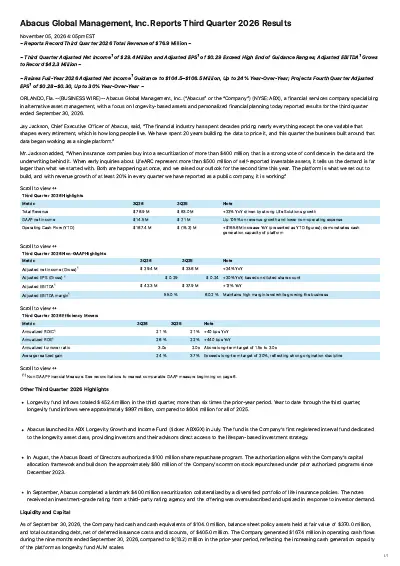
Third quarter adjusted net income of $29.4 million came in above the top end of the $26 to $28 million range we guided to last quarter. Based on that strong performance, we are raising our full-year 2026 guidance for the second time this year.
We now expect adjusted net income of $104.5 to $106.5 million, up from $100 to $106 million, and adjusted EPS of $1.05 to $1.07, up from $1.00 to $1.05. At the top end, that represents 24% growth over 2025.
For the fourth quarter, we expect adjusted net income of $28 to $30 million, or adjusted EPS of 28 cents to 30 cents, which at the top end represents 30% growth over the fourth quarter of 2025. As a reminder, our adjusted net income guidance is presented on a gross basis before estimated tax effects.
Jay said it well: Our momentum remains strong at Abacus across an increasing range of value creation opportunities. In the third quarter, we deployed $235.3 million of capital, which brings our year-to-date total to $596.8 million, up 71% compared to our 2025 pace.
In Q3, we reviewed 17,787 qualified policies, and year-to-date the total number of policies reviewed has surpassed 101,000. Similar to our comments last quarter, Abacus continues to improve inbound volume through the top of the funnel and has also enhanced screening and underwriting efficiency through technology and AI.
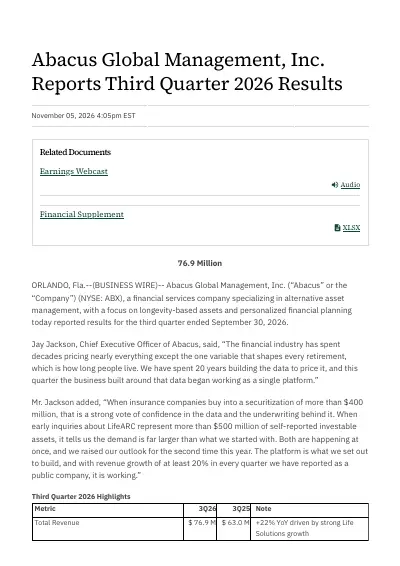
Demand was also strong in our longevity fund products, with capital inflows totaling approximately $452.4 million in the third quarter, which is more than six times the rate of the prior-year period. Turning to our financial results, Abacus generated revenue of $76.9 million for the third quarter, an increase of 22% year-over-year.
That growth was driven by Life Solutions revenue of $71.3 million, up 32% from $54.1 million a year ago, and Technology Services revenue of $0.6 million, up 155% from $0.2 million a year ago. In the Life Solutions segment, growth was driven by strong performance on life settlement policies sold.
Specifically, realized gains on policies sold and matured rose by $25.8 million year-over-year, more than offsetting an $11.1 million decline in unrealized gains. Abacus also generated strong growth in both insurance commissions and on originations, which were up 145.5% and 281.9%, respectively, compared to a year ago.
Operating expenses for the third quarter totaled $43.4 million, driven by general and administrative expenses of $33.6 million, up from $24.7 million, and sales and marketing expense of $5.6 million, up from $3.8 million. The 32% increase in total operating expenses was largely driven by higher legal and professional fees.
General and administrative expenses rose $8.9 million, primarily reflecting $5.2 million of higher legal and professional fees incurred in connection with various strategic projects and $1.8 million of higher payroll from staffing added through acquisitions, while sales and marketing rose $1.8 million on higher advertising to support Life Solutions growth. Adjusted EBITDA in the quarter of $42.3 million, representing a margin of 55%, which remains very strong despite the increase in professional fees I just mentioned.
Adjusted EBITDA increased 12% year-over-year, driven by strong growth in Life Solutions, partially offset by lower asset management fees and higher professional fees. As a result, adjusted net income grew 24% year-over-year to $29.4 million in the third quarter, which equates to adjusted EPS of 29 cents.
Our adjusted return on equity was 26%, up 440 basis points year-over-year. Cash held at quarter-end was $104 million, with policy assets of $370 million.
As we highlight in the presentation, we are very pleased with the acceleration we've captured in cash conversion from EBITDA. Year-to-date, we have generated $1.46 of operating cash flow for every dollar of adjusted EBITDA.
Our long-term debt balance, excluding non-recourse liabilities, is now $366 million. Overall, our balance sheet is a strength for Abacus and provides us a platform to grow and add shareholder value in a number of ways.
In addition to supporting growth driven by LifeArc and our growing partnerships, Abacus also returned capital to shareholders through share repurchases and dividends. In August, our board authorized a $100 million share repurchase program that runs through May of 2028.
In the quarter, we repurchased $1.7 million worth of ABX stock at an average share price of $8.13. Additionally, we are pleased to announce that our board unanimously approved a 10% increase in our regular annual dividend to 22 cents per share, with an ex-dividend date of December 1st, 2026.
All told, our results and expectations continue to reflect strong growth and momentum in our strategy. As Jay said, we are excited about what lies ahead for Abacus.
With that, let me turn the call over to Elena to detail the performance of our balance sheet and investment strategy.
Elena Plesco
Thanks, Bill. This quarter, I want to do three things: walk through how the balance sheet performed; talk about the closure of our landmark $400 million securitization and why it matters; and then explain the unit economics of each distribution channel and where we're steering the business.
Let me start with the balance sheet. For the third quarter, annualized portfolio turnover was 3 times, above our long-term target of 1.5 to 2 times.
That level of turnover reflects continued demand for the assets we originate and our ability to recycle capital efficiently while holding our underwriting discipline. We deployed approximately $235.3 million of capital during the quarter, up 130% year-over-year, which tells you origination volume and investor appetite are both strong.
Our average realized gain on policy sales for the quarter was approximately 24%, comfortably above our long-term target of 20% plus. I want to underline what that number represents because it is central to how we think about the business.
These are realized transactions at real prices with real counterparties. Our book turned 3 times this quarter on an annualized basis.
Turnover will vary from quarter to quarter, but that's real cash realized, not marks on a screen. Every turn of the book validates the fair value we carry.
In a market that is spending a great deal of energy debating whether private asset marks are real, that distinction matters, and I will come back to it. Holding period is another measure of efficiency.
Policies we sold this quarter were held on average for approximately 62 days versus approximately 212 days for policies still on the balance sheet, mainly driven by capital recycling late in the quarter due to the timing of the securitization. Now let me turn to our latest securitization, which closed in September and was a defining event of the quarter, and is setting the trajectory for our business.
The objective was to diversify how we distribute what we originate. Our balance sheet functions as a warehouse.
We originate policies, hold them while they season, and then distribute them, which is why turnover is such an important measure for us. Our focus has always been on building out the channels that sit on the other side of that warehouse, and securitization is the newest of them.
It adds a deep, lower-cost source of capital alongside institutional sales and our funds, sized to keep pace with origination of $235.3 million in the quarter. We pooled longevity assets into a special purpose vehicle and issued investment-grade rated Class A and Class B notes, privately placed primarily with insurance companies.
The total structure, including the residual, is more than $400 million. That is roughly eight times the size of our inaugural $50 million note in October 2025.
This deal was oversubscribed, and demand allowed us to upsize it. Abacus retains a portion of the residual interest and remains servicer.
I would point to four things this adds to every turn of our flywheel. Cheaper capital: Investment-grade notes fund more origination per dollar of equity.
Faster recycling: More channels with consistent execution allow us to recycle capital faster, and those proceeds go straight back into origination. On a book that turned 3 times this quarter, that compounds.
Recurring income: We stay servicer and keep the residual, the economics stay with Abacus long after the sale. I will come to the number in a moment.
New investors: Insurance companies and other fixed-income buyers now have a rated entry point into this asset class. That opens a deep pool of capital that did not have a practical way in before.
There is also a validation point here that I do not want to understate. An investment-grade rating means independent agencies reviewed the collateral and our origination and servicing platforms and were comfortable rating the notes.
The buyers were insurance companies, some of the most conservative capital in the market. Put that next to a book that realizes its marks in cash, and you have about as strong and external confirmation of how we value these assets as you can get.
Securitization also scales our servicing platform, which today covers 3,905 policies and $8 billion of face value. Our intent is for this to be a repeatable channel, not a one-off.
Now I want to spend a moment on channel economics, because they explain the direction of the business better than any target does. We distribute what we originate through three channels: institutional sales since 2004, managed funds since 2023, and securitization since 2025.
All three are priced under one framework. That means we earn the same upfront gains, historically 20% to 25% on a gross basis, whichever channel a policy goes into.
What differs is what happens after the sale. Institutional sales: The upfront gain is the end of it.
It is a one-time sale with no recurring fees, and the buyer keeps the upside. Longevity fund: When the same policy goes into one of our funds, we earn the same upfront gain.
We also earn 75 to 100 basis points a year in management and servicing fees on the fund AUM, plus performance fees above hurdle rates. Securitization: We earn the same upfront gain plus 50 to 100 basis points a year on portfolio value.
We also keep a residual paid after the noteholders. Depending on the structure, we target the residual to be in the teens on the IRR basis.
The same asset originated once and priced once is worth meaningfully more to us in a fund or securitization than in a wholesale trade. That is why we're shifting the mix.
Our target of 70% fee-related revenue by 2030 is not the reason we're doing this. It is the result of putting more of what we originate into the channels that pay us more for longer with less balance sheet capital.
Fee-related revenue is still only about 11% of our mix today, and every securitization and every fund dollar moves it higher. The story remains straightforward: We run a differentiated origination platform with disciplined underwriting and consistent monetization, and we're moving more of what we originate into the channels with the best economics.
Those are the priorities we laid out at Investor Day, and the third quarter was real progress against them. With that, let me turn it back to Jay for some closing thoughts.
Jay Jackson
Thank you, Elena. Before we turn to your questions, I'd like to emphasize one important takeaway for our investors and analysts.
Clearly, we remain most excited about the long-term potential and breadth of LifeArc. We truly believe that Abacus will continue to broaden and compound the value use cases our data and platform can generate.
To that point, this past quarter is another great example of the drumbeat of proof points Abacus is earning in the market. Whether it be through new financial service partnerships like Retirable or through significant scaled investment from institutional capital in our $400 million securitization, we are excited for our shareholders.
The long-term value proposition of our stock is massive. We certainly believe it.
What is especially rewarding is showing frequent evidence to back up that belief as we continue to issue press releases and report quarterly results. Thank you again for being with us, and we'll now take your questions.
Operator
Thank you. To ask a question, you may press star then the one on your telephone keypad.
If you're using a speakerphone, please pick up your handset before pressing the keys. If at any time your question has been addressed and you'd like to withdraw your question, you may press star then two.
We'll take our first question from Patrick Davitt with Autonomous Research. Please go ahead.
Patrick Davitt
Hey, good evening, everyone. I know it's early days, but given the coming political shift in D.C., I'd be curious if you are aware of any Democratic priorities that will now probably get more airtime that could either positively or negatively impact your business.
Jay Jackson
Sure. Thank you, Patrick.
There's a couple things. First, I think we're all kind of keenly aware that gridlock in D.C.
is not a terrible thing overall on a regulatory basis, meaning that not a lot will get done. With that said, if you're viewing it from what are some of the Democratic positions that may impact, what's interesting is that it'll be interesting how they approach the estate tax, if they're going to try to reverse anything out of the big, beautiful bill that had raised the estate tax level for the overall net worth requirements.
If that were to happen and they were to somehow push through and lower that, that would actually lead to an increased amount of insurance policies probably being sold because now people would try to gap that estate tax planning with additional insurance contracts, which long-term could be positive for what we do and acquiring those contracts later. Other than that, from a regulatory point of view, we're in a really good position regardless of party, and it even goes back to the prior administration where we didn't see any real significant changes on a regulatory basis related to our industry or related to the underlying contracts that we're acquiring.
We think that we'll see a fairly favorable path forward on future regulatory just because it's such a positive transaction for the underlying client.
Patrick Davitt
Great. Good to hear.
You've had the ABX Longevity Growth and Income Fund in the market now for a few months. Could you update us on the plan for distribution on that product, and to the extent you can, any pipeline for new platform adoption, and/or how initial uptake is tracking with platforms that are already selling it?
Thanks.
Jay Jackson
Sure. The ABX Longevity Growth and Income Fund is our interval fund product with a ticker, public fund.
We have made significant progress in getting that on a number of platforms. There are a couple platforms that are more time-based than others, predominantly driven by Schwab.
There are other platforms that don't have that time requirement, as meaning they want a one-year track record. Because of that, we've been working directly with a number of large RIAs that we already source and do business with in the life insurance space, which has been a terrific corollary for us to be able to talk to them about this particular fund.
Overall, the response has been exceptional. We expect in Q1 to start to see some interesting flows into that product.
In addition to that, I would also just add pension funds, large financial institutions are also taking a close look at this product because it's another way to access our asset without traditional closed-end-type GPLP structures and funds. We're making significant progress.
We've got great distribution that's being added as we speak, and that's why I mentioned it at the tail end of my comments tonight.
Operator
Thank you. We'll take our next question from Timothy D'Agostino with B.
Riley. Please go ahead.
Timothy D'Agostino
Hi. Thank you.
It was mentioned on last quarter's conference call, but I noticed it again. Just on the fees on AUM, just looking at our model, it seems that it ticked down quarter-over-quarter.
I guess, could you just provide some more color there? Is it similar to what happened last quarter where I believe it was just more flows into ETFs, but just any more color quarter-over-quarter would be helpful.
Thank you.
Jay Jackson
Sure, and yeah, I'm glad you asked the question. What's interesting about this quarter on those, we expect those to start to move in the other direction going back up coming into Q4 and Q1.
We look at this as this was kind of a quarter where we had some one-time adjustments, specifically related around some closed-end funds that were nearing the end of their maturation. Because of that, we kind of saw a one-time kind of adjustment there.
Then we'll see that adjustment, I think, shift back in the other direction coming into next quarter. Specifically when you think about the securitizations, adding that securitization will start to have an impact on those fees as well.
I know that there were a couple of kind of back-to-back with the ETFs bringing some stuff down, and then we had a couple of adjustments due to some of the funds, particularly our offshore funds. Those adjustments will be reconciled or effectively you'll start to see that trend go the other way in Q4 and Q1.
Timothy D'Agostino
Thank you. Then if I could just ask a second, on repurchases, could you just maybe provide some more color on how you judge how much you repurchase in a quarter?
I guess trying to understand what might increase your appetite to repurchase more versus less. Thank you.
Jay Jackson
Sure. In relationship to the stock, when we think about buybacks or buying back our stock, it's a pretty simple, straightforward equation for us.
We map it out against what our ROI and ROE is, either prior quarter or what we're sitting in at the time. If you'll notice, our ROE is pretty high on policies.
I think it was north of 26%. When you compare that against buying stock, it's do we see 26% upside in the stock?
Of course we do. We see much more than that, just as I think you do, is closer to 50-plus percent.
That's kind of the math on it. We also try to balance the amount of capital that we have against the buyback.
If we're looking at the buyback, we'll say we want to remain in the market, make sure that we're not influencing the market related to the volume of the stock traded in the day, and then we just measure that where the average purchase price is. I think in the filings we were talking about where the buyback prices were, and typically you'll see us historically around that low $8 price, and in some cases, I think our historical number is below $8.
If you're looking at maybe a signal of where we're historically buying, it tends to be in the very low $8 or even sub-$8. It makes a lot of sense for us to acquire the stock.
Timothy D'Agostino
Great. Thank you so much for taking the questions.
Jay Jackson
Sure.
Operator
Thank you. We'll take our next question from Andrew Kligerman with TD Cowen.
Please go ahead.
Andrew Kligerman
Good evening. Hey, congrats on that securitization.
Just kind of curious, in terms of the Class A and Class B notes, what are their respective durations? Then with regard to the residual, how much capital has Abacus put to work there?
Elena Plesco
Hi, Andrew. This is Elena.
For Class A and Class B notes, the weighted average life in the base case is expected to be for sub-5 years for each of them, but the legal final maturity is over 20 years. If we want to wait until the very last asset is repaid under a more stressed scenario, this capital is fully duration-matched, which is quite convenient.
Andrew Kligerman
I see. The capital in the residual?
Elena Plesco
The residual here is 15%.
Andrew Kligerman
Got it. Okay.
With regard to Manning & Napier, could you share some metrics on some of the new business that they're doing with Abacus products, whether it's the funds or the life insurance products?
Jay Jackson
Sure. Manning & Napier is a fantastic organization, as we've talked about in the past, with north of $18 billion in assets under management in both their RIA and their investment funds.
We had designed that relationship to have effectively three different areas of synergies. First was sourcing policies from their clients, and specifically we track the number of policies that their clients have now engaged with us to potentially purchase.
It's been exceptional. I think just really educating that client base that this financial option exists for them creates the flywheel that we were talking about, because the next area of synergy that we have with Manning is that when we acquire that contract, that new capital for that client that we've paid for their policy goes back into the client's accounts as assets under management.
As now you're seeing an increase, our potential positive feedback of increase of AUM within Manning & Napier because that client has more liquidity within their accounts to invest. Then the third area is distribution of funds.
Their clients, specifically when we think about our interval fund, is a great fit for that. Those clients have an opportunity to either put some of that work back into an asset that has just provided them some additional liquidity, or even their other clients who are just simply seeking some less-correlated, less-volatile assets than what they might have, specifically in the types of markets that we're faced with today.
We're seeing this in three areas: sourcing new policies; we're seeing it in increased lead gen for new financial advisory clients; and then we're seeing distribution of Abacus's funds throughout their platform.
Andrew Kligerman
You're seeing impact in all three areas, then.
Jay Jackson
We are, and it's been a short time. It's just been a few months since our initial announcement earlier this year, and already we're seeing real-dollar-amount impacts for that.
Keep in mind, too, LifeArc is a program where we're talking about lifespan-based financial planning and lifespan-based asset allocation, which is truly going to fundamentally change how retirees asset-allocate in retirement, right? If the number-one fear is running out of money in retirement, shouldn't they know how long they're going to be in retirement?
That lead gen is generating new leads for Manning & Napier. In addition to that, that also is going to generate additional asset allocation models, because if you're 65, most people go conservative very quickly.
In this case, it encourages them to remain in equities and alts. Now they have the actual evidence to make the decision that says, "Hey, my estimated lifespan might be more north of 22 years.
You should be in equities. You should be in alts.
You should let your money work for you longer versus going into a highly conservative bond portfolio with a lower yield. In this case, you can increase your retirement income if you just know that basic number."
LifeArc will be rolled out within Manning & Napier, and that's happening as we speak.
Andrew Kligerman
That's great. Thanks for the insights.
Jay Jackson
Sure. Thank you.
Operator
Thank you. We'll take our next question from Crispin Love with Piper Sandler.
Please go ahead.
Crispin Love
Thank you. Appreciate taking the questions.
On the securitization, I get the positive long-term economics there, the recurring fees. Are you able to share what the securitization contributed to earnings or EPS in the quarter, what that one-time gain was?
Jay Jackson
We're not breaking out the one-time gain or gain associated with securitization, but I do think that it was certainly reflected in our ability to put capital to work, right? I think that's one KPI, I know Crispin, you and I have spoken about this in relationship to what's the capital deployed within any given quarter, and historically, we were $100 to $140, and then this year we were targeting $130 to all the way up to maybe even $150, $160, and then this quarter we deployed $230 million.
When you start to see how we're able to do that and still have a significant amount of cash coming into Q4, I think is really important when you think about what the securitization does, because as Elena highlighted, it's a velocity of capital. When you have that velocity of capital, you saw the book turn come up.
Another area I would point to on the KPI is you've got now a 3x on the turn on an annual basis. Ultimately what happens is, as successful as the securitization was, we're already looking at the next one and targeting 2 to 3 a year and maybe even more, but that's our target is 2 to 3 per year.
You can see how that's going to impact growth and earnings. At the same time, I look at this as a way that this means our earnings get in my opinion very kind of consistent and remain consistent, just as they've been for the last two years.
From our perspective, the KPIs I think to pay attention to here is you're seeing capital deployed increase, you're seeing turns increase, which ultimately is impacting EPS in a positive way.
Crispin Love
Great. Thank you, Jay.
Appreciate all the color there. Then just on slide 11, you outline the shift in revenue mix by 2028, I think Life Solutions getting to 40%, asset growth 30%, et cetera.
Since you've first shared this about a year ago, I think Life Solutions has increased a little bit, like 84% to 89%. Definitely shows the success in Life Solutions, but just a little bit less on the asset management side.
I'm curious if you can just kind of drill into some of the drivers to adjust that mix. Is it more securitizations, more fee revenues, more AUM?
Just curious on the kind of how you're thinking about
Jay Jackson
that. Right.
There's a couple ways we're going to see this mix I think adjust, and particularly as we're looking out into '27 and '28. You've nailed it.
The success of Life Solutions impacted the percentage increases related to asset management, which is not a bad thing, right? That's something that we should all be proud of as we continue to grow that business.
Now we have a platform to continually issue the securitizations, remain balance-sheet-light. We are earning ongoing fees in relationship to those securitizations.
That's going to start to have, I think, a significant impact. Additionally, when we look at even our GPLP funds, we're seeing that fee structure starting to really click in as well.
As we look into '27, I do believe we'll see a significant shift on a percentage basis, not because we're going to see Life Solutions come down dramatically, but we are really starting to see capital inflows into not just our funds, but the securitizations, which is going to lead to more fee-related earnings. I'm more excited about when I look at '27 and '28 and '29 and '30 is just the consistency now.
You have the consistency of the Life Solutions business, and the other areas of fee-related earnings are really starting to deliver. You can see the numbers increasing in real time now, it's no longer, "Hey, this is what we want to get to," but this is actually what's happening.
Then we're going to see this really start to play out in '27, and that should have a good, solid, consistent impact in '27 and '28.
Crispin Love
Great. Appreciate that.
Thank you, Jay.
Jay Jackson
Sure. Thank you.
Operator
Thank you. We'll take our next question from Mike Grondahl with Northland Securities.
Please go ahead.
Mike Grondahl
Hey, thank you, guys. With the securitization being as large as it was and kind of opening up that third distribution channel, capital deployed for policy originations the last four quarters, it's running a little over $200 million.
The five quarters before that, it was a little over $100 million, maybe around $120 million a quarter. What are the constraints on that number continuing to go higher to kind of feed that securitization engine?
Jay Jackson
Sure. Thank you, Mike.
I'm glad you asked that question. What we're really thoughtful of is when we think about capital deployed, we think about the securitizations.
Elena touched it on not just duration matching, but really capital matching. The inventory is is something that we think about almost like a dial, and and we dial the inventory in relationship to the capital that you have, because you don't want to be caught in a position where you're sitting on, A, too much inventory, or, B, too little inventory.
As we're we're already planning for the securitizations forthcoming, I think what you'll start to see is is that you'll start to see a really efficient, consistent flow of assets, meaning the balance sheet, as we meet the securitizations, as we meet some of the fund flows in relationship to both our interval fund as well as our private funds, you'll you'll start to see that kind of origination flow uptick. What you point out is, can I then grow 100% year-over-year on capital deployed?
I I don't think that's realistic. I think that because capital is not going to grow 100% year-over-year and continue to go, 100%.
Like I I think when we start to look at '27 and '28, you're going to see consistent, very targeted growth numbers, and and that's going to then match where we see in the capital deployed. This year I thought was we're we're we're tracking at, I think year-over-year 20 our 24% on on our on our guidance that we had just provided for Q4, the the top end of that guidance.
As we look at '27, we want to, continue to grow, but do it in a smart way that that we can manage it and do it do it consistently.
Mike Grondahl
Got it. Just follow up to that, do you have I don't know, a target range for the 1Q '27 securitization?
Would it be at least $400 million, or how are you kind of planning for that now?
Jay Jackson
Sure. If you think about our securitizations, and Elena I think had touched on this where we're targeting 2 or 3 additional securitizations per year, in and around similar size.
What we don't want to say is that it's for sure targeted at this number, and then it's slightly lower or higher based upon and that's not demand-driven, it's generally by portfolio construction-driven, meaning that there's a specific type of policy that you need to have that fits really well within that securitization. There's a certain type of profile that you want to have, and sometimes you might use more smaller policies or more larger policies, and that might impact the dollar amount.
We're also focused on the number of lives that you have in there to provide a certain mix. The dollar amount might be ranged, but we're targeting a certain number of lives within those securitizations to ensure that you have proper diversification.
Mike Grondahl
Got it. Okay.
Thank you.
Operator
Thank you. We'll take our next question from Dmitrii Primashov with Freedom Broker.
Please go ahead. Your line is open.
Dmitrii Primashov
Hello. Thank you for taking my question.
Congratulations with a great results. I wanted to ask about corporate debt.
Your senior notes become callable in February 2027. Do you plan to call them, and if so, should we expect you to redeem them with a cash on hand, including securitization proceeds, or refinance them with a new debt?
More broadly, is there a target level of debt you're going to have, and how do you think about the future level of debt? Thank you.
Okay.
Jay Jackson
When we think about our capital, and debt versus equity, we want to use debt efficiently, and where debt can be accretive. When we're looking at the debt that you're referencing as the first stage of callable, those are all things that are taken into consideration.
It wouldn't be a situation where we would just use cash to pay off debt. We would consider refinance and other scenarios.
When we look at that debt, it's also good debt. That carries out another almost year and a half beyond its call date.
We have time. It's not a decision we need to make in Q1.
As we look at where the balance sheet is and its funding, and we're comfortable where the debt multiple is related to EBITDA, and there's potential room that we could have more debt to and still be within a very comfortable conservative range on our debt ratio related to our EBITDA. From our perspective, when we think about capital, whether it's debt or equity, it's got to be accretive.
Are we making investments that are accretive, meaning the underlying investments? Are they accretive relative to the capital that we're using?
I think that we've answered that with very effectively and with confidence that we are making decisions on the capital and the debt relate and and they are accretive. That's the decision process that we have when we think about debt just in general.
We're very comfortable with the debt that we have, and we'll continue to keep a close eye on that. If there's opportunities where there's for strategic debt refinancing or other types of debt, we would take that into consideration based upon macro and market conditions.
Dmitrii Primashov
Thank you. Thank you very much.
A quick follow-up regarding the Retirable partnership. What revenue impact do you expect from it?
Jay Jackson
Just
Dmitrii Primashov
overall.
Jay Jackson
Sure. Retirable is a really unique business in that they have effectively are providing financial services and financial planning to a variety of different account sizes, all the way down to they have zero account minimum.
Many times we have clients that might have policies less than $100,000, and they might receive a $30,000 or $50,000 capital payment, and they would like to learn the best ways to invest that. They've got a terrific AI-driven platform that is along with real advisors that we were very impressed with that is also capitalizing on our LifeArc program, effectively incorporating lifespan-based financial planning and helping people improve their income in retirement.
We're excited about the relationship. We're excited about their team and think that this could be a long-term partnership over the years.
Dmitrii Primashov
Thank you. That's very helpful.
Mhm.
Operator
Thank you. We'll take our next question from Randy Binner with Texas Capital.
Please go ahead.
Randy Binner
Hey, thanks for squeezing me in. I came in a little late, I apologize if this was covered.
There's two things on slide 30 that stand out to me. The realized gain is very strong in the mid-20s.
I think we talk about this every quarter. It keeps being better than 20%, which I kind of think of as the long-term target, and that's in some of the illustrations.
Just stopping on that. I want to talk about the turnover ratios as well, but is it going to go back to 20 or can we stay here in the mid-20s?
Because it makes a big difference in the model. It's obviously a great number, but just trying to understand kind of how you think about that going forward.
Jay Jackson
The way we think about is that we like to conservatively model and conservatively think about our average realized gains. What happens is with this number is that if you think about it being above 20, as we continue to capitalize on more efficient cost of capital, we're able to maintain where that realized gain is.
In the foreseeable future, we are comfortable with the trend that we've seen on realized gain. If you come back to Q1 of '24 when it was closest to 20%, you had a little bit different rate environment.
I think that it's worthwhile considering the rate environment that we are entering into related to cost of capital. I would recommend to continue to model the way that we do, which is a little more conservatively in that 20 range.
If we happen to be a little bit higher than that, and maybe can factor in a little bit higher realized gain number, but I think that the conservative approach gives us a little more flexibility in relationship to short-term interest rate movements.
Randy Binner
That's helpful. Then, yeah, on the turnover ratio, kind of jumping above the band there to 3x, obviously that's helpful.
Was there something unusual or one-time there? Was it securitization-related that you're just
Jay Jackson
turning
Randy Binner
over so quickly? Okay.
Jay Jackson
It was. Yes, if you look at when we closed the securitization, it was towards the end of Q3, and we had a number of transactions that took place in relationship to the securitization right towards the end of the quarter, which jumped that multiple up.
However, with that said, as we continue to have success issuing securitizations, which we believe we will, we're targeting another 2 to 3 in 2027, it's likely that we will continue to see a slightly elevated turnover ratio, and whether that dips below 1.5, but maybe towards the upper end of our 2x target.
Randy Binner
Thanks for that, Jay. Appreciate it.
Jay Jackson
Sure.
Operator
Thank you. This concludes our question-and-answer session.
I'd like to now turn the conference back to Jay for any additional or closing remarks.
Jay Jackson
Thank you to everyone who took the time out of their day to jump and listen on our call today, and I am hopeful that you are as excited as we are. As everyone in this room where we sit today are shareholders, and we are aligned with your thoughts and goals and the way that we see our path forward.
This last quarter was one that I think that we have truly displayed what we did in the sense of what we said we were going to do. That's an important piece that when you lay out goals and targets, and getting the securitization across the finish line and it was significantly oversubscribed, I think is a great indicator of what's to come next.
When you think about some of the recent volatility due to political reasons or change in control at the House and Congress, I would just highlight to everyone that if you consider our underlying asset class, which is considerably less correlated to any other market, I think that's just such an important distinguishing factor when you're looking at our business, right? This is the type of time period when you have this volatility where we typically see originations go up, and we see capital coming to our type of market and our type of asset.
We believe that that will continue coming into the new year. Thank you so much for your time, and look forward to speaking with you again soon.
Operator
Thank you. This brings us to the end of today's meeting.
We appreciate your time and participation. You may now disconnect.