Accelevation Holdings Corp.
NNASDAQ:ACCVQ3 FY2026 · Earnings Call TranscriptNovember 13, 2026
Operator
Good day, and thank you for standing by. Welcome to the Excelvation Q3 2026 Earnings Call.
At this time, all participants are in a listen-only mode. Later, we will conduct a question-and-answer session.
To ask a question during the session, you will need to press *11 on your telephone. You will then hear an automated message advising that your hand is raised.
To withdraw your question, please press *11 again. Please be advised that today's conference is being recorded.
I would now like to hand the conference over to your first speaker today, Larry De Maria. Please go ahead.
Larry De Maria
Thank you, operator. Good morning, everyone, and thank you for joining us for Excelvation's third quarter 2026 earnings call, our first as a public company.
I am Larry De Maria, Senior Vice President of Investor Relations and Capital Markets. With me today are Michael Rubiera, our Founder and Chief Executive Officer, and Ken Krause, our Chief Financial Officer.
The call is being webcast live on the Investor Relations section of our website at www.excelvation.com, where you will also find our earnings release and the presentation that accompanies today's remarks. A replay will be available on the same site following the call.
Let me remind you that today's presentation and remarks include forward-looking statements within the meaning of the Private Securities Litigation Reform Act of 1995, including statements about our outlook, backlog, bookings, margins, cash flow and capital expenditures, capital structure and leverage, customer demand and diversification, capacity, new products and markets, and growth plans. These statements are based on current expectations and assumptions and are subject to risks and uncertainties that could cause actual results to differ materially from those expressed or implied.
These risks, including those identified on slide 2 of today's presentation, in the risk factors section of our final prospectus for our initial public offering, and in our other filings with the Securities and Exchange Commission. Except as required by law, we undertake no obligation to update any forward-looking statement.
We will also discuss certain non-GAAP financial measures, including adjusted EBITDA, adjusted EBITDA margin, adjusted net income, free cash flow, and net leverage. These measures should be considered in addition to, and not as a substitute for, our GAAP results.
Reconciliations to the most directly comparable GAAP measures are included in our earnings release and in the appendix to today's presentation. Michael will begin with an overview of Excelvation and a third quarter business update.
Ken will then review our financial results, capital structure, and the 2026 outlook. Michael will close with the key takeaways before we open the line for questions.
With that, I'll turn the call over to Michael.
Michael Rubiera
Thank you, Larry, and good morning, everyone. Today is a milestone for us, our first earnings call as a public company.
To our new shareholders, welcome, and thank you for your confidence in Excelvation. To our employees, thank you.
You built the company investors see today, and you delivered the results we're going to walk through this morning. For those of you who are new to our story, my wife and I founded Excelvation in 2018 with a simple idea: build a US-based manufacturing company that innovates and operates at the speed of technology.
Today, we design, manufacture, and install highly customized thermal, infrastructure, and electrical distribution products. Our primary end market today is the domestic mission-critical data center buildout, and we sit at the critical point in that buildout.
We custom design, manufacture, and self-perform the installation of the complex, integrated systems that are the last mile of construction, the final step before compute goes live and our customers can start generating revenue. Let's start with where we play.
Our focus is the mission-critical white space, the server hall where power distribution, thermal management, airflow containment, and structural systems power, cool, and support the compute. While this infrastructure is a relatively modest share of the total cost, it is the critical path to ensure our customers get to compute faster, start generating revenue sooner, and avoid costly delays.
Gray space is a natural adjacency and a real opportunity for us to expand our offerings beyond the white space over time. While most of our business today is tied to data centers, most of the products are end-market agnostic, and we expect to target new markets as we grow.
What makes Excelvation different? We own the whole process, from design through fabrication, installation, and commissioning with one integrated team accountable from start to finish.
We are not a standard product catalog company. We co-design our solutions with our customers to meet their unique needs.
That matters more every quarter. Projects have been getting bigger, deployment schedules keep compressing, and for our customers, a delay is not just a construction problem; it pushes back the moment their major investments in land, power, and compute start generating revenue.
Fragmented multi-vendor models add handoffs and add risk. Our model takes them out.
Customers are buying speed to compute and certainty of execution, and you can see that in the three results on this slide. First, we have broadened our customer base.
We added seven significant new accounts in the third quarter alone across mission-critical end markets. This has also significantly diversified our customer base, and at this point, only two customers represent a double-digit percentage of our bookings for the quarter, with our largest customer representing less than 20% of revenue for the third quarter.
Within our core United States market, we are also working to diversify the states where we do business. Since we are in the last mile, we go where customers need us and where power and permitting are not a risk.
Second, we are winning a bigger share of each customer's wallet. We began shipments of our Skybridge modular solution in late August, a product that comprises a significant amount of our backlog that did not exist in the first quarter.
By selling a complete modular unit that includes all of our products and services, we have seen our average order size grow 4x year to date versus a year ago. Third, we are investing deliberately in capacity ahead of expected need so that we are positioned to meet rapidly growing demand.
The market is quickly shifting towards modular, factory-built infrastructure. We positioned Excelvation for that shift.
Our US operating footprint has grown to approximately 1.5 million square feet, up from less than 170,000 square feet at the start of 2025. We have built all of this efficiently, with capital expenditures of approximately 3% of revenue year to date.
Our domestic model makes that capacity even more valuable. Our manufacturing and supply chain are predominantly US-based and close to where our customers are building, to enable us to respond faster and remain more agile than many of our competitors.
For selective scopes, we can go from raw materials to shipment in as little as 24 hours. We are investing in our people to match.
Excelvation Academy builds skilled trades in-house, and our Build Together ownership program makes our employees owners of the company. I'll come back to that in the end.
Put it all together: a broader customer base, a growing share of wallet, and capacity in place ahead of expected demand, and you have a platform built for sustained, profitable growth. Now to the quarter.
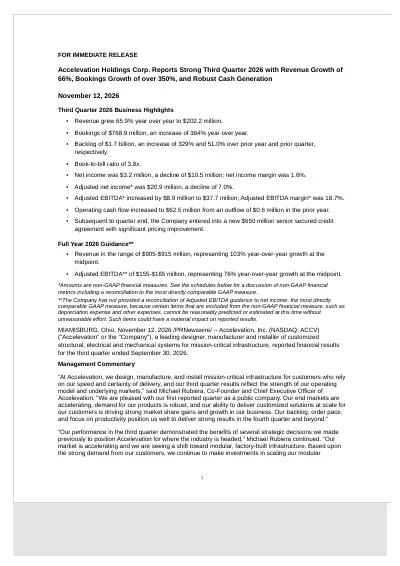
The headline: our differentiated model delivered robust growth, solid profitability, and strong cash flow generation all in the same quarter. Revenue grew approximately 66% from prior-year quarter to $202 million.
Gross margins were 29.3%, while adjusted EBITDA was approximately $38 million and 18.7% margin. Ken will take you through the details in a moment.
Demand remains strong. Bookings in the quarter were approximately $770 million, up more than 350% year over year, bringing year-to-date bookings to approximately $1.9 billion and backlog to $1.7 billion.
Book-to-bill was approximately 3.8 times, our second consecutive quarter above three times. Once again, orders materially outpaced revenue.
That expanded our backlog and increases our confidence in our 2026 guidance as well as our visibility into 2027. We also landed a major new relationship.
This quarter, we received the largest order in our company's history from a new customer, with delivery expected over the next 6 to 12 months. That customer provided a significant upfront deposit, which strengthens our cash flow and liquidity.
This customer first engaged us over the summer. They needed a new partner who could custom design a unique solution to their specific need, which would reduce their time to compute.
Execution of the program is progressing as planned. We are also building to meet growing demand across all customer segments.
During the quarter, we opened Second Flight and broke ground on Third Flight, our next facility in Dayton, right next to our First and Second Flight facilities. Third Flight will add approximately 286,000 square feet and is expected to be operational by late summer 2027.
It will add capacity ahead of demand, supported by our backlog and pipeline. It will expand our modular capabilities and gives us room to grow our power products.
Demand in the quarter was broad-based across our entire portfolio and customer segments. Our power products, which include remote power panels, branch circuit webs, and power distribution units, are strategically important.
They increase our content per installed megawatt and let us deliver a more complete scope as part of our modular solution and simplifies the total project complexity for our customers. Customers continue to prioritize modularity and prefabrication because moving work from the job site into a controlled manufacturing environment reduces field labor, limits handoffs, and improves schedule certainty.
That momentum drove backlog to a record $1.7 billion, with a third quarter book-to-bill of 3.8 times. In addition, our pipeline of new business remains healthy and gives us further confidence for 2027 and beyond.
As a reminder, our pipeline only includes projects where our engineering and solutions teams are actively designing the specific white space solution for a specific job site that is already under construction, with hard timeline requirements for delivery. That means those projects are beyond the permitting and electrification stage, and in many cases, we were the specified basis of design for the end customer.
Now, I know the financial markets have been volatile, and investors continue to debate the pace and returns of AI infrastructure investment. Let me tell you what we're seeing from our customers.
The demand signals remain strong: strong orders, a record backlog, a healthy pipeline, and continued demand for faster deployment. Program timing, designs, and site schedules can and will change, but our relatively short lead times, in-house engineering, and domestic manufacturing position us to adapt while staying focused on the broader demand trend.
We stay focused on what we can control. Internally, we call it winning in the turns: staying close to customers, executing with discipline, and investing where we see the greatest long-term opportunities.
Innovation is core to our DNA. In fact, over 80% of our third quarter product orders came from offerings we developed in the prior 12 months.
That number says a lot about our culture. It is built on speed, agility, and an entrepreneurial spirit.
We work behind the curtain with our customers to design solutions that solve their specific needs and challenges. That means we become the specified basis of design for all of their projects and campuses.
While we talk a lot about our patent-pending Skybridge modular solution, the truth is, it is just one of eight unique platform designs today. This is what has allowed us to grow so rapidly and is the foundation of our future success.
Our growth strategy goes well beyond any single product. We see five reinforcing levers: one, expand wallet share with our key blue-chip customers; two, broaden the customer set and geographies; three, increase power and thermal content per megawatt; four, expand lifecycle retrofit and maintenance services; and five, selectively apply our capabilities in adjacent mission-critical electrical markets.
Over time, we also intend to expand from our current white space focus into selective gray space solutions, where our design, manufacturing, and installation model can create a similar advantage. We intend to pursue all of this with discipline.
Finally, I want to come back to our people. Through the Build Together ownership program, more than 1,800 employees are now owners of this company.
That alignment matters. It drives retention, quality, and a sense of urgency our customers feel every day.
We move at the speed of technology, and our employees think and act like owners. One more point on this, because I know it matters to our shareholders: the majority of the cost of the Build Together is borne by our pre-IPO shareholders, who put the program in place.
The remainder is funded through our standard equity incentive plan within the share reserve we laid out at the time of the IPO. This program does not add dilution beyond what investors already saw in our prospectus.
Public shareholders get the benefit of a workforce of owners, with the vast majority of the cost carried by the shareholders who came before them. I'm also pleased to announce the promotion of Erica Harrison to Chief Commercial Officer.
Erica has been a key member of our leadership team and has led the critical manufacturing capacity expansion over the past few years. Before I hand it over, let me sum up: record backlog, strong growth with solid profitability and cash generation, a broadening customer base, and capacity in place ahead of demand.
This is a strong start to our life as a public company, and we are excited about what is ahead. With that, I'll turn it over to Ken.
Ken Krause
Thank you, Michael, and good morning, everyone. We are pleased to deliver strong third quarter results, our first quarter as a public company.
We delivered robust revenue growth, healthy margin levels, and we're positioned extremely well as we start the fourth quarter. Our customer base is starting to broaden, we are beginning to see projects in new geographies, and our pipeline of new business is very healthy.
During my prepared comments, I will compare revenue with the prior-year quarter and also discuss sequential performance, that's Q3 performance relative to Q2 of this year, which I believe provides the clearest view of our current operating trajectory as we scale. Unless otherwise noted, balance sheet figures are as of September 30, and therefore precede the closing of our IPO and refinancing that occurred in early October.
We delivered a strong third quarter, with revenue of approximately $202 million, up 66% year over year and more than 11% sequentially. During the quarter, we began ramping up production of our modular systems, moving away from our more traditional on-site assembly.
We're just starting to see the benefits of this transition and expect continued growth and improved profitability in future quarters. With that said, growth continued to be broad-based and almost entirely organic, driven by backlog conversion, increased activity on newer programs, and new customer contributions.
We're beginning to add new customers and penetrate new geographies, which are helping us build a more sustainable business model. No single customer accounted for more than 20% of revenue in the quarter, which is down considerably from prior quarters.
Furthermore, states like Texas no longer comprise more than 50% of our business, as we see demand in new states like North Dakota, Wisconsin, Indiana, and many others. Profitability improved from the second quarter, with gross profit rising to $59 million from $48 million, and gross margin expanding approximately 260 basis points to 29.3% from 26.7%.
Higher volume, pricing, and a more favorable project mix drove the improvement, partially offset by certain inefficiencies associated with the initial modular production ramp and certain legacy projects. SG&A in the quarter was approximately $27 million, or 13.1% of revenue.
SG&A increased 68% year over year, and excluding approximately $5 million in recurring transaction costs and certain non-cash items, SG&A would have increased much more modestly, reflecting controlled growth alongside our expanding revenue and customer base. Adjusted SG&A was about 11% of sales, in line with our low double-digit target.
Sequential results highlight the platform's earnings potential: approximately $21 million in additional revenue generated about $11 million in additional gross profit and $13 million in additional adjusted EBITDA, representing incremental margins of roughly 52% and 63%, respectively. While we don't expect those incremental margins to repeat every quarter, they do, however, demonstrate the operating leverage available as we increase manufacturing utilization, spread fixed costs over higher volumes, and shift towards more modular production.
Adjusted EBITDA was approximately $38 million, or 18.7% of revenue, compared with approximately $25 million in the second quarter. Net income was about $3 million, compared with a net loss of about $2.5 million in the second quarter.
Adjusted net income was $21 million versus $15 million in Q2 2026. Our earnings release and presentation provide the reconciliations and the items excluded from our non-GAAP measures.
Cash generation was strong: net cash provided by operating activities was approximately $63 million, and free cash flow was $55 million. Working capital benefited from the significant upfront customer deposits that Michael had mentioned previously.
Customer deposits and milestone billing help align cash receipts with procurement and production requirements on larger programs, reducing the amount of capital required to support our growth. CapEx was 3.7% of revenue.
We continue to target and expect CapEx at or below 3% of revenue going forward. Our ability to expand in a capital-efficient manner while customers help fund project working capital through deposits and milestone billing supports attractive returns on invested capital.
As of September 30th, cash and cash equivalents was approximately $109 million, total debt was approximately $665 million, and net debt was approximately $557 million, using the definitions in our public presentation. The quarter-end balance sheet reflects our prior credit facilities, as the IPO and refinancing closed after quarter-end.
We incurred non-cash debt extinguishment costs in October of $10 million to $11 million associated with the replacement of the pre-IPO credit facilities. Following quarter-end, we used the net primary proceeds of $171 million from the IPO and borrowings under new senior credit facilities to repay the prior credit agreement.
The new facilities consist of a $400 million revolving credit facility and a $250 million term loan A, both of which are maturing in 2031. Pricing is SOFR plus 150 to 250 basis points following the initial pricing period, compared with SOFR plus 450 to 525 basis points under the prior facilities.
The refinancing materially reduces our cost of capital and improves our financial flexibility. We expect cash interest costs to approximate $8 million in the fourth quarter.
At September 30, net leverage under the definitions shown in our presentation was 4 times. Pro forma for the IPO and refinancing, completed after quarter-end, net leverage was below 3 times.
Our priorities are clear: support high-return organic growth while continuing to delever and build the financial profile of an investment-grade company over time. Transitioning to slide 17, today we're introducing fiscal 2026 guidance.
We expect revenue of $905 million to $915 million, up more than 100% at the midpoint versus 2025, and adjusted EBITDA of $155 million to $165 million, representing over 75% year-over-year growth at the midpoint, with a margin of 17.1% to 18%. I remind you that 2026 is a transition year, with some inefficiencies driven by the second-quarter transition from stick-built to the third-quarter launch of Skybridge modular production and the wind-down of legacy contracts.
During the first nine months of 2026, we incurred approximately $23 million of losses that are not expected to repeat in the next year. That equates to about 350 basis points of margin year to date and about 250 basis points of margin for the full year.
Our guide incorporates current backlog, expected program timing, production capacity, and normal fourth-quarter seasonality, including fewer working days around the December holidays. Our $1.7 billion backlog as of September 30 and continued order momentum positions us to finish 2026 strongly and to enter 2027 with meaningful visibility and a strong foundation for continued, profitable growth.
I'd further reinforce that our pipeline remains healthy and broad-based. We expect to provide 2027 guidance when we report fourth-quarter results in the first quarter of next year.
Finally, on margins, we continue to see a path to the mid-20% range for recurring adjusted EBITDA margins. We have opportunities to improve margins associated with procurement savings, insourcing, automation, the benefits of modular, and fixed-cost leverage, to name just a few.
Quarterly margins will move with project timing and mix, but the third-quarter sequential incremental margin demonstrates the earnings power available as revenue scales across our platform. In closing, we are positioned well as we look towards 2027.
Demand is strong, we have opportunities to continue delivering robust, above-market levels of growth, and we are starting to see a broadening of our customer and geographic exposure. We are focused on executing and driving towards the full profitability potential of our business.
Our goal is to be a mid-20% adjusted EBITDA margin business over the medium term, and the trajectory of our quarterly results is demonstrating that potential. Our cash flow profile in the quarter demonstrates the strength of our business model.
As we scale, we have the potential to deliver very strong cash flow and return on invested capital in our capital-light business model. With that, I'll turn the call back over to Michael.
Michael?
Michael Rubiera
Thank you, Ken. Let me close with a few takeaways.
First, we delivered a strong quarter. Revenue grew 66% year over year, gross margin improved to over 29%, and adjusted EBITDA increased meaningfully from the second quarter.
Second, demand remains strong. We had bookings of approximately $770 million in the quarter, growing over 350% over the prior period, bringing year-to-date bookings to approximately $1.9 billion and our backlog to $1.7 billion.
We are also beginning to broaden the customer base. Finally, we continue to expand the value we provide customers through modular solutions, power products, and self-performed installation and increasing our content per megawatt.
We're pleased with the quarter, and we remain focused on execution. We have significant demand in front of us, capacity in place to support growth, and a team that is moving quickly to serve our customers.
We will continue to invest and execute with discipline. Before we take your questions, I want to thank our employee owners.
They made this quarter possible, and through the Build Together ownership program, they share in the value they help create. Our IPO was an important milestone, but it is also just the beginning of a new chapter.
We are excited about the opportunity ahead and focused on earning your confidence quarter by quarter. Operator, please open the line for questions.
Operator
Thank you. As a reminder, to ask a question, you will need to press *11 on your telephone and wait for your name to be announced.
To withdraw your question, please press *11 again. Please stand by while we compile our Q&A roster.
Our first question will come from the line of Tomohiko Sano of JP Morgan. Your line is open.
Tomohiko Sano
Good morning, everyone.
Ken Krause
Morning, Tomo.
Tomohiko Sano
Congratulations on becoming a public company. Maybe start with you added several significant new customers this quarter.
How are you seeing those relationships develop beyond the initial project, for example, through repeat orders, expansion to additional campuses, or a broader scope of products and services?
Michael Rubiera
Thanks, Tomo. This is Michael.
That's a great question and one we're really proud to share. With all of these new customers who started doing work with in Q3, we've actually started to also engage with them to design their future platforms.
For example, one of the frontier cloud customers, we're already on project number four with them. One of our other customers, who actually was the largest customer order that we received in Q3, we're engaged with them to look at developing a solution that can actually provide their product across the entire globe, which we're really excited to do.
We've also already engaged with them on another large campus build that they're going to execute in 2027. It really speaks to the value of our model, which is we're not selling them a standard solution.
We actually engage with their engineers to develop the solution that they need and want and help design something that's unique to their specific challenges.
Operator
Our next question will be coming from the line of Joe Ritchie of Goldman Sachs. Your line is open.
Joe Ritchie
Hey, guys. Good morning and congratulations on your first quarter out as a public company as well.
Look, your backlog grew about 50% sequentially, and now covers almost 2x your revenue base for 2026. As you think about 2027 and where your backlog is today, I'm just trying to understand how quickly you could turn the backlog, and whether lead times have extended at all in your business?
Ken Krause
Thanks for the question, Joe. It's Ken.
The business, we have good visibility out into 2027, and we're starting to have increased visibility out into 2028. When we look at our business, not only is the backlog healthy, but the pipeline is healthy as well.
It's a multiple of what our backlog is. It gives us good visibility as we think about the next several quarters, but also into 2028.
We continue to benefit from continued wins and opportunities to work with new customers. It's interesting, when we look at some of the work we're doing with some of the larger customers that we interact with, we might be the basis of design across four or five different designs, but we're currently only working on maybe two or three.
We've got that opportunity very much ahead of us. It provides a sense of optimism as we think about the future.
Michael Rubiera
Joe, this is Michael. One thing that has been consistent over the history of Excelvation is our lead times in our business are a red line.
It's not something we move. Our team knows it.
We've designed the organization to not adjust our lead times at all. We've scaled this business to maintain what we believe to be the industry-best lead times, and we will continue to have the industry-best lead times as we go forward.
Joe Ritchie
That's helpful, guys. I guess maybe just a follow-on question.
Ken, you gave some good margin color on what's not going to repeat in 2027 in terms of some of the headwinds that you saw in 2026. I'm just curious as you look at the gross margin that you're booking in your backlog relative to what you're showing in the P&L today, how does that compare and the pricing that you're getting on the types of orders that you're winning?
Ken Krause
We continue to see good margins. We're getting paid for the value we're providing, the value that Michael referred to: the ability to move quickly, to accelerate time to token, the ability to customize.
We're very much being paid for that, and as a result, we're seeing good progress on the gross margin. In the quarter, we posted a 29%-plus gross margin.
That's up from just over 26% in the second quarter. As we think about the future, we certainly see a low to mid-30% gross margin ahead of us based upon what we're seeing in the backlog, but also what we're seeing with our productivity opportunities across the manufacturing floor.
Joe Ritchie
Great. Thank you, guys.
Ken Krause
Thank you.
Operator
Next question will be coming from the line of Devin Leonard of Bank of America. Your line is open.
Devin Leonard
Hi there. For the seven customers added in the third quarter, how long did it take for them to go through qualification?
Should we be thinking 3 months, 6 months? Could you size how many or give any color on the prospects you currently have in the qualification process?
Michael Rubiera
That's a great question. Honestly, this industry moves very, very quickly.
With the customer we landed in Q3 that was the largest customer, we went from first conversation to basis of design in under 4 weeks. Additional customers that we're currently engaged with that are new customers that we anticipate landing in Q4 is also following that same sort of trajectory.
There's a lot of urgency in the marketplace, and a lot of expectation that their partners are able to execute. Time to compute has always been a very, very sensitive and high-priority focal point for this industry, and if anything, it's getting to be even more of a major trigger for who our customers are deciding to partner with as they go forward.
Ken Krause
It's interesting, Michael. The things that I highlighted during the course of my prepared comments: one, these customers are helping us diversify our geographic base.
Not too long ago, states like Texas were well over 50% of our business; today, they're well under 30%. We continue to see diversification across the geographies, bringing in states like Indiana, North Dakota, Wisconsin, just to name a few.
Then just the customer concentration as well. When you look at Q3, there was no single customer that comprised greater than 20% of our revenue.
That's down considerably from a few quarters ago. We're making great progress at winning new customers, expanding wallet share with existing customers, and continuing to grow and create a more sustainable business.
Devin Leonard
Got it. Then just as a quick follow-up, how successful have you been in attaching maintenance and services in the recent months?
I know customers are very focused on speed. Are they willing to engage in discussions on services as well early in the process?
Michael Rubiera
Yes, especially let's say on some of our power product solutions. We are engaging with them on discussions for long-term contracts now.
It is a relatively new part of our business, and at this stage relatively still less significant versus the initial, but it is a major area of focus for us as we go forward, and we've actually dedicated some new high-level resources to focus on building out that model.
Operator
Our next question will come from the line of Mark VanderPloeg of Morgan Stanley. Your line is open.
Mark Vander Plume
Great. Thank you, operator.
Good morning, guys.
Ken Krause
My
Mark Vander Plume
congrats on first quarter as a public company. Wanted to just follow up here.
You actually called out strong share gains in the release yesterday. Could you help us frame where those gains are coming from?
Separately, I thought slide 7 really kind of highlighted some of the progress you guys have made over the past year. If you could unpack that 4x growth in order size you guys have seen over that time, is that a function of the scale of the projects, the content, project mix, price, or some combination really of all the above?
Michael Rubiera
It's definitely a combination of all of the above, but to the first question: so we talk a lot about Skybridge as our modular solution. That is, let's say, our standard product offering for the broad market.
We actually have seven other modular platforms that are specific for specific customers, where we're the sole basis of design for those customers' design, and those other seven platforms are very, very different from Skybridge. Most of those discussions started at the beginning of 2026, and we're now just starting to see orders come through for those platforms.
If you were to talk with our customers or see a project, our name is actually on the designs that go out to all the general contractors across the US for those specific campus works. We're starting to see the return on all that investment that we made with those customers at the beginning of the year.
The truth is, those same customers are now engaging us on even new platforms that they'll roll out in 2028, 2029, and 2030 and beyond. That's a really, really powerful differentiator because when we design the solution for our customers or with our customers, we are then the ones who are in line to actually, of course, take those projects as we go forward.
That has driven a lot of it. Also the modular solution is really kind of bundled all of our products into singular offerings.
When we sell to a customer, we don't sell 50 different line items. We typically sell a single line item, which is the total project execution.
We have seen our content per megawatt increase substantially across the board, and that's what's really driven our average order size, which has increased by 4x versus last year.
Mark Vander Plume
Great. Just a quick follow-up.
As we kind of entertain the migration from white space to gray space, do you guys kind of foresee a similar strategy where you want to get in early on the design process and kind of come to market with more modular solutions? Or how are we thinking about addressing the gray space, and what sort of milestone should we be looking for there?
Michael Rubiera
Yes, 100%. The entire category is moving to more and more modularity across the entire data center build, and anything you can do off-site in a controlled environment and deliver complete drastically reduces the time it takes to turn on a campus.
That is definitely our strategy going forward as well as we look to migrate into the gray space.
Mark Vander Plume
Great. Thanks, guys.
Ken Krause
Thank you.
Operator
Our next question will be coming from the line of Guy Hardwick of Barclays. Your line is open.
Guy Hardwick
Hi, good morning, Michael, Larry, and Ken.
Ken Krause
Good morning,
Guy Hardwick
Guy. Just wanted to drill down a little bit on a follow-up to Joe's question earlier.
During the whole IPO process, I probably got asked more about the pipeline than anything else. I think investors would want to know or hear, have some indications what percentage of the backlog is deliverable in 2027?
Ken Krause
It's interesting. It's a great question, Guy.
It's Ken. I'll take that.
I think the majority of our backlog certainly should ship during the course of 2027. We're not booking out multiple years necessarily.
The pipeline, when we think about 2028, that's where the pipeline really starts to step in and give us a sense of confidence. The better part of that backlog, I'm not saying all of it, but a better part of that backlog is going to probably ship over the course of the next 12 to 18 months.
That's just the nature of our business. Customers are engaging with us because of our ability to respond quickly and accelerate their ability to get online.
As we all know, that white space is the last mile, and so we stand between the final stage of buildout of the data center and the data center actually going online. There's a real value for us to be able to help accelerate that.
As a result, the backlog for the most part will ship out over the next 12, 18 months.
Michael Rubiera
One thing I'd really want to kind of clarify because our business is a bit different than others is nothing is in our pipeline, let alone our backlog, that isn't an active job site already, that's already been pre-permitted and pre-electrified. For something to come into our pipeline, which is a multiple of our backlog, our engineering team is actively engaged and then designing that solution.
We can't design a solution for a site that doesn't exist. We have a lot of visibility to the outline years, let's say 4 to 6 years out, for where campuses will be built, but that is not in our pipeline at all.
We don't bring anything into the pipeline unless the site has already started construction and we know when the white space buildout will need to start.
Ken Krause
It's interesting. The other point I think Michael's getting at there is cancellations.
Always a lot of questions around what's the risk of cancellation in the backlog, and for us, we really don't see it. It's a very small component of the data center.
It's the final mile. It's well after permitting and power has been established, and so our business, fortunately, doesn't feel the impact of those sorts of things.
Guy Hardwick
Thank you. Just one one follow-up.
Ken, I think you provided the bookings was less than 20% from one customer. Could you be willing to give the breakdown of the backlog by customer concentration?
Ken Krause
It's actually improving just the same. It's maybe not at 20% yet, but it might be more like a 30% sort of figure in the backlog.
That backlog is secure, never see any cancellations coming out of that backlog historically, and so we feel good about it. It's diversifying across the geography, but it's also diversifying across the customer set.
Guy Hardwick
Thank you, Ken.
Ken Krause
Thank you, Guy.
Operator
Our next question will be coming from the line of Brian Drab of William Blair. Your line is open.
Oh,
Brian Drab
you got it. Drab.
You got it. Thank you very much.
Congratulations on the milestone. First, I just wanted to ask a little more specifically on the gross margin, which is headed clearly in the right direction.
Can you say more specifically for the fourth quarter where you expect gross margin to land given what you're seeing so far in the quarter? Just at a higher level related to gross margin, are you seeing any challenges related to supply chain that are just so common across the industry right now?
Maybe just reaffirm for us your relative advantage that you really have given the largely domestic supply chain?
Ken Krause
Certainly. Thank you, Brian.
It's Ken. A couple questions there.
I'll try to cover them all, but Michael will step in if I don't. One is from a supply chain perspective, we do benefit from having a US-focused, US-centric supply chain.
We're not immune to supply chain challenges, but I would say we're much better positioned than the marketplace when it comes to the supply chain. We have not seen any major changes, hiccups, or challenges to deliver for our customer, and that's part of the reason why we're benefiting and we're winning share.
We have sufficient capacity out here in southwestern Ohio. We continue to build on additional capacity very efficiently.
If you look at CapEx, we've spent very little in CapEx, roughly 3% of sales year to date to build out a really comprehensive manufacturing facility. It's allowing us to respond quickly.
Integration and vertical integration is core to our business, and that's one of the special sauces that go into creating our business and allowing us to respond so quickly to the customer base. In turn, we're able to price that value as we think about pricing and margin opportunity.
29%-plus gross margins in Q3, that was good to see. We're not done yet.
We certainly see opportunity for upside there. In fact, if you look at the midpoint of the guide for Q4, that infers roughly a 20% EBITDA margin.
Q3 was 18.7%, it implies that we're going to see continued improvement on that gross line. That's what we're seeing.
As I said earlier, the backlog continues to come in at a very healthy pricing level, but we also continue to see good delivery and good realization of those gross margins. It's one thing to get it priced and get it in the backlog at a certain margin; it's another thing sometimes to get it out of the factory into the customer with that same sort of margin.
We're starting to see that. We've got challenges there as we've talked about ramping and meeting this growing demand, but we certainly have optimism in our ability to deliver improved gross margins as we think about the future.
Brian Drab
That's really helpful. Could I just ask for a little more detail in the seven significant new accounts?
Can you tell us what category some of those customers are in? Are there any new hyperscaler customers?
Then also maybe elaborate on when you say geographic diversification, where you had success in that respect?
Michael Rubiera
We won't give, of course, any specific customer names, but we are selling to all five hyperscalers. We're doing projects for all five hyperscalers.
We're doing projects for basically all the blue-chip neoclouds as well as the blue-chip colo customers. In Q3, we saw a nice mix between those three buckets.
From a geographic standpoint, we have a large field network that's spread across the US and can cover every state. We're seeing jobs pop up in new places.
More importantly, we have the teams to be able to support wherever our customers need to build a data center. As Ken mentioned, 12 months ago, Texas was a disproportionately large portion of the data center builds that were happening in this country.
We see a lot now happening in places like Indiana, North Dakota, Iowa, of course, Alabama, Mississippi, Louisiana. We're really seeing a lot of additional projects start in locations where we hadn't historically done a lot of work.
Brian Drab
That's really helpful. Thanks very much.
Ken Krause
Thank you.
Operator
Our next question will be coming from the line of Luke Junk of Robert W. Baird and Company Inc.
Your line is open.
Luke Junk
Good morning, and congrats for me as well. Thanks for taking the question.
Hoped we could start with an operations question. Just any color you could share on how modular/Skybridge is ramping here in the first half of 4Q 2026 coming out of that initial launch in the August and September timeframe?
Then maybe just any KPIs you're able to share on the ramp as well? Thank you.
Michael Rubiera
Thanks, Luke. Modular is ramping extremely nicely.
We were well-prepared for the transition. One of the things we did, which was really a differentiator, is we actually brought in our teams of field installers 90 days prior to first production to help us both build and design the work cells as also to work through the kinks of being able to execute these projects, because the modular solutions these days also have a lot of additional components that we weren't initially expecting: things like lighting, sensors, electrical cabinets, things that are very different that our customers are asking us to do to again take time out of the field and put it in a controlled environment in the plants.
We shipped our first unit in late August, and we're actually really proud to say in the month of September, we shipped close to 200 megawatts of capacity in the first 30 days of production. We're only getting started.
With the demand that we see in front of us, we've actually started to look at adding a second shift for modular and have in place the capability to do both wrap shifts over the weekend as well as third shifts if needed as we continue to scale this business. I would give a lot of kudos to our operations team.
They absolutely executed this very, very well over the last 60 days, and we couldn't be more proud of what they've been able to achieve in such a short period of time.
Ken Krause
Luke, it's interesting, if I just think about the ramp of this business in the modular: Q3, we started to ship those products and those solutions; Q4 will become more meaningful, it won't be all of our business at that point, we're still doing a little bit of the more traditional stick-built. I imagine by Q2 of next year, we will be in full swing.
I certainly expect to be hitting our stride at that point with the modular design and shipping those products. We're seeing great success.
We're seeing good performance across the factory, and the operations team is really knocking it out of the park and stepping up and delivering for our customers.
Luke Junk
Appreciate that. All very helpful color.
In terms of my follow-up, I want to ask about your comments in the pipeline. Michael, forgive me if this is somewhat myopic, but would be curious to see if there's any change you've seen in the nature of your customer pipeline engagement post-election, just insofar the modular certainly seems like one of the unlocks in the current environment, or maybe what you might expect to see in that front?
Thank you.
Michael Rubiera
Thanks, Luke. We have not seen any sort of real change in customer behavior since the election.
One thing we're seeing, and this started before the election, we're seeing timelines compressed even more, which actually plays into our strength. Even more importantly, with some of our active projects that we have going on today, we're seeing customers want to parallel execution.
To give you an example, there are a few campuses where we were doing building one, building two was supposed to start next year, building three soon after that, and our customers are asking us if we can do building one, building two simultaneously now. The focus on time to compute is becoming more and more critical for our customers.
It also means that they're much less tolerant if their vendors are not able to execute with the set timeline. Now, our business, the way we designed this as a child of COVID, is that we're incredibly agile, incredibly fast, and are able to design custom solutions for our customers.
We're seeing a lot of the new customers that we mentioned coming in in Q3 and Q4, they're looking for certainty. They're looking for certainty in being able to execute designs that they need for the go-forward platforms in compressed timelines.
For us, that's the perfect combination because we custom design everything and we operate with best-in-class lead times.
Ken Krause
It's interesting, Michael. It's about delivering on commitments, right, with the customer.
When we think about that, not only do we think about delivering on commitments for our customer, but we think about delivering on commitments with our shareholders. You hear about all this positive and all of the momentum in our business, and as a result, all that momentum provides a high degree of confidence in what we expect to do here in 2026 and also in 2027.
Quite frankly, we probably have of upside to the guide, but we're very cautious as we enter the public markets. Luke, we want to develop a reputation for consistently delivering and, if anything, outperforming your expectations.
We have good line of sight into 2027 and expect another strong year. We'll unveil those expectations as we do our Q4 call early next year.
Luke Junk
Really helpful. I'll leave it there.
Thank you.
Operator
Thank you. Our next question will be coming from the line of Nigel Coe of Wolfe Research.
Your line is open, Nigel.
Aidan Harmon
Hi, guys. This is Aidan on for Nigel.
Just had a quick question on the cash flow performance. First, the down payment, if orders are four times as large today, should we think of down payments as being more of a material tailwind to cash flow generation going forward?
Are you pushing to receive more cash up front? Then given how strong 3Q cash performance was, how should we think about the avenues for deploying excess cash in the balance sheet going forward?
Thank you.
Ken Krause
Thanks for the question, Aidan, I appreciate that. It's Ken.
Cash flow performance was exceptional in Q3, well ahead of what a lot of folks expected. Those down payments are a really important part of it.
We're certainly starting to see more and more of that activity. We're really focused on aligning the billing cycle, the collection cycle with our manufacturing cycle.
If you go back in time, we were underbilled for quite some time. We're now moving towards more of an overbilling or deferred revenue sort of benefit, if you will.
That's certainly a big part of what we're doing. We're not only doing it with one customer, but it's a big part of our entire interaction across the customer base.
That's helping us accelerate the cash generation in the business in Q3 and starting to set up for some nice progress here as we go into next year. From a cash deployment perspective, we entered the market prior to being a public company, we were well over 4 times leverage.
We entered the market in October, and right after entering the market, we took the primary proceeds and we serviced the debt, we pro forma leverage that's under 3 times. Our focus is to continue to delever in the near term, get that ratio or that metric down under 2 times, and then start to introduce more balance across the capital allocation strategy in considering share repurchase and other uses of capital across the spectrum.
We continue to look at M&A, and as you might know, M&A has been a part of the strategy. It hasn't been a part of the strategy in terms of growing and bringing customers, but how do we bring new technology, new know-how, and new people into the business?
We'll continue to deploy it in that manner. We're continuing to look at opportunities to grow our business and expand our position with our customers through M&A as well.
More to come, but we're really happy with the cash flow performance that we're seeing thus far.
Aidan Harmon
Thanks, Ken. Great to see the cash up front.
Ken Krause
Thank you.
Operator
I would now like to turn the conference back to Larry for closing remarks.
Larry De Maria
Hey, thank you for joining us and for your interest in Excelvation. We look forward to updating you when we report fourth quarter results and to meeting with many of you in the months ahead on the road.
Have a great day. Thank you.
Operator
This concludes today's program. Thank you for participating.
You may now disconnect.