Arch Capital Group Ltd.
Q3 FY2026 · Earnings Call TranscriptOctober 28, 2026
Operator
Good day, ladies and gentlemen, and welcome to the 3Q 2026 Arch Capital Earnings Conference Call. At this time, all participants are in a listen-only mode.
Later, we will conduct a question-and-answer session, and instructions will follow at that time. As a reminder, this conference call is being recorded.
Before the company gets started with its update, management wants to first remind everyone that certain statements in yesterday's press release and discussed on this call may constitute forward-looking statements under the federal securities laws. These statements are based upon management's current assessments and assumptions, and are subject to a number of risks and uncertainties.
Consequently, actual results may differ materially from those expressed or implied. For more information on the risks and other factors that may affect future performance, investors should review periodic reports that are filed by the company with the SEC from time to time, including our annual report on Form 10-K for the 2025 fiscal year.
Additionally, certain statements contained in the call that are not based on historical facts are forward-looking statements within the meaning of the Private Securities Litigation Reform Act of 1995. The company intends the forward-looking statements in the call to be subject to the safe harbor created thereby.
Management will also make reference to certain non-GAAP measures of financial performance. The reconciliations to GAAP for each non-GAAP financial measure can be found in the company's current report on Form 8-K furnished to the SEC yesterday, which contains the company's earnings press release, and is available on the company's website at www.archgroup.com and on the SEC's website at www.sec.gov.
I would now like to introduce your hosts for today's conference, Mr. Nicolas Papadopoulo and Mr.
François Morin. Sirs, you may begin.
Nicolas Papadopoulo
Good morning, and welcome to Arch's third quarter earnings call. Arch delivered very strong results this quarter, reflecting excellent underwriting performance across each of our businesses and a relatively low level of catastrophe activity.
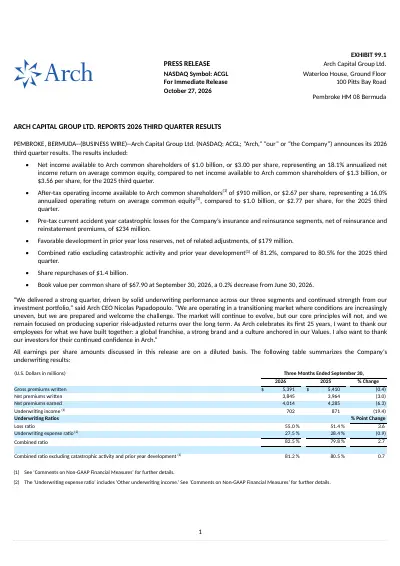
After-tax operating income was $910 million, or $2.67 per share, resulting in an annualized operating return on average common equity of 16.0%. Strong returns from our equity method investments contributed to an annualized net income return on average common equity of 18.1%.
Despite increasingly competitive market conditions, we continue to generate strong returns, reflecting our ability to proactively shift capital to optimize long-term returns. This is the essence of cycle management, and given this dynamic, we were able to return approximately $1.4 billion to our common shareholders through buybacks in the quarter.
Book value per share was essentially flat in the quarter. However, it's worth noting that tangible book value per share, excluding AOCI, increased approximately 15% from a year ago.
Arch's brand, underwriting expertise, and relationships, combined with our diversified platform, give us broad access to business across insurance and reinsurance. In addition, continuing investments in data and analytics enhance our risk selection and provide deeper insight into our portfolios.
Each of these elements allows us to be highly selective about where and how we deploy capital. Importantly, we are led by returns.
Therefore, premium growth is not the ultimate objective. We continue to act on what we see, growing where returns remain attractive and exercising restraint where they do not.
Let me now turn to our segment performance, starting with insurance. Insurance generated $108 million of underwriting income in the quarter, with a combined ratio of 94.4% and a current accident year combined ratio, excluding catastrophes, of 89.2%.
Gross premiums written increased 7.8% and net premiums written increased 2.7% compared to the same quarter last year. Premium growth in the quarter benefited from a new captive program in alternative markets and increased writings of marine war breach coverage related to the Iran conflict.
The premium growth we saw this quarter was stronger than the underlying trend for the year. Year-to-date, adjusting for the planned reduction in middle-market commercial program business, gross premiums written increased 4.2% and net premiums written increased 1.6% compared to the first nine months of last year.
This low single-digit underlying growth is consistent with our expectations given current market conditions. In North America, we continue to see opportunities across excess and surplus casualty, construction, and national account casualty, where rate and market conditions remain attractive.
Internationally, we continue to benefit from our position as a lead market across many classes at Lloyd's. At the same time, property and short-tail markets remain more competitive, while rate increases have moderated in some of our casualty lines.
We continue to believe that adverse development emerging across the industry for more recent accident years reinforces the need for casualty pricing to remain at or above loss cost trend. Moving to reinsurance, which delivered $393 million of underwriting income in the quarter, with a combined ratio of 78.3%, aided by light catastrophe activity.
Gross premiums written declined approximately 8% compared with the same quarter last year, reflecting abundant reinsurance capacity, particularly in property and short-tail lines. Consistent with our cycle management approach, we are reducing participation where returns no longer meet our objectives, and increasingly leveraging third-party capital to manage net exposure and optimize returns on our own capital.
While casualty generally remains attractive, additional capacity continues to enter the market. We will not chase growth for the sake of growth.
We will remain patient and deploy capital where pricing and terms and conditions appropriately reflect the underlying risk. Our objective is not to become an index of the overall market.
Our global reach, underwriting expertise, and third-party capital platform allow us to take advantage of opportunities as they emerge, and to construct a portfolio that delivers our required risk-adjusted returns. Our mortgage segment generated $201 million of underwriting income in the quarter, and continues to be a valuable contributor to our results.
New origination volume remains constrained, primarily due to mortgage interest rates currently above 7%, limiting near-term growth opportunities. Importantly, the underlying quality of our in-force portfolio remains strong.
In USMI, favorable reserve development has moderated from prior years, while positive homeowner credit conditions continue to support a low delinquency rate of 2.2% at September 30th. Higher mortgage rates also support persistency by reducing voluntary refinancing activity.
Our business outside of primary US mortgage insurance wrote $66 million of net premium in the quarter, and we continue to see opportunities in these businesses, providing diversification from our USMI business. As always, the mortgage team remains focused on disciplined execution, optimizing the platform, and managing expenses in line with the market environment.
Finally, investment contributed $451 million of pretax net investment income in the quarter. Our equity method investments also performed very well, contributing $224 million to pretax net income.
With $49.2 billion of investable assets, investment income is expected to remain an important contributor to Arch's overall earnings. Last Friday, Arch celebrated its 25th anniversary.
I want to recognize this milestone and thank our employees for what we have built together: a global franchise, a strong brand, and perhaps most importantly, a unique culture anchored in our values. I also want to thank our investors for the confidence they have placed in Arch over the past 25 years.
As I reflect on my 25 years at Arch, one thing has remained consistent: our ability to adapt and generate attractive returns across very different market environments. That has been our legacy for our first 25 years, and it remains our focus for the next 25.
Today, we are operating in a transitioning market where conditions are becoming increasingly uneven. As this quarter's results demonstrate, we are prepared for that environment, and we welcome the challenge.
The market will continue to evolve, but our core principles will not. We will remain disciplined underwriters and thoughtful stewards of capital, always focused on producing superior risk-adjusted returns over the long term.
That gives me confidence in Arch's position today and the opportunities ahead over the next 25 years. With that, I will turn the call over to François.
François Morin
Thank you, Nicolas, and good morning to all. As you saw last night, our third quarter results were highlighted by strong underwriting performance and solid investment results.
Capital management and capital returns also remained very much at the forefront of our initiatives this quarter, as we took advantage of an attractive share price to repurchase 14.8 million of our common shares at an aggregate cost of $1.4 billion in the quarter. Through nine months of 2026, we have repurchased approximately 109% of our net income in our own shares.
While our first choice will always be to invest our capital in the business, a transitioning business environment presents an avenue to return excess capital to our shareholders. Turning to our operating performance for the quarter, our three business segments delivered excellent underlying results, with an overall ex-cat accident year combined ratio of 81.2%, up 70 basis points from the same quarter last year.
Our underwriting income included $179 million of favorable prior year development on a pretax basis in the third quarter, or 4.5 points on the overall combined ratio. We recognized favorable development in all three of our segments, and in many of our lines of business, but mainly in short-tail lines in our P&C segments and in mortgage due to ongoing strong cure activity.
Current year catastrophe losses were $234 million in the quarter, net of reinsurance and reinstatement premiums. These catastrophe losses originated from a variety of events across the globe, and include losses associated with the Iran conflict.
The insurance segment's net premiums written increased 2.7% year-over-year, as we were able to grow in select areas where expected returns met our underwriting criteria, primarily in our international operations. These opportunities more than offset the headwinds from the non-renewal of certain program business discussed on prior calls.
The ex-cat accident year loss ratio, net of reinstatement premiums, improved by 170 basis points to 55.8% compared to the same quarter one year ago. Most of the improvement was due to the benefit of incremental marine war breach earned premium.
Our insurance expense ratio was lower this quarter compared to the same quarter one year ago, reflecting the introduction of the Bermuda QRTCs. Turning to our reinsurance segment, net premiums written were down 9.3% from the same quarter one year ago, reflecting reduced writings from lower rates and reduced participations across many lines of business, with the notable exception of casualty, where we were able to find growth opportunities.
Overall, our ex-cat accident year combined ratio of 78.4% increased 160 basis points from last year, due to the shift in line of business mix towards longer-tail lines and a more competitive rate environment. As I mentioned earlier, favorable prior year reserve development in the quarter was primarily from short-tail lines, with nominal movements in casualty and longer-tail lines of business.
Our mortgage segment produced another very strong quarter with underwriting income of $201 million. The decrease in underwriting income reflects lower net premiums earned from last quarter, with the reduction occurring in our USMI business due to lower monthly premiums and higher ceded premiums, and in our international operations, where last quarter was favorably impacted by single premium terminations.
Overall, the credit quality of our in-force portfolio remains very strong, as reflected by a low delinquency rate and favorable cure activity. Persistency of our in-force portfolio remains at around 80%, and is an important factor in the sustainability of future premium flows.
On the investment front, we earned a combined $675 million from net investment income and income from funds accounted for using the equity method, or $1.98 per share pretax, up from the $1.76 per share we earned last quarter. We note that the returns from equity method funds contributed 340 basis points to our annualized net income return on average common equity on a year-to-date basis, and represents an important part, though variable, of our book value growth over time.
Cash flow from operations remained very strong at $1.8 billion for the quarter, given the strong underwriting results of our operations. The recent increase in interest rates is also expected to provide a tailwind to net investment income, given the short duration of our fixed income portfolio, and new money yields outpacing our book yield by approximately 65 to 70 basis points.
Income from operating affiliates was $33 million for the quarter, down from $62 million from the same quarter one year ago. Our effective tax rate on pretax operating income was 15.8%, reflecting the mix of income by tax jurisdiction.
As of October 1, our peak zone natural cat PML for a single event, 1-in-250 year return period on a net basis, is up slightly to $1.9 billion, and now stands at 8.6% of tangible shareholders' equity. With these introductory comments, we are now prepared to take your questions.
Operator
Thank you. If you would like to ask a question, please signal by pressing star, one on your telephone keypad.
If you are using a speakerphone, please make sure your mute function is turned off to allow your signal to reach our equipment. Again, press star, one to ask a question.
We'll pause for just a moment to allow everyone an opportunity to signal for questions. Our first question comes from the line of Elyse Greenspan with Wells Fargo.
Your line is open, please go ahead.
Elyse Greenspan
Hi, thanks. Good morning.
I guess my first question is just on capital. You guys have been, leaning into, buyback of late.
I was just hoping to get an update on how you're kind of balancing buyback and how you guys see, some inorganic opportunities that are out there today. Then can you let us know, provide an update on buybacks in the fourth quarter to date in October?
François Morin
Sure. Good morning.
Through last night we bought back just about another $100 million of buybacks in October. Again, our strategy has not changed over time.
We look carefully at capital, where best to deploy it. Last quarter, and I mentioned it earlier, we thought the stock price was particularly attractive, and we had the opportunity to buy back a meaningful amount of shares in that period.
We seized the opportunity. How do we think about the rest of the year in 2027?
We're in a good position, obviously our capital base is very strong, we're generating very strong earnings, and the challenge for us right now is growing. In an environment where growth is a bit more difficult, and we still generate very strong earnings, we'll be in a position to probably most likely return back even more capital as we move forward.
Nicolas Papadopoulo
To answer your question, good morning, Elyse. We don't think of inorganic growth as a capital management.
I think for us, we think more M&A as a strategic, as...
Elyse Greenspan
Okay. Then my second question, you guys said, right, the underlying insurance growth is kind of in the low single digits right now.
Just as you guys think about the market evolving, not only for the fourth quarter, I'm really more interested in '27, how do you see that underlying growth trending within the insurance business over the next 15 months or so?
Nicolas Papadopoulo
Our view hasn't changed, Elyse. I think we believe that we're trading in a pretty good market overall, and we see attractive opportunities in insurance, especially in the casualty lines of business and in some of the specialty we write in London to be able to grow.
There is headwinds, continued headwinds on the property side that we are aware of, but overall, we feel good about the market we trade in.
François Morin
If you compare '26 to what could happen in '27, and compared really to '25, we had some headwinds in '26. We talked about, right, the non-renewal of MC programs, the property, cyber, D&O, there's some lines that we shrunk because the market wasn't attractive to us.
Now if you compare '27 versus '26, we think there's a good opportunity for us to grow, at some level in '26, our middle-market business in the US, we think will has an opportunity to grow. There's a number of areas where if you compare '27 versus '26, we think we'll be in an environment that is attractive in some places and we'll find a way to go get some of that business.
Elyse Greenspan
Thank you.
François Morin
You're welcome.
Operator
Your next question comes from the line of Pablo Singzon with JP Morgan. Your line is open, please go ahead.
Pablo Singzon
Hi, good morning. First question is on the expense ratio, operating expense ratio.
I was hoping you could frame that as we go into next year. Seems like there's going to be some pressure on your premium base, but at the same time, you're getting a step-up in Bermuda tax credits and then of course, the normal course expense management issues that you'll be implementing anyway.
Just any perspective on how that might trend from here.
François Morin
I'm assuming the question's more for insurance, the way that we think about it, and we always go back to trailing 12 months, what's the run rate, certainly as there's seasonality in some of our expenses and all that, but no question that the Bermuda QRTCs is not a one-time event, right? It's sustainable.
Yes, in Q3 specific, we didn't have it Q3 '25, we had it Q3 '26, so that's what we're trying to certainly communicate in the earnings release, and that'll be there going forward. As and you mentioned it, the credits are expected to go up in '27 on a percentage basis based on what the Bermuda government is committed to.
Then we had a couple of things that we had to absorb this year, right? We had a little bit of duplication of expenses around the integration of our middle-market business.
That is, for the most part, if not completely behind us in terms of the double counting or double expense, so that will be a benefit. Normal, call it, inflationary costs on expenses, we think should kind of track generally closely to the premium growth.
Expense ratio, you put it all together, we think has a chance to kind of come down a little bit from the current levels, but and you mentioned it, we'll be working aggressively to manage our expense base, there's potential improvements and efficiencies, etc., that we'll realize over time, but that's kind of how we think about it.
Pablo Singzon
Thanks, François. Then the second question on the MI business and not specifically about the quarter, but I just wanted to get your thoughts on changes on the regulatory side there, where there's a recent pilot announced, I think it's meant to streamline MI cancellation upon reaching some threshold LTVs, right, based on home market values.
How do you see that affecting your business? Thanks.
Nicolas Papadopoulo
The way we think about it is we don't see any near-term impact. I think the pilot is really for new mortgages, and it's going to take some time to implement.
As far as we're concerned, I think we think mortgage remains a terrific business for us.
François Morin
Right, and I think the pilot, what's been identified, right, is, I think that there's the vision or this acknowledgment that there's some inertia, because it's not a change, right, per se, like the current rules have always been in place. People have the ability to cancel their MI if they reach certain LTV levels, etc.
That's nothing new there. I think they're trying to have people realize that there's this optionality, they want to encourage it, they want to encourage home affordability, and we're fully supportive of that, but and I'd say where the MI product is been truly a massive benefit to promoting homeownership and home affordability is, and we have the stats, we ran the stats recently, last year, through MI, we were able to support 75,000 first-time homebuyers in the US.
We think that's a very positive thing to promote homeownership and to promote home affordability. I think the consensus within the housing market is that there's definitely room and MI is a big part of that ecosystem, but, obviously, having people get beyond a little bit the inertia of cancellation, etc., I think they're trying to develop a mechanism to make that a bit more efficient.
Pablo Singzon
Thank you.
François Morin
Welcome.
Operator
Your next question comes from the line of Alex Scott with Barclays. Your line is open, please go ahead.
Alex Scott
Hey, good morning. Wanted to see if you could dig a little bit more into the international growth for us, specifically the kind of risk you're taking and the kind of loss experience you're seeing in that business in particular, if it's Middle Eastern related.
Nicolas Papadopoulo
Yes, I think we are a leader in the London market, and whether it's war on land or marine war breach, those are coverage where we with others provide, and we've been providing for a while. I think when we look at what's happening today in the Middle East, I think we look at our market share of those losses and the premium we get paid, and I think we see it more as an opportunity than anything else.
I think we trade carefully in that region, but we also want to support the insured we've been insuring for a while in that region, so. We take it very seriously, and I think we trade carefully, but we see this as doing our job in helping those insured at the time where they really need the insurance.
Alex Scott
Got it. That's all helpful, thank you.
Could you talk also about just what you're seeing in terms of private capital emergence in the reinsurance landscape and property as well, and just how Arch can take advantage of that, but also maybe some of the risks associated with the depressing environment that come along with it, and maybe just your high-level perspective on some of that capital?
Nicolas Papadopoulo
Yes, third-party capital is a helpful tools for us, I think for the industry in general. As pricing goes down, I think it's a capacity that has a lower cost of capital, and the industry has been using it to provide solution to our brokers and cidents.
Arch is doing that. On the property side, I think it's has been there for a while.
I think the supply comes and goes, I think, as a carrier, we have to be able to manage that. I think it's an interesting and valuable tools to have.
On the casualty side, I think on the reinsurance side, it's a little newer and untested, and it doesn't look that the product provides as much tail risk. The question is who has the tail risk in the structure?
That's still a question.
Alex Scott
Thank you.
Operator
Your next question comes from the line of Cave Montazeri with Deutsche Bank. Your line is open, please go ahead.
Cave Montazeri
Thank you. The first question is on this marine breach premiums.
As we think about your run rate underlying loss ratio, could you maybe help us quantify the impact that had during the quarter? How much did that kind of boost your accident year ex-cat loss ratio this quarter?
François Morin
I touched on my comments, I think it was most of the improvement. You compare year-over-year, that was pretty much, there's always gives and takes here and there, but try to make it clear or easy for you guys to think about it.
It was most of the improvement. You can see the premium flows through our international short-tail and property specialty line of business in the supplement.
It was definitely noticeable, so that's why we highlighted it.
Cave Montazeri
Got it. Thanks for the color on the insurance OPEX.
I guess I'll maybe ask about that on the reinsurance side. Obviously, earned premium is coming down, but year-to-date, your OPEX ratio also improved, went down.
Can you unpack what's driving that improvement, and is anything we should keep in mind as we try to run rate that improvement going forward?
François Morin
The nuance, or maybe the difference for reinsurance is there's certainly some profit commissions on third-party capital that come into play here, and it's been a relatively benign cat environment the last couple of years. Are we earning or is that a run rate?
That's for you guys to decide whether, on a more normalized cat year, we would probably have slightly less in terms of profit commissions. The rest, it's, again, our teams are working hard to manage the expense base and kind of have that line up with the growth in the premium.
That's, again, just back on the profit commissions, that may be the one thing on reinsurance that is something to think about.
Cave Montazeri
Thanks.
Operator
Your next question comes from the line of Andrew Kligerman with TD Cowen. Your line is open, please go ahead.
Andrew Kligerman
Good morning. I'll skip my follow-up and ask this question that has a couple of pieces to it.
I heard Nicolas say that casualty is attracting much more capital now. At the same time, I think Nicolas, you also said that you're seeing a lot of growth opportunities in insurance casualty.
Then later, I think François was saying he sees opportunities in casualty in reinsurance for growth. It seems like that's the growth area.
What I'm hoping to hear is, A, where in both segments do you see the growth opportunities, and B, and maybe I should reverse the order, and the second part of it is in both segments, what are rates, terms, and conditions doing? I hear in reinsurance, it's getting a little softer in terms of ceding commissions and maybe terms.
That's it.
Nicolas Papadopoulo
You're right in the sense that the opportunity on the casualty is probably more clear on the insurance than it is on the reinsurance side. We mentioned in my comments the lines of business that we've been growing, I think we have a decent value proposition, lots of data and historical data on the segments we're writing in.
We're not writing the entire market in casualty on the insurance side, we're not targeting the large account excess towers, which we think is still challenging, but the rest, the E&S casualty and some of the other specialty we write, like construction, we feel very good about our brand and our expertise and the solutions we're solving for clients in the current market environment. On the reinsurance side, it's a little different.
I think the underlying business that our guys target is very similar to what we do on the insurance side, but the terms and conditions are probably not where we'd want them to be. I think for them to be able to like a piece of business, you need both the underlying to be attractive and the terms and condition to be attractive, and despite the fact that some of the major players have withdrawn, there's still an abundance of smaller players that are providing enough capacity to keep those terms and condition, in our view, too high.
We find opportunities, but they are not as likely as in the insurance group. The role of third-party capital, it adds another dimension to the supply on the reinsurance side, I think it contributes to more supply, which makes it more difficult to find growth.
Andrew Kligerman
Thanks, that was helpful. Maybe anything you could say on rates in casualty just in general?
Nicolas Papadopoulo
Primary casualty rates have been decelerating, but they're still about loss trend. I think we still think it's adequate overall.
Andrew Kligerman
Thank you.
Operator
Your next question comes from the line of Josh Shanker with Bank of America. Your line is open, please go ahead.
Josh Shanker
Thank you. Good morning, everybody.
Over the past year, you've returned 100% of your earnings to shareholders, and if you look at comprehensive income, you've returned more than 100%. It begs the question, you might be pushing into excess capital here.
How big is that excess capital cushion that you could be returning 100% of your capital or more for a while? Where does the Bermuda tax credits sit in that sort of capital availability?
François Morin
I know you're hoping I'm going to give you the number, and I'm not,
Josh Shanker
so that's
François Morin
good try on that one. No question, right?
Excess capital, we talk about it a lot, we certainly don't look to carry excess capital, too much of it. We were in a position a few years ago and our results have been very strong the last few years, and we didn't buy back a whole lot in '24, we started buying back a little bit in last year and more so in the second half of the year and a lot this year.
No question that the stock price is a factor in how much we return and how quickly, but no, yeah, we have accumulated a lot of excess capital over the years, and there's still some on the balance sheet. It's not, as we've said before, it's not burning in our pockets, we're not going to go waste it, and we're very careful with it, and, again, if there's a good opportunity where we can put it to work in the business, we'll absolutely, that's always our top priority, but you look at our numbers, we do still have some excess capital that at the right time will be certainly, absent some opportunity to deploy it in the business, we'll return to shareholders.
That's part of that. Part B, your question in terms of the Bermuda tax, there's no new developments.
We have talked about this potential kind of DTA going away. Is it going to be in the fourth quarter?
Is it going to be next year? Is it not going to happen?
There's a lot of discussions with both Bermuda government and OECD and lots of interested parties. We're waiting, we'll see we'll hear more probably over the coming months, but right now no new news to communicate.
Josh Shanker
It's probably about $900 million to a billion dollars. Do you internally give yourself any capital credit for it through the rating agencies?
How do you think about it when you're assessing your capital cushion?
François Morin
It's capital, but internally we look at it with and without, we take the view and we always run analysis with and without it, because it's a possibility that we lose it, it's not a certainty. For us, it's important to run scenarios or run models both ways.
Josh Shanker
All right, thank you for the details.
François Morin
Yep.
Operator
Your next question comes from the line of Rowland Mayor with RBC Capital Markets. Your line is open, please go ahead.
Rowland Mayor
Hi, good morning. I wanted to go off Pablo's MI question.
Could you maybe walk through the amount of capital that backs the pre-2023 loans that have significant HPA? I assume there would be significant unlock there if there was a regulatory change or the friction was reduced via AI.
François Morin
Sorry, Rowland, we couldn't quite... Can you repeat the question?
It didn't come through clear to us. Sorry.
We're not... Did we lose him, or...
Nicolas Papadopoulo
Can you hear me? We can hear you now.
François Morin
You're a bit better. Sorry,
Rowland Mayor
weird phone issues. Going off Pablo's MI question, could you maybe walk through the amount of capital that backs pre-2023 loans that have significant HPA, in case there is a regulatory change or AI reduces friction in terms of detaching those loans?
François Morin
Again, it's in the supplement that you can look at the risk in force that is for pre-'23. We have the risk in force by year, it's, call it, pre-'23, it's somewhere around 25% of our risk in force again, we got a category for 2016 and prior, which goes back longer, but big picture, call it 25% of the risk in force.
Again, the executive order is very specific that it's going to be prospective. It's a fair question you ask, but for us right now, it's not a concern.
We were supportive of the initiative, but at this point, more to come and how the pilot program's going to work and what it's going to achieve.
Rowland Mayor
Thank you, that's helpful. Then my second question, the buyback quarter-to-date you said was a meaningful slowdown.
Is that because the stock moved when you were in a blackout period, or should we think about 3Q as a pull-forward?
François Morin
Sorry, in the fourth quarter?
Rowland Mayor
I believe you said $100 million through last night, and that would be a sharp slowdown versus the pace earlier this year.
François Morin
Slowdown, again, there's a variety of considerations. We were in a blackout period, we put a 10b5-1 plan in place, and there's limits on it, etc.
Now that we'll be back in open window starting tomorrow, we'll see what we do. That's, again, I don't want you guys to read too much into what happened on a daily basis, because there's a lot of considerations that go into it.
Rowland Mayor
Thank you, that's great. Congrats on 25 years.
François Morin
Thank you.
Operator
Your next question comes from the line of David Motemaden with Evercore ISI. Your line is open, please go ahead.
A gentle reminder to unmute locally.
David Motemaden
Hi, thanks, sorry about that. You guys have spoken a bit about how you expect low single-digit insurance growth going forward.
I'm wondering if you could just share your view on the reinsurance side and maybe just touch on how you're thinking about the 1/1 property cat renewals.
Nicolas Papadopoulo
Yes. We really don't give guidance, keep that in mind.
Clearly, we expect some continued pressure on the short-tail book, catastrophe excess of loss, and other property, which is a big part of the portfolio in reinsurance, much bigger part than in insurance, so that would put pressure on the top line. As we like the market we are in.
I think we're trading well, we have a big book, we have great brand, we're still finding opportunities. I think, and we also take underwriting actions as pricings are going down.
I think you have to put all of this together and figure out where we going to end up at 1/1. The market on the property side, due to the fact that it's been a light catastrophe year, yeah, you can expect continued pressure, I think, on the rates, so.
David Motemaden
Got it, no, thanks, that makes sense. Thought it was worth a try to ask about.
Maybe just following up, it's interesting to hear you talk about casualty pricing still being attractive, but it sounds like moderating within North America E&S casualty and large account casualty, but at the same time, the Lloyd's pricing is moderating. It sounds like you said pricing is still above loss trend on casualty just broadly in insurance.
How narrow is that now? Has that been narrowing enough where that could potentially get to a point where you guys are thinking about pulling back, or do you still think there's still a pretty good runway to continue to grow in casualty?
Nicolas Papadopoulo
First correction is, I think I said the pricing in casualty has decelerated, and now it's about loss trend to below. I think that margin now is zero or turning negative, so that's one.
The business we write, we think has still very good margining in it, I think there is a decent runway in front of us for us to continue to find that business attractive.
François Morin
Right, I think just to clarify, Dave, we still like the absolute returns, it's just that on a relative basis, it's not improving, but it's holding up. We're still chasing, or hoping to get more of that business because on an absolute level, returns meet our thresholds, and it's good business.
David Motemaden
Great. Appreciate that.
Thank you.
François Morin
You're welcome.
Operator
Your next question comes from the line of Tracy Benguigui with Wolfe Research. Your line is open, please go ahead.
Tracy Benguigui
Morning. I hate to be the dead horse on capital, but it was great to hear that you're in a position to return even more capital as you move forward, and your buybacks this quarter quite remarkable on a payout ratio basis.
I'm curious if that level was debt-funded? I'll just point out that out of your $2 billion debt raise, about $1.1 billion was incremental debt, and the balance was pre-funding.
I'm also curious how you factor in negative marks in your capital return capabilities. I know at least S&P capital cares about that.
François Morin
Part one, no question that, yeah, we talked about in last quarter, the debt raise in June, you're right, had about $1.1 billion of incrementally new capital, effectively, that we earmarked for general corporate purposes, and sure, buybacks being one of those, the buybacks in the third quarter, where did it come from exactly? It's all the same pot of money, right?
You're right, that certainly helped support the buybacks in the third quarter. Our debt-to-capital ratio is still very low.
We've got a debt maturing in December that will reduce it further, $500 million that will be redeemed or repaid back in December. We're still in a very, very low leverage position in terms of debt-to-capital.
Again, people ask about M&A, and we've got capacity here, and we want to maintain that capacity. It's just that we ended up, effectively being at, we felt, a level that was probably a little bit too conservative pre this debt issuance, we're still in a very good spot.
Discussions with rating agencies, they are, I'd say, very supportive of our approach and our philosophy around capital management. Right now, no concerns.
Our mark-to-market, if the question part B more on the move in interest rates, I think the impact for us was noticeable obviously in the third quarter, but not in a material way that we have issues that we have to think about.
Tracy Benguigui
Great.
François Morin
The portfolio's very short duration, yep.
Tracy Benguigui
No, understood. I have a big picture question.
Arch is known for cycle management, but in the last soft cycle, you were much smaller and perhaps more nimble. How should we expect you navigate this soft cycle?
Is it fair to assume maybe a less intense push on non-renewals?
Nicolas Papadopoulo
On the reinsurance side, I would say, yes, but again, we have different tools today that we had back then. I think if you look at our gross number and ceded number and net number on the reinsurance side, a large portion of our premium is already ceded to sidecars or third-party capital.
I think for us, the philosophy is to really manage the net portfolio, and ultimately stay in front of our clients, we have a leadership position, and really figuring out and working with third-party capital, which, as I mentioned, have lower cost of capital, to be able to find solutions for cidents and brokers. That's how we see it.
Tracy Benguigui
On the insurance side?
Nicolas Papadopoulo
Insurance side, I think it's a little different because our relationship with distribution partners is a lot more relevant than it was probably five or six years ago, I think. I think there is a flight to quality in terms of the company, our distribution partner wants to trade with.
We're benefiting from that. The data and analytical work that we've done to manage our portfolio, it's a lot more granular.
I think we can maintain margin by just attacking a small portion of the business that is the worst part of anyone portfolio. I think we're much more granular in terms of our approach, I don't expect that managing the cycle in the next three or four years will mean cutting large portions of our business on the insurance side.
I think it will be more being very laser-focused on the worst business in each of our portfolio, and making sure that we change the mix toward business in that portfolio that have a better loss ratio. That's how we see it.
Tracy Benguigui
Thank you.
Nicolas Papadopoulo
You're welcome.
Operator
Your next question comes from the line of Brian Meredith with UBS. Your line is open, please go ahead.
Brian Meredith
Thanks. Just quickly here, François, on the Iran conflict, premiums that you had in the quarter, the marine stuff, I'm assuming that as long as the war is going on, you're still writing that business.
Should we expect you'll see similar benefits in the fourth quarter from that, or is the business just not as profitable as you maybe think it is, maybe you're dialing it back?
François Morin
You should absolutely expect similar levels in the fourth quarter. Beyond that, just have to watch the news and you'll get a sense.
No question that the business is still priced, we think at a very attractive level. There's inherent risk in that business, we get it, we understand it, Nicolas touched on it, we're doing it carefully, but in terms of the amount of premium that we expect to write in the fourth quarter, I would expect a similar amount.
Brian Meredith
Makes sense, thank you. Then second question, just bigger picture, we're hearing a lot about business moving from the non-admitted market to the admitted markets.
I'm just curious, are you seeing that happening yourself, obviously you got non-admitted and admitted. Then when that happens, is that good or bad for y'all, as I think about going from non-admitted to admitted?
I think
Nicolas Papadopoulo
anecdotally we hear that. We hear some of our wholesale brokers, when they lose an account and we lose the account, complaining that it stayed with the retailer, they found an admitted market.
It's true on property and real estate, and it's true on casualty, but we don't have a good line of sight into specific numbers, but certainly we're hearing more of it. For us, I think we have very different channels, certain product we write on E&S basis, certain product we write on the retail basis, I think when the wholesaler lose the business to the retail market, I think it hurts that our E&S franchise.
For those particular risks, I don't think we pick them up on the retail side because we don't want channel conflicts,
Brian Meredith
so. Makes sense, thank you.
Nicolas Papadopoulo
Welcome.
Operator
Your next question comes from the line of Bob Huang with Morgan Stanley. Your line is open, please go ahead.
Sid Ganju
Hey, this is Sid on for Bob. One more question on the Iran conflict.
I know you guys mentioned it impacted the cat losses in insurance, too. I was wondering if you could give us a sense of what was the premium and the cat loss dollar amounts in that?
François Morin
It's a lot less on the loss side, in the $230 million or so of cat losses, it's a lot less than half of that number in the quarter. We don't disclose individual numbers by event, so that's how we think about it.
In terms of premium, again, there is some premium on the reinsurance side that we're getting, also given our reinsurance structures of some syndicates at Lloyd's, we're picking that up, but that's smaller, but the bigger impact is on insurance, and I pointed you to the volume or the premium numbers in the supplement in the international kind of line of business for short-tail property, so that's kind of how you can get a sense of the amount of business we wrote there.
Sid Ganju
Thanks. Then follow-up just on capital management, do you have any thoughts on continuing or accelerating share repurchases for the quarter versus potentially doing another special dividend?
François Morin
At this point, given the stock price, I think we're certainly more in favor, I think share buybacks make more sense to how we think about returning capital, so that would be the preferred approach at this point. The pace, again, we touched on it earlier, I think there's no set kind of number that we try to get to, it's a reaction a little bit to stock price and what we see in the market, could it go up, could it go down?
We don't know, ultimately it'll be something that happens over time.
Sid Ganju
Okay. Thank you so much.
Appreciate it.
François Morin
Yep.
Operator
Your next question comes from the line of Mike Zaremski with BMO. Your line is open, please go ahead.
Mike Zaremski
Hey, thanks. Maybe first, kind of a macro questions, given you guys have a bird's-eye view into a lot of markets.
In terms of kind of data center-related premiums, a couple industry executives have talked about kind of $10 billion net new insurance premiums in the marketplace this year and likely to grow in the future. Just kind of curious if from your vantage point, you're seeing an opportunity there and you think that the opportunity is really indeed that large?
Nicolas Papadopoulo
Yes, I think the number, talking to the major brokers, and if you look at what they write and summed them up, I think it sounds right, around $10 billion new business. For us, it's an opportunity, but it's not a big opportunity.
I think we write it out of our London office, and so we have a construction team there that leads some of the panels, but premium-wise, I don't think it's a game changer for us.
Mike Zaremski
Got it. Follow-up on some of your playing offense, and I know you've been playing a bit of offense in E&S casualty for a while.
Is that more like small account or middle? I think you said it's not large, just kind of curious what sandbox that is in.
Nicolas Papadopoulo
It's not the national account, like the big chains or the big retailers or we're more in the I would say middle market. I think average account premium is in the hundreds of thousands, I think it's not small, we're not competing with the binding authority or the small E&S.
I think we are more in the middle market, and I think our insured are the construction companies, the energy companies, but not the contractors, but not the really national retail accounts, but.
Mike Zaremski
Got it. Maybe just sneaking one last one in, probably an easy one, but reinsurance margins continue to be excellent, especially on an underlying loss ratio basis.
If the consensus is right that reinsurance pricing continues to decelerate or decline, should we just continue to expect the underlying loss ratio to kind of glide path up from low 60s to mid-60s? I know there's lots of moving parts there, but just directionally.
François Morin
Certainly it should go up. I think just the reality of rates coming down a little, it's going to be a glide path, it's not going to be a stair step, it's going to happen gradually, and maybe it plateaus if rates kind of stabilize.
It probably could go up, a couple hundred basis points maybe over the next little while, depending, again, on how 1/1 renewals will have an impact, etc., and then the mix obviously is always part of the answer.
Mike Zaremski
Thank you.
François Morin
Yep.
Operator
Your next question comes from the line of Meyer Shields with KBW. Your line is open, please go ahead.
Meyer Shields
Great, thanks so much for fitting me in. I just had a couple of quick questions.
One, corporate expenses only $22 million in the quarter. Is anything unusual there?
François Morin
Well, again, that the the QRTCs being, look, quarter-over-year, year-over-year, that that's part of the answer, right? No question that we didn't have QRTC, credits in Q3 of '25, we had them this quarter, so that's most of it.
There's also, a variety of expenses that we had last year, consulting, etc. I and, it's, too many to list, but the the big item this quarter was definitely QRTCs, and, again, that's sustainable, so as you look forward, something to think about.
Meyer Shields
Perfect. Second, does the rising interest rate environments have any implications for loss trends for short-tail lines?
Nicolas Papadopoulo
I would say it's neutral, because the rates is applied to the values on the short-tail lines, if the underwriter does a good job, or if the broker does a good job, the total sum insured should be adjusted to reflect the inflation. It's never perfect, so as inflation step up, there may be momentarily an adjustment that we make to estimate the catch-up that needs to happen for the replacement cost.
I think it's not a big factor, I think, except in transition, a transition time.
Meyer Shields
Perfect. Thank you so much.
Operator
Your next question comes from the line of Chris Hartwell with Autonomous Research. Your line is open, please go ahead.
Chris Hartwell
Hey, good morning, and thanks for taking my questions. A couple of hopefully quick ones.
Just on reinsurance. I think into and post-Monte Carlo, the brokers have been increasingly talking about the need for reinsurance to take more frequency.
Given what's seen on pricing over the course of this year, I was wondering your views on how much scope there is for the reinsurance industry collectively, and also your attitude to accepting that increased frequency.
Nicolas Papadopoulo
We don't have an issue with frequency, the thing we have to recognize is it's harder to price, and severity. For us, we are agnostic as long as we get paid for the risk we take.
We do a lot of sub-layers, we used to do it and we still do some. Yes, I think what the brokers have been talking about is selling more sub-layers.
With pricing going up, attachment point have raised up, and so there is an opportunity to bring the attachment point of the programs down, and I think we would support that as long as we get paid for the risk.
Chris Hartwell
Thank you. Secondly, just on some of the news flow that's been around one of your equity investments, Coface, in recent weeks, I wonder if you could just I guess remind me of your sort of thoughts and views around that specific investment, and how I guess how important that relationship is to you.
Nicolas Papadopoulo
It's very important. I think we actually love the investment.
I think it's been good to us, there's nothing to complain, and we like the business. I think we like the business, we like the management team there, the CEO, we have a lot of confidence in their ability, and they've done a great job, they were really the number three players, and I think now they probably competing to be the number one player in the space.
I think we like it a lot.
François Morin
I think the structure, people, yes, it's an investment, but we think of it as a quota share on a top-notch credit insurer, it's almost slightly different structure, but the results have been terrific, and we're very happy with it.
Operator
Your next question comes from the line of Yaron Kinar with Mizuho. Your line is open, please go ahead.
Yaron Kinar
Thanks for taking my questions here. First one, hopefully a quick one, just with the riots that we've seen in France and across Europe, just want to confirm that should not really drive any significant losses for the industry and certainly for Arch.
François Morin
Yaron, for us, yeah, and the industry as well, I think our understanding is it's de minimis. I've seen numbers about, call it a billion dollars, maybe, it could be ongoing, it seems like every Saturday the French get together to protest even a bit more, but it's not something we do in a big way, it's for us, I wouldn't expect anything material in the fourth quarter on that.
Yaron Kinar
Okay. Then my second question, maybe a little unfair to ask or difficult to answer, but I'll try anyway.
With the appetite that you guys still have in casualty, particularly in reinsurance, it does stand out a bit relative to what we're hearing from other executives in the industry, I'm just trying to figure out why that would be. Ultimately, my assumption is that the terms and conditions and the pricing doesn't really fluctuate a whole lot from one reinsurer to the other, what is it that allows you to see this as a more attractive liability or risk than others?
Is it that you have a lower cost of capital, or are there other parameters that I'm missing here?
Nicolas Papadopoulo
No, I think it's a better loss experience than our competitors. I think we didn't write a lot of casualty back in the '15s, '16s, '17s.
We started to write a bit more in '20, '21, but ultimately, our loss pick haven't really moved, and so that gives us confidence that with the right terms and condition on the reinsurance, supporting the book of business that closer to what we do on the insurance side, I think is good business, so that that's
Operator
Your next question comes from the line of David Motemaden with Evercore ISI. Your line is open, please go ahead.
David Motemaden
Hey, guys, thanks for taking my follow-up. Just a quick one on the insurance underlying loss ratio.
If I just sort of assume that I guess all of the improvement year-on-year is coming from the Iran incremental premiums, it was basically flat year-on-year at 57.5, which is up quite a bit versus the first couple quarters, which I know there's seasonality, but you had also improved the loss ratio year-on-year in the first half versus roughly flat in 3Q. I'm wondering if there's anything else underneath that, or if it's just purely a mix dynamic.
François Morin
We would steer you to look at trailing 12 months, I think, that's certainly how we look at it. There's always going to be some noise one quarter, good or bad, and that influences the latest.
This quarter might be a little bit elevated, there's a couple of claims here and there, but our view is what we've done last 12 months, even if you adjust for the Iran conflict, is, call that, it's been flattish in terms of compared to a year ago, and given that we'll have some of the underwriting actions we've taken with programs as we look forward, we'd like to think that that range that we're talking about in terms of ex-cat accident year loss ratio is kind of generally in the right direction for '27.
David Motemaden
Awesome. Thank you.
François Morin
You're welcome.
Operator
I'm not showing any further questions. I would now like to turn the conference over to Mr.
Nicolas Papadopoulo for closing remarks.
Nicolas Papadopoulo
Thank you for your time today, and I want to remind you that you're all invited to come our 25th anniversary. We are ringing the bell at the NASDAQ in a few weeks, we hope to see you there.
Thank you.
Operator
Ladies and gentlemen, thank you for participating in today's conference. This concludes the program.
You may all disconnect.