Acadia Healthcare Company, Inc.
Q3 FY2026 · Earnings Call TranscriptNovember 5, 2026
Operator
Acadia Healthcare third quarter 2026 earnings call. After today's prepared remarks, we will host a question and answer session.
If you would like to ask a question, please press star one to raise your hand. To withdraw your question, press star one again.
I will now hand the conference over to Jason Plagman, VP Investor Relations. Jason, please go ahead.
Jason Plagman
Thank you, and good morning. Yesterday after the market closed, we issued a press release announcing our third quarter 2026 financial results.
This press release can be found in the Investor Relations section of the acadiahealthcare.com website. Today, Debbie Osteen, Acadia's Chief Executive Officer, and David Duckworth, Interim Chief Financial Officer, will discuss the results.
To the extent any non-GAAP financial measures are discussed in today's call, you will also find reconciliation of that measure to the most directly comparable financial measure calculated according to GAAP in the press release that is posted on our website. This conference call may contain forward-looking statements within the meaning of the Private Securities Litigation Reform Act of 1995, including statements, among others, regarding Acadia's expected quarterly and annual financial performance for 2026 and beyond.
These statements may be affected by the important factors, among others, set forth in Acadia's filings with the Securities and Exchange Commission and in the company's third quarter news release. Consequently, actual operations and results may differ materially from the results discussed in the forward-looking statements.
At this time, I would like to turn the conference call over to Debbie.
Debbie Osteen
Good morning, and thank you for joining us. I'm pleased to be with you today to discuss Acadia's results for the third quarter of 2026.
Acadia delivered strong results again this quarter that were ahead of our expectations as we continue to make progress on our key operational and financial priorities. As always, Acadia is guided by our mission to provide compassionate care that improves lives, inspires hope, and elevates communities.
Our capabilities and the commitment of our employees allow us to stand as a leader in the behavioral healthcare industry through the important work we do. During the third quarter, we continued to execute on our key priorities: providing quality patient care, expanding access so we can provide care to a greater number of patients, delivering consistent operational excellence with strong financial discipline, and continuing to strengthen our leadership team throughout the company.
I'm pleased to say that our positive momentum continued in the third quarter. A few notable highlights include the following: We delivered revenue, adjusted EBITDA, and adjusted EPS that were above our expectations.
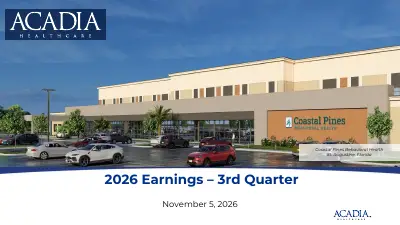
We generated $47 million of free cash flow and reduced our debt by $63 million during the quarter. We opened our new 144-bed de novo acute facility near Jacksonville, Florida in August.
Coastal Pines Behavioral Health is our fourth new acute facility opening in 2026 and our 16th since the beginning of 2023. Our revenue in the third quarter increased 5.1% compared with the prior year period, driven by solid growth in patient volumes and strong revenue per patient day.
We saw contributions to our growth from new facilities that we've opened over the last four years, as well as from legacy facilities. Same facility revenue growth was 5.2%, which was at the high end of our expectations.
As I discussed last quarter, our team is operating with a strong sense of urgency and focus, and this has allowed us to accelerate timelines across multiple key milestones for our new facilities, including licensing, accreditation, and payer contracting. This is important because it allows us to begin to serve patients sooner, as well as accelerating contracting activities with commercial payers.
All of the new facilities that were in our development plans are now open. Our team's focus and dedication enabled our new JV facilities, including Orlando Health and Methodist Jennie Edmundson, to move through the initial accreditation and licensure processes at a record pace for Acadia, and much faster than in prior years.
As we've discussed in prior quarters, we are focused on delivering more value from the investments we've made in our expanded bed capacity and the new facilities that we've opened over the last four years. The positive momentum we are seeing in our new facilities that we've opened in 2026, as well as in 2023, 2024, and 2025, provides us with increasing confidence and visibility in our path to delivering on the $200 million of incremental adjusted EBITDA relative to 2025 that we've discussed previously.
As a result, we expect to deliver approximately $60 million of incremental adjusted EBITDA from these cohorts in 2027 compared to 2026. This outlook is supported by our expectation for continued occupancy gains and strong fiscal discipline and efficiencies.
We anticipate contributions from new facilities opened in the last 12 months as they move towards break-even, along with continued positive momentum from facilities that opened in earlier years. Overall, we continue to see strong demand for our services.
We are well-positioned to meet this demand with our expanded capacity, and also through our initiatives aimed at providing patients with access to the full continuum of care, including our outpatient services that facilitate clinically appropriate step-downs to partial hospitalization and intensive outpatient programs. In addition to our strong financial performance, we are also focused on building an even stronger set of leaders across our organization through investments in internal talent development and collaboration, as well as targeted additions to the team.
As an example, in August, we hosted an Executive Leadership Summit that strengthened the connections and partnership between our facility CEOs, our corporate support teams, and our executive leadership team. We also continue to make meaningful progress advancing clinical quality, patient safety, and patient outcomes across Acadia.
During the third quarter, we expanded our measurement-based care initiatives across additional acute and specialty facilities, strengthening our ability to use patient-reported outcomes and other clinical data to guide treatment decisions and improve care. We remained focused on leveraging technology, analytics, and evidence-based practices to increase transparency into key quality metrics, support continuous improvement, and drive better outcomes for patients.
I'm also proud to share that Geisinger Behavioral Health Center Northeast was recognized with The Joint Commission's inaugural Care Team Award. Joint Commission sets the standard for healthcare quality in the United States, and its Care Team Award was established to recognize interdisciplinary teams that demonstrate exceptional collaboration, coordination, and patient-centered care.
Geisinger Northeast is the first recipient of this national honor. Since opening in 2023, our team at Geisinger Northeast has built a culture where patient safety, quality, and experience are at the center of every decision.
We believe this award reflects Acadia's commitment to safety, teamwork, and patient-centered care at Geisinger Northeast and across our entire organization. Overall, we have made significant progress on our key priorities so far this year, driven by our strong collaboration, execution, and sense of urgency.
I am confident that we have the team and the capabilities in place to continue to drive Acadia forward and build on our momentum in the fourth quarter and beyond. With that, I will turn it over to David to review the financial details.
David Duckworth
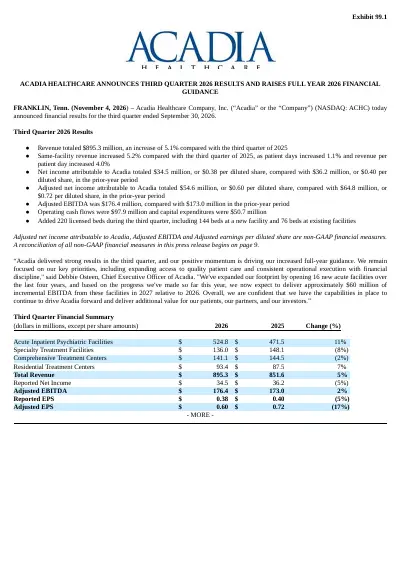
Thanks, Debbie, and good morning, everyone. Looking at our third quarter results, revenue of $895 million grew 5.1% compared to last year's third quarter.
Same facility revenue in the third quarter increased 5.2% on a year-over-year basis, driven by 1.1% growth in patient days and 4.0% growth in revenue per patient day. Similar to last quarter, the impact of changes in the New York Medicaid program on our Pennsylvania facilities reduced our third quarter same facility revenue growth rate by approximately 1% and our same facility volume growth by approximately 2.6%.
Revenue in our acute business was $525 million in the third quarter and grew 11% on a year-over-year basis. We delivered strong acute volume and admissions growth in the third quarter from both legacy facilities and the new JV and de novo facilities that we've opened over the last four years.
Specialty revenue in the third quarter was $136 million, which represents positive growth compared to last year's third quarter after normalizing for facility closures and the impact of changes in the New York Medicaid program on our Pennsylvania facilities. Looking at our RTC service line, revenue in the third quarter was $93 million and increased 7% year-over-year, driven by steady volume growth and growth in revenue per day.
In our CTC business, third quarter revenue was $141 million, which was stable with the second quarter. Demand for CTC services remains solid, and we are seeing improving admissions trends in September and October related to some of the initiatives we've launched.
Additionally, over the last few quarters, we have increased our operational efficiency and reduced our cost in the CTC service line. Moving down the income statement, consolidated adjusted EBITDA for the third quarter was $176.4 million.
On a same facility basis, adjusted EBITDA was $228.8 million in the third quarter and grew 6.1% compared to the prior year period. In terms of supplemental payments, during the third quarter, we recognized revenue and provider taxes related to Florida for the 2026 program year, consistent with our historical practice that we discussed last quarter.
Third quarter adjusted EBITDA includes an accrual of $13.4 million for expected payments for the Florida supplemental payment program year ended September 30, 2026, which compares to $5.6 million included in our previous guidance. There may be additional contribution from the 2026 program year, pending final approval.
From a revenue cycle perspective, our bad debts and denials in the third quarter were stable as a percentage of revenue compared to the prior quarter. As we moved through the quarter, we saw steady advances in our revenue cycle initiatives, and we anticipate continued progress in the fourth quarter.
Outside of the same facility group, our losses from startup facilities were $12 million in the third quarter, which was slightly better than the midpoint of our expectations. For closed facilities, we had less than $1 million in operating losses during the quarter.
Moving to the balance sheet and statement of cash flows, we remain in a solid financial position. Operating cash flow in the third quarter was $98 million, and capital expenditures were $51 million, resulting in free cash flow of $47 million.
We repaid $63 million on our debt during the quarter, and our net leverage ratio, as defined in our credit agreement, stood at approximately 3.9 times adjusted EBITDA at the end of the quarter. Looking at development, we added 220 licensed beds during the third quarter, which includes the opening of a 144-bed de novo facility near Jacksonville, Florida, as well as adding 76 beds to existing facilities.
In total, we've opened 542 beds in 2026. Additionally, in the CTC service line, we opened one new clinic and closed one existing clinic during the quarter.
With respect to capital expenditures, following a review of our ongoing and planned capital projects, we have reduced our full year forecast for capex to a range of $210 million to $230 million. Turning to our 2026 guidance, we are raising our guidance ranges based on progress made this year, and our updated full year guidance now reflects revenue in a range of $3.44 billion to $3.46 billion, adjusted EBITDA in a range of $615 million to $625 million, adjusted EPS in a range of $1.70 to $1.80, and operating cash flow in a range of $375 million to $400 million.
Our team continues to monitor supplemental payment programs that we believe could be approved in 2026 or early 2027. We estimate that programs in Florida and Ohio currently under regulatory review for the 2026 program years could add more than $20 million in incremental EBITDA, but we have not included those expanded programs in our guidance ranges.
I will now turn the call back over to Debbie.
Debbie Osteen
Thanks, David. We've made significant progress on our key priorities so far in 2026, and our strong execution has allowed us to raise our financial guidance for the third consecutive quarter.
We are confident that we have the capabilities in place to continue to drive Acadia forward and deliver additional value for our patients, our communities, and our investors. Above all, our team of dedicated employees remains committed to our mission and to providing clinical excellence for our patients and the communities we serve.
With that, we will now turn it over to the operator for questions.
Operator
We will now begin the question and answer session. Please limit yourself to one question and one follow-up.
If you would like to ask a question, please press star one to raise your hand. To withdraw your question, press star one again.
We ask that you pick up your handset when asking a question to allow for optimum sound quality. If you are muted locally, please remember to unmute your device.
Please stand by while we compile the Q&A roster. Your first question comes from the line of A.J.
Rice with UBS. Your line is open, please go ahead.
AJ Rice
Thanks. Hi, everybody.
Maybe thinking about where you're at in the recovery and turnaround process, I know you made a lot of progress in this year. As you think about closing the year and going into '27, where do you think some of the best opportunities still remain for you to get the company completely back on track and to a level of earnings and growth that you think it's capable of developing?
Debbie Osteen
A.J., my goal when I returned as CEO was to position Acadia for long-term success. Part of that was strengthening the team, which I think we've done.
We've refined our operational structures, we've made changes there to give more visibility and focus. I think that we've set a very clear set of priorities for the team.
As I think about our opportunities for the fourth quarter and also next year, I think we have opportunity to continue to drive volume and to ramp our facilities to realize the investments that we've made. I believe that as the team works on those issues and also our legacy facilities that still have opportunity for occupancy and growth, we're going to see not just a strong fourth quarter, but next year I think we're very well-positioned.
We're maintaining discipline with our costs and our expense controls, and along with that, I think we're working very well with payers. I'm optimistic that we have opportunity.
We've laid out the $60 million, but as we give our guidance in February, we'll talk more about other opportunities that we see.
AJ Rice
Maybe just then for my follow-up to ask about that $60 million of incremental EBITDA, it seems like the new bed capacity, the newer facilities are contributing it sounds like more quickly than maybe you had even planned for. I know you've laid out the contribution for next year that you expect from what you've already put in place.
I wonder, does it make you think about increasing the pace of new development or going back to maybe some incremental JVs? How do you think about that versus focusing on just the organic opportunity that you have?
David Duckworth
A.J., we do believe the company right now with the 16 new facilities that we've added in the four-year period and the capacity we have from that, we have just an incredible runway of growth over the next few years, as implied by the $60 million of incremental EBITDA that we outlined for next year. Of course, we will always be looking at new opportunities.
The company has just tremendous flexibility for how we evaluate whether it's a new facility, a new joint venture opportunity, adding beds across our many markets that we're in, just our existing operations. We will continue to evaluate that, not factoring any new facilities into our plan for next year at the current time.
As we move forward, we'll continue to provide updates around that. Yes, the new facilities, the 16 that we've added over the last four years, they are beginning to contribute to our results.
Of course, we have had facilities in the startup mode for several years in a row now. The contribution that we've seen this year from those new facilities, just to size that for everybody, we would size that around $15 million that we've achieved thus far of the $200 million.
As we look ahead to next year, we see the pace increasing dramatically. Part of that is just moving out of new facility losses, and it also reflects just the progress we've made.
The new facilities that we've added this year are ahead of schedule in terms of how they have achieved key milestones with opening, getting licensed, getting through their accreditation process. We've been very pleased with that and are in a good position next year to just realize a greater portion of that $200 million opportunity.
AJ Rice
Great. Thanks so much.
Debbie Osteen
Thank you.
Operator
Your next question comes from the line of Ben Hendrix with RBC Capital Markets. Your line is open, please go ahead.
Ben Hendrix
Great, thank you very much. Just wanted to ask about the revised capex guidance.
Are there any particular capital programs that are looking less attractive that's kind of guiding your decision to kind of scale that back a little bit? Just kind of a little more detail on kind of what's driving that decision.
David Duckworth
Ben, at the moment, we do look at our capex plan regularly. At the beginning of the year, of course, there was a decision already made to reduce the capital spend in terms of new facilities.
That's the area where we've seen the largest adjustment, even as we've moved through the year, just looking at new facility investments. We'll continue to have maintenance and IT capital, that's just a normal part of our overall capex number.
We will continue to have existing facility investments, those continue to be compelling opportunities for the company. The reductions we've made, we would say are mostly related to de novo facilities as well as those joint venture facilities.
Of course, we did still have some spending for those two components of our overall capex during 2026. As we think ahead to next year, we expect further reductions in the overall capital, just as we see the new facility spend that we've had this year not recur into next year.
We'll continue to evaluate all of those capital opportunities going forward, just under the disciplined framework that we have for looking at growth opportunities. Going forward, we would think existing facilities, maintenance capital, and having a focus on mainly those buckets going into next year, that's the source of the reduction we've seen this year and the further reduction that we expect going into next year.
Ben Hendrix
Great, appreciate that. Then kind of separately, just wanted to follow up on the comments about the record licensure speed in some of the newer bed adds, the newer facilities.
Is that something that has to do with the way you're operationalizing the process internally, or is that more kind of a reduction of a logjam on the regulator side?
Debbie Osteen
Ben, I think it it's really I give credit to the team. We've have a whole playbook now around licensure and all the pieces that go with that as you, get all the approvals and our Medicare and Medicaid numbers.
They've done a good job of looking at who the key decision makers are. It differs by state.
Really mapping that out, and looking at where we need to be, if there are delays, pushing, because our patients need care. I think that, by really focusing on each one of the facilities we've opened this year, and also who those decision makers are, and being willing to collaborate with our partners, has made a big, big difference.
We've been able to, dramatically cut the time that it took last year as well as years before. And, in some cases it's it's just been remarkable how fast we've been able to get these approvals.
Ben Hendrix
Thank you very much.
Debbie Osteen
Thank you.
Operator
Your next question comes from the line of Brian Tanquilut with Jefferies. Your line is open, please go ahead.
Brian Tanquilut
Hey, good morning, guys, and congrats on the quarter. Maybe, David, just to double-click on that $60 million.
You said you already have recognized 15 this year, there's an incremental 60 next year. When I look at your guidance, and maybe adjust for PLGL and some of the DPPs, I think I'm baselining at about 610, we just basically add that 60 and then assume whatever growth on the legacy portfolio to get to a right EBITDA number?
Is that the way you're thinking about it?
David Duckworth
We'll provide more commentary in February around our 2027 outlook. Wanted to provide the $60 million target for now because we have all the facilities open, all of them at a key point in the process where we now have more visibility.
The $60 million is a key part of the company's opportunities for next year. We'll provide more detail in February as it relates to how that fits into our overall 2027 outlook.
Of course, we've already talked about continued momentum and progress that we see even in the legacy facilities. Many of those have added beds over the last few years.
There's other sources of opportunity for the company going into next year. We'll provide more commentary as well around the supplemental programs.
We did have during our first quarter and our second quarter a couple of out-of-period of items, $11 million in Q1, $26 million in Q2 for Ohio and Florida respectively. That's something to just keep in mind as we go into next year.
We also have, as we mentioned earlier, some upside around what we've recognized thus far for 2026 and what we ultimately think we might get, which is more than $20 million of upside. Don't have certainty right now as to whether that'll be a fourth quarter item or early next year, but a positive there as we think about the final potential approval in those programs.
More to come in February though, Brian.
Brian Tanquilut
Got it. Okay.
Then as I look at the revenue rather you reported for CTC and specialty, it looks like it's been flat sequentially. Do you guys think that we're now bottoming out or we're stabilizing and that this is the right baseline to inflect from and grow these businesses from?
Thanks.
Debbie Osteen
I'll just say we are seeing improving admissions trends in September and October, and it's related to some of the initiatives that we put in place. We still feel like there's a strong demand for the services.
I think it's 16% of our total revenue, and we're in 33 states, we're going to see variances there from time to time. The team is very focused on looking at making sure we're providing access for those who need the CTC services, but then also the patient experience.
I think that it's making a difference. We are, as you said, stable sequentially.
Going forward, we're looking at each region really that we're in across those 33 states, and we have plans that are more detailed around those regions, which is I think the right way to look at it.
Brian Tanquilut
Awesome. Thank you, guys.
Debbie Osteen
Thank you.
Operator
Your next question comes from the line of Pito Chickering with Deutsche Bank. Your line is open, please go ahead.
Pito Chickering
Hey, good morning, guys, and thanks for taking my questions. Can you remind us what the timing is of when you do PLGL checks and what causes increases or decreases to those assumptions?
As you look at the number of lawsuits and the size and scale today versus a few years ago, is it possible that these expenses start to reverse, and when could that occur? Any color on the legal settlement on the gain that occurred this quarter?
David Duckworth
Pito, the timing of our PLGL review, we talked about moving as we moved into 2026 a more frequent review. We did complete the mid-year review during our second quarter, and we will have another review in the fourth quarter.
That's the frequency and the updated timing around the reviews that we've had in place this year. We'll have more commentary once we go through that fourth quarter review as to our expectations for the 2027 expense.
In terms of the legal settlement that I think you're asking about on our line item, we did have a positive gain that was from, as we disclosed in our 10-Q, that was from our derivative lawsuit settlement. I think you're probably asking about that $7 million gain on our P&L, added back, not included in our adjusted EBITDA results, but related to a derivative settlement that we had disclosed.
Pito Chickering
Great. Then a follow-up question to Brian's CTC questions.
Just can you size the number of new patients sort of coming to clinics versus a year ago? Any views around medications like buprenorphine versus methadone?
Just general views about can this sort of be a growth category again going forward, or is it just sort of more structurally impaired as there are less opioid addicts as doctors are trying to actively avoid opioids? Thanks.
Debbie Osteen
Pito, we currently give both of those medications, but methadone is by far, it's considered the gold standard, and 90% of our patients receive that. We want to meet the patient needs, and so we're able and prepared if a patient and a physician decides that they need, not methadone, but another medication, we're able to dispense that.
Part of what I mentioned a minute ago on patient experience is just making sure they're coming to us for help with their addiction, and we want to make sure that that medication fits their needs. I think that both have been around for years, but we're able to do both.
We just think that methadone is considered the gold standard as we think about those that need that kind of care.
David Duckworth
In terms of, Pito, the number of patients, as we've expanded and added de novo clinics, I think we've seen and the industry has seen just a lesser number of patients being served by clinic, which is just been a positive in terms of access to care, more people getting treatment. Where we stand today, there's still unfortunately a small percentage of patients that are getting treated today that need treatment.
We do think there are growth tailwinds for this business as we think about the strengths of the service line, the diversification, our geographic profile today, but also where there still is a need across the country. It's stable.
We've actually seen improved admission trends, as we mentioned earlier, just in the last couple of months. Just with some revenue challenges in certain of our markets, the team's been able to manage very well with operational efficiencies and a reduced cost structure.
Operationally, the team's doing a great job, and we do think there are growth opportunities in that service line.
Pito Chickering
Great. Thanks so much.
Debbie Osteen
Thank you.
Operator
Your next question comes from the line of Matthew Gillmor with KeyBanc Capital Markets. Your line is open, please go ahead.
Matthew Gillmor
Hey, thanks for the question. On the bad debt and payer denial topic, the year-over-year pressure moderated in the third quarter, but I think some of that may have just been due to an easier comp.
I was curious if there's any additional comments to make just in terms of the underlying activity and sort of what level of pressure do you expect year-over-year going forward?
David Duckworth
We've seen just steady progress and are pleased with the team and the tools that we've deployed over the course of the last year related to our revenue cycle initiatives. Have been encouraged to see stability sequentially as we just look at our bad debts and denials on a percentage of revenue basis especially, comparing to the first part of the year.
You're right. I think the year-over-year headwind moderation that we've seen going down is as much about the comp and the trend that we saw in 2025, but also reflects stability that we've seen throughout 2026.
I think it's even more impressive the result that we've seen just as you think about it on a percentage of revenue basis. Our $4 million that we highlighted on our slides, which is our year-over-year headwind, a significant portion of that, more than half of that, is just revenue and volume growth in our business.
The other part is a slight uptick in the percentage of revenue. It is down to being in our minds just a very nominal level of a year-over-year headwind and an opportunity for the company as we move forward.
We'll continue to advance our revenue cycle initiatives, what we're doing as a team to deploy new tools into front-end documentation, positioning for continued improvement, as well as how we just intervene quickly and manage every aspect of our revenue cycle with just a greater sense of urgency and closer monitoring in terms of what's happening across our markets. Pleased with the stability that we've seen, and hopefully we'll see further opportunities as we move forward.
Debbie Osteen
I'll just add, we're rolling out technology and analytic tools in this area just to help our team identify the trends earlier and to intervene, as David said, more quickly. The team's very focused on kind of the back to basics, which is making sure that our documentation reflects the acuity of the patient that's in our care.
We've tried to approach it by what is our part here, but then also, particularly with denials, making sure that we vigorously appeal those, because with medical necessity, our patients are acute, and across all service lines, they need our care. It's up to us to make sure we're able to reflect that acuity and to document that, but then also to work with our payers in a collaborative way, but also to be aggressive to make sure that we're getting paid for what we do.
Matthew Gillmor
That's great. Then on the New York Medicaid issue, I wanted to see if there is any additional details to share with respect to backfilling those facilities and conversations with other referral sources across the state.
Debbie Osteen
I think the team has done just a great job of replacing patients. As we still had some New York patients in our Pennsylvania facilities in the first quarter, and second quarter, we had no New York patients.
We've been able to be successful in developing new referral relationships in states that are surrounding Pennsylvania, but we've also seen an increase in referrals from Pennsylvania. It's still a work in progress because it was a pretty large number of patients, but they are exceeding our expectations as far as what they've been able to replace, but we're very focused on that.
Still in dialogue with New York, and we know that there are referral sources in New York that would like to use our facilities, we're making sure that New York understands that.
Matthew Gillmor
Great, thanks a lot.
Operator
Your next question comes from the line of Jason Cassorla with Guggenheim. Your line is open, please go ahead.
Hi, this is Aling Ong for Jason. Congrats on the solid quarter.
Debbie Osteen
Thank you.
I have a question on length of stay. Length of stay declined 5.1% this quarter and last quarter.
Just wondering what's driving the shorter length of stay. Actually how we should think about length of stay into 2027?
David Duckworth
Understood. Okay.
It's a function, and we've talked about this over the last several quarters, as our service mix has changed to reflect a greater number of acute facilities and acute volume, our length of stay naturally declining due to service mix, a greater mix of those acute beds relative to a longer length of stay for our specialty as well as our RTC business. I think we'll continue to see that trend as the $200 million opportunity that we talk about is achieved.
Those are acute facilities. The JV and de novo facilities that represent those 16 facilities are all acute facilities.
We will continue to see service mix reflected in certain metrics, especially the length of stay metric.
Debbie Osteen
I'll just add, back to New York, those patients stayed a much longer length of stay. Also some of the closures that we've done in our specialty area, they had a longer length of stay.
That does impact the number as well as the acute mix that David talked about.
Oh, great. That's very helpful.
A separate question, you just mentioned that your legacy facilities still have opportunity for growth and efficiency. I'm just wondering how much incremental volume growth and efficiencies you can possibly drive from legacy facilities later on?
Thanks.
David Duckworth
For the company, our legacy facilities have always focused on growing their programs and the services that they provide within the markets. We're now in a greater number of markets and have an even stronger just footprint than we've had in years past.
Feel like those opportunities to grow in our existing markets will continue to be there for the company. The beds that they've added over the last few years, we think give them the opportunity to increase the occupancy from where we see it today.
Just as we've seen strong performance from those legacy facilities, 1.6% volume growth during the third quarter, we think there's continuing opportunities, especially as we just continue to evaluate services that we provide and whether we can expand within our existing markets.
Debbie Osteen
I'll say that the team has done a good job of really looking at our legacy facilities and those that might be underperforming. They are looking at detailed plans around what are the issues, what can we do to problem-solve those issues and making sure patients have access to our facility and they are able to access us in a timely way, looking at the expense structure that's within the facility.
Each facility has more visibility, I think, than they've ever had of just how do we improve those that might be underperforming, but then, as David mentioned, how do we grow those that still have capacity?
Great. Thanks a lot.
Debbie Osteen
Thank you.
Operator
Your next question comes from the line of Andrew Mok with Barclays. Your line is open, please go ahead.
Andrew Mok
Hi, good morning. Admissions growth accelerated to roughly, 6.5% this year, but the patient day growth remains in the low single digits across your legacy and ramping facilities.
One, can you give us can you talk about the sources of strength on admissions? Two, given all the mix effects on length of stay that you just talked about, can you give us a sense of what patient day growth looks like within the acute inpatient business?
Thanks.
David Duckworth
Andrew, and that admissions metric is a similar dynamic to what we just talked about around length of stay, where our acute facilities do have a greater number of admissions, just with the shorter length of stay, greater number of admissions relative to other service lines. We see that reflected in the relationship between the admissions and the patient days that we report for the overall company.
Within patient days, the acute business has performed very well this year, seeing very strong demand and inquiry growth within that business. Our volumes within the acute service line increased 7.5% during the quarter.
They are having a great year, just tremendous momentum in the legacy facilities as well as those new facilities going into next year.
Andrew Mok
Great. If I could just follow up on commercial mix.
It finished at 20.9% this quarter, which is down, nearly 400 basis points and more than 10 percentage points below the highs of 2022. Can you give us, can you help us understand how you're thinking about the progression of commercial mix over the next 12 to 18 months, and where does specialty sit now in like the broader strategy?
Thanks.
David Duckworth
The change that we see year-over-year, we've been stable at that lower level in the low 20s for commercial throughout the year. The change year-over-year reflects the closures that we had within the specialty service line.
That is where we see, especially in certain of our specialty facilities and the ones that we closed, that's where we saw a greater commercial mix. I think it would settle out around where we have it today, just as it's been stable throughout this year.
The specialty service line has had a great year and has grown their revenue, if you adjust for the headwinds that we've called out between New York Medicaid as well as some of the closures that we've had. That business line is performing very well as we move through the year and is an important service line for the company moving forward.
Andrew Mok
Great. Thank you.
Operator
Your next question comes from the line of Ann Hynes with Mizuho. Your line is open, please go ahead.
Ann Hynes
Great, thank you. Just on the one big beautiful bill, can you remind us how you view your exposure as a work requirements going to affect next year?
Can you remind us how many of your Medicaid patient days are in expansion states? Thank you.
Debbie Osteen
I think about 50% of our Medicaid patients are in expansion states. I don't think that next year we don't see much impact from the big beautiful bill.
When we look at the work requirements and other parts of that bill, we don't feel that our patients are going to be significantly impacted. We believe that the vast majority of our Medicaid patients will be exempt from those work requirements.
As we've watched some of the states and how they've set out how it's going to work within each state, there is a process where the patient will be able to attest that they have the medical frailty. We hope that all the states will look at how to make it as streamlined as possible, but we're also prepared to work with our patients to help them.
I do think that overall we're not going to see the impact that perhaps other areas of healthcare might see with that requirement.
Ann Hynes
Great. Then just the $60 million for next year, can you give us some key assumptions that you think those hospitals will achieve, meaning like capacity, what capacity on average are they running at now, and what capacity do they have to reach next year to get to that $60 million of EBITDA positive?
Thank you.
David Duckworth
Sure, Ann. It really depends.
All of those 16 facilities, and it's over a four-year period, they are in a different point in time within their startup processes, and they all have a different target for next year. Even that target that they have depends on factors other than how long they've been open.
For example, a larger facility may have a little more time to reach the occupancy target that we think it will ultimately reach, whereas a smaller facility can often ramp up more quickly. In general, a key part of the $60 million is the startup losses that we've incurred this year, and the progress that we can make on just getting those facilities not only ramped up to a break-even occupancy level, which for us is usually around 40%, is where we start to see that break-even opportunity, but also just manage the cost structure that we have for those facilities as they ramp up to that occupancy level.
A key part of the 60 in our minds is the $45 million of current year operating losses for those startup facilities going away, especially as we move from the beginning of the year to the later part of the year. The facilities that have been open longer than that have a contribution to make as well.
About half of the $60 million is from the startup facilities or the new facilities, with the other half being the older facilities within the cohort, call it the '23 to '25 openings that we've done, which also are at a really good point where they're breaking even today, for the most part, and now have the opportunity to continue to make gains around occupancy and margins.
Operator
Your next question comes from the line of Whit Mayo with Leerink Partners. Your line is open, please go ahead.
Whit Mayo
I just wanted to follow up or some of that last question, clarification of this. Are you assuming that 40 the $45 million of startup losses completely goes away next year?
David Duckworth
Whit, our preliminary math is that we think that we can get it down from about $45 million to around $10 million. As you think about that and plan for your quarterly modeling of that, obviously where we are beginning of the year, beginning 2027, is very different from where we think we can end the year, just with where the newer facilities are today.
Two facilities opened in June, one and our last facility opened in August. As we end the year, start next year, we'll see a greater weighting and quarterly spread of that $10 million into the first part of the year, and expect for those facilities to make significant progress over the course of the year.
A reduction from $45 million to $10 million is our projection that's incorporated into that $60 million projection.
Whit Mayo
Okay. I thought I heard in the prepared comments, David, you mentioned something about some expense or cost action that you took in the CTC segment.
Any way to frame or size what the annualized savings is?
David Duckworth
In our minds, it's just operational focus and execution, especially in the markets that have underperformed slightly relative to our expectations this year, but even across other markets, being able to drive efficiencies and make some cost reductions to make sure that the impact to the company of the revenue performance that we've seen is mitigated, and that from a earnings perspective that and it's 16% of our revenue, and then they've been able to manage through the revenue performance very well from a cost perspective. The earnings impact just with those two dynamics has really helped to mitigate the revenue performance that we've seen.
It's not something we would really quantify as incremental cost savings, as much as it is an ability of that team to be able to manage their cost structure based on what they see operationally.
Debbie Osteen
I'll just add, Whit, part of it also is just looking at how we're set up by region, and how do we have the organization structure, if we have a regional person, are there ways to combine that structure? We've had a lot of growth, as I think everyone knows, and some acquisitions, really just making sure that we have the right leadership structure in place has been part of what the team has looked at.
I just have to give them a lot of credit. They've been very proactive with this area, and I think it's made a big difference.
Whit Mayo
Thanks.
Debbie Osteen
Thank you.
Operator
Your next question comes from the line of Ryan Langston with TD Cowen. Your line is open, please go ahead.
Ryan Langston
Thanks, good morning. Debbie, I'd be interested if you had any initial thoughts on this week's election cycle, and maybe how that might not only impact Acadia, but maybe just the behavioral health industry overall?
Debbie Osteen
Sure, I think both parties recognize the need to protect and expand access to behavioral health and substance use care. Over my career in behavioral health, and I had a leadership role at one point on the NABH board, I always believed, and I know that NABH believes this, it's always important to work with both parties and to bring visibility.
I do think that we're going to remain a priority at both the state and the federal level. We have so much demand for our services, and there is, I think, a recognition with both parties that access to care is a challenge in part of the country.
We will be engaging constructively with Democrat and Republican leadership and as well at the state level where we think it's important for them to know what we do. We often invite them to come to our facilities to see what we're doing and how we're serving patients.
We think that's important. Our Chief Strategy Officer was appointed earlier this year to the HHS and CMS Health Care Advisory Committee, and so they are looking at how to shape and improve and strengthen healthcare.
We have a voice there, but again, I think both parties understand the importance of what we do.
Ryan Langston
Great. Then just maybe an update on staffing and hiring.
Anything in particular you'd call out in terms of trends and maybe how recruiting is progressing at the newer facilities you've recently opened? Thanks.
Debbie Osteen
We utilize a centralized approach in many of the positions, particularly CEOs, but also RNs and if we find that, whether it's be a therapist, a social worker it's difficult to recruit for, we use our centralized team. They have done a very good job of making sure that when they have visibility around openings, that they're filling those positions.
It varies by market, but that's not really been, there may be a few exceptions, a gating item to really building volume. In many and almost all of our markets, we've been able to get the staff in a timely way and also with the idea of retaining them.
There's a whole effort going on right now within the company on retention, and how we onboard staff, and making sure they understand their roles. I would say the labor trends are stable, and we've been able to find the individuals we need to staff the new facilities.
Operator
Your next question comes from the line of Joanna Gajuk with Bank of America. Your line is open, please go ahead.
Joanna Gajuk
Oh, yes, hi. Good morning.
Thanks so much for taking the question. I guess maybe first, I'll just follow up on the discussion around the core business growth, which I know you're not prepared now to give us guidance for next year, but in terms of just one element, the same-store volumes, right?
They tracking, call it, about 1% this year, but there's obviously that New York headwind here. The question is, essentially what do you think the sustainable same-store facility volume growth could be once you overcome the New York issue?
Really, can you grow 2%, call it, plus next year from these legacy facilities? Also, what level of volume growth you need to get operating leverage?
David Duckworth
Joanna, if you look at our reporting throughout this year, obviously the same facility patient day metric is affected by the New York item that we've highlighted. If you adjust for that, the Q3 patient day growth was 3.7%.
A key driver of that is, of course, the new facilities and the progress we've made there, but also legacy facilities contributed 1.6% to that 3.7. We're not going to size today our expectation for those legacy facilities going into next year, but think that they do have growth opportunities.
Think that just the impact from that 60 million that I know we've been talking about throughout the call, but the impact from those facilities should continue to drive that overall patient day growth opportunity to continue to be in that 3% to 4% range, but we'll provide more detail around that in February.
Joanna Gajuk
Great, thank you. If I may, a different topic, the government investigation related costs are down a lot year-over-year, right, but it's still $18 million so in this quarter.
Is there anything about the current pace of activity with the DOJ or SEC that might changes how we should think about legal spending next year, or maybe potential resolution timing? Thank you.
Debbie Osteen
It's going to vary, Joanna, by quarter. I wouldn't read anything into that.
We're still working in collaboration, cooperating fully with the government. We wouldn't have any other comment there, but it's going to vary, and there's other legal expenses in there as well, I wouldn't read too much into it.
Joanna Gajuk
All right, thank you.
Debbie Osteen
Thank you.
Operator
There are no further questions at this time. I will now turn the call back to Debbie Osteen, CEO, for closing remarks.
Debbie Osteen
Thank you for your time this morning, and for your interest in Acadia Healthcare. Please feel free to contact us if you have any additional questions.
Have a good day.
Operator
This concludes today's call. Thank you for attending.
You may now disconnect. This event has now concluded.
Access the Acadia Healthcare Company, Inc. IR website for more information.
This line will now disconnect.