Axcelis Technologies, Inc.
Q3 FY2026 · Earnings Call TranscriptNovember 5, 2026
Operator
Good day, ladies and gentlemen, and welcome to the Axcelis Technologies call to discuss the company's results for the third quarter of 2026. My name is Rivka, and I'll be your coordinator for today.
I would now like to turn the presentation over to your host for today's call, David Ryzhik, Senior Vice President and Interim Chief Financial Officer. Please go ahead.
David Ryzhik
Thank you, operator. This is David Ryzhik, Senior Vice President and Interim Chief Financial Officer, and with me today is Russell Low, President and CEO.
If you have not seen a copy of our press release issued earlier today, it is available on our website. In addition, we have prepared slides accompanying today's call, and you can find those on our website as well.
Playback service will also be available on our website as described in our press release. Please note that comments made today about our expectations for future revenues, profits, and other results are forward-looking statements under the SEC Safe Harbor provision.
These forward-looking statements are based on management's current expectations and are subject to the risks inherent in our business. These risks are described in detail in our annual report on Form 10-K and other SEC filings, which we urge you to review.
Our actual results may differ materially from our current expectations. We do not assume any obligation to update these forward-looking statements.
Given the pending merger with Veeco, we will not be addressing questions related to the transaction. During this call, we will be discussing various non-GAAP financial measures.
Unless otherwise noted, all income statement-related financial measures will be non-GAAP other than revenue. Please refer to our press release and accompanying materials for information regarding our non-GAAP financial results and a reconciliation to our GAAP measures.
Now, I'll turn the call over to President and CEO Russell Low.
Russell Low
Thank you, David. Good morning, everyone, and thank you for joining us for our third quarter 2026 earnings call.
Before I get into our quarterly results today, I'd like to share a brief leadership update. As we announced on October the 27th, we are pleased to welcome Jeroen Dielsman as Executive Vice President and Chief Financial Officer beginning November the 12th.
Jeroen brings deep financial expertise, extensive global industrial and semiconductor industry experience, a strategic mindset, and proven leadership ability to the role. He has a demonstrated track record of leading organizations through phases of growth and transformation, building strong teams, and translating strategy into measurable results.
I look forward to partnering with him as we pursue our growth opportunities and build an even stronger company through our next chapter. I'd also like to thank David for his contributions and leadership while serving as interim CFO.
Following Jeroen's arrival, David will transition to his new role as Senior Vice President, Corporate Development and Investor Relations, reporting directly to me. His deep knowledge of Axcelis, our markets, and our business will be especially valuable as we continue to advance our strategic priorities.
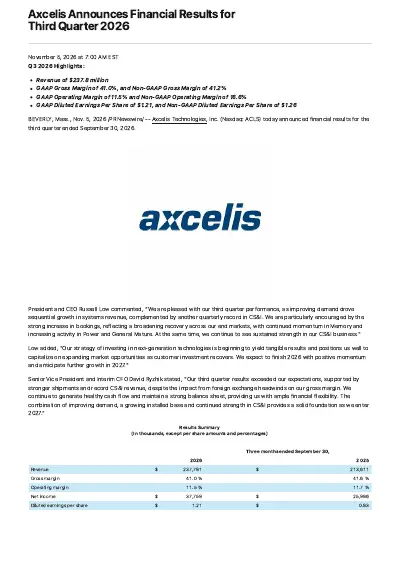
Turning to our performance in the quarter, we continued to build momentum in the third quarter as the demand backdrop strengthened further. We reported revenue of $238 million and earnings per diluted share of $1.26, which exceeded our expectations due to higher revenue and lower operating expenses more than offsetting lower gross margins due to foreign exchange headwinds.
These results reflect sequential improvement in systems delivered, combined with another quarterly record in CS&I revenue. As expected, systems growth in the quarter was driven by an improvement in power and memory markets, partially offset by a relatively small sequential decline in general mature following a strong second quarter.
CS&I continues to exhibit strong momentum supported by our growing installed base, higher customer utilization of our tools in the field, and the continued growth in our service contract and upgrade offerings. CS&I continues to represent an important driver of our long-term growth and profitability across market cycles.
System bookings grew significantly quarter over quarter, with our book-to-bill coming in at 1.5. This further supports our view that the end markets we serve are strengthening and that we are entering 2027 with positive momentum.
Turning to our systems revenue by segment, sales to mature node applications accounted for approximately 78% of systems shipments, with memory and advanced logic making up the balance of our sales. Now let me review our trends by end market.
Beginning with power, sales from silicon carbide applications grew notably on a sequential basis. This reflects broad-based improvements in demand, including customer pull-ins in Europe and Asia.
Combined with high utilization rates and increased customer engagement, this reinforces our view of a strengthening demand environment. We're also seeing an expanding range of applications driving silicon carbide adoption beyond traditional automotive, industrial, and solar markets.
AI-driven power requirements and data center investments are emerging as additional demand drivers. At the same time, declining wafer costs are improving the economics of silicon carbide across a broader range of applications, including consumer and commercial products.
As a result of the investments we have made over the past few years in our technology, we are now well positioned to capitalize on these dynamics and the increasing adoption of more advanced device architectures and customers' transition to 200 silicon carbide wafers. Our wafer handling technology enables demanding high-temperature implant applications, while ongoing improvements in cost of ownership deliver value to customers and expand opportunities for our CS&I business.
We're also beginning to see the benefits of our early investments in the precision and process control capabilities required to enable low-cost superjunction adoption. This is translating into growing commercial traction with multiple Tier 1 customers selecting our Purion XE family equipped with advanced channeling technology.
In our other power markets, third quarter sales declined modestly following a strong second quarter, but remained elevated compared to the prior-year run rate. Demand continues to benefit from improving utilization across automotive, industrial, consumer, and data center applications.
In silicon IGBT specifically, we're also seeing growing interest in our new proton implant solution with multiple orders for the Purion VXE LT+. Proton implantation is increasingly important in high-performance silicon IGBTs, helping improve power efficiency and device reliability.
We're also seeing growing interest in our solutions for power management ICs, or PMICs, supported in part by increasing data center demand. In general mature, sales declined modestly on a sequential basis, but remained consistent with levels seen throughout 2026.
More importantly, bookings showed strong growth on a sequential basis following several years of softer demand, supported by rising utilization rates and renewed customer investment. North America was a particularly strong contributor, reflecting increased customer investment, including capacity expansion plans associated with AI-related demand.
General mature continues to represent a large market opportunity for Axcelis, given the high implant intensity of these applications and our ability to address a wide range of customer requirements with our broad portfolio of high-energy, high-current, and medium-current platforms. Our recently introduced Purion H6 high-current system further strengthens our competitive position in this market, and we are seeing increased customer interest as investment activity recovers.
Turning to our advanced logic market, we shipped the follow-on system we highlighted last quarter for materials modification application supporting 2 nm production. We continue to work closely with leading customers on advanced node technology roadmaps where 2 nm and future process technologies are creating additional opportunities for materials modification applications.
In memory, the industry demand environment remains robust, supported by accelerating investments in DRAM and HBM capacity to address growing AI-related requirements. We are seeing momentum in engagements with our memory customers in Korea, as well as with our customers outside of Korea.
In fact, building on our strong presence in Korea, we recently celebrated the groundbreaking of a new manufacturing facility in Pyeongtaek, representing a $35 million investment in our global production capabilities. We were especially pleased to mark the occasion alongside representatives from our major Korean customers, underscoring the strong relationships we have built in the region and our long-term commitment supporting their growth.
The approximately 200,000 square foot facility will consolidate and expand our Korean manufacturing operations and enhance our ability to respond quickly and with more flexibility to meet customer requirements. Production is expected to begin in the second half of 2028.
This investment represents an important step in expanding our global operations infrastructure to support our customers' long-term growth plans. Now let me wrap up my thoughts and provide our perspective as we exit 2026 and move into 2027.
While the broader demand environment is clearly improving, we are particularly pleased to see our strategy of continuing to invest through the recent digestion period beginning to yield results. Our next-generation technologies, including our Purion H6 high-current implanter for general mature, a new high-energy proton implant solution for silicon IGBTs, our advanced channeling technology for silicon carbide, and several other technologies, are gaining traction as customers' investment recovers.
In addition, we have seen increased interest in our highest-energy solution, the Purion XE Max, and we also recently expanded our engagement with a leading European research institution with the placement of a medium-current system to complement our existing high-current system already installed, expanding our portfolio there. As we look ahead, we are increasingly encouraged by the broadening recovery across our end markets and expect growth in 2027 across memory, power, and general mature.
This outlook is supported by continued investment in DRAM and HBM capacity, recovering conditions in silicon carbide, and growing activity across general mature applications. Higher customer utilization, increased bookings, expanding investment plans further reinforce our confidence in demand environment.
At the same time, our CS&I business continues to provide a growing foundation for revenue and profitability. We also look forward to completing our pending combination with Veeco Instruments and the potential to create a stronger company with expanded capabilities, broader growth opportunities, and long-term value for our shareholders.
The parties continue to work constructively towards obtaining the required regulatory clearance in China. Given the upcoming expiration of our current HSR clearance, we also plan to promptly make a new HSR submission.
We now expect the merger to close by the end of the first quarter of 2027. Finally, I want to thank our employees, customers, partners, and shareholders for all their continued support and confidence in Axcelis.
With that, let me turn the call over to David for a closer look at our financial results and outlook.
David Ryzhik
Thank you, Russell, and good morning, everyone. Let me now start with the financial details of the third quarter before turning to our outlook for the fourth quarter.
Third quarter revenue was $238 million, consisting of system revenue of $145 million and CS&I revenue of $93 million. Beginning with our third quarter results, we are no longer separately disclosing the services component of revenue and gross margin.
Services represents a small percentage of our broader CS&I business and, on a standalone basis, is not representative of the overall performance of CS&I. Accordingly, we believe presenting these amounts within our consolidated results provides a more meaningful view of our business.
Now, turning to our revenue by geography, revenue in China remained flat from Q2 at 46%. Korea was our second largest revenue-generating region at 18% of our total revenues.
In our other regions, the United States was 13%, Europe 12%, Taiwan was 2%, and Japan was 1%. The remaining 8% of revenue came from the rest of the world.
Bookings were $222 million, the highest quarterly bookings since the fourth quarter of 2023. As a result, our backlog exiting the quarter increased to $531 million.
Now let me share some additional detail on our results. Gross margin was 41.2%, below our outlook of 43%, primarily due to the sharp strengthening of the Korean won relative to the US dollar.
Given our growing presence in Korea, this presented a headwind to our gross margin. This was partially offset by a corresponding FX gain in other income.
Third quarter operating expenses were $58.5 million, below our outlook of $62 million, primarily due to lower than expected fringe costs, as well as slower than expected onboarding of new hires. Tying it all together, our operating margin was 16.6%.
Third quarter adjusted EBITDA was $44 million, and adjusted EBITDA margin was 18.5%. Other income was $7 million, higher on a sequential basis due primarily to the aforementioned foreign exchange gains.
Our tax rate was 16%. In the quarter, we benefited from the reversal of tax positions resulting from an audit closed in the period.
However, these discrete audit-related items have been excluded from our non-GAAP effective tax rate. Finally, third quarter earnings per diluted share was $1.26, exceeding our outlook of $1.11.
Free cash flow for the third quarter was $38 million, and we exited the third quarter with a strong balance sheet consisting of $615 million of cash, cash equivalents, and marketable securities on hand. This includes $143 million of long-term securities.
With that, let me discuss our fourth quarter outlook. We expect revenue of approximately $275 million.
We anticipate the increase to be primarily driven by sequential improvement in our power and general mature markets. As we look beyond the fourth quarter, we currently anticipate revenue in the first quarter of 2027 to be relatively consistent with fourth quarter levels.
This is despite the seasonally lower CS&I revenue we typically experience in the first quarter. We expect fourth quarter gross margins of approximately 42.5%.
We expect operating expenses of approximately $65 million. The sequential increase primarily reflects annual merit increases, continued investment in R&D, higher fringe costs, and an increase in variable compensation associated with an improvement in our business.
Adjusted EBITDA in the fourth quarter is expected to be approximately $56 million. We anticipate a tax rate of approximately 15%, and finally, we estimate net earnings per diluted share of approximately $1.50.
In summary, we're exiting 2026 with strong momentum, positioning Axcelis for another year of growth in 2027. At the same time, we remain focused on investing in the key growth opportunities ahead of us while maintaining discipline on cost.
Taken together, these priorities along with our robust balance sheet provide a strong foundation as we prepare to merge with Veeco and position us to deliver attractive long-term growth, profitability, and value creation for our shareholders. Before I turn it over to Q&A, I'd like to add that it has been a pleasure to lead our talented finance organization in an interim capacity.
I look forward to continuing my engagement with investors and analysts, while also leading the integration planning and execution for our pending merger with Veeco and our broader corporate development efforts. I also look forward to working with Jeroen and introducing him to the investment community after he joins.
It's an exciting time at the company, and I believe we have the right strategy and talented team to capitalize on the opportunities ahead. With that, operator, we are ready to take questions.
Operator
Thank you. At this time, we will conduct a question-and-answer session.
To ask a question, you will need to press *11 on your telephone and wait for your name to be announced. To withdraw your question, please press *11 again.
We ask that you please limit your questions to one question and one follow-up. Please stand by while we compile the Q&A roster.
Our first question comes from the line of Christian Schwab of Craig-Hallum. Your line is now open.
Christian Schwab
Congrats on the solid results and outlook. Can we just get a exact percentage on memory?
I'm just trying to figure out how memory business did last quarter, Q2 to Q3.
David Ryzhik
Christian, it was about 20% of our total system sales.
Russell Low
I think we did actually have one NAND system in the quarter, but the majority of all of our memory revenue is DRAM.
Christian Schwab
Great. Then the makeup, I guess, maybe you said it, but I don't have it written down, just on the extremely strong bookings that you had in the quarter, can you give greater clarity of specific applications or geographies if that's handy, too?
Russell Low
Sure. I would say that it was a broad-based recovery in bookings.
We're seeing continued strength in our bookings across all of our market segments, and also across each of our regions as well. I think the biggest uptick was in general mature, and we're seeing that obviously in China.
It's always been a strong market for us, but we're also now seeing that in Europe and also in the US, which is very encouraging. That's an example of what's happening in general mature.
I think power is also broad-based by geography as well. The customers in different geographies are slightly focused on different items.
Some are looking at 6-inch to 8-inch transitions. They're looking from planar to trench transitions, while others are just ramping what they have, but it is broad-based at this stage, geographically and across our end markets.
Christian Schwab
Great. Then just lastly, do you guys have some type of expectation for calendar '27 yet, for the combined company or by market?
Or is it a little bit early, and we'll hear from you in January?
David Ryzhik
Christian, a little early. You'll hear more from us on our Q4 call, but we talked about Q1 revenue being relatively similar to Q4, and that's despite CS&I being seasonally lower.
You can use that Q1 as a starting point. As Russell said in his prepared remarks, really, we do expect now memory, power, and general mature to all grow next year.
How much, I think, is a little too early to tell, but we do see a growth year next year. CS&I as well, I think, continued growth there as well.
Russell Low
Yeah.
Christian Schwab
Great. Fantastic.
No other questions. Thank you.
David Ryzhik
Thanks, Christian. Thanks, Christian.
Operator
One moment for our next question. Our next question comes from the line of Jed Dorsheimer of William Blair.
Your line is now open.
Jed Dorsheimer
Hi, thanks. Thanks for taking my question.
First off, congratulations, too, of operating well in a difficult environment. I guess, first question is a follow-up to Christian's.
It sounds like silicon carbide's kind of returning back to growth as utilization is absorbed. I know that the shift between planar and trench is going to be a benefit to you.
Is there anything with moving to higher voltage, such as 2.3 or 3.3 kV for a solid-state transformer that requires additional tools? Does that necessitate additional high-energy implant, or any color around that would be useful, and then I have a couple follow-ups.
Russell Low
Sure, Jed. Thanks.
It's Russell. We have seen four consecutive quarters of bookings rising in power, and we are now seeing that coming through into revenue.
Power is definitely recovering on the macro scale. Although, I would say that year over year, we're still slightly down on 2025, just kind of give you that color there, but we are seeing strengthening in silicon in power.
Talking about silicon carbide specifically, as obviously the killer application is EV vehicles, and we are seeing outside of the US there's still a healthy number of EV vehicles being sold. Those EV vehicles are getting more and more silicon carbide content, not only because they're taking on the traction conversion, but they're also taking on additional applications as well, such as the onboard charger and DC-DC, and I expect that to accelerate as the suppliers to the car manufacturers start to basically produce modules.
They have a module, which is a three-in-one, for example, where you get traction inverter, you get onboard charger, and DC-DC all in one module. That module is cheaper, it's smaller, it's lighter, and from a manufacturing point of view, it's a lot less complex to build around.
We're definitely seeing EVs doing very well. The next kind of piece we're still seeing doing well is solar and wind turbines and all the battery backup systems.
That's working out well. The 800 V stuff is actually very interesting.
I think we've talked before about 800 V. I think it was developed for the car industry initially so that you could have really super charging, and I kind of consider the 800 V architecture in an EV being basically EV 2.0.
It cuts the charge time by a factor of 2, which is now getting really close to that chasm that people want to cross regarding kind of concerns about charging rates and distance. Then, that 800 V technology is equally now making its way into data centers.
I think you're seeing that silicon carbide has a real role to play in data centers, but it's going to be sitting between the grid and the rack. It's going to take the grid voltages, the kilovolts, bring it down to the 800 V, and I think we're seeing some opportunity there.
Obviously, it's not as big as the EV market, but it's certainly growing very quickly. It's a very interesting area to be watching.
Jed Dorsheimer
That's helpful color. Thanks.
I guess for my follow-up, two-part question. One, did you mention the share of China in the bookings?
Then two, just in memory, for DRAM specifically, is that all high bandwidth, or is it traditional, or are you not able to tell on that? In that build-out, are there any examples where you're the lead in terms, or are you second source there?
Thanks.
Russell Low
I'll let David quickly look up what the percentage of China bookings were in Q3. I think that was your first question, right, Jed?
David, do you have
Jed Dorsheimer
that number? Yep.
Russell Low
Yeah. I'll give you a couple more seconds.
I'll start answering the second one. I think the second question was the build-out of memory and how much of that was high-bandwidth memory, and then what do we think essentially could be our opportunities in memory?
Was that correct?
Jed Dorsheimer
That is correct.
Russell Low
Okay. The vast majority of our revenue is high-bandwidth memory.
We did have one NAND tool. I don't consider it a trend.
There really is not a lot going on in NAND right now for implant. Obviously, when they start doing more wafer starts, that's interesting, but right now they're focused on mostly more and more layers.
It's all about DRAM and HBM. As some companies have been talking about not having sufficient capacity all the way through to 2028 and onwards, and the pricing has gone up in this supply-demand crunch.
We've historically done well in Korea. I actually think we're starting to do really quite well outside of Korea as well.
I think we're now getting more share of the whole DRAM market. Then, when I kind of look about what are the opportunities, I think, if you look at the really big manufacturers, the top three or so, they're looking to add up above 1 million wafer starts a month over the next 4 to 5 years, right?
That's a huge amount of capacity that's been presented to the public. These are megafabs.
Some of these fabs like 600,000 wafer starts a month on their own, that's just one one customer. Then you say, okay, what is the opportunity?
I think historically we've said it's about $150 to $200 million of implant equipment required to do 100,000 wafer starts per month. Now you're kind of seeing the size of this market opportunity in the next 4 to 5 years, and then I think your final part was, well, okay, how much do you think you might get of that?
I think we do well in Korea, and we'll continue to do well in Korea, and we're obviously always looking to get to get additional market share. I think we begin to see outside of Korea, our memory business start to actually show strength.
We're actually pretty upbeat about memory.
David Ryzhik
Jed, and just to answer your question earlier on China, on our overall revenue perspective for Q3, China was 46%, and you can think about system bookings as being close to that number, mid-40s.
Jed Dorsheimer
Thanks, guys.
David Ryzhik
Percent of the overall bookings.
Jed Dorsheimer
I appreciate it. I'll jump back in the queue.
David Ryzhik
Thanks, Jed. Thanks, Jed.
Operator
One moment for our next question. Our next question comes from the line of Craig Ellis of B.
Riley Securities. Your line is now open.
Craig Ellis
Thanks for taking the question, guys, and congratulations on the upturn in the business, given the 50% increase in bookings quarter on quarter. I'll start there with a different line of inquiry than this before, and the question is this: Russell, can you talk about the linearity of bookings through the third quarter?
What did you see by end markets? Can you characterize the strength of bookings fourth quarter to date versus what you saw through the third quarter and exiting the third quarter?
I think,
Russell Low
looking at the Q3 bookings, as you saw, that the book-to-bill went to a healthy 1.5, which was good. We did talk about across the market segments that deliver the most revenue for us, general mature, power, and memory, that was a pretty good spread.
Although, we did say there was a particular uptick in general mature. The largest gain in bookings was seen in general mature, which we've kind of talked about the lifecycle of a recovery.
It goes from you start to see utilization rates go up, you start to see CS&I spending in spares go up, then you start talking to customers about forecasts, then the POs come, then the calls to pull in come, and then the revenue comes. I think general mature, we're seeing the bookings coming in, we're confident that it's strengthening into the end of the year and into 2027.
We've obviously talked about power, and we mentioned that that was actually slightly further ahead. We had four consecutive quarters of improved bookings in power, and now we're seeing that come through in the revenue.
Obviously, we're saying that memory, we believe, will continue to stay strong. We're expecting to see higher memory revenue in 2027, and we're watching very, very carefully the availability of kind of greenfield cleanroom space, because, clearly, today our customers are often four-wall constrained.
As that capacity starts to come on board, that's when we start to see more of our opportunities going into memory.
Craig Ellis
The signposts there, as you're walking through just the sequence of events, the customer engagement to orders to revenue, sounds like what you're saying, Russell, is that the momentum on the order side fourth quarter to date is continuing or strengthening from what you saw in the third quarter. Is that right before I move on to the follow-up question?
Russell Low
That's a fair point, Craig. Sorry, I missed your first part of that question, but, yes, I'd say that it is a trend.
We actually believe we will continue to see growth into 2027, and the bookings will reflect that.
Craig Ellis
Right. Thank you.
Then, a question and a clarification. The question is a stellar quarter from CS&I, $92 million, I think, by far the best you've ever done.
The question is, as customers sometimes add capacity to respond to higher utilization with CS&I before their major equipment orders and installations, can you characterize how you'd expect the general arc of CS&I to trend through the year next year? Then the clarification is, what did you bake in on the FX side to fourth quarter's gross margin guidance?
Thank you.
David Ryzhik
On the CS&I question, I think at this point, when we look at 2027, well, first off, for 2026, certainly CS&I has grown faster than what we expect for systems, certainly. For 2027, it could be reversed where systems grows faster than CS&I, just coming from a lower base.
That's number one. We still do expect CS&I to grow next year as utilization rates are strong, and even if there are new fabs, that's still an opportunity for more spares, more consumables, upgrades, etc.
We're in a pretty good position on the CS&I side. As far as FX, as what's dialed into Q4, we don't expect the kind of headwind that we saw from FX on the Korean won side in Q3.
It was a pretty sharp move in the Korean won, and as Craig, we've been increasing our presence in Korea over the past several years, but we don't expect that kind of impact in Q4.
Craig Ellis
Got it. Thanks, David.
Thanks, Russell. Good luck, guys.
Thanks, Craig.
Russell Low
Thanks, Craig.
Operator
One moment for our next question. Our next question comes from the line of Duksan Jang of Bank of America Securities.
Your line is now open.
Duksan Jang
Hi. Yes, thank you for taking the question.
Just going back to the memory point you brought on earlier, obviously the market's very strong. You say you have very good presence in Korea, but then last quarter, I think you also mentioned some wins at the North American customer.
If you could have any more details around that, that would be helpful. Thank you.
David Ryzhik
We're not going to comment on any particular customer, but as Russell said, we're seeing strength in Korea and seeing strength outside of Korea. It's not just rising tide, Duksan.
It's we are investing in technology, we're delivering solutions, we're engaging with customers, and that's ultimately what matters to customers most. We feel pretty good about our position and the investments we've made, and we think that's going to translate into wins.
Duksan Jang
Got it. Then, for next year, you also said that, obviously memory continues to remain strong along with the other end markets, but then CS&I comes down as a percentage of mix.
How should we think about the margin profile, as obviously CS&I tended to be accretive and then memory more dilutive?
David Ryzhik
There are a number of things that work for next year. There's mix, and so mix within systems can vary, right?
Memory, as has a lower than corporate margin on the systems side. Although, we still really like the memory business because it has a nice CS&I attach.
Over the long term, that's a profitable business. That's, generally speaking, lower than power and general mature.
There's also mix between system and CS&I, as we discussed, and then there's mix within CS&I. A little too early to predict and determine the mix for next year.
I think at least we do expect higher mix of overall systems versus CS&I next year. We do expect overall volume to be higher, so that helps us on the gross margin, generally from factory absorption.
We're also focused on a number of different initiatives, company specific, that we can work on to drive more gross margin, so, improving the cost of our systems, improving manufacturing efficiency. By the way, the more you innovate, the more value you can drive for customers.
We are focused on a number of initiatives plus higher volume. At this point, we would expect, on a year-over-year basis, gross margins would be higher than in 2026, but we'll provide a little bit more color on our next call.
Duksan Jang
Great. Congrats on the results.
David Ryzhik
Thanks.
Russell Low
Thanks.
Operator
One moment for our next caller. Our next question comes from the line of Denis Pyatchanin of Needham & Company.
Your line is now open.
Denis Pyatchanin
Thank you very much. Good morning, Russell and David.
Maybe if we could perhaps start with some sort of outlook for 2027, whether qualitative or quantitative. Maybe you can tell us about your visibility into next year.
How far does it go, and perhaps discuss some of the key drivers for revenue between DRAM, general mature, and then the two power segments, please?
Russell Low
Sure. Think about the major revenue contributors in the near term for us.
It's power, it's memory, it's general mature, and it's obviously CS&I. We've talked about the strength in CS&I.
We expect that to continue to grow. We kind of said it wasn't expected to grow at the same rate of the systems.
Let's now kind of talk a little bit about memory, power, and general mature. Think about memory, the story for us right now is all about DRAM.
We're not expecting NAND to play a significant role for us next year, and we're expecting a year-over-year improvement in DRAM. I think we should point out that 2026 is actually looking like a good year for DRAM, and you can say, well, and it's a year-over-year gain versus 2025, but 2025 was a relatively quiet year, but one quarter of revenue, the first quarter of revenue in '26, was more than the entire revenue of DRAM in 2025.
Kind of gives you an indication that 2026 is strong. We do expect that to continue to strengthen into 2027.
I would say, keep an eye on the fabs. There's a lot of fabs being built.
They're being pulled forward very, very aggressively, and that's going to be the key to a lot of the DRAM going into new fabs. Obviously, there's still some fabs being filled up, but that's kind of the story on memory.
Regarding power, we're actually still seeing silicon carbide and silicon doing well. We talked a little bit about the opportunities in IGBTs with proton implantation.
That's a good opportunity for us in high energy. We're also seeing a lot of opportunities in silicon carbide, and for all the reasons I was talking to Jed about a moment ago about the opportunities in 800 V, the next generation of electric cars.
General mature has always been a very broad category, right? It can be many, many things, but it's all of those chips in every one of the units you see around you.
They're in your phone, they're in your fridge, they're everywhere, and we're seeing that particularly ramp up. We're expecting to see basically continued strength in memory and CS&I and continued recovery in general mature and power.
David Ryzhik
Denis, I'd also add that it's not just a rising tide, but, as we've said, we've invested in a number of products. We're seeing increased interest in our new high-current H6 for general mature, channeling for silicon carbide, and a number of other areas that we've invested in.
We are seeing increased customer engagement, so that's also a factor in our view for next year.
Russell Low
We're actually really pleased, and it was, obviously our strategy to continue to invest in new products and services during the kind of recent digestive period so that we could work with our customers to develop these new technologies. Now, as they ramp, we are seeing the benefits of that strategy play out.
Denis Pyatchanin
I appreciate the detailed answer. For my second one, maybe we could discuss another wide hot topic for this quarter, which is semi-equipment companies are being impacted by component shortages.
Maybe you can discuss if you're seeing any pressure in terms of components, any particular ones that maybe hard to come by for you, and any impact you may see on revenue or gross margins because of this?
David Ryzhik
Denis, like other companies, we are seeing tightness in the supply chain, but for our fourth quarter, we are not constrained, and I give credit to our operations team. I think it's a world-class operations team.
We've been through this before, and we invested in inventory ahead of time, as and so, that's helping us now, and so we'll see about 2027. We're monitoring supply chain very closely, but for Q4, we are not constrained.
Denis Pyatchanin
I think that's it for me. Thanks, Denis.
Thanks, Denis.
Operator
One moment
David Ryzhik
for our
Russell Low
next caller.
Operator
Our next question comes from the line of David Duley of Steelhead Securities. Your line is now open.
David Duley
Thanks for taking my question. Congratulations on a nice quarter and recovery in the business.
I guess, in your prepared presentation on slide number six, in the general mature bucket, you talk about North American activity strengthening, including AI-related capacity expansion, and it seems like in the current quarter, the general mature area was responsible for a big spike in the orders. I'm just kind of wondering, what exactly are the applications that's driving North American general mature bookings?
Is it like trailing-edge foundry logic, or maybe just help us understand specifically why we're seeing the spike in orders in this area?
Russell Low
Thanks, David. It's Russell.
I think what you're seeing is that, data centers were driving advanced compute, the GPUs, the memory, the super-fast stuff. Now, as they're starting to build out these data centers for AI, you're seeing that all of the supporting infrastructure needed as well, a lot of that is basically relatively mature from a device performance standpoint, silicon devices.
I would say, just as a caveat, the technology being used in the ion implanters to support these applications is anything but mature. I think so you're seeing, well, we've always said before, general mature is a very broad category, but lots of devices that are being used, I would say, to support the growth in data centers.
David Duley
You're kind of seeing the spillover of all the other parts that go next to the GPUs and the CPUs that aren't so...
Russell Low
That's kind of how I'm looking at it, yeah. That's right.
That's how I'm looking at it, David. It's basically a spillover.
Plus they're also gone through their digestion anyway. They were already getting tight in supply, all the other applications were going to be demanding extra supply.
Then on top of that, you've got the data center demand, it's kind of a recovery with extra demand.
David Duley
A lot of the GPUs and CPUs are built on advanced nodes, where perhaps the companion chips and a lot of the other things that you're exposed to are built on 7 and 10 and 28 nm, and so you're basically seeing a spillover in demand from the data center into the general mature bucket.
Russell Low
That's right. Yeah.
Put.
David Duley
Do you expect this to be a sustainable trend throughout '27 and '28, or is this more just a one-time event?
Russell Low
I think we're going to see it being a sustained growth. I think we had a digestion period anyway just without data centers.
We were in a digestion period, and we were coming out through that anyway, whether it be for automotive, consumer. We were starting to see that recover anyway, just kind of, as you've seen, in days of inventory on hand.
Then this is obviously additive, but I do think the genie in the bottle for AI is out, and I think now all of these additional devices, whether it's your phone, whether it's your fridge, are all going to be interacting with these data centers. The communications components, the local stuff, I think that's all going to benefit from having these very large data centers running AI.
David Ryzhik
Then on top of that, you think about robotics, Dave, over the longer term. That's going to drive general mature as well.
Yep.
David Duley
Okay. My second question is on the memory segment.
You've outlined how there's really only three major memory guys, but how the top three are adding a million wafer starts per month. I suspect that's a much higher number than they've added in the last couple of years.
Maybe you could help us with understanding, as far as the industry grows, how much more capacity is being added in '27 and '28 versus '26? Since you've highlighted how much the industry is going to add, you probably know what your memory segment's going to do.
Could you take a stab at the growth rate of that segment for 2027? Thanks.
David Ryzhik
We're not going to give a concrete number for memory for next year, and I'll let Russell weigh in on maybe the bigger-picture dynamics, but we do expect memory to grow next year from '26 levels.
Russell Low
I think what you've seen the last couple years, '25 and '26, are people re-jiggering fabs. We actually have seen some NAND fabs or otherwise getting converted into DRAM.
We've seen some of the lower-performing devices get outsourced or given to other companies, which is another kind of trickle down to some of the foundries. They get some of the non-leading edge from some of the big guys.
Ultimately, as we look at memory, it's been more about trying to get the best out of what you have, the kind of in four-wall constraint, maybe there's a couple of extensions added to some fabs. What you're seeing now, if you kind of read about this, these are mega plants being built, and they're huge, right?
They're just waiting for that investment to basically come online. I'd say that it's kind of moving tools between buildings, trying to increase the productivity, driving the uptime, all those wonderful things, to now there really is a brand-new, big megafab to be filled up.
I think you're going to start to see those megafabs opening their doors to new equipment starting in 2027, but they're going to be in phases, right? It's going to be a number of wafer starts added every six months as they build out these kind of what I'd consider megafabs.
David Duley
Maybe let me ask it a different way then. The amount of cleanroom space coming online in 2027 in the memory space is much greater than it was in 2026, right?
Because of what you just highlighted, right? In 2026, they were jiggering fabs around to try to get more output out of the current footprint, but in '27, the footprint's going to expand dramatically.
Would you expect the growth rate to accelerate in 2027 versus '26 in the memory space?
Russell Low
We've definitely said that 2027, we believe, will be an up year for us in memory. Quite honestly, we're expecting this year to be our best ever year on DRAM.
There's kind of a data point. Prior in, I think it's 2023, we managed to achieve $90 million in DRAM.
This year, we're going to surpass that, and we're expecting to surpass that again next year. The reason I caution about the capacity coming online, it comes online in phases, right?
It might come online in 30,000 wafer start chunks, and it might happen every six months they add another one and another one and another one. They're going to be building this thing out in phases.
They're not going to wait for the entire factory to be complete and then fill it all at the same time. There really is so little supply out there, they're trying to bring it online as quickly as possible.
They're building the cleanrooms first, they're trying to get the machines in there, but they're going to be bringing it on, go to the next phase, bring it on. I think you're going to see, like I say, I don't know if it's going to be linear or not, but I think you're going to see a relatively consistent addition of capacity every six months by some of these customers.
A
David Duley
final question for me is, could you just talk about the competitive environment? You've done really well in the silicon carbide space and always had a strong position in memory.
What's the competitive environment versus Applied, and are they trying to come into some of your markets or maybe just describe what's going on in the dynamics?
Russell Low
We have multiple competitors, as we always have done, right? We've got competitors in the US, competitors in Japan, Taiwan, China is now developing their own domestic supply for ion implanters.
I think we're always going to do what we've always done, right? We're going to work really closely with our customers, and we're going to try and resolve their most valuable problems in a really differentiated, valuable way, right?
That's where all the innovation comes from. We've talked about all these new products we're developing.
Those have been developed with customers, and that's where we're gaining revenue is by working with these customers on these new solutions that really add value. I think, David, what's going to happen is we're going to continue to be a full-portfolio, full-service supplier to our customers, and we're going to continue to be investing heavily in R&D such that we can solve their problems and come out with new technologies, and that will help grow gross margin and market share.
That's what we'll be doing.
David Duley
Thank you.
Russell Low
Thanks, Dave.
Operator
I am showing no further questions at this time. I would now like to turn it back to David Ryzhik for closing remarks.
David Ryzhik
Thank you. Thank you, everyone, for joining us today and your interest in Axcelis.
Operator, you can close the call.
Operator
This concludes the presentation. Thank you for your participation into today's conference.
You may now disconnect. Have a good day.