Ascent Industries Co.
NNASDAQ:ACNTQ4 FY2025 · Earnings Call TranscriptMarch 3, 2026
Operator
Good day, and thank you for standing by. Welcome to the Ascent Industries Co.'
s Fourth Quarter 2025 Earnings Conference Call. At this time, all participants are in a listen-only mode.
Please be advised that today's conference is being recorded. After the speakers' presentation, there will be a question-and-answer session.
To ask a question, please press *11 on your telephone and wait for your name to be announced. To withdraw your question, please press *11 again.
I would now like to hand the conference over to your speaker today, Bryan Kitchen.
Bryan Kitchen
Thanks, Josh, and good afternoon, everyone. Before we continue, I would like to remind all participants that the discussion today may contain certain forward-looking statements pursuant to the safe harbor provisions of the federal securities laws.
These statements are based on information currently available to us and are subject to various risks and uncertainties that could cause actual results to differ materially. Ascent advises all those listening to this call to review the latest 10-Q and 10-K posted on its website for a summary of these risks and uncertainties.
Ascent does not undertake the responsibility to update any forward-looking statements. Further, the discussion today may include non-GAAP measures.
In accordance with Regulation G, the company has reconciled these amounts back to the closest GAAP-based measurement. The reconciliations can be found in the earnings press release issued earlier today and posted on the Investors section of the company's website at www.ascentco.com.
Please note that this call is available for replay via our webcast link that is also posted on the Investors section of the company's website. Now with that, let's talk about the business.
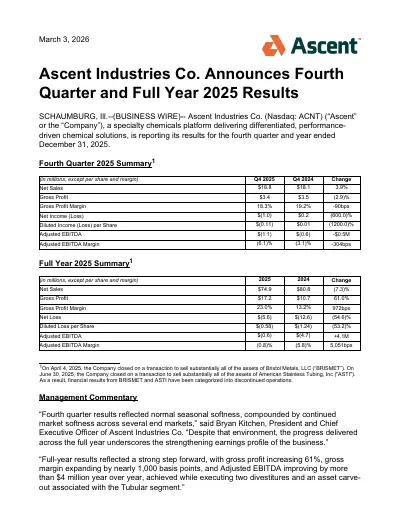
We exited 2025 as a pure-play specialty chemical company and a structurally stronger business. Gross margin expanded nearly 1,000 basis points.
Gross profit increased 61%. Adjusted EBITDA improved by more than $4 million year-over-year despite operating on approximately 7% lower revenue.
We delivered these results while fully exiting our legacy Tubular segment. That is not cyclical recovery.
That is structural improvement. The business we are building has a higher earning power, and we are still in the early stages of unlocking it.
Fourth-quarter results reflected continued end-market softness and unfavorable mix, which pressured absorption and led to sequential moderation in margin and adjusted EBITDA. While the quarter did not extend the momentum of Q2 and Q3, it does not alter the trajectory of our business.
Importantly, we did not chase volume to protect optics. We protected margin integrity.
We are reshaping our book of business towards higher margin, lower volatility revenue. That transition can create short-term variability, but the earnings foundation today is materially stronger and more durable than what it was 12 months ago.
Against that backdrop, the fourth quarter was defined by several tangible advances that reinforce our structural progress. We permanently exited Munhall, eliminating a legacy drag that will contribute approximately $2.1 million of run-rate improvement in 2026.
We secured a significant new commercial program expected to generate more than $10 million of incremental annualized revenue that will improve operating leverage across two of our manufacturing sites. Our pipeline conversion reached 25% in Q4.
We won 38 projects across 23 customers with an average sales cycle of 2.9 months. These wins generated commitments of $9.4 million of annualized revenue.
Approximately $7.1 million came from new customer program and $2.3 million came from additional wins carrying margins in excess of 40%. The majority of these wins came from existing customers, reinforcing strong runway with share-of-wallet expansion.
Product sales represented 47% of the wins, with custom manufacturing contributing the balance. In the fourth quarter, we added a record $43.4 million of new selling projects and sunsetted $40.8 million.
Of the projects that we removed, some reflected continued demand softness, while others were opportunities we chose not to pursue because they did not meet our return thresholds. Finally, in December, we modernized the demand engine.
Website traffic increased 218%, and contact submissions rose 122% within weeks of repositioning our digital strategy. These advances were achieved while removing more than $5 million of labor, overhead, and other costs as compared to 2024, more than offsetting targeted reinvestment.
We are strengthening the business while lowering the structural cost base. What underpins this progress and gives it durability is a deliberate upgrade of our operating platform across marketing, sales, R&D, and operations.
These were not defensive moves. They were intentional investments in people, processes, tools, and capabilities designed to improve coordination, discipline, and earnings quality.
In marketing, we built and scaled measurable demand engines that did not exist two years ago. This function is tightly integrated with both sales and R&D, generating qualified opportunities and strengthening our authority in priority chemistries and markets.
In 2025, marketing delivered a return on investment well in excess of 100% across trade shows, digital demand, and inside sales campaigns, and that engine is translating into commercial momentum. In sales, resources are directed towards customers and programs that meet defined return thresholds and generate durable earnings.
We are not managing for pipeline optics. We are managing for margin, cash generation, and long-term retention.
Through structured account planning and executive engagement, we are embedding our solutions into customer formulations and validated workflows, increasing defensibility as integration deepens. R&D has become a growth catalyst.
Approximately 95% of our fourth-quarter wins were driven by or enabled by R&D efforts, including formulation development, process optimization, scale-up support. That depth is elevating conversion quality, strengthening our margins, and shortening our sales cycle times.
In operations, we prioritize leverage over expansion. Rather than adding fixed costs, we revitalize existing assets and debottleneck capacity.
Guided by a disciplined return on investment mindset, we deployed approximately $435,000 to bring idle equipment back online, capability that would have required more than $3.7 million of new investment. This improves asset utilization and expands capability without increasing structural overhead.
What gives us confidence in this next phase is the operating discipline now embedded across the organization. Quality, service, reliability across our asset base have never been stronger.
Teams are increasing uptime, driving out waste, and executing with appropriate urgency. That execution is the backbone of our margin expansion story.
It enables us to grow efficiently, protect profitability, and deliver for customers in any environment. Every investment we make in people, processes, or technology is deliberate and return-driven.
We are doing this from a position of financial strength. We ended the year with significant liquidity, no debt, and a clean balance sheet.
That's after buying back approximately 7% of our outstanding shares. Our strong balance sheet gives us resilience in soft demand environment and flexibility to continue investing in high-return opportunities.
Stepping back, as I reflect on 2025, I'm proud of what the team has delivered. We improved margins and earnings in a difficult market while reshaping the portfolio and reinforcing the foundation of the business.
That doesn't happen by accident. It reflects ownership, accountability, and disciplined execution across the organization.
As we look ahead, our priorities are clear: deepen customer partnerships through innovation, reliability, and speed; fill available capacity with high-margin organic growth; and preserve balance sheet strength and allocate capital with discipline. We are not waiting on the market to recover.
The market didn't do it to us, and the market's not going to fix it for us. We are building a stronger company regardless of the cycle and positioning it to compound.
Our company looks very different today than when we began this journey two short years ago. It is stronger, more disciplined, and built for durability.
To the entire Ascent team, thank you. You are our unfair advantage.
With that, I'll turn it over to Ryan to walk through the financials in more detail. Ryan?
Ryan Kavalauskas
Thanks, Bryan, and good afternoon, everyone. Starting with net revenue, the key takeaway for the quarter is that we delivered year-over-year growth despite an uneven demand environment.
Net sales increased 4%, supported by a 6% lift in shipments as several higher-throughput programs ramped. As expected, that benefit came with a mix shift.
Incremental pounds skewed toward lower price, lower margin wins, which compressed spreads on a consolidated basis. Turning to the full year, net sales declined 7.2%, as a 17.7% contraction in demand more than offset 10.9% in pricing action.
In that context, we remained disciplined on value and continued to sharpen mix and execution, positioning the book to participate as volumes normalize. From a profitability standpoint in the quarter, while mix in the broader cycle remained uneven, gross profit was essentially flat year-over-year, down less than $50,000, and gross margin declined by approximately 90 basis points.
Holding margin movement to that level, given the spread compression and demand variability, is a solid outcome, and it reinforces that we're scaling throughput without compromising the earnings profile we're building. Stepping back to the full year, gross profit increased by $6.5 million, and gross margin expanded by nearly 1,000 basis points, driven by 2.5% improvement in material profit as our sourcing initiatives, product line management, and operating execution took hold across the portfolio.
Moving to SG&A, expenses were $6.5 million compared to $5.4 million in the prior-year period. The year-over-year comparison is influenced by merit accrual reversals in the fourth quarter of 2024, along with an unfavorable impact from litigation settlement expenses in the current period.
On a full-year basis, SG&A was up $3.2 million, largely driven by $2.1 million related to legacy Munhall and Palmer activity that was reclassed to SG&A in the second quarter, as well as stock compensation and incentive payouts, partially offset by reductions in professional fees. Adjusted EBITDA for the quarter was a loss of $1.1 million, a decrease of roughly $600,000 year-over-year.
Full-year EBITDA was a loss of $570,000, an improvement of $4.1 million year-over-year. Turning to the balance sheet, we ended the quarter with $57.6 million of cash, no debt, and $11.4 million of incremental availability under our revolver.
We finished the year with significant liquidity and a clean balance sheet, which gives us flexibility and staying power as we move through this part of the cycle. With the cash conversion cycle down to 61 days, we're demonstrating tighter working capital discipline, building confidence that the business is getting more resilient even as demand softens.
With that, I'll turn it back to the operator for questions. Thank you.
Operator
Thank you. As a reminder, to ask a question, please press *11 on your telephone and wait for your name to be announced.
To withdraw your question, please press *11 again. One moment for questions.
Our first question comes from Adam Waldo with Managing Member, Lismore Partners LLC. You may proceed.
Adam Waldo
Yes, good day, Bryan and Ryan. I hope you can hear me okay.
Ryan Kavalauskas
Yes.
Bryan Kitchen
We can.
Adam Waldo
Thanks. I wanted to dig in a little bit more on the cadence of the quarter by month.
As you released your third quarter results, were you starting to see some of the softness or did that develop really late in the quarter? How is the macro environment, as we sit here two months into the first quarter?
Obviously, some geopolitical developments the last few days, but before that, were you seeing an improving macro environment?
Bryan Kitchen
Adam. I really appreciate the question.
Related to the demand build inside of 2025, what we're dealing with is still some inherent seasonality challenges with the legacy book of business, really strong Q2, really strong Q3, and a little bit of softness in Q4 and in Q1. As I mentioned in the script, one of the things we're working on is building a more stable, ratable book of business throughout the year so we can minimize the impact of some of the seasonality volatility that we have.
Related to the most recent conflict that emerged over the weekend, what I'd say is, look, with the cost of petroleum, input raw material costs will likely go up, and if and when they do, we already have demonstrated the ability to pass along those raw material increases to customers. We're pretty well protected on that.
Adam Waldo
That's very helpful. Now, as we're sort of building up our outlook for 2026, just directionally, I know you don't give specific forward guidance, but you issued a press release on December 1st, about the sizable new win, a client win of over $10 million in annualized revenue, which portended mid-teens or better revenue growth in 2026 if the existing same client revenues would be flattish year-over-year in '26 relative to '25.
Are you still comfortable that the company, based on that win and the existing new business pipeline and backlog, can deliver double-digit revenue growth for 2026?
Bryan Kitchen
It is certainly the plan, yes. That piece of new business that we won has started.
It's beginning to scale. I think we're on track for getting that to full run rate early Q2.
Adam Waldo
Okay. Last question, and thank you for allowing the questions.
Are we feeling pretty good about the ability to deliver a consolidated gross margin that's sort of at or above the low 30s or better level to which Ryan had said the company kind of on a steady state basis is aspiring on a consolidated basis now pro forma for the tubular divestitures and having moved the Munhall facility off the books?
Bryan Kitchen
I'll start and Ryan, you can jump in. Certainly, that's what we're running and gunning towards.
What we said from from day one is we were targeting margins in that 30% to 35% range. That flowed through to SG&A of 15%.
Obviously, we need to grow into that SG&A, and then flow through all the way down to, 15% EBITDA margins. That wasn't an immediate target.
That wasn't, hey, we're going to go fulfill that this month or this quarter or even this year. That was more of a long-term target.
You could do a quick look back and look at our performance in Q2 and Q3 and, what we delivered was was squarely in the upper 20s to lower 30 lower 30s range.
Adam Waldo
Okay. The new business you've been bringing on more recently is at higher gross margin, is it reasonably conservative but plausible to expect a consolidated gross margin for 2026 in at least that high 20s to low 30s range that you articulated, Bryan?
Bryan Kitchen
I think so. Look, it's early.
There's always going to be puts and takes along the way. We'll see how the year shapes.
Certainly the mid-20s to lower 30s is still a target.
Adam Waldo
Thanks so much.
Operator
Thank you.
Bryan Kitchen
Thanks, Adam.
Operator
Our next question comes from Gregory Kitt with Pinnacle. You may proceed.
Gregory Kitt
Hi, Bryan and Ryan. Thank you for taking my questions.
Bryan Kitchen
Hey, Greg. Hey, Greg.
Gregory Kitt
First, congratulations on a good year in which you had to accomplish a lot with divestitures and managing the portfolio and through that, you were still continuing to win new business. I've read your comment that you're exiting with a clean and focused platform capable of delivering higher-quality earnings and operating leverage.
If I could kind of break it down into revenue, margins, and operating leverage, kind of piggyback on some of Adam's questions. On revenue, just to make sure that I understood, did you say that you won $9.4 million of business in the quarter?
Then how do I reconcile that with the December 1st announcement of that $10 million plus that you announced? I was a little confused.
Bryan Kitchen
That's right. What we flashed was $9.4 million of wins in the fourth quarter, of which I believe was $7.1 million of that was attributed to that new customer program.
$2.3 million, or the balance of that, came from additional new customer wins outside of the programmatic win that we announced.
Gregory Kitt
Okay. That $7.1 million, there's an opportunity for that to continue to grow to reach that $10 million potential?
Bryan Kitchen
Absolutely, yes.
Gregory Kitt
Okay. Great.
Is there some way to think about, you had talked about somewhere in the range of a combined $30 million of wins, a little north of $30 million of wins over the course of '25. Is there any way to think about how much, if any, of that contributed to results last year?
Bryan Kitchen
It's a good question. Let me take an action, and I'll follow up with you on that on our follow-up call.
I don't want to spitball a number. I did want to go back, Greg, to your prior question around the $7.1 million versus the $10 million and trying to reconcile that.
Of the $9 million, $9.4 million that we referenced, that is predicated on us actually receiving a firm purchase order for a shipment. Part of that $10 million, we've shipped out a number of SKUs, but we haven't shipped out all of them.
Because of that, there's going to be some bleed over into the first quarter.
Gregory Kitt
Okay. Okay.
Oh, that's great. Thank you for that clarification.
I think the big thing for me is, not to say that you were distracted, but you did have other operational focuses with the divestitures that you don't have anymore. I think I look at the platform and say, hey, you can just focus on winning business.
Something that you said in your prepared remarks that was interesting was that you invested some amount of dollars to effectively expand your capacity, and you did that in a cost-effective manner rather than having to buy new equipment. What are you looking at or maybe walk us through that decision because you've talked about how your assets are relatively underutilized.
Just that decision-making process in investing to effectively expand your capacity now. What's giving you that confidence to do that?
Bryan Kitchen
Yeah. Just to be clear, what I said was to expand our capability, not our capacity.
This isn't a function, Greg, of adding additional reactors to the mix, because as we have a fair amount already that are grossly underutilized. What this really refers to is putting old storage tanks back into commission to support new business that we have won.
Another example is in Virginia, we had rail capability going inbound into our multi-purpose plant that at some point in time had been paved over with asphalt. The team in Virginia found a really creative way in partnership with the local railroad to get that back in service for nominally $20,000, right?
That just another example. These are not material as we're going out and adding net new capacity.
It's all about capabilities to support existing and new business.
Gregory Kitt
Okay. Great.
Thank Thank you. On the on the gross margin side, I would guess that that was that was the only piece where I said, I can't wait to learn more because I think you'd had, great linear progress in Q2 and Q3 of of last year, and this is a, it's going to be revenue-based.
You're you're absorbing fixed overhead, and so I I expected margins to be down this quarter. Can you give us any sort of way to think about gross margins going going forward?
Did did anything this quarter make you I I heard what you said to Adam, but did anything you said you saw in the fourth quarter make you revisit your margin targets and say, hey, this this might take a little bit longer than we thought or it might be more challenging than we thought? No, but
Bryan Kitchen
I'll let Ryan jump in on that. Ryan?
Ryan Kavalauskas
Yeah. Nothing in the quarter.
We have some inventory adjustments, some accruals and things like that. There was a handful of one-time items, some building of stock, some customers there wherein we control the raw material spend, you see raw material costs come up, the margins were affected the same, but those type of things came through in the fourth quarter.
Nothing that we saw, in my opinion, is structural. It's more just timing and predominantly just mix.
Some of our newer customers, we've gone out and win, we were aware that there was a volume aspect that we were willing to trade for margin. We won't always do that, but in the scenarios where our plants are so grossly underutilized, these are deals that come few and far between in this kind of macro environment where you can go out and find large chunks of volume who are willing to kind of move.
We took on that business, and we did see some of that mix effects, which did compress margins in the quarter. Nothing that happened in this quarter would make me think that our targets of plus 30% are unachievable.
We'll still continue to march that way. Sometimes the quarters will get choppy and the mix will throw that off and kind of take away that kind of linear progression you saw where we were kind of ramping up margins every quarter.
We should get back to that mid-20s, low 20s here for the first half, and hopefully start to ramp back up as capacity increases and utilization increases. Our capacity utilization increases.
Okay.
Gregory Kitt
Thank you. Two more for me, quick ones.
On SG&A, is there any way to think about that litigation settlement, how material that could have been in the quarter?
Ryan Kavalauskas
It was about $200,000, a little over $200,000. That was a legacy issue we've been working on.
We finally got it wrapped up. It's a good win for us in the end of where we thought it could be at, call it $200,000, a little over that.
Gregory Kitt
Thank you. Then you and the board announced that share repurchase authorization back in November, not a ton of traction in the fourth quarter.
Can you help us think about capital allocation? I'm assuming you're still continuing to look at potential acquisitions and how you weigh that versus share repurchases.
Ryan Kavalauskas
Yeah. Predominantly, the first thing we focused on is reinvestments in the assets.
As Bryan mentioned, some of that can be capacity or capability enhancements, process improvements, first-time-in-spec, things like that, where we're able to streamline and be more efficient. We'll always allocate dollars to that first.
When we looked at share buybacks, the stock was trading sub-$15. We thought there was a really good opportunity from where we felt we could be in a few years, and then the stock did run a little bit up, it kind of came out of our buybox for a little bit.
We'll still have that in our quiver, but it was much more attractive in the places where we were quite a bit more active. We'll continue to look at that, be opportunistic where we can in buybacks.
We've positioned ourselves to do that. Then M&A is always there.
Right now, there is so much capacity not only within our own assets, but within the broader industry in the whole, specifically in North America. We haven't seen anything attractive to this point.
We're continuing to be open and looking, but again, our first, second, and third focus is filling up our own assets. We're hesitant and we'll be cautious when we see assets come along that look similar in utilization to our own.
We don't need that added problem. We'll continue to kind of look at things that way, in that priority order: invest in our assets and people first, opportunistically buy shares where we can and where the price looks right, and then if an attractive asset comes along or a product portfolio comes along, we're in a position to make that move quickly if we need to.
Gregory Kitt
Thank you very much.
Operator
Thank you. As a reminder, to ask a question, please press *11 on your telephone.
Our next question comes from Howard Root with Fairhope Capital. You may proceed.
Howard Root
Good afternoon, and thanks for taking my call, Bryan and Ryan. Just a little follow-up on the gross profit.
I was kind of surprised going from 29% in Q3 down to 18% in Q4. Was any of that related to new contracts you took on or is it you talked about one-time, if it wasn't for the one-time expenses you had, would that have been closer to the 23% you had for the year or how much of that can we look at as one-time, one-quarter and how much of that might be continuing into 2026?
Ryan Kavalauskas
I'd say about call it a little over half a million was kind of what I would consider one-time. Are they normal course of business things like inventory accruals and things like that?
Yes. They were things that were headwinds and normally they are.
When we look at comps year-over-year, there were some tailwinds in '24 that we didn't get in '25. I think if you stripped all that out, we would probably have been somewhere in that low 20% margin.
Definitely a compression compared to Q3. Again, some of that's just mix-driven, right, where we have these higher volume, lower mix customers.
That mix just shifted a little bit for us in Q4. You compound that with some of the things we did to clean up the inventory and things like that, and that's what pulled things back.
Again, these aren't structural margin compression we're seeing. These are more just timing and mix-related.
We should get back into that 20% going forward and then start again to get back on that ramp closer to 30%, which is where we hope to be long term.
Howard Root
Okay. Great.
Thanks. Then just a general question on the M&A environment.
What are you seeing out there in terms of the size of targets and valuation and kind of also your appetite for it as you've another quarter in? Do you see that as something you want to do this year, you would do for the exact right thing, or are things getting into the right price range for you to do something now?
Bryan Kitchen
Look, I would say that we were always in the hunt, but it's got to be the right opportunity. As Ryan mentioned, the last thing that we want to do is go out and buy another, let's say, a distressed asset that has relatively low utilization when all that would do is effectively compound our existing problem statement.
What we'd really like is a product line or product lines that we could acquire and then integrate into our manufacturing base to get that utilization up and get that dual bump. We haven't found that right opportunity just yet.
We're not running away from M&A, but we're certainly don't have any dollars burning a hole in our pocket, Howard.
Howard Root
Great. All right.
Thanks. Thanks again for all the hard work last year getting this set on the right path forward, I look forward to a great 2026 for you guys.
Bryan Kitchen
Appreciate it, Howard.
Ryan Kavalauskas
Thank you.
Operator
Thank you. I would now like to turn the call back over to Bryan Kitchen for any closing remarks.
Bryan Kitchen
Josh. We'd like to thank everyone for listening to today's call, and we look forward to speaking with you all again when we report our first quarter 2026 results.
Thanks very much, and have a great day.
Operator
Thank you. This concludes the conference.
Thank you for your participation. You may now disconnect.