ACV Auctions Inc.
NNYSE:ACVAQ4 FY2025 · Earnings Call TranscriptFebruary 23, 2026
Operator
Greetings and welcome to the ACV Q4 2025 earnings conference call. At this time, all participants are in a listen-only mode.
A question-and-answer session will follow the formal presentation. If anyone should require operator assistance, please press *0 on your telephone keypad.
As a reminder, this conference is being recorded. It is now my pleasure to introduce your host, Tim Fox, Vice President of Investor Relations.
Thank you. You may begin.
Tim Fox
Good afternoon and thank you for joining ACV's conference call to discuss our fourth quarter and full-year 2025 financial results. With me on the call today are George Chamoun, Chief Executive Officer, and Bill Zerella, Chief Financial Officer.
Before we get started, please note that today's comments include forward-looking statements, including statements regarding future financial guidance. These forward-looking statements are subject to risks and uncertainties and involve factors that could cause actual results to differ materially from those expressed or implied by such statements.
A discussion of the risks and uncertainties related to our business can be found in our SEC filings and in today's press release, both of which can be found on our investor relations website. During this call, we will discuss both GAAP and non-GAAP financial measures.
A reconciliation of GAAP to non-GAAP financial measures is provided in today's earnings materials, which can also be found on our investor relations website. With that, let me turn the call over to George.
George Chamoun
Thanks, Tim. Good afternoon, everyone, and thank you for joining us today.
We are pleased with the ACV team's execution in Q4, delivering revenue at the high end of guidance and adjusted EBITDA above the high end. Our performance was driven by solid execution in our dealer wholesale business despite challenging market conditions, as we continue to gain market share, expand our dealer partner network, and drive adoption of our value-added dealer solutions.
Again, ACV Transport and Capital delivered strong revenue performance. We also executed on our product roadmap to further differentiate ACV's marketplace experience, support our commercial wholesale strategy, and expand our TAM.
Turning to 2026, we are expecting revenue growth in the low double digits and adjusted EBITDA growth of approximately 28%, which includes additional growth investments to support our medium-term financial targets. We're confident that executing on this profitable growth strategy will create significant long-term shareholder value.
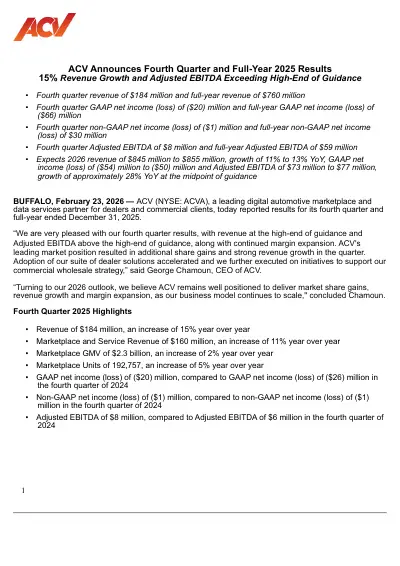
With that, let's turn to a recap of our results on slide 4. Q4 revenue was $184 million, growth of 15% year-over-year, and we sold 193,000 vehicles.
For the full year, we delivered 19% revenue growth and grew units by over 86,000, or 12% year-over-year. Adjusted EBITDA grew by over 100%, demonstrating the scale in our model.
Next on slide 5, we'll again focus our discussion around the three pillars of our strategy to maximize long-term shareholder value: growth, innovation, and scale. I'll begin with growth.
On slide 7, we highlight how ACV is leveraging AI to attract new buyers and sellers, increase penetration and wallet share, and gain traction with large dealer groups. Let's begin with our marketplace.
Our highly accurate condition-adjusted pricing guidance enables sellers to set more informed reserve prices. Flexible auction durations and scheduling allow dealers to customize the marketplace experience.
Given the challenging market conditions in Q4, dealers increasingly leaned into ACV's technology. For buyers on our marketplace, we tailor their experience across buyer personas and optimize the bidding process by providing AI-enabled recommendations informed by dealer preferences and current market factors.
These investments in our leading marketplace experience were key to growing our dealer network in 2025, with 15,000 unique sellers and over 22,000 unique buyers transacting with ACV. Our franchise rooftop penetration achieved a new milestone, reaching 35% during the year.
Our major account team delivered impressive results with a 300 basis point increase in rooftop penetration. Next on slide 8, I'll provide some highlights on our data services.
Market traction for ClearCar remains strong, especially for ClearCar service that enables dealers to seamlessly produce consumer appraisals and offers from their service lanes. ClearCar is also an effective lever to increase wholesale wallet share and attract new dealers to our marketplace.
During 2025, existing dealers that launched ClearCar increased their wholesale volumes with ACV by over 50% after going live. We're also seeing early momentum with our strategy to bundle ACV MAX with wholesale.
A recent cohort of new ACV MAX dealers increased their wholesale vehicle sales on our marketplace by an average of 40% within one quarter of launching MAX. Our strategy to offer a broader set of value-added solutions is creating another growth lever for ACV.
Again this quarter, we're excited to share feedback from one of our dealer partners, the Hendrick Automotive Group, which is using ACV's full suite of offerings. We posted a video on our IR website highlighting the significant value they're deriving from ACV solutions.
Turning to slide 9. From a geographic perspective, we continue to drive strong growth within our more established regions where network effects are driving significant market share.
At the same time, our footprint has expanded across the country as highlighted in these four regions, which delivered strong year-over-year unit growth in Q4. As we discussed in our Q3 call, there are certain emerging regions where we are increasing our territory manager and VCI footprint to drive accelerated growth.
These efforts began in Q4 and will continue during 2026, and we are confident in the medium-term growth outlook for these markets. Turning to slide 10.
Let's review our marketplace service offerings, beginning with ACV Transportation. The transport team had strong execution in Q4, with 20% revenue growth and 110,000 transports delivered.
AI-optimized pricing continues to drive strong growth and operating efficiency. Revenue margin has already achieved our mid-term target in the low 20s, and our off-platform transportation service continues to gain traction from our dealer partners, creating additional growth opportunities.
Next, I will wrap up the growth section on slide 11 with ACV Capital highlights. ACV Capital delivered strong revenue performance with 48% year-over-year growth in Q4, despite actively lowering our exposure to higher-risk customer segments.
The ACV Capital team implemented new growth strategies while driving process enhancements to mitigate portfolio risk. As such, we are confident that ACV Capital will remain an important value-added service for our dealers and a long-term growth opportunity.
Next on slide 12, I'll address the second element of our strategy to drive long-term shareholder value: innovation. Turning to slide 13, let's go deeper into how we are leveraging ACV AI to drive growth and to deliver value to our dealer and commercial partners.
Using machine learning, we combine inspection data and dynamic market data to provide real-time pricing for every vehicle within ACV's pricing platform. For example, we are leveraging our pricing platform to offer ACV Guarantee to sellers and deliver no-reserve auctions to buyers.
This offering remains the fastest-growing channel on our marketplace. We are pleased to see ACV Guarantee mix increase to 19% in Q4.
As a reminder, our guaranteed sale is a highly differentiated offering that benefits buyers, sellers, and ACV by accelerating bidder engagement, increasing buyer satisfaction, removing seller market risk, while delivering 100% conversion rate. We're confident our guarantee offering will be another key driver of market share gains.
On slide 14, we highlight how we are further differentiating ACV in the market with AI-driven next-gen products like Viper and Virtual Lift. We're extending our industry-leading inspection technology, vehicle data, and pricing capabilities to dealers looking to unlock consumer vehicle acquisition at scale in their service lanes.
At the recent NADA industry conference, we announced the next wave of availability for the Viper early access program, and dealer reception was tremendous. We're excited to kick off the commercial launch of Viper with select dealer partners, providing them with a unique and scalable consumer sourcing platform that will expand our TAM at a rooftop level by tapping into the large peer-to-peer segment.
By leveraging pricing models that bundle Viper with wholesale, we're creating a powerful new lever to drive wallet share expansion and unit growth. Wrapping up on innovation, let's turn to our commercial wholesale strategy on slide 15.
We are pleased to see the initial range of capabilities developed over the past year powering our first Greenfield remarketing center in Houston. Our team has been in active conversations with commercial customers to deepen our understanding of their requirements for the next phase of our software build.
We believe this new digital model and end-to-end experience will transform commercial vehicle remarketing, and we also look forward to launching an additional Greenfield location in Chicago this year. With that, I'll hand over to Bill to take you through our financial results and how we're driving growth at scale.
William Zerella
Thanks, George, and thank you for joining us today. We are pleased with our Q4 financial performance, with revenue at the high end of our guidance range and adjusted EBITDA exceeding the range.
On slide 17, let's begin with a brief recap of our fourth quarter results. Revenue of $184 million grew 15% year-over-year compared to very strong results in Q4 '24.
Adjusted EBITDA of $8 million grew 36% year-over-year, reflecting strong expense discipline. Finally, non-GAAP net loss of $1 million was favorable relative to our guidance range.
Next on slide 18, let's review additional revenue details. Auction and assurance revenue was 55% of total revenue and grew 11% year-over-year against a very tough comparison of 40% growth in Q4 '24.
This performance reflects 5% unit growth, which also faced a tough comparison of 27% growth in Q4 '24. Auction and assurance ARPU of $528 grew 6% year-over-year and 4% quarter-over-quarter.
Marketplace services revenue was 39% of total revenue and grew 23% year-over-year, reflecting continued strong performance for ACV Transport and ACV Capital. Lastly, our SaaS and data services products comprised 5% of total revenue, with year-over-year growth accelerating to 8%.
Next, I'll review Q4 costs on slide 19. Non-GAAP cost of revenue as a percentage of revenue increased approximately 400 basis points year-over-year.
The increase was primarily driven by higher arbitration costs, as expected, within a specific cohort of customers. Recall that our Q4 guidance assumed arbitration costs would remain elevated in the quarter, but that trends would normalize in 2026 following mitigation steps we implemented.
These steps are already showing positive returns in early 2026. Non-GAAP operating expense excluding cost of revenue as a percentage of revenue decreased approximately 400 basis points year-over-year, reflecting operating leverage in our model.
Moving to slide 20, I'll frame our investment strategy as we drive profitable growth. In 2026, we expect OpEx growth of approximately 9%, which is a decline from 12% in 2025.
Note that 2026 OpEx includes approximately $11 million in additional go-to-market spending to support regional growth objectives. Even with these growth investments, adjusted EBITDA margin is expected to increase by approximately 100 basis points year-over-year.
Next, I will highlight our strong capital structure on slide 21. We ended Q4 with $270 million in cash and cash equivalents and $190 million of debt.
Note that our cash balance includes $171 million of marketplace float. In the figure on the right, we highlight our solid operating cash flow, which reflects adjusted EBITDA growth and margin expansion.
Now turning to guidance on slide 22. First quarter revenue is expected to be $200 to $204 million, growth of 9% to 12%.
Adjusted EBITDA is expected to be $14 to $16 million, reflecting a 7% to 8% margin. 2026 revenue is expected to be $845 to $855 million, growth of 11% to 13%.
Note that full-year revenue guidance assumes that our go-to-market investments will drive slightly higher growth in the second half of the year. 2026 adjusted EBITDA is expected to be $73 to $77 million, growth of approximately 28% year-over-year.
We are expecting non-GAAP OpEx excluding cost of revenue to grow approximately 9% year-over-year. With that, let me turn it back to George.
George Chamoun
Thanks, Bill. Before we take your questions, I will summarize.
We are pleased with our Q4 execution while navigating through challenging market conditions. We continue addressing these market challenges by enhancing our technology and operating models, ultimately making us even more resilient.
We are attracting new dealer and commercial partners to our marketplace and expanding our addressable market, which positions ACV for attractive growth as market conditions improve. We are delivering on an exciting product roadmap powered by ACV AI to further differentiate ACV and drive operating efficiencies.
We are focused on achieving strong adjusted EBITDA growth and delivering on our mid-term targets that we believe will drive significant shareholder value. We are committed to achieving these results while building a world-class team to deliver on our goals.
With that, I'll turn the call over to the operator to begin the Q&A.
Operator
Thank you. We will now be conducting a question-and-answer session.
If you would like to ask a question, please press *1 on your telephone keypad. A confirmation tone will indicate your line is in the question queue.
You may press *2 to remove yourself from the queue. For participants using speaker equipment, it may be necessary to pick up the handset before pressing the star keys.
One moment, please, while we poll for questions. Our first question comes from the line of Andrew Boone with Citizens Bank.
Please proceed with your question.
Andrew Boone
Thanks so much for taking my questions. I would love to just double-click in terms of 4Q '25 units sold.
We've seen this deceleration. Can you just help us understand whether that's competitive pressure, the market, macro, anything you want to call out in terms of highlighting 4Q results?
Then, I'd love to ask about MAX. It sounds like you guys are seeing real results in terms of better integrating with dealers to just drive more volume.
Can you help us understand what's the roadmap to drive better MAX adoption more broadly? Thank you.
George Chamoun
Yeah. Hey, Andrew.
When you look at Q4, first we delivered, as you could see, on our revenue expectations. I think we had a strong quarter from a revenue perspective.
For the year, we grew units 12%, so that was solid. When you look at the Q4 compare, it was a tougher compare.
What we're doing about creating more growth are the things we've talked about. We're adding more inspectors out in the field, we'll start to see that benefit throughout this year.
That's one area we're adding. We also talked about investing in a few more of the regions where we're adding additional territory managers.
We talked about that on the call. Then we also talked about our differentiation with our products like MAX that you brought up.
I do want to actually bring up the backdrop here on dealer wholesale is growing from the physical auction. Still 70% of the business out there is happening at physical auctions.
The broader need is still just to bring more and more business being had at physical auctions over to digital, which between our differentiated offerings is starting to happen more and more. On your second question on MAX, we are really starting to scale that business where it's now being connected more to wholesale.
For some of the rooftops, we added a additional offering that puts a guarantee on units. Not only are we providing pricing guidance, but we'll put a guarantee, and we're starting to scale that with additional rooftops.
Look forward to scaling MAX additionally throughout the year.
Andrew Boone
Thank you.
Operator
Thank you. Our next question comes from the line of Rajat Gupta with JPMorgan.
Please proceed with your question.
Rajat Gupta
Great. Thanks for taking the question.
I had a question, just following up on the previous one. It looks like your 2026 guidance, it does not assume much of a change in overall market share growth versus what you saw in recent quarters, despite your incremental margins moving lower versus where you were last year.
I'm curious why that would be the case. If there are any one-time investments, maybe Viper and other initiatives around commercial that might be causing that incremental margin to slow down.
It just seems a little counter-intuitive to look at the incremental margin dropping versus market share not accelerating. If you could clarify that, and then I have a quick follow-up.
Thanks.
George Chamoun
Yes, certainly, Rajat. I'll start, and then Bill can chime in.
Two of the investments we're making, at least two, and Bill can chime in with additional, is what we've made with the in-field, which are additional inspectors. We're hiring some additional territory managers, as I mentioned a few minutes ago.
That's one area of additional expense. Bill could kind of go a little deeper.
Second is yes, we're starting to invest in the Viper rollout, so that's also part of the number. We believe, Rajat, as we're making these investments throughout the year, we'll start to see more of an impact towards the back half of the year, because obviously it takes a little time to get these things going.
Bill, maybe you can chime in some more on this.
William Zerella
Rajat, just to go through the numbers again. The incremental spend that we've baked into our guidance for this year in terms of those go-to-market investments is approximately $11 million.
If you look at our incrementals excluding that, they would have actually grown 500 bps year-on-year from 25% to 30%. That's number one, just to ensure you've got the right numbers, right?
As George said, at this point, it's early in the year. We're making these investments obviously with the objective of driving more share gains.
We're pretty conservative at this point in terms of what we're going to bake into our guidance until we start to see these investments pay off over time.
Rajat Gupta
Understood. To the market share, you essentially are applying higher market share acceleration later in the year, assuming these investments bear some fruit, right?
William Zerella
We're assuming a slight increase in the second half of the year versus the first half. Again, we're taking a more conservative perspective at this point until we start to see this play out over time.
Rajat Gupta
Understood. Just a quick follow-up, a little more high-level question.
Could you, maybe, comfort investors around just the risk of AI to the business? Clearly, there seems to be a lot of interpretations around, just provide more clarity around that, what differentiates ACV, what differentiates your business model, is there risk, is there benefit from AI?
Maybe if you could just dig a little deeper into that, and just how you're thinking about that. Thanks.
George Chamoun
Yeah. The irony, Rajat, is we are that disruptor.
We are the AI disruptor in this category. We are that company that is aiming to change automotive for the better.
We're the company who's trying to help a traditional retailer, like a franchise dealer, as cars drive through a service drive, take pictures and videos and predict the retail price within $38 what it's going to sell for and estimate the wholesale value within $100 to the point we'll guarantee it. We're the ones making predictions on what types of inventory they should be buying and selling.
We're adding new capabilities throughout the year that we believe will help franchise dealers become more efficient and actually need less people. We're huge fans of what you can do with AI.
We're aiming to be that disruptor. We're aiming to be the one that helps really franchise dealers modernize their use of these tools.
We're integrating with a lot of different vendors, it's not like we're picking one widget or one thing. We're integrating with all the CRMs and all the DMS solutions, and so regardless of what tech stack the dealer chooses.
We should be one of the beneficiaries of the theme that you're hearing from investors is that all industries will change. AI will change every single industry.
This will be one of them, and we should benefit from that.
Rajat Gupta
I guess the interpretation is that there might be a new startup or a young company that can do what you're doing in a much easier fashion, in a much simpler fashion, maybe providing the inspection capability to the dealers directly, or the pricing capabilities. Is there anything you can do to protect your position, or do you even see that as something realistic or practical?
Thanks.
George Chamoun
Listen, I think investors should do their homework. You should watch the video we posted regarding what we do for the largest private automotive company in the country.
Post it on our Hendrick Automotive. Watch that video, see what we're doing.
They should do the research we're doing for some of the public automotive groups who speak very, very highly about what ACV is doing for them. I think when you do your homework, you'll see we're not just predicting numbers.
We're predicting them to the point where we can back them and guarantee them. There could be startups that emerge in this category, but I think they'd have to raise hundreds of millions of dollars, if not billions, to then have the balance sheet and the data, which would be very difficult to do, where we've inspected over a million cars a year, that we know all these scratches, all these dents.
We've now earned the credibility to be part of the workflow for all these dealer groups. I can see why in other industries they would be concerned, but in this one, Rajat, we are that disruptor.
Rajat Gupta
Fair enough. Great.
Thanks for all the color, and good luck.
George Chamoun
Thank you.
William Zerella
Thank you.
Operator
Thank you. Our next question comes from the line of Ronald Josey with Citi.
Please proceed with your question.
Ronald Josey
Great. Thanks for taking the question.
George, I wanted to ask about conversion rates and just wondering if they returned back to normal seasonality in the quarter after some sort of ups and downs last year, and then thoughts on conversion rates into '26. Then maybe bigger picture, when we look at the unit growth improvements across the Carolinas, South Florida, South California to East Texas, remind us what led to that outsized growth here, and sort of what this means going forward.
Thank you.
George Chamoun
Certainly, Ron. On the first point, our conversion rate for Q4 was up year-over-year, where most of our competitors were flat or down.
We did see a year-over-year improvement on conversion rate, and we saw that I think the overall improvement where our no-reserve sale is doing this, what we refer to investors as the guarantee offering, we give the guarantee to the seller, the buyer gets a no-reserve offering where they can bid without a reserve. It's really helping not only differentiate ACV, but delivering a better buying experience, better seller experience.
We did see conversion rates. Obviously, Q4 is always tougher on conversion rates, but we're executing well.
We actually do see our guarantee and no-reserve offering continue to grow. This quarter, it started out we're already in the 20% range of our total units now selling.
We're seeing more and more of our customers start to adopt the product. One, I would say conversion rate, I believe we're starting to become some of the best in the industry.
We did also, to help on conversion rates, we were harder on sellers who were giving us overpriced cars. We did get rid of a few sellers.
We implemented more policies to make sure it's a better buyer experience. We're being more and more prudent on not just chasing units, but making sure we're building the best experience.
We really sort of managed a marketplace with stricter rules, and that's really coming out. I think we're seeing higher buyer NPS as it relates to the sell-through rate, conversion rate, probably than I've seen in several years.
We're seeing some confidence from buyers coming back on conversion rate. That was a long-winded conversion.
William Zerella
Yeah. Then, Ron, just to put a finer point on the numbers.
Sell-through in Q4 was up 150 bps year-on-year. Which, for us, as we think about our business and kind of the trends that we can hopefully drive going forward, that can over time become more and more material.
George Chamoun
Then on your second question, what did we do differently? To give you an example, the Carolinas, we took a very strong performer of ours that was in the New York metro area who was a territory manager.
We promoted him to a regional director down to Carolina, we brought somebody that really knew the ACV model. He then worked with the local territory managers.
We also, I believe, added an additional territory manager in his region. We hired additional inspectors.
We really just doubled down. Strong execution.
They really know how to present our differentiated offering. I would say that market, Carolinas, took us a little bit longer than we would like to grow, but now it's growing.
We've got strong talent there. They've got great momentum.
We feel really good about it. The same story with South Florida.
Our team down there is just a great team. They keep differentiating the ACV offering, whether it be the guaranteed sale.
They're also one of the ones that are starting to leverage our inspector teammates to go out and help on the buying activity on the demand side, leveraging our inspector base, not only listings, but just getting out into the field more, both sellers and buyers. That leader down there, I met with him last week, is doing a fantastic job of just building out South Florida.
We're really showing that region by region, we got more work to do over here, but I'm really really excited to see where we've got the right talent, we've got the right folks out there, we're starting to take share at healthy rates.
Ronald Josey
Thank you, George. Thank you, Bill.
George Chamoun
Thank you, Ron. Thank you.
Operator
Thank you. Our next question comes from the line of Bob Labick with CJS Securities.
Please proceed with your question.
Bob Labick
Good afternoon. Thanks for taking our questions.
George Chamoun
Thank you, Bob.
Bob Labick
I wanted to ask about Viper. You talked about rolling out this year.
You talked about a lot of dealer interest at recent shows and stuff. Have you said, I guess, when will it be in the field?
More importantly, what are the keys you're watching for in your launch once you get it out there, before you decide to do maybe a more widespread roll out?
George Chamoun
Yeah. Thanks, Bob.
Our number-one priority with Viper in these initial rollouts is really to help ensure the dealers kind of be able to leverage this to acquire more vehicles. When we think about dealers, optimizing their revenue is all about the top of the funnel, sourcing more cars.
If they can source more cars, then they can optimize and decide which cars should they be retailing, which cars should they be put with wholesale. These initial customers primarily have ACV MAX as their inventory management system.
Our goal is to get them to buy more cars. Think a dealer buying 30, 40, 50, 70-plus cars what they call off the curb or off-street primarily from their service drive.
That's a key KPI is helping them buy more cars. Some of the dealers we're talking to have very large goals.
Bill and I actually met with one of them last week, and the general manager of that store was a dealer who said he'd like to buy 100 and what was the number?
William Zerella
He wants to retail 100 more used cars a month, which means he's probably going to buy more like 125 to 130. Retail the ones that he wants to keep.
George Chamoun
That would be an example, Bob, of here's a dealer who just got Viper, and those are the words of a specific dealer. We're excited, cuz here's the simple math.
They buy more cars, they're going to wholesale more. The more they buy, they're going to keep the best 60% to 70% for retail, and then they'll end up wholesaling somewhere around 30% to 40% of these cars.
Think about it as TAM expansion for us at a rooftop level. You'll see cars that either would have went peer-to-peer or cars that would have went to one of the large big-box-type companies will now get purchased by that dealership.
Said another way, we think some of the best-run dealerships in the country are going to be dealers that have Viper. If we could turn that rooftop into one of the best-run dealerships in the country, right, then there's even a bigger reason to be working with ACV and the ACV portfolio.
Bob Labick
That's exciting. Can't wait to watch that as it rolls out.
You gave us a few stats on ACV, price guarantee, 19% in the quarter and ticking up already for no-reserve auctions and percent of volume. Is there a natural level or a goal for that or a level that it can't go above, or how do you think about the progression in the no-reserve auctions and the percent of volume that could be?
George Chamoun
I think, if we could see our no-reserve sale being, and this this won't I don't know what it'll hit this year, but I think if it could hit mid-20s percent range this year, I'd be ecstatic. Maybe higher, who knows?
It's really we're not saying every single car should run no reserve, right? If you if you look at some vehicles, like a front-line vehicle, a dealer just running it for 24 hours in our platform, we're not saying every single car needs to run that way.
There is a halo that's happening on ACV's marketplace right now, because the more cars that are running no reserve, buyers are showing up. We're still now, I think I mentioned this on a prior call, that we we've got 9.8 bidders per car.
I think we're now at over 10 bidders per car. That that keeps climbing, where we've got tremendous bid activity.
That's on average, cuz there's some cars that might have 20 or more bidders per per vehicle. We've got great bid activity.
Our It's allowing us to have our data science and predictions are getting better and better. Rajat asked a question earlier about AI.
When you think about the ultimate sort of machine learning AI predictor is not just using third-party data out there in the internet, but this is our data, where we can put a number on a car, measure it of how well we execute, and then to have the bidirectional integration with the DMS, where we know what dealers are retailing the cars for. We're We're in a really unique spot.
We're we're really pleased with where we're at today with our our guarantee offering and and how it's producing these sort of no-reserve opportunities for buyers.
Bob Labick
Super. Thanks very much.
George Chamoun
Thank you, Bob.
Operator
Thank you. Our next question comes from the line of Chris Pierce with Needham & Company.
Please proceed with your question.
Chris Pierce
Hey, good afternoon, everyone. Just two.
I just want to understand I may not have the math right, but if I look at just pure auction marketplace revenue per unit, it's in line with Q3, and on the prior call you talked about incentivizing sellers, power sellers, and people to try the price guarantee. I know that incentivizing power sellers has sort of been a long-standing industry dynamic.
Should we think about that for you guys as something that's not temporary and that's sort of going to be sort of like the new normal as industry competitive levels change, or am I reading into something? I just want to get your thoughts on that.
George Chamoun
I think that's a good point, Chris. Revenue per unit in Q4 was healthy, to your point.
I don't think you should think of that as temporary. We're not that worried about competition, where we think revenue per unit is going to fall.
Bill might be able to add a little more color here, but I think that's a really good point. We did want to bring up to investors in the last earnings call that we didn't want our investors and analysts significantly increasing ARPU over the next year to give us that ability, as you said, to reinvest.
Having said that, I don't anticipate ARPU to go down meaningfully. Bill, maybe there's more you can chime in here.
William Zerella
Chris, just look at the numbers. In Q3, right, our auction and assurance ARPU declined slightly from $523 in Q2 to $508, and then it bounced back up in Q4 to $528.
What's baked into our model and going forward and incorporated into our guidance is an assumption that that $528, pretty much is flat to maybe up very modestly in Q4 in 20 I'm sorry, in 2026. That's kind of the modeling that we've baked into our financials in terms of what we're giving you guys for the year.
We'll see how it goes, but it's going to hold up probably slightly better than we previously were modeling on our last call.
Chris Pierce
Okay. Then just on competitive dynamics broadly, I can't speak for all investors, but I feel like there was a school of thought that, if we look back two years ago, wholesale was going digital and it was going to be a winner-take-most market.
Would you push back that on maybe investor sentiment changing, or industry sentiment changing, that wholesale is going to go digital, but it'll be a duopoly-type market and that'll naturally be buffers for each other's growth and comps will play a role and things like that? I guess, when you look at the industry 3 to 5 years from now, do you have a different perspective than you did maybe 18 months ago?
George Chamoun
I think at the end of the day, we're going to focus on being the leader. I believe we are still the dealer wholesale leader.
We put on how many units last year, I said in the call? 86,000 units.
I don't believe anybody else put on 86,000 dealer wholesale units last year. When you think about our differentiator, we're not only in the wholesale category.
We're helping dealers operate their business better. I really recommend, as folks are thinking about this, not only watching the videos, but talking to our own customers.
The people we're working with are happy with our wholesale results, but they're really saying is ACV's helping us run our business better. Go back to Rajat's question about AI changing industries like automotive.
I think investors should be worried that AI will change industries. I think that is a legitimate worry.
We're doing that in this industry. We're helping dealers execute better.
Now, is there still a ways to go, where physical auctions are still the majority of the cars sold? Yes.
We will continue to grow. Now, is there also some, I would say, credit to also it may not be a winner take all.
There could be a couple winners in this category. I think there's truth to that, too.
I think we're going to be the leader. I believe we're going to have the most differentiated offering.
I believe there's also room for others, cuz at the end of the day, there's only 30-ish percent of the industry right now that's moved to digital.
Chris Pierce
Okay. Thank you, and good luck.
George Chamoun
Thank you.
Operator
Thank you. Our next question comes from the line of Eric Sheridan with Goldman Sachs.
Please proceed with your question.
Eric Sheridan
Thanks so much for taking the question, guys. Maybe two if I could.
Given some of the moves you made to expand footprint through 2025, how should we be thinking about investments to deepen that footprint reach in 2026 as a driver of growth and how that fits into your broader strategic priorities? That'd be number one.
Any update on Project Viper? I don't think I saw anything in the prepared remarks or anything on the call so far.
Just wanted to get a quick update on the technology side from Project Viper and how to think about that rollout as we get deeper into '26 as well. Thanks so much.
George Chamoun
Certainly, Eric. We are hiring away on the inspectors.
I think between next couple months, we've got between this month and next month, I think we've got like 20 or 30 people in training right now. We're hiring.
We're training. We will hit our inspector inspector number goals, I'm hoping, by Q3, which incorporates both the hiring and training to really get the national footprint I would I'd like in place right now.
We'll so you will see us just continually executing in in that regard to increase our opportunity of going out, inspecting more cars, and growing our footprint across the country. It will take us several quarters to both get the hiring and training in place, but I'd like to get this national footprint the way I would like it to be from a talent and inspecting more cars a day.
My My goal is to get most of this in place by, I would say, by the end of Q3 is sort of my my goal. It's an aggressive goal, but we're we're working hard.
That's on the like how to think about the the talent and and hiring and training, cuz obviously it's not just it's not just hiring, but it's also training and getting getting all the people in the right right places. Then, second, your question on Viper, we are we're just we're we've done two things.
One is we're starting to implement somewhere, I don't know, it's about 5 to 10 Vipers a month right now. It's We're in the early days, Eric.
We're out putting somewhere, I think, around 5 to 10 a month over the next, throughout the year. Think about these as the early dealers that are are dealers who are helping us not only integrate with the other third-party vendors, think about like CRM CRM companies, DMS, like the various vendors, but also helping us nail down a few of the other requirements.
Our goal is to put somewhere north of 100 of these out in the field, maybe as close as 200, think like 100 to 200 of these. We've We've got at least 200 hand-raisers, probably more than that, of dealers saying they want it right now.
I don't think we'll get them all live this year. We'll we'll see.
That'll be getting them all live, making sure the product is accomplishing objective number one, which is helping them buy more cars; objective number two, helping them have retail photos faster on their websites, which helps them retail cars faster; and objective number three, which is on their service revenue, helping them dealers, for example, we're predicting tire depth at a pretty incredible like my team is saying 90% confidence, higher than 90% confidence on tire depth. Think about cars going through, and the dealer can now upsell tires to consumers as they're coming through, and it's also a way to help value the vehicle.
Whether it's selling more cars, buying more cars, or a or their service revenue going up, those are the three key things we're watching. Our Our goal will be to start scaling this early next year, where once we've proved our we feel really, really good, we just don't want to go build 100 of these a month right now or, some significant number, and then we find out we wanted to tweak something, we just wanted to change change something.
The thought is be prudent. As many of we do move fast, but we are pretty prudent over here, make sure we feel like everything's going in the right direction, and then early next year really start to scale this thing, where throughout the year we'll also start taking orders.
William Zerella
Hey, Eric, it's Bill. Just, again, just going through the math.
We already talked about the $11 million incremental investment on the go-to-market side. The incremental investment on the Viper side, that's primarily going to flow through our financials as CapEx, since we capitalize these units and then amortize those costs over a subscription period.
That's also another high single-digit millions. Call it approaching $20 million of incremental investment for those two initiatives combined.
George Chamoun
Then more to come on the business model on future car calls, but think subscription, but also tying back to wholesale. That will be an opportunity for us to both help the dealer achieve their objectives, but also us drive our wholesale wallet share and rooftops working with us.
Eric Sheridan
Great. Thank you, guys.
George Chamoun
Thank you, Eric.
Operator
Thank you. Our next question comes from the line of Naved Khan with B.
Riley Securities. Please proceed with your question.
Naved Khan
Great. Thank you very much.
George, maybe just looking back at your commentary in November, I think when you're thinking about 2026 back then, you said it's prudent to probably assume that wholesale market stays flat in 2026. Now we are in Feb 2026.
Anything that might have changed in terms of your thinking about the market for this year versus maybe 3 months ago? That's my first question.
Then the second question is around arbitration expense, and just wondering what are the kind of drivers here to get this thing down? Is it really more of a function of price volatility, and as that comes down, you expect it to come down, or you need to do some cleanups?
Just trying to understand the drivers here in collateral context.
George Chamoun
Certainly. On your first question on market, as of right now, we're not changing our perspective of dealer wholesale being flat for the year.
Obviously a very good question. In January, according to NAAA, dealer wholesale was down by 6.5%.
You saw the market was down. Obviously there was a lot of weather.
February, there's been some weather, obviously. I think too early to say it'll be down for the whole year.
I think there's enough things going on in the industry between what can happen with the tax refunds and when you generally think about the benefits right now of buying a used car from a tax perspective, there's benefits. There's going to be enough benefits on the used car side.
There's going to be supply benefits of off-lease coming, and dealers are going to buy a lot of these cars. As of right now, even though I would say the year started out with dealer wholesale being down, we are still thinking that it'll be a flattish year.
On your second question, arbitration, a very good question. We feel really good about where our arbitration is in Q1 and where we're going into the year.
We moved out some bad actors on the platform in this November and December of last year, and we started to really just govern the platform better. That's really playing out well.
I think it's also the ACV brand of we're not letting folks take advantage of us anymore starting to get out there. I wish I would have just done this sooner, but I think as leaders, kind as you're growing these businesses, you sometimes are just chasing a little bit.
I'm really proud of the team, really, really proud of the team. We executed extremely well in Q4.
We are going into the year. I'm seeing NPS, I'm seeing buyer satisfaction, I'm seeing on the seller side and the buyer side more and more accountability.
Plus our technology is getting better. Another thing Rajat mentioned about using AI, we're starting to use AI to figure out what's going on with sellers and buyers and other types of things.
All in all, I'm proud of how the team's executing on arbitration.
William Zerella
One other item I would add to what George indicated is with all the inspectors that we're adding that we've already added and we'll continue to add this year, we're also going to be leveraged that increased inspector head count out there to also validate certain arbitration claims. That'll kind of give us another opportunity to ensure that we're paying out when it makes sense to pay out based on validated claims.
George Chamoun
This is a this is something we've recently started piloting. Having the additional head count really helps, cuz we we we right now to send these cars to a some type of local dealership and we found really it's been very helpful to go put our own eyes on the car.
As Bill mentioned, that'll be another it'll be another positive way of us managing arbitration and allows us to handle these claims faster, cuz we can It's not only us having a it becomes for the good actors a better process, cuz now we can send our person out there to validate validate the arbitration.
Naved Khan
Got it. Thank you.
Thank you, Bill. Thank you, George.
George Chamoun
Yep. Thank you.
Operator
Thank you. Our next question comes from the line of Jeff Lick with Stephens.
Please proceed with your question.
Jeff Lick
Great. Thanks for taking my question, guys.
I got a kind of a series of questions around helping dealers run their business better. They're all kind of related.
First, could you maybe dig a little deeper on the early returns on using Viper to boost service attachment and upsale in the service lane? Then along with that, if you guys do a scan, do you own the data or does the dealer own the data, or do you guys both have access to it?
Then I was wondering, I know you guys are doing some kind of private label auctions or intra-dealer auctions with different groups using your data. Just kind of wondering if you could talk about those things.
George Chamoun
We've been starting to scale our service drive acquisition, both pre-Viper and now starting to leverage Viper as well. We're, Jeff, we've got rooftops buying, I would say, anywhere between four and one as high as 10% of all ROs, repair orders, think of service orders coming through their service drive.
These are unbelievable numbers. Think on a rooftop basis, this could be anywhere between 40 and 100 cars a month.
Bill and I met with one the other day that was already buying, what did he say, 75?
William Zerella
No, he's already buying over 150 a month.
George Chamoun
A month.
William Zerella
Yeah.
George Chamoun
We're already starting to see, Jeff. Now, we got to scale it.
Think we got to go from dozens of rooftops to thousands. Where ACV's in place and where the dealer takes our best practices, our numbers are off the chart.
We've got to get more rooftops doing it. ClearCar by itself meant the dealers still have to go around, they got to do the yes/no questions, which by the way, only takes a few minutes.
I would like to see more and more of them using it. We now, in parallel, for a few rooftops, again, early stage, will actually put a guarantee on the cars.
That's actually helpful, cuz one of the negatives we're finding is even with all of our tech, they still only go put offers on the ones they really want to buy, which is not good for them or us. Now that we have, in some pilots, actually put a guarantee, now then they don't feel like they're taking a risk buying a car they have no business buying.
That's also being helpful. We just got to take this from dozens of rooftops to hundreds to thousands of rooftops.
The great thing what I found in my entire career, I remember when we were selling a few hundred cars a month at ACV Auctions, and we told the world we're going to go out there and disrupt dealer wholesale. Probably a lot of people thought we were crazy.
I'm sure there's folks who are saying, "You're going to do all this with AI? It sounds a little crazy."
Once you could do it with dozens, you can do it with hundreds, you could do it with thousands. I've seen that throughout my entire career.
That was your question one. Your question two on data is it's the dealer's data at the end of the day.
Then we have the right to use the data in an aggregated methodology. I don't really want to speak any more to that on a public call like this.
It's a win-win on how we're respectful about their data, but then how we could use the data for doing the things we're talking about, like we're talking about today, pricing predictions, things like that. We have a very senior team from a legal and data perspective here and doing it for 10 years, and so we've been able to do this in a way that's both positive for the dealers and us.
Jeff Lick
Do you see eventually the ability to charge kind of non-volume-contingent recurring revenue, maybe charge more for helping a dealer run their business better and not necessarily tying that to auction volume?
George Chamoun
It will be both. The way the model work, now let's try not to talk about the model today, that's really for middle of this year.
At a really high level, the way it'll work is the dealer will pay several thousand bucks a month, I won't say the numbers just yet, just in case no one's modeling it yet, and then there'll be a rebate. If we don't get the wholesale volume that we'd like to get, then they'll just pay us a healthy number.
By the way, that's still a win-win. If they end up just being a high SaaS revenue account for us, and that's what they decide, let's just say that dealer happens to own a physical auction as an example, right, there's a couple dealers here that across the country that own physical auctions.
We have a great model. What we're going to charge them is still fantastic, but it would be a more significant subscription revenue.
It'll be a win-win whether we get the wholesale volumes, which we think the wholesale volumes per rooftop could add TAM expansion that could be 20%, 30%, maybe more, than the typical rooftop. We're pretty excited about it.
Jeff Lick
Great. Thanks very much for taking the questions and best of luck in 2026.
George Chamoun
Thanks, Jeff.
Operator
Thank you. Our next question comes from the line of Gary Prestopino with Barrington Research.
Please proceed with your question.
Gary Prestopino
Hi, good afternoon, all. Hey, George, I had a question on guarantee, and I had a question on Viper.
With the guarantee, once it hits the reserve, do you start to see an influx of increased bidding? Does it kind of work like some of these classic car Mecum auctions, where once the reserve comes off, the price goes up precipitously?
George Chamoun
Yes, Gary. That's exactly the way this world operates.
Dealers that are bidding on cars want to know a car's for sale. When they know a car's for sale, they'll invest the time.
They don't want to go bid on car after car and waste their time. We believe the ACV no-reserve sale, let's pretend that's its own auction, as though the rest of ACV doesn't exist, as though the rest of the industry doesn't even exist.
While our no-reserve sale is going on, we believe we have the highest bid activity in the industry. Gary, yes, you're seeing exactly that, because dealers are willing to invest their time because they know the top bidder is going to get the car.
Gary Prestopino
Okay. Then on Viper, I realize it's real early in the game here, but what does your system do, or how are the dealers getting over the reticence of the individual who owns the car to really trust the data, to trust what's being spit out by the dealership?
There's always an inherent conflict of interest there, right?
George Chamoun
Yeah. Good point, Gary.
I think you're really bringing up that between AI and machine learning, we need the end customer to appreciate and trust, right, the system. The good news is we've been out showing the end results of our data profile.
When you look at the last few months, and really the last few quarters, our retail prediction of what a car is going to sell for in the next 30 days, most recent results was within $38. That's not me just saying, "Hey, this should work someday."
This is saying our prediction of what the car is going to sell for. Even if it was within $100, even if it was within $200, that's incredible.
Gary, We didn't just build a hardware unit here and say, "Okay, go learn." We've been learning through ACV MAX.
We've been learning through ACV Auctions. Our wholesale predictions are within 100 bucks.
When you have this ability to walk in there with hardware that you've already been learning, you've already been proving, it allows us to have more credibility to do what you're asking, which is how do we change their process to trust it, because we are walking in. Now, will there still be a transitory process to get trust?
Of course. At least we're walking in to this opportunity with a lot of credibility.
Gary Prestopino
Okay. Thank you.
George Chamoun
Thank you, Gary.
Tim Fox
Gary, I think we're at the end of the call. From here, I'll just say thank you for joining us tonight.
We hope to see you on the conference circuit over this next quarter. Again, thank you for your interest in ACV, and everybody have a great evening.
George Chamoun
Thanks so much.
Operator
Thank you. This concludes today's conference, and you may disconnect your lines at this time.
Thank you for your participation.