ANDRITZ AG
Q3 FY2026 · Earnings Call TranscriptOctober 29, 2026
Matthias Pfeifenberger
Good morning from Andritz, and a warm welcome to our Q3 2026 earnings call and webcast. I've got with me our CEO, Dr.
Joachim Schönbeck, and our CFO, Vanessa Hellwing. Now let me run through the agenda quickly for today.
We will start, as usual, with the key CEO messages and Q3 highlights, followed by the financial performance. Vanessa Hellwing will then give an update on the financial performance, followed by the update on the business areas, and then again an update on the guidance and our medium-term targets.
Now it's my pleasure to hand over to Dr. Joachim Schönbeck for his initial remarks.
Thanks a lot.
Joachim Schönbeck
Thank you, Matthias. Good morning, ladies and gentlemen.
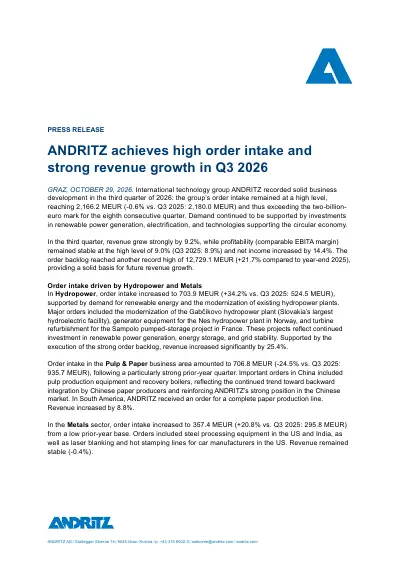
Thank you for joining us this morning for our Q3 call. We are happy to report strong results in the third quarter 2026.
We had a good order intake, eighth consecutive quarter we could book above €2 billion in a quarter, and the eighth consecutive quarter with a book-to-bill higher than 1. Growth was driven by Hydro Power and by Metals.
I think we are on a good path there. Revenue have increased significantly, high service share remained.
We are delivering from the high backlog, which reached a new record level in Q3 of €12.7 billion. We could grow profit and profitability, stable profit in Pulp & Paper, significant increase in profitability in Hydro Power as well as in Metals, where the restructuring really now pays off.
We could see a slight margin decline in Environment & Energy, which is driven by higher project costs and learning curve effects for the green growth projects, as basically expected. The guidance for '26 is confirmed, and as well as the new midterm financial targets.
If we go to the numbers, order intake at €2.2 billion, basically same level as third quarter last year. Revenue strong, up by 9% to €2.1 billion.
Order backlog reached €12.7 billion, all-time high, giving a good cushion for the future growth. EBITDA went up by 10%, €185 million, 9% on a comparable basis, and €176 million, 8.5% on a reported basis.
Net income rose by 14% to €127 million. Project activity is on a high level, as you see here.
We have significant quarters, eight quarters with high order intake and book-to-bill significantly above 1. We are also do not see a decline in the markets where we are currently working on.
We go to the details in order intake. You can see that on the Q3, we had a drop in Pulp & Paper as we booked three large orders in Q3 last year.
You see that on the full-year base, Q1 to Q3, we're basically on par with previous year. In Metals, strong growth in the third quarter by 21%, and I would say also a decent growth over the first three quarters by 9%.
Hydro Power, strong growth, 34% order intake in Q3 and 68% growth in Q1 to Q3. That is quite remarkable.
Environment & Energy has a slight decline, -6% for the quarter and -10% for the first three quarters. However, project pipeline remains active, but investment climate, especially related to new energy technologies, remains uncertain.
Significant change in order intake by regions. If we compare with the previous year, we see a clear drop in Europe and a clear increase in South America and in Asia outside China.
That is worthwhile to note. On the revenue side, we see a strong growth, 9% for the group, 9% also for Pulp & Paper.
It's on the revenue side flat for Metals in the quarter, and basically also flat for the year. Hydro Power, strong increase in the revenue for the quarter, 25%, and for the year, 17%.
I know that especially in the last year, you have asked when these large orders and the good order intake from Hydro Power will be converted to revenue. That's now starting, and you can see that basically strong not only year-on-year, but also quarter-to-quarter, strong growth.
We had no more headwinds from currency translations, and of course, growth also has been supported by the acquisitions we have made in the previous year. Backlog, as already mentioned, reached all-time high, €12.7 billion.
50% now in the hand of Hydro Power, basically due to the long execution time. 1/4 belongs to Pulp & Paper, and a good 10% each Environment & Energy and on the Metals side.
I think it's a good basis and good visibility for the times to come. EBITA has grown strongly in comparable and in reported margins.
Would say the restructuring efforts in Metals really bearing fruit. The low-margin legacy projects are phasing out, and their part of the revenue is becoming less, and we could improve our project execution.
In the Q3, we had non-operative items of €9 million, and in the first three quarters of €27 million. The majority is cost for restructuring, mainly in Metals, but also some rightsizing we are doing currently in Pulp & Paper, in Environment & Energy.
Service business is on a steady growth path. If we compare last year with the last 12 months, it's a strong increase, €260 million.
We could see service revenue growing 5% in Q3, 6% in Q1 to Q3 '26. I think we are on a right path, further improving profitability in total and stabilizing the exposure of the group.
ESG targets, I would say we are on track on our targets to reach the 2030 targets. For the first time now for Q1 to Q3 '26, we can report that the key impact revenue has reached levels above 50%.
That is very good. On the ESG performance, externally recognized, we have been confirmed by EcoVadis on the gold rating also for '26.
We already had that in '25. Also on the ESG score with S&P Global, we could improve from 53 to 61.
I think we are on a good track there. Having said that, I hand over to Vanessa to provide you the details on the financial performance.
Vanessa Hellwing
Thank you, Joachim, and good morning, everybody. Good to have you on the call.
As just shared by Joachim, we delivered a strong third quarter with the expected growth in revenue and improved margins, visible in EBITDA and and net income. At the same time, our order backlog reached a new all-time high, underpinning our growth trajectory.
Cash flow has been significant, supported by the good order intake, and prepayments also driving up our net liquidity. Overall, the first three quarters of '26 actually reflect a pretty strong operational execution.
From a CFO perspective, the third quarter confirms that the growth we achieved comes with strong financial quality. Operating cash flow in Q3 increased to €320 million, 121% above last year on a quarter-on-quarter comparison.
We more than doubled our net liquidity position to €844 million on a year-on-year perspective, but also increased sequentially. The return on invested capital amounted to 18.1%, still recovering from the M&A-driven temporary dilution in '25, and impacted by the 12-months average basis due to high acquisition activity from the second half of last year.
However, substantial value generation is implied with almost 900 basis points above our weighted average cost of capital. Operating net working capital again improved sequentially for the fourth consecutive quarter to €761 million.
Even though I will not elaborate in further detail, it is worth mentioning that our total net working capital has turned negative for the first time in almost 3 years again. Let's have a look at the EBITA to net income bridge.
The higher revenue base translated into a strong EBITDA increase by €50 million to €627 million, and further improved EBITDA margin of 10.6% compared to 10.4% as of last year. Depreciation increased slightly due to M&A-related assets and increased capex spending, but remained stable at percentage of revenue.
IFRS 3 amortization decreased due to the phase-out of larger acquisitions from the amortization schedule in last year, and we also continue to expect the level around €55 million at year-end, as mentioned in the last call. The financial results decreased year-on-year in the first 9 months, and this is due to lower gross liquidity and lower interest, as well as higher financing costs in the first half of the year.
However, a clear improvement in the net financing cost is seen in Q3 standalone on a year-on-year basis. Besides this, actually the major driver in comparison to last year was the positive valuation effect of €22 million from ANDRITZ shares in '25.
Please keep in mind that this difference will further increase to €36 million in Q4 within the financial results. Importantly, to mention the net interest result in fact improved in Q3 on a year-on-year perspective, and the total financial result also improved compared to Q2 '26, on a quarterly development.
Further below, the tax rate also improved well to 23.5% from 25.4% in the previous year's period, and that is already well in line with the full-year tax rate in '25, which we also expect for the full year of 2026. Consequently, net income increased to €328 million after the first three quarters of '26, and net income margin expanded to 5.6%, confirming a resilient profitability despite our lower financial results.
Before moving to cash flow, a brief general word on the margins, as we always get the the questions on this. Hydro Power is growing, but legacy projects and its service structural profitability mean that margins will, on average, remain below the group performance for a while before improved pricing and scale effects kick in.
Metals is improving due to stabilization in top line and successful restructuring measures, while Pulp & Paper retains capacity and expert knowledge for large-scale projects. Environment & Energy currently carries costs from new technologies and some restructuring, as Joachim will outline in a minute.
Summing up, these different developments explain why group margins improve gradually. In a long-cycle project business, the pace of improvement depends on execution time and business mix.
We are moving in the guided direction, steady, but with the pace that can be expected from a long-cycle project business, as this was also outlined in our recent Capital Markets Day, but wanted to repeat it here briefly. Let me now move on to our free cash flow bridge, starting again from EBITDA of €627 million.
The main operational improvement in operating and free cash flow generation again came from a significantly lower net working capital outflow. Working capital generated €128 million of cash, compared with an with a €86 million outflow of last year.
Customer advances and contract liabilities are the the largest source, the conversion rate should not be extrapolated mechanically here. Higher cash taxes partly offset the operating improvement, while net interest cash flows made a small positive contribution.
Change in provisions and other items led to lower cash outflows compared to last year, and this mainly reflects movements in provisions, other receivables, and payables, as well as various non-cash and also valuation-related effects. Summing up, these effects result in a significantly improved operating cash flow of €611 million, compared to €314 million last year.
Capex went up year-on-year by €36 million to €200 million, that was spent on capacity expansion like for for turbo generator business, as well as on expanding our service business and driving digitalization and innovation. After deducting it, free cash flow reached €411 million, a very strong level and significantly above the prior year's period where we reported €150 million.
The first three quarters of '26, there were no M&A transactions, as you may have noticed. M&A capex of €42 million reflect residual outflows from acquisitions that we closed in 2025.
Turning now to the operating working capital, we saw an increase in that metric in the course of last year, 2025, reflecting a larger service service share and the consolidation effects from acquisitions. We can now report the fourth consecutive decrease in operating net working capital in absolute and in relative terms from Q3 '25 onwards, reverting actually back to a nice level of 9% of revenues currently.
Also here, we please keep in mind that we might see a swing in operating capital operating working capital from project execution by even three-digit millions quarter to quarter, depending on the execution phase of our businesses or our projects. Let me elaborate on the moving parts and contract and trade working capital on the next slide.
Here you is clearly shows the improved elements. On the contract working capital side, you see another significant sequential increase in prepayments and contract liabilities in Q3, alongside the good order intake reported.
Trade working capital remains flat sequentially and decreased slightly further to the percentage of sales at percentage of sales, and was influenced by a typical seasonal buildup in Q1 to Q3. Also, the high service business and a general strong order intake supported here.
Factually, we have shifted slightly from large over-time projects towards more mid-sized and completed contract orders that leads to an increase in work in progress. Generally, WIP of non-POC orders nearing completion can support revenue in Q4, depending on delivery and customer acceptance.
Please keep that also in mind. Separately, we maintain selected inventories to protect part availability for our customers in our inventories.
Overall, you see we remain in really good shape, I would say. Also quite typical for a project business, quarterly operating cash flow remains volatile.
Q3 operating cash flow of €320 million more than doubled compared to last year, and also increased from Q2. That was driven by the improvement in operating net working capital as well as better operating profit.
The focus is kept on a well-managed cash conversion in order to sustain a structurally strong cash generation profile. Moving on to our financial position here, net liquidity significantly increased by €131 million from €713 million at year-end '25 to €844 million year-to-date 9/26.
Operating cash flow more than covered capex, dividends, and acquisition-related payments. As formerly mentioned, the €42 million of acquisition-related payments relate to deals that were closed in 2025.
That means Andritz is well positioned to continue on its capital allocation strategy while maintaining a strong financial profile with disciplined M&A spending. Please keep in mind that some of the liquidity will be used on the way to execute our orders.
As a rule of thumb, in the first third of the order term, we usually have a slower cost progress, as it starts with engineering work and mobilization of the project sites. Looking at ROIC, ROIC recovery is visible in the first three quarters of 2026, reaching 18.1% after the acquisition-related temporary dilution in 2025.
Those of you who have the 18.5% from Q2 in mind, let me briefly explain the invested capital is calculated on a 12-months average base, and the many acquisitions we closed last year mainly affected the second half of 2025, and that's why it now kicks into our metrics here. However, the number certainly confirms that our capital deployment is translating generally into satisfactory returns, with the ROIC mainly remaining significantly above the WACC.
To summarize, we continue on a path of profitable growth. Order intake remains strong, order backlog has reached another record, and our book-to-bill ratio of 1.4 provides a solid basis for continued revenue growth, while we further improve operating margins.
Our financial position also remains strong. Operating net working capital improved again sequentially, and as we yeah, we saw a significant increase in both operating cash flow and net liquidity.
As mentioned in the beginning, here in this chart, you see the the total net working capital now nicely negative. Importantly, we continue to create substantial value.
ROIC, as just mentioned, is underlining the strength of our value creation, with significantly above the WACC. With this, I say many thanks for your attention, and we'll now hand back to Joachim to provide an update on our business area performance and outlook.
Thank you.
Joachim Schönbeck
Thank you, Vanessa. A few words to the to the business areas from my side, starting with Pulp & Paper.
Would say, volume-wise, good good development on order intake in the first three months, -3%, basically stable. Revenue, strong revenue growth by 9% in the quarter, respectively 7% for the first three quarters.
Would say, what is driving the market is still the trend of the Chinese paper industry to to backward integrate into pulp making. Would say, we have a strong position in this Chinese market, and with the recent orders that have been placed, this market leadership is confirmed.
We are positively looking looking to that development. On the profitability, it's on a remains on a on a high level, and it's supported by good capital business and by growing service business.
You can see in the order intake by regions, you could see the clear drop in Europe from 37% to 27%, and a strong increase in China, but also Asian Asia excluding China in in this year. This shows shows the trend where the investments are currently currently made.
Turning turning to Metals, we can see we can see a good a good growth on the order intake, both for the quarter as well as further for the first 9 months. We The market is not brilliant, but definitely better than it has been last year, and we are taking we are taking our fair share.
This is why this is why the revenue is stable, and however, our restructuring efforts as well as our improved project execution is bearing fruit. We could see a strong strong increase on the profitability.
For the for Q3, we reached 7%. That's the lower limit of the new of the new target area that we have announced for 2029.
That's that's definitely a good sign. Strong up 60 basis points from Q3 last year, and for the first 9 months, we reached the 6.3% on the EBITA margin, that's also 60 basis points above last year.
I would say we are we are on a on a good track there. Would say, on the regions, significantly up is Asia outside China, and that's mainly for the Metals business, mainly India, where steel as well as automotive is investing.
Hydro Power is for sure, would say, positive in all in all aspects. Strong increase in order intake for the quarter and for the first 9 months.
Backlog reached record highs. The revenue increased 17% for the first 9 months and 25% for the for the quarter, which shows you that this increasing trend of converting backlog into sales is continuing.
The profitability reached 8.9%, very high level for the quarter, and we are at 7.7% for the first for the first 9 months, significant increase from previous year, 190 respectively 130 basis points. The the order intake is remarkably increased in South America, that is mainly Brazil, and it dropped a bit in Europe.
Here we we see the market the market is strong. We take our fair share, and we expect the market to remain in that condition.
Environment & Energy, we we had, I would say, subdued investment climate across across various industries. We could we could improve order intake in Separation and Pumps.
It was a decline in in Clean Air. However, we expect for this for the fourth quarter, we we expect some some major orders to be booked.
Therefore, for the for the full year, we are not too pessimistic. Revenue are basically are basically stable compared to last year.
The margin dropped, as I already said, to 7.6% compared to 10.3% Q3 last year, and in the first 9 months, it's down to 9.1%. That's that's additional costs we have from the projects for the for the new green growth projects.
There's some learning curve effect. That is nothing that is a surprise to us because if you develop new technologies, usually during during installation and startup, you find you find some additional topics that you have not considered before.
Therefore, this is not this is nothing that we did not expect and is which is not included in what we are guiding for. If we go to the guidance, maybe one one more one more remark to the international situation.
We still do not see an adverse impact from the increasing trade barriers and the, I would say, geopolitical turmoil. It does not say that it does not affect us, and our teams are working on a daily basis to to adjust to the new situations that we that we see around the world.
We do not We have we have provided for it, we know how to deal with it, and this is why we do not see an adverse impact in our financials. The the headwind on the FX turned into a very small tailwind, no significant impact on that in our Q3 results.
If we go for the guidance 2026, we can confirm our financial targets: revenue €8 to €8.3 billion, we we trust that we might more more move towards the upper end; on the comparable EBITA, 8.7% to 9.1%, we feel comfortable with the midpoint. Basically, all of that is confirmed.
Are the new midterm targets 2029, as presented a few weeks ago on the Capital Market Day: financial targets for 2029, €12 billion and comparable EBITA margin of 10%. I don't think I need to go through what we do to reach that, but at least the Q3 Q3 results confirm that we are on a good track to do that.
For completeness, new midterm targets for 2029, as as you have seen, they are they are up for Metals and for Hydro Power, and they have been harmonized for Environment & Energy. I would say, what is a what is a good sign that Metals as well as Hydro Power is for the Q3 of this year already within the new margin corridors.
Having said that, I hand over to Matthias, and thank you for your attention.
Matthias Pfeifenberger
Yes, thanks a lot to Vanessa and Dr. Schönbeck for the elaborations, and we'll start the Q&A session.
Operator
Ladies and gentlemen, we will now begin the question and answer session. Anyone who wishes to ask a question from the webinar may click the Q&A button on the left side and click on raise your hand.
For written questions, please click on Q&A, select text, and type in your question. If you are connected via phone, please press star followed by 1 on your telephone keypad.
You will hear a tone to confirm that you have entered the queue. If you wish to remove yourself from the question queue, you may press to lower your hand from the webinar or press star and 2 on your telephone.
Anyone who has a question may queue up now. One moment for the first question, please.
The first question comes from Akash Gupta from JP Morgan. Please go ahead.
Akash Gupta
Yes, hi. Good morning.
I got two to start with, and I'll ask one at a time. My first one is on hydropower margins.
It was quite increasing to see a big step up in margins to 8.9% in the quarter. I'm wondering if you can elaborate a bit more into details like was there any positive one-off on better execution, or have we reached the inflection point in project mix because we know that the newer projects have better margins compared to legacy projects?
Is that reflective of that? Then maybe on the same topic, when we look at in hydropower, we see implied incremental margins are around mid-teens percentage points.
Could this be a right way to look at where the margins can go in the next couple of years?
Joachim Schönbeck
Am I on speaking? Can I talk?
Operator
Yes. Yes, we can hear you.
Joachim Schönbeck
I would say the margins in Q3, for Hydro Power, there is no one-time effect, but it's definitely, I would say, due to a mix where particularly high percentage of new orders and low percentage of the legacy projects have put into sales. I think should take it as a good sign that margin level is possible, and should give you the confidence that the new margin corridor is a realistic target.
Of course, we cannot expect that for the next quarters to repeat every month, but definitely we will see a steady increase as we have the margin. Also with a strong increase in sales, we also have a cost degression that will lead to a margin improvement.
Then
Akash Gupta
my second question is on Environment & Energy business margin. I think we saw a quite significant weakness, and we also saw one unexpected management change there, probably they could be seen together.
I don't know, maybe if you can confirm that. Then when we look at what needs to happen for business margin to improve, is this more orders in part of the business where you may be facing some underabsorption, or is there any need for restructuring in the business to improve margin?
Just curious about your thoughts on how shall we expect Environment & Energy margins in the next few quarters. Thank you.
Joachim Schönbeck
I would say these cost impacts on the new projects and the change in the management, there is no connection on that. It is Dietmar Heiser.
He resigned due to personal reasons, and so I took over that position as interim, and we are looking for a succession there. We believe that for the beginning of the next year, we will be back in good shape there.
We have these startup costs, this learning for our green new products. That is more, I would say, a booking in the Q3, not so much that this will now be the new normal in this business area.
We see signs of improvement in the market in the other areas. We expect that we will be for the next quarters, I would say, towards the lower end of the margin corridor or slightly below.
Akash Gupta
Thank you, Dr. Schönbeck.
Operator
The next question comes from Sven Weier from UBS. Please go ahead.
Sven Weier
Good morning. There's just one question left from my end, and it's just on the order intake side.
You talked a little bit about the order pipeline. Was just wondering the kind of order level of just above €2 billion, is that something we should also be kind of penciling in for the fourth quarter?
Because obviously we don't really have any visibility as far as further hydro projects are concerned, big ones, but you do, maybe any kind of guidance you can give us on that end? Thank you.
Joachim Schönbeck
As I said, we do not see changes in the market, we expect also a good order pipeline for the fourth quarter, yeah. We have hydro, but also in Metals and other areas, there are projects out, I would say we do not expect a decline quarter on quarter.
Sven Weier
That's fair. Maybe also following up on the pulp side in China, when you look at your pipeline there in terms of this trend towards integrated mills, how long of a runway do you still see there?
Do you think this can still carry on into next year, or where are we at this kind of cycle?
Joachim Schönbeck
We expect this continues into next year, for sure. Of course, it will not continue forever, but once this trend is set and the investments have been made by the market leaders, everybody needs to follow, otherwise, they will be driven out of the market because they're not competitive anymore.
We will see this trend continuing, and we definitely have a very strong position there with market shares well above 50%, we believe that we can further benefit from that trend.
Sven Weier
What do you see as the impact for the Latin American greenfields? Are you seeing this delays the placement of these orders further, or where are we on some of these?
Joachim Schönbeck
I would say that the situation in China is definitely carefully watched by everybody in South America, and they understand that they need to work hard on their competitiveness to stay in that game. If we look at from a global point of view, I see the biggest pressure from that development is definitely on the European pulp producers much more than on the South Americans because the availability and cost of wood is still significantly higher than it is in South America, and also from Europe there have been significant pulp shipments to China.
This is where the market is, I would say, decreasing a bit.
Sven Weier
Understood. Thank you, Dr.
Schönbeck.
Joachim Schönbeck
You're welcome.
Operator
The next question comes from Daniel Lion from Erste Group. Please go ahead.
Yeah.
Daniel Lion
Hi, good morning. Actually two from my side.
One kind of housekeeping about restructuring costs, can we model basically the run rate we've seen in the first quarters in the fourth one and then reduce it starting from next year to lower levels? Or is there any difference we should keep in mind?
Joachim Schönbeck
I think that's a fair assumption as you have laid it out, yeah.
Daniel Lion
Perfect. The second one, could you maybe also provide an insight on timing of potential acquisitions going forward?
Would you expect still something to happen this year or rather next year? Maybe any indication on usage on the high net cash position that you currently have, maybe regarding to dividends in case of acquisitions won't happen?
Any, yeah, statement from your end?
Joachim Schönbeck
We cannot guide on that because we never know which deals come or do not come. We are actively looking.
We are in intensive and loose talks on several targets along the strategy that I explained also on the Capital Markets Day. That, historically, we are very cautious in what we pay for an acquisition, and so that also implies the possibility that we don't get the deal.
If we would not conclude for an acquisition this year, we would find other ways to use our cash.
Daniel Lion
Okay. Thanks.
Operator
The next question comes from Christoph Blieffert from BNP Paribas. Please go ahead.
Christoph Blieffert
Good morning. Thank you for taking my questions.
I have two, please, on Pulp & Paper. The first one is on the increase in order intake and service Valmet has reported yesterday.
Here it would be helpful if you could give us your view on the pulp and the paper and packaging service market, please. Secondly, it would be helpful sharing some feedback from discussions with your Pulp & Paper customers when it comes to capex demand in '27, and here keeping aside the very large projects and also the special situation in China, the question is more on the base business.
Thank you.
Joachim Schönbeck
Thank you for that question. In Pulp & Paper, we see a good growth on the service side.
I cannot comment on Valmet's numbers, but I'm sure that they can explain this very detailed to you. We are growing in Pulp & Paper Service.
We are also seeing decline because temporary mothballing of several pulp mills in the Nordics is definitely also affecting the service business because neither wear parts nor shutdown work is required. We are growing in other regions.
The investment mood in the Pulp & Paper industry, I would say in general, is probably not at its best, but what you see in the order intake is that we still have it on a rather good level. I would say, visibility on what is happening in the main market in China is not too clear.
Tariffs are also affecting the export business into other countries, and the profitability of our customers also declined. Putting all that together, I would say we are not overly optimistic on investments in the next 6 months, but therefore, we have the service business, which will kind of counterbalance that, and we have the Chinese impact, which will help us there.
Christoph Blieffert
Thanks a lot.
Operator
The next question comes from Ben Thielmann from Bernstein. Please go ahead.
Ben Thielmann
Hey, good morning, everybody. Can you hear me?
Joachim Schönbeck
Yes.
Ben Thielmann
Perfect. Two questions from my side, if I may.
First one is on guidance. You confirmed the €8 to €8.3 billion revenue guidance for this year.
If I look at what you achieved so far, it seems like that we're going to end up at the upper end of it. In fact, if I look at Q4 last year, you can have barely any revenue growth this year in Q4 to come up with €8.3 billion.
Is it fair to say from your point of view that we should aim for the very upper end of the €8 to €8.3 billion revenue guidance?
Joachim Schönbeck
I think that's could be a good assumptions.
Ben Thielmann
Maybe on orders, you mentioned that quarter over quarter you don't expect a decline. If I look at Q4 last year, you were at approximately €2 billion, now we're at €2.17 billion something.
Is it fair to say that in Q4 we could see mid-single digits order growth back on the table?
Joachim Schönbeck
I I commented on the on the order growth. I would not, I would not, guide for a, for any percentage increase.
It's, we we expect that, we don't expect a decline in order intake on a quarter-on-quarter basis. That's, that is what, what I would repeat here.
Ben Thielmann
Then maybe one last question on tax rate. I've seen it on the slides, should we assume in Q4 that there is also year-over-year tax rate improvement in Q4 for this year?
Joachim Schönbeck
I have to ask Vanessa to step in.
Vanessa Hellwing
As outlined, we expect the current Q3 tax rate to continue to also to the end of this year, being on the same level as we have been in '25.
Ben Thielmann
Perfect. That's it from my side already.
Thank you.
Operator
Then we do have a follow-up question from Akash Gupta from JP Morgan. Please go ahead.
Akash Gupta
Yes, hi. I have a question on IFRS 18.
I think next time when we will be seeing you, you will be giving full-year results and give 2027 guidance. Maybe any early thoughts that you may have on how IFRS 18 might impact some of the moving parts, I guess it's more specific for companies that are in project businesses, given some of the rules that have been proposed that might impact companies like you more than some of the others.
Maybe any thoughts on IFRS 18 and when you will guide for next year, anything that we should be aware of? Thank you.
Vanessa Hellwing
Actually, we will start, of course, reporting under IFRS 18 starting next year. We are now currently in the conversion of the numbers to this, but there is no major impact seen so far.
Yeah. We, of course, yeah, we've changed our P&L, how we disclose our P&L, but no impact on the numbers as we know it.
Akash Gupta
Maybe if I can ask a follow-up to that, I think one of the major changes for project companies is how these guarantee lines will be treated, because some companies treat them in net financial expense, if you treat them as operating expense. You are saying that you don't treat that as a financing expense, there won't be any change that this financial expense suddenly going above the line as part of COGS?
Vanessa Hellwing
This is also still in discussion with our auditors, and I would not comment on this by now. We will elaborate on this next year.
Today, they are a part of the EBITDA. Yeah.
Akash Gupta
Okay. Thank you.
Vanessa Hellwing
Thanks. Then
Operator
the next question comes from Patrick Steiner from ODDO BHF. Please go ahead.
Patrick Steiner
Good morning, Patrick Steiner speaking. One question left from my side.
During the Q2 conference call, you discussed the packaging and containerboard market, the current market situation, that we believe that that's bottomed out, but there's no real sign of increase. Can you maybe give us an update on this area?
Thank you.
Joachim Schönbeck
The bottoming out, we could see that the closures of assets, I would say, have come to an end. We don't see that that often anymore.
As you could see from our press releases, we had, would say, a comparably strong booking on paper machines in this year. One large machine from Northern Africa and one from Latin America, which were basically board and kraft grades.
I would say that at least is a sign that there is investment mood in that area.
Patrick Steiner
Perfect. Thank you very much.
You're
Joachim Schönbeck
welcome.
Operator
Ladies and gentlemen, that was the last question. I would now like to turn the conference back over to Matthias Pfeifenberger.
Matthias Pfeifenberger
Yes, thanks a lot to all the participants for interest and participation in our today's earnings call and webcast, and I'd like to hand back the word to Dr. Schönbeck for concluding remarks.
Thanks a lot.
Joachim Schönbeck
Thank you, Matthias, and thank you all for your interest and listening, and we trust that we can also hope to see you at 3 years 3 months from now for the full year's call. Thank you for your attention, and for everybody who attended our Capital Market Day, also would like to express my appreciation once more for that.
Thank you very much.